MAY 23, 1701: HERE’S LOOKING AT YOU, KIDD

William “Captain” Kidd was a Scottish sailor who was tried and executed for piracy on May 23, 1701. Some modern historians consider his reputation unjust, suggesting that Kidd acted only as a privateer, not a pirate. A pirate plundered ships; a privateer, under government authorization,  plundered ships belonging to another government. (See the difference?) Pirate or privateer, Kidd was among the most famous of his lot and one of the handful that people today can name – unusual because he was not the most successful nor the most bloodthirsty. Perhaps it’s because he did bury treasure, an important undertaking for any pirate worth his sea salt.

Several English nobles engaged Kidd to attack pirates or French vessels, sharing his earnings for their investment. He had substantial real estate holdings in New York, a wife and children, a membership in an exclusive club.   In short, he was respectable. But, foolish man, he decided to engage in one more privateering mission. Kidd set sail for Madagascar and the Indian Ocean, then a hotbed of pirate activity, but found very few pirate or French vessels to take. About a third of his crew died of diseases, and the rest were getting out of sorts for the lack of plunder. In 1697, he attacked a convoy of Indian treasure ships, an act of piracy not in his charter. Also, about this time, Kidd killed a mutinous gunner named William Moore by hitting him in the head with a heavy wooden bucket, also a no-no.

In 1698, he and his men took an Armenian ship loaded with satins, muslins, gold, and silver. When this news reached England, it confirmed Kidd’s reputation as a pirate, and naval commanders were ordered to “pursue and seize the said Kidd and his accomplices” for acts of piracy.

Pursued, seized, and hanged he was.   After his death, the belief that Kidd had left a large buried treasure contributed considerably to the growth of his legend. This belief made its contributions to literature in Edgar Allan Poe’s “The Gold-Bug”, Washington Irving’s The Devil and Tom Walker, and Robert Louis Stevenson’s Treasure Island. It also gave rise to never-ending treasure hunts in Nova Scotia, Long Island in New York, and islands off Connecticut and in the Bay of Fundy.

MAY 22, 1856: SENATORS WILL BE SENATORS

It all started in the Senate chamber in 1856 when Senator Charles Sumner, a Massachusetts Republican, addressed the Senate on the explosive issue of whether Kansas should be admitted to the Union as a slave state or a free state. Three days later on May 22 the “world’s greatest deliberative body” became a donnybrook fair.

In his speech entitled “Crime Against Kansas,” Sumner identified two Democratic senators as the principal culprits in this crime—Stephen Douglas of Illinois and Andrew Butler of South Carolina. In a little bit of overkill, Sumner called Douglas to his face a “noise-some, squat, and nameless animal . . . not a proper model for an American senator.”  Andrew Butler, who was not present at the time, received an even more elaborate characterization.  Mocking the South Carolina senator’s image as a chivalrous Southerner, the Massachusetts senator charged him with taking “a mistress . . . who, though ugly to others, is always lovely to him; though polluted in the sight of the world, is chaste in his sight—I mean,” added Sumner, “the harlot, Slavery.”

Representative Preston Brooks was a fellow South Carolinian to Butler. He read a certain amount of ridicule into the remarks, and he took great umbrage on Butler’s behalf.  In one of the Senate’s most dramatic moments ever, Brooks stormed into the chamber shortly after the Senate had adjourned for the day, where he found Sumner busily attaching his postal frank to copies of his “Crime Against Kansas” speech.

Brooks claimed that if he had believed Sumner to be a gentleman, he might have challenged him to a duel.  Instead, he chose a light cane of the type used to discipline unruly dogs. Moving quickly, Brooks slammed his metal-topped cane onto the unsuspecting Sumner’s head.   As Brooks struck again and again, Sumner rose and staggered helplessly about the chamber, futilely attempting to protect himself.  After a very long minute, it ended with Sumner lying unconscious. As Sumner was carried away, Brooks walked calmly out of the chamber without being detained by the stunned onlookers.  Overnight, both men became heroes in their home states.

Surviving a House censure resolution, Brooks resigned, was immediately reelected, and promptly died at age 37.  Sumner recovered slowly and returned to the Senate, where he remained for another 18 years. But the incident symbolized the breakdown of civility and reason in the capital and serves as a reminder to current legislators to always play nice with one another.

MAY 15, 1482: TOSCANELLI’S COMET

Paolo Toscanelli, born in 1397, was your typical Italian Renaissance Man, dabbling in everything from astronomy to mathematics to philosophy to cartography. He rubbed elbows (and influenced) the likes of Leonardo da Vinci and Christopher Columbus. In fact, that fickle finger of fate could have just as easily pointed at Paolo instead of Columbus.

As we all know, Christopher Columbus as a boy used to sit on the docks in Genoa watching ships slowly disappear over the horizon. While all the other boys sitting on the docks attributed this phenomenon to the ships falling off the edge of the world, Christopher determined that ships were gradually disappearing because the world was actually round. A fairy tale, of course. Columbus knew the world was round because Paolo Toscanelli told him it was round. Toscanelli even gave Columbus a map (a flat map admittedly) that showed Asia to the left on the other side of the Atlantic. Neither of them had reckoned on that other continent lying in-between. Yet Columbus got an October holiday and a city in Ohio while Toscanelli got squat.

Another near miss for Paolo was his observation of a comet in 1456. Although Paolo was the first to identify it, it remained known only as the Comet of 1456 until 300 years later when English astronomer Edmond Halley predicted its 1759 return and got naming rights.

Paolo died on May 15, 1482, ten years before Columbus sailed the ocean blue and some 350 years before “Halley’s” Comet did an encore.

Over the Rainbow

She threw her arms around the Lion’s neck and kissed him, patting his big head tenderly. Then she kissed the Tin Woodman, who was weeping in a way most dangerous to his joints. But she hugged the soft, stuffed body of the Scarecrow in her arms instead of kissing his painted face, and found she was crying herself at this sorrowful parting from her loving comrades.

Glinda the Good stepped down from her ruby throne to give the little girl a good-bye kiss, and Dorothy thanked her for all the kindness she had shown to her friends and herself.

Dorothy now took Toto up solemnly in her arms, and having said one last good-bye she clapped the heels of her shoes together three times saying, “Take me home to Aunt Em!

Lyman Frank Baum, born in Chittenango, New York, on May 15, 1856 (died 1919), was best known for writing The Wonderful Wizard of Oz, although he wrote a total of 55 novels, 83 short stories, over 200 poems, and made many attempts to bring his works to the stage and screen.

In 1897, after several abortive early careers, Baum wrote and published Mother Goose in Prose, a collection of Mother Goose rhymes written as prose stories, and illustrated by Maxfield Parrish. The book was a moderate success, allowing Baum to quit his door-to-door sales job and devote time to his writing. In 1899, Baum partnered with illustrator W. W. Denslow, to publish Father Goose, His Book, a collection of nonsense poetry. The book was a success, becoming the best-selling children’s book of the year. Then in 1900, the duo published The Wonderful Wizard of Oz to critical acclaim and financial success.   The book was the best-selling children’s book for two years after its initial publication.

Oz was a popular destination long before the famous 1939 screen version of the book.  A  musical  based closely upon the book,  the first to use the shortened title “The Wizard of Oz”, opened in Chicago in 1902, then ran on Broadway for 293 performances.   Baum went on to write another 13 Oz novels.

Baum’s intention with the Oz books, and other fairy tales, was to tell American tales in much the same manner as the Brothers Grimm and Hans Christian Andersen , modernizing them and removing the excess violence.  He is often credited with the beginning of the sanitization of children’s stories, although his stories do include eye removals, maimings of all kinds and an occasional decapitation.

Most of the books outside the Oz series were written under pseudonyms. Baum was variously known as Edith Van Dyne, Laura Bancroft, Floyd Akers, Suzanne Metcalf, Schuyler Staunton, John Estes Cooke, and Capt. Hugh Fitzgerald.

Baum wrote two newspaper editorials about Native Americans that have tarnished his legacy because of his assertion that the safety of white settlers depended on the wholesale genocide of American Indians. Some scholars take them at face value, others suggest they were satire. Decide for yourself.

The Pioneer has before declared that our only safety depends upon the total extermination of the Indians. Having wronged them for centuries we had better, in order to protect our civilization, follow it up by one more wrong and wipe these untamed and untamable creatures from the face of the earth. In this lies safety for our settlers and the soldiers who are under incompetent commands. Otherwise, we may expect future years to be as full of trouble with the redskins as those have been in the past.

SEPTEMBER 17, 1908: FLYING TOO HIGH WITH SOME GUY IN THE SKY

It had been about five years since Wilbur and Orville Wright made history with their airplane flight at Kitty Hawk, North Carolina. During the following years, the brothers developed their flying machine into the first practical fixed-wing aircraft, the Wright Flyer. And in 1908, Orville took the Flyer flyerto Fort Myer, Virginia, to demonstrate it for the US Army Signal Corps division.

     Lieutenant Thomas Selfridge arranged to be a passenger on the demonstration flight while Orville piloted the craft.  Selfridge might be considered one of the first frequent flyers. Selfridge took his first flight in 1907, a flight that took him 168 feet in the air above Bras d’Or Lake in Nova Scotia, Canada. He also piloted a Canadian craft that flew three feet off the ground for about 100 feet.  He next took to the air in Hammondsport, New York, traveling 100 feet on his first attempt and 200 feet on his second. The next day he added another 800 yards to his mileage credit. A successful flight with Orville would no doubt have given him an upgrade if not a free flight.

     On September 17, 1908, Selfridge and Orville circled Fort Myer in the Wright Flyer 4½ times at 150 feet. Halfway through the fifth go-round, the right propeller broke, losing thrust. A nasty vibration ensued, causing the split propeller to hit a guy wire bracing the rear vertical rudder. Luggage flew out of the overhead storage compartments; the wire tore out of its fastening and shattered the propeller; the rudder swiveled and sent the Flyer into a nose-dive. Orville ordered Selfridge to return to his seat and fasten his seat belt. Then he shut off the engine and managed to glide to about 75 feet, but the Flyer hit the ground nose first — not a smooth landing.

     Orville was bruised and quite embarrassed.  His passenger was unfortunately dead, the first ever airplane fatality.  If Selfridge had been wearing a helmet of some sort, he most likely would have survived the crash. The fatality also saddled the fledgling flying industry with a pretty poor safety track record – one death per 2,500 passenger-feet,  just slightly better than traveling on the back of a hungry lion.


September 16, 1732: How Hot Is It?

Some people find their true calling early on in life, some take a good part of their lives to find it and fahrothers never find it.  A young man named Gabriel who lived in Danzig around the turn of the 18th century took some time to find his calling. Starting out as a merchant, Gabriel found himself ill-suited as an entrepreneur; every business he touched failed.

     Stand-up comedy didn’t work so well either. If anyone were foolish enough to rise to the bait of Gabriel’s opening remarks about how hot it had been with the question “How hot is it?” they didn’t even get the mediocre chuckle of “It’s so hot that my chickens are laying hard-boiled eggs” or “It’s so hot that even Mitt Romney seems cool.” Gabriel might answer, “On a scale of 32 to 212, I’d give it a 92.” Yawn.

     But hidden in his failure as a comedian was success of a sort – he had actually constructed the device that measured the temperature of which he joked. Up until that time all measurements of temperature were as vague as “hot as a basted turkey” or “cold as a Republican’s heart.” Many a scientist – including Isaac Newton – had tried to develop a means of measuring the temperature. Gabriel had done it – and had found his calling.

     At first, he made his temperature measuring devices using wine-filled tubes, but he couldn’t achieve any degree of accuracy and someone was always drinking the contents of his thermometer. Switching to mercury solved both problems. He marked the tube at the point where the mercury stood when the tube was placed in freezing water and again at the point it reached in boiling water. The freezing point became 32 degrees (his lucky number, perhaps). He then divided the space between that and the boiling point into 180 parts (something to do with half a circle). It was just mysterious enough that it caught on, and it became oh so trendy to measure the temperature of things.

     His thermometer took his name, and would from then on be known as the Gabriel. Well it might have been, but his agent insisted that his last name, Fahrenheit, was much more scientific sounding. Even after Gabriel Fahrenheit’s death on September 16, 1736, the Fahrenheit Thermometer remained the standard by which temperature was measured, used by everyone except some guy from Stockholm named Celsius.

A Harvard Medical School study has determined that rectal thermometers are still the best way to tell a baby’s temperature. Plus, it really teaches the baby who’s boss. — Tina Fey

SEPTEMBER 2, 44 BC: O Tempora, O Mores

Some 2,000 years give or take before our current leader (?) kicked up his first tweetstorm another statesman/orator/philosopher launched the Roman equivalent of a tweetstorm. On September 2, 44 BC, Marcus Tullius Cicero delivered the first of a series of speeches known as the Philippics (or Philippicae in Latin) hectoring his favorite enemy Mark Antony.

As every schoolchild knows, a group of unhappy Roman senators had removed Julius Caesar from office a year earlier. Cicero had not taken part in the affair, but he heartily approved of it. In a letter written afterward, he said: “How I wish that you had invited me to that most glorious banquet on the Ides of March!”
Cicero was not a fan of Caesar’s protege, Mark Antony, either. He was convinced that Antony was planning revenge upon the Ides gang. Cicero’s attacks on Antony rallied the Senate in his favor and established him as the leading politician of his age.

Antony did not take these insults lightly (Cicero had called him a sheep and said he had small hands). He and his supporters prepared to march on Rome and “lock him up, lock him up,” forcing Cicero to hit the road.  But to no avail; Cicero was intercepted and executed.

“O tempora! O mores!” (Oh what times. Oh what standards.)

O Tempora, O Swine

Another Cicero might be more familiar to a lot of us. That would be Cicero Pig, a diminutive version of his famous Uncle Porky. He first appeared in the cartoon “Porky’s Naughty Nephew” as a bit of a brat. He was called Pinky at the time, then Algernon, and finally Cicero. He never went by the name Marcus Tullius, and no one ever called Marcus Tullius Pinky — although Mark Antony probably would have had he thought of it.

Never try to teach a pig to sing; it wastes your time and it annoys the pig.  — Robert Heinlein

Carry a Big Shtick

Vice President Theodore Roosevelt was somewhat of an orator himself.  He delivered a speech at the Minnesota State Fair On September 2, 1901 in which he publicly used the phrase with which he would always be associated:  Speak softly and carry a big stick; you will go far.  Four days later, President William McKinley was shot by an assassin and following his death eight days later, Roosevelt became President.

My father always wanted to be the center of attention.  When he went to a wedding, he wanted to be the bridegroom.  When he went to a funeral, he wanted to be the corpse. — Alice Roosevelt Longworth


AUGUST 28, 1963: I HAVE A DREAM

In Washington DC, on  August 28, 1963, Martin Luther King, Jr. spoke to a crowd stretching from the Lincoln Memorial to the Washington Monument.

“Go back to Mississippi, go back to Alabama, go back to South Carolina, go back to Georgia, go back King_Jr_Martin_Luther_093.jpgto Louisiana, go back to the slums and ghettos of our northern cities, knowing that somehow this situation can and will be changed. Let us not wallow in the valley of despair.”

I have a dream that one day this nation will rise up and live out the true meaning of its creed: ‘We hold these truths to be self-evident: that all men are created equal.’ I have a dream that one day on the red hills of Georgia the sons of former slaves and the sons of former slave-owners will be able to sit down together at the table of brotherhood. I have a dream that one day even the state of Mississippi, a state sweltering with the heat of injustice, sweltering with the heat of oppression, will be transformed into an oasis of freedom and justice. I have a dream that my four little children will one day live in a nation where they will not be judged by the color of their skin but by the content of their character. I have a dream today.”

“When we allow freedom to ring, when we let it ring from every village and every hamlet, from every state and every city, we will be able to speed up that day when all of God’s children, black men and white men, Jews and Gentiles, Protestants and Catholics, will be able to join hands and sing in the words of the old Negro spiritual, ‘Free at last! Free at last! Thank God Almighty, we are free at last!'”


Part of that is when they try and demean me unfairly, because we had a massive crowd of people. We had a crowd… I looked over that sea of people, and I said to myself, ‘wow’, and I’ve seen crowds before. Big, big crowds. That was some crowd. — Donald Trump

AUGUST 24, 1850: MEET ME AT THE FAIR

London’s Bartholomew Fair, a wild celebration on the eponymous saint’s anniversary, died not with bartha bang but a whimper after enduring for more than seven centuries, Although originally established for legitimate business purposes, the fair had become all eating, drinking and amusement (for shame!) and a bit of a public nuisance with rowdiness and mischief.

Serious pursuits, uplifting exhibits, and dramatic entertainments had given way to shows and exhibits catering to the lowest common denominator of British fair-goers tastes – conjurers, wild beasts, monsters, learned pigs, dwarfs, giants. A prodigious monster with one head and two distinct bodies, a woman with three breasts, a child with three legs. A mermaid with a monkey’s head and the tail of a fish. Puppet shows, pantomimes, and coarse melodramas. A pig-faced lady and a potato that looked like King Henry VIII.

Eventually the fair grew less curiouser and curiouser, and on August 24, 1850, when the mayor went as usual to proclaim the opening of the fair, he found nothing to make it worth the trouble. No mayor went after that, and in 1855 the fair rolled over and expired.

I went to the animal fair,

The Birds and the Beasts were there.
The big baboon, by the light of the moon,
Was combing his auburn hair.
The monkey, he got drunk,
And sat on the elephant’s trunk.
The elephant sneezed and fell on his knees,
And what became of the monk, the monk?
The monk, the monk, the monk.

— Minstrel Song

AUGUST 16, 1896: THERE’S BACON IN THEM THAR HILLS

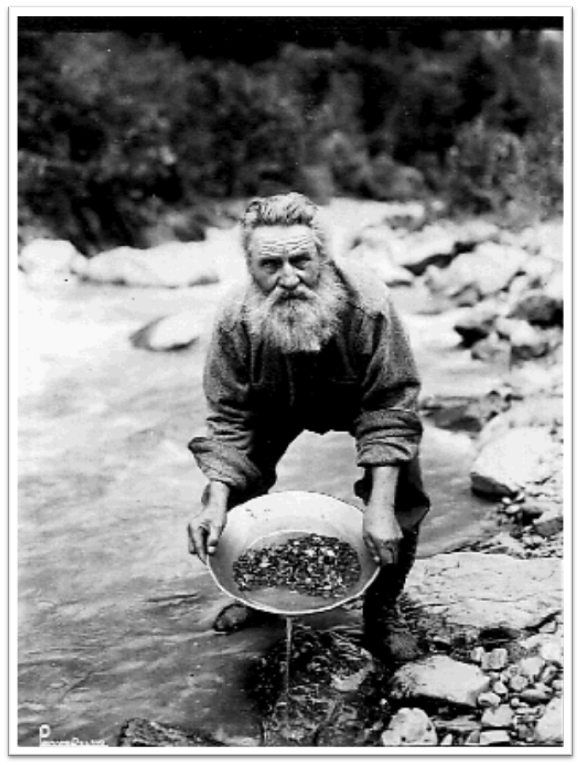
Tagish-Tlingit Packer Keish (Lone Wolf), commonly known as Jim, carried equipment and supplies for early prospectors over the mountain passes from the Alaskan seacoast to the headwaters of the klondike.previewYukon river. He earned the nickname “Skookum” (Chinook for big and strong) for his feat of carrying 156 pounds of bacon over Chilkoot Pass in a single trip. (You don’t pull the mask off the old Lone Ranger, And you don’t mess around with Jim.)

Eventually, tired of of slogging other folk’s bacon, Skookum Jim formed a partnership with his sister Shaaw Tlaa (Kate), his cousin Dawson Charlie (Tagish Charlie), and Kate’s husband George Carmack (no nickname) to go look for the Big G.

On August 16, 1896, the Skookum party discovered rich gold deposits in Bonanza (Rabbit) Creek, Yukon.  Although Skookum Jim is believed to have made the actual discovery, George Carmack was officially credited for the gold discovery because the actual claim was staked in his name. The group agreed to this because they felt that an Indian’s claim would not be recognized because of the rampant racism of the time.

Well, you can just imagine what happened when word of their discovery got out. The Klondike was suddenly a “destination” for every would-be prospector who ever dreamed of the Big G. The exodus known as the Klondike Gold Rush (Yukon Gold Rush) (Alaskan Gold Rush) (The Gold Rush to End All Gold Rushes) was on.

Together our heroes worked what would become known as Discovery Claim (Look What We Found) and collectively earned nearly a million dollars. Skookum Jim built a home for his wife (the little woman) and daughter (junior) in the Yukon Territory (Tagish First Nation) where he spent the winters trapping, hunting and eating lots of bacon hauled in by others. George and Kate moved to California where he deserted her for another woman. You can’t trust anyone without a nickname.


AUGUST 14, 1619: THOU SHALT NOT

Those folks who think they have it pretty rough in Virginia these days should thank their reactionary stars things are not as they were back in 1619. The very first general assembly got together in Jamestown that year to pass laws that pretty much told everyone how they could and could not behave. The burgesses, as members of the assembly were called, were 30 old white men determined to dictate morality to everybody else, a tradition that hasn’t changed much over the years.

     Nor has the politics. The burgesses passed laws requiring all colonists to attend two religious services every Sunday and to bear arms (pieces, swords, powder and shot) while doing so – just in case religious fervor pushed someone over the edge.  Even those bearing arms were forbidden from gambling, drinking, idleness and “excesses in apparel,” (which probably didn’t mean too much clothing).  Not wishing to overlook any sin they hadn’t thought of, the burgesses also approved a stern enactment against immorality in general. In the eyes of the burgesses, one can imagine, that might cover a lot of territory (and the colonies had lots of territory). The planting of mulberry trees, grapes and hemp was also proscribed, for we all know that that seemingly innocuous flora is the first step on the road to degradation (spelled with a ‘d’ and that rhymes with ‘p’).

     The burgesses had only nice things to say about tobacco however. Colonists were urged to dedicate the times they were not in church to the growing of said crop. The colonists responded with enthusiasm, even to the point of growing tobacco in the streets of Jamestown – 20,000 pounds a year – despite His Royal Stick in the Mud King James calling it “dangerous to the lungs.”

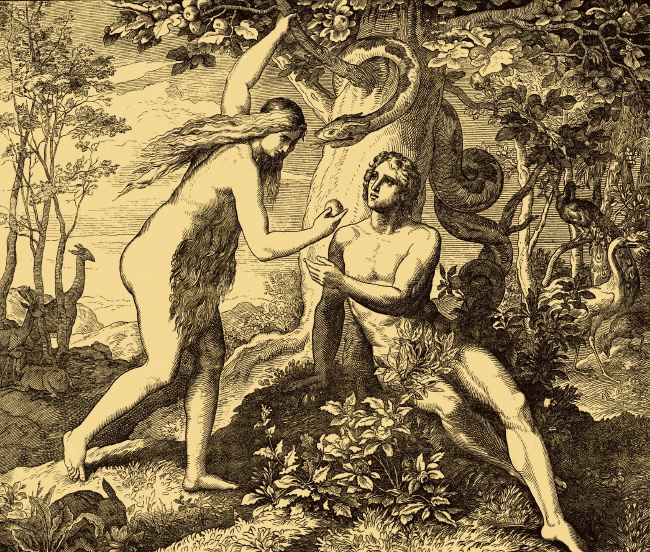
“Adam was but human—this explains it all. He did not want the apple for the apple’s sake, he wanted it only because it was forbidden. The mistake was in not forbidding the serpent; then he would have eaten the serpent.” ― Mark Twain