SEPTEMBER 22, 1761: GEORGE, THE SEQUEL

With the usual pomp and circumstance, the marriage and coronation of King George III of England and Charlotte Sophia of Mecklenburg-Strelitz took place on September 22, 1761. The couple were married on the day they met, but remained married for 50 years and 15 children.  George was a notable monarch for several reasons, the most familiar being the loss of the American colonies and his supposed madness. Although many people see a link between the two, it’s a stretch. He was also the longest reigning monarch at 60 years until the reign of his granddaughter Queen Victoria.

George didn’t really lose the American colonies any more than George Washington found them. But independence “happened on his watch” a phrase Americans in the future would delight in applying to practically anything gone wrong. Also on his watch, Great Britain defeated the French in the Seven Year’s War and once again many years later the French under Napoleon at the Battle of Waterloo.

In his later life, George III had recurrent, and eventually permanent, mental illness. Finally in 1810, a regency was established, and George III’s oldest son, George (coincidentally), ruled as Prince Regent. On III’s death, George Jr. succeeded his father as George IV.

The subject of George III’s mental illness was explored in the play The Madness of George III which inspired the movie The Madness of King George. The name change was supposedly for other reasons, but some maintain that it was because American audiences would think The Madness of George III was a sequel and wonder what happened to the first two movies.

O Mighty Caesar

“He is blessed with a kind of magic truth, the uncanny ability to project the core and humanity of the character he is playing. Beneath the surface humor there is a wry commentary on the conventions and hypocrisies of life.”  Sid Caesar was born on September 22, 1922. He lit up 50s television with his incomparable humor on Your Show of Shows and Caesar’s Hour as well as many movies during his long career.

SEPTEMBER 21, 1219: I’M-A GONNA GIVE YOU APPLE AND A PLUM AND AN APRICOT OR TWO

Every history buff is familiar with the great Khwarezmian Empire. No? The Khwarezmian Empire under the stewardship of Shah Ala ad-Din Muhammad reached the height of its glory during the early 13th century. It also reached its nadir during the early 13th century. The story of the Khwarezmian Empire is a cautionary tale about the  genghisimportance of peace, friendship and good manners and as such would be uplifting in its own special way were it not for all the bloodshed and gore.

Khwarezmia was a neighbor to Mongolia whose benevolent commander-in-chief was none other than Genghis Khan, who had a bit of a bad reputation throughout the East. Nevertheless Genghis offered an olive branch to the shah by sending him a rather lavish fruit basket with the Hallmark words of friendship: ‘You are the ruler of the land of the rising sun and I of the setting sun.’

Comes a watershed moment in the history of Khwarezmia and possibly the reason it doesn’t trip off our tongues today. Genghis sent a delegation of several hundred men to deliver the fruit basket, but the shah, in an admittedly bad start to a relationship, had them tossed into a dungeon. He kept the fruit basket.

Genghis was irked, but thought maybe the shah misunderstood his intentions (his being a foreigner and all). So he sent three royal ambassadors — two Mongols and a Muslim interpreter –to make inquiries. The shah, in what we can all agree was a doozie of a tactical blunder, had everyone in the first delegation killed, shaved the heads of the two Mongol ambassadors, and sent them back with the head of the interpreter as his answer to Genghis.

Genghis Khan sent no further pleasantries. On September 21, 1219, he personally visited Khwarezmia, along with thousands of his best cutthroats. Khwarezmian cities fell like dominoes. The shah’s army was decimated and four million Khwarezmians were killed. Genghis even diverted rivers to erase the shah’s birthplace. The empire ceased to exist.

Violence never settles anything. — Genghis Khan

Since we Americans are no longer allowed to travel to Europe, the Almanac, as a public service, will bring Europe to you. This will be accomplished through the magic of occasional postcards from Europe and other faraway places with strange sounding names. You’re welcome.

Wish You Were Here: Greece

The Trojan Horse dates way back to the war between the Trojans and the Greeks in the thousand or so BC. The Greeks pretended to sail away, leaving the large wooden beast as a going away gift. But weren’t there a gaggle of Greeks hiding inside. Laocoon, a Trojan priest warned the others that he feared the Greeks bearing gifts. Perhaps if he had been more precise, counseling the Trojans to beware a gift bearing Greeks or not to look a gift horse in the mouth or you might see a Greek looking back at you, the outcome may have been different. But it wasn’t.

The Trojan Horse became a symbol of Greek might and was revered through the ages, resting at its home in the Trojan Horse National Park. Inexplicably, the Greeks tired of it and it was eventually converted to a condo. The horse which had once been filled with ancient Greek warriors came to house only five Greeks, the Thermopolis brothers — Dmitri, Ergo, Aristotle, Zorba and Smitty.

SEPTEMBER 17, 1908: FLYING TOO HIGH WITH SOME GUY IN THE SKY

It had been about five years since Wilbur and Orville Wright made history with their airplane flight at Kitty Hawk, North Carolina. During the following years, the brothers developed their flying machine into the first practical fixed-wing aircraft, the Wright Flyer. And in 1908, Orville took the Flyer flyerto Fort Myer, Virginia, to demonstrate it for the US Army Signal Corps division.

     Lieutenant Thomas Selfridge arranged to be a passenger on the demonstration flight while Orville piloted the craft.  Selfridge might be considered one of the first frequent flyers. Selfridge took his first flight in 1907, a flight that took him 168 feet in the air above Bras d’Or Lake in Nova Scotia, Canada. He also piloted a Canadian craft that flew three feet off the ground for about 100 feet.  He next took to the air in Hammondsport, New York, traveling 100 feet on his first attempt and 200 feet on his second. The next day he added another 800 yards to his mileage credit. A successful flight with Orville would no doubt have given him an upgrade if not a free flight.

     On September 17, 1908, Selfridge and Orville circled Fort Myer in the Wright Flyer 4½ times at 150 feet. Halfway through the fifth go-round, the right propeller broke, losing thrust. A nasty vibration ensued, causing the split propeller to hit a guy wire bracing the rear vertical rudder. Luggage flew out of the overhead storage compartments; the wire tore out of its fastening and shattered the propeller; the rudder swiveled and sent the Flyer into a nose-dive. Orville ordered Selfridge to return to his seat and fasten his seat belt. Then he shut off the engine and managed to glide to about 75 feet, but the Flyer hit the ground nose first — not a smooth landing.

     Orville was bruised and quite embarrassed.  His passenger was unfortunately dead, the first ever airplane fatality.  If Selfridge had been wearing a helmet of some sort, he most likely would have survived the crash. The fatality also saddled the fledgling flying industry with a pretty poor safety track record – one death per 2,500 passenger-feet,  just slightly better than traveling on the back of a hungry lion.


September 16, 1732: How Hot Is It?

Some people find their true calling early on in life, some take a good part of their lives to find it and fahrothers never find it.  A young man named Gabriel who lived in Danzig around the turn of the 18th century took some time to find his calling. Starting out as a merchant, Gabriel found himself ill-suited as an entrepreneur; every business he touched failed.

     Stand-up comedy didn’t work so well either. If anyone were foolish enough to rise to the bait of Gabriel’s opening remarks about how hot it had been with the question “How hot is it?” they didn’t even get the mediocre chuckle of “It’s so hot that my chickens are laying hard-boiled eggs” or “It’s so hot that even Mitt Romney seems cool.” Gabriel might answer, “On a scale of 32 to 212, I’d give it a 92.” Yawn.

     But hidden in his failure as a comedian was success of a sort – he had actually constructed the device that measured the temperature of which he joked. Up until that time all measurements of temperature were as vague as “hot as a basted turkey” or “cold as a Republican’s heart.” Many a scientist – including Isaac Newton – had tried to develop a means of measuring the temperature. Gabriel had done it – and had found his calling.

     At first, he made his temperature measuring devices using wine-filled tubes, but he couldn’t achieve any degree of accuracy and someone was always drinking the contents of his thermometer. Switching to mercury solved both problems. He marked the tube at the point where the mercury stood when the tube was placed in freezing water and again at the point it reached in boiling water. The freezing point became 32 degrees (his lucky number, perhaps). He then divided the space between that and the boiling point into 180 parts (something to do with half a circle). It was just mysterious enough that it caught on, and it became oh so trendy to measure the temperature of things.

     His thermometer took his name, and would from then on be known as the Gabriel. Well it might have been, but his agent insisted that his last name, Fahrenheit, was much more scientific sounding. Even after Gabriel Fahrenheit’s death on September 16, 1736, the Fahrenheit Thermometer remained the standard by which temperature was measured, used by everyone except some guy from Stockholm named Celsius.

A Harvard Medical School study has determined that rectal thermometers are still the best way to tell a baby’s temperature. Plus, it really teaches the baby who’s boss. — Tina Fey

Since we Americans are no longer allowed to travel to Europe, the Almanac, as a public service, will bring Europe to you. This will be accomplished through the magic of occasional postcards from Europe and other faraway places with strange sounding names. You’re welcome.

SEPTEMBER 14, 1914: THOSE THRILLING DAYS OF YESTERYEAR

It may be every kid’s dream to run away and join the circus. Not many do, but Jack Carlton Moore, born September 14, 1914 did at the tender age of eight. It may also be every kid’s dream to grow up to be the Lone Ranger. Jack did that too. With his new name, Clayton Moore, he donned a black mask, picked up a Native American buddy and rode into television history.

Following his stint in the circus, Moore worked as a model, a stunt man and a bit player in western movies. In 1949, his work in the serial Ghost of Zorro brought him to the attention of the producer of the Lone Ranger radio program. He was signed to play the ranger in the television series, along with Jay Silverheels as Tonto. The series was the first Western written specifically for television. It aired for eight seasons — 221 episodes.

tontoAfter the series ended, Moore refused to give up his mask, wearing it in public appearances. This rather dismayed the owner of the rights to the character who in 1979 secured a legal ruling preventing Moore from wearing his mask in public. In response, the daring and resourceful masked rider of the plains began wearing oversized sunglasses. The ruling was eventually reversed.

Return with us now to those thrilling days of yesteryear. The Lone Ranger rides again!

We Come in Pieces

Back in 1957, the Soviet Union had stunned the rest of the world with the success of Sputnik. In the United States this was viewed as a major crisis, triggering a catch-up effort. The Space Race, the scientific side of the Cold War, was on. And two years later, on September 14, 1959, those pesky commies did it again. Luna 2 landed on the moon.

Luna 2, son of Luna 1, was the first spacecraft to reach the surface of the moon, and in fact the first man-made object to land anywhere in space.

It certainly wasn’t the last. Since then, the moon has become somewhat of a landfill for us Earthlings. Crash landings, the preferred method of landing for unmanned spacecraft, have left the remains of more than 70 vehicles spread across the moon. Other spacecraft, just passing by, have jettisoned junk of all sorts, it too finding a home on the lunar surface. And visiting moon1astronauts rarely practiced “carry in, carry out” when visiting. Estimates suggest the moon is home to over 400,000 pounds of man-made castoffs.

A highly selective inventory: Rovers, modules and orbiters; a dozen pair of boots; hammers, rakes and shovels: cameras; javelins: objets d’art; barf bags; golf balls; a silicon disc with the words “Man has reached out and touched the tranquil moon. May that high accomplishment allow man to rediscover the Earth and find peace there. –Pierre Elliot Trudeau;” a plaque that reads “we came in peace for all mankind.”

And left you our garbage.

SEPTEMBER 10, 1913: On the Road Again

Beginning on September 10, 1913, a motorist could hop into his or her automobile at Times Square in New York City and drive for 3,389 miles on a paved road all the way across the country arriving (eventually) at Lincoln Park in San Francisco. Said motorist would be traveling the transportation marvel known as the Lincoln Highway on an odyssey through New York, New Jersey, Pennsylvania, Ohio, Indiana, Illinois, Iowa, Nebraska, Colorado, Wyoming, Utah, Nevada, and California — passing through more than 700 cities, towns and villages.

In the 1920s, when highways began to be numbered, a good chunk of the Lincoln Highway got the more colorful designation U.S. Route 30, and with the introduction of the Interstate Highway System in the 1950s, the even more fanciful I-80.

Part of the fun of the Lincoln Highway was all the wonderful oddities created by local entrepreneurs to squeeze a few dollars out of passing motorists — the mystery spots, the reptile farms, the world’s largest this and the world’s smallest that.

When was the last time you stopped by one of these places?

Do Do That Voodoo

Get a lover, keep a lover, get rid of a lover. She could do it all. “She could keep anybody from harming you and she could do anything you wanted done to anybody. How she used to do it, I don’t know. She used to say prayers and mix different things to give people to drink, to rubMarieLaveau with, to throw over your shoulder, to throw in the river. Oh! She had a million things to do but everything would happen just like she would say.” (Aileen Eugene, 1930)

For most of the 19th century, Marie Laveau was the most famous and powerful Voodoo Queen of New Orleans. Rich and poor, black and white, they all respected and feared her. She was born a Free Woman of Color on September 10, 1794. A devout Catholic, she attended Mass daily. She worked as a hairdresser and a nurse before becoming involved in the practice of voodoo, a religion that draws freely from both West African ancestor worship and Catholicism.

Even after her death in 1881, she continued to influence the people of New Orleans. People still visit her grave in the city’s St. Louis Cemetery, leaving money, cigars and rum with the hope she will fulfill their wishes.

Speaking of Voodoo . . .

I got your voodoo.  It’s all in this fun little novel — charms spells, magic, romance, danger — all sorts of things that go bump in the Caribbean night.  Take a look.  I’ve been known to stick pins into little dolls to get what I want.


SEPTEMBER 9, 1754: ET TU, FLETCHER?

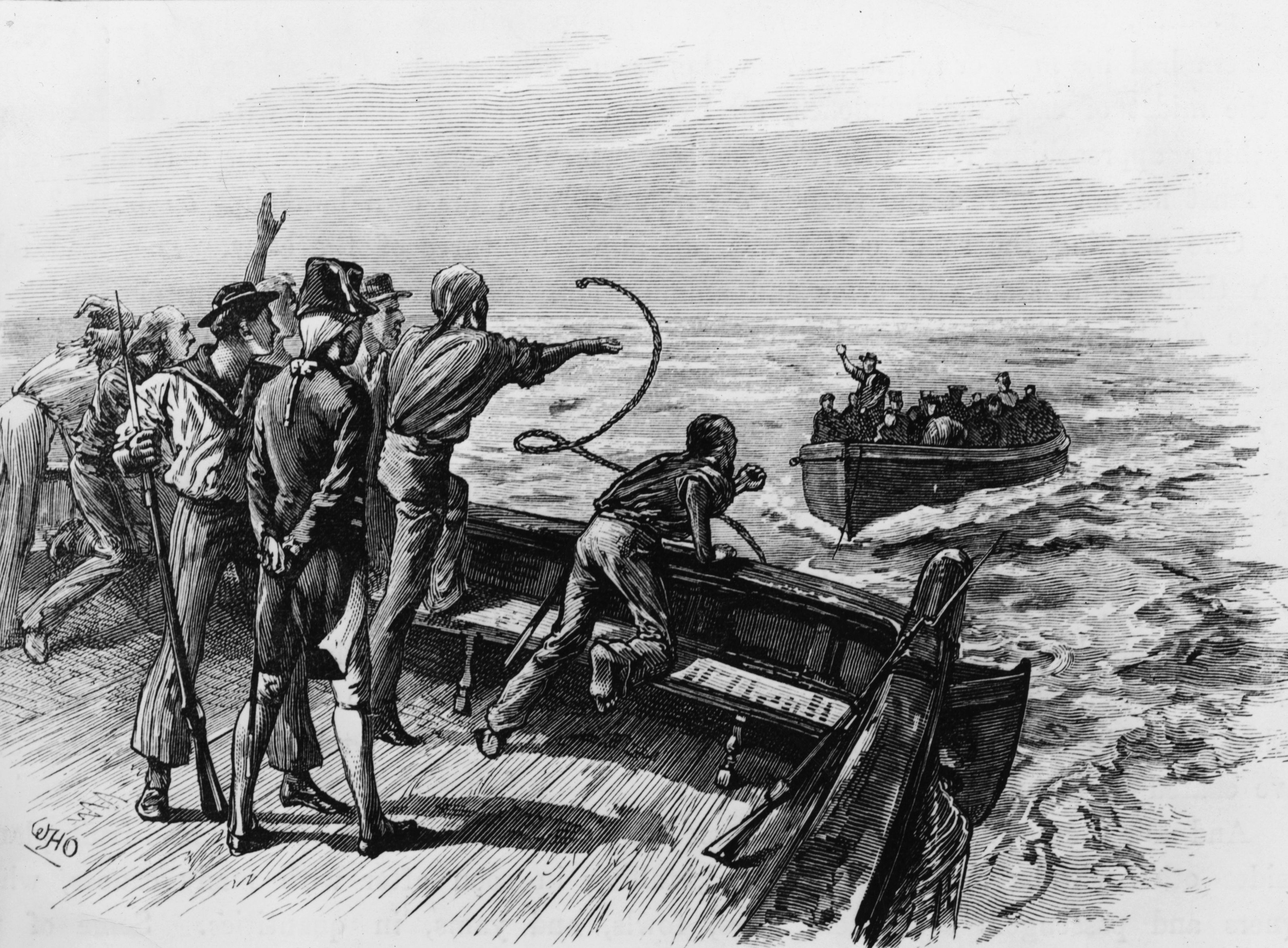
When little Billy Bligh, born on September 9, 1754, joined the British Royal Navy at the tcirca 1817: English naval officer and victim of the celebrated mutiny on the bounty William Bligh (1754 - 1817) is cast adrift. (Photo by Hulton Archive/Getty Images)ender age of seven, he certainly never thought he’d grow up to haul breadfruit around the world. At sixteen, he became an able seaman, then a year later a midshipman. And in 1787, Bligh became Captain of the Bounty.

The Royal Society was offering special prizes to those who would travel to Tahiti, pick up a bunch of breadfruit trees and haul them back to the Caribbean as a source of cheap high-energy food for slaves. It sounded simple enough on paper, but getting there was far from half the fun. First, there was Cape Horn. The Bounty tried to get round it for a month before giving up and taking a longer route. Then Bligh and his crew had to sit around in the tropical sunshine for five months waiting for the little breadfruit babies to get big enough to travel. And when finally they set off for the Caribbean, didn’t Fletcher Christian and his cohorts, having grown fond of the Tahitian ambiance, up and mutiny.

Bligh and his loyalists were loaded into a launch with nary a breadfruit tree and set adrift. Amazingly, they survived and sailed over 4,000 miles to Timor, from where they returned to England. And two years later Bligh headed another expedition and this time successfully carried a load of trees to the Caribbean. However, the slaves refused to eat the breadfruit, wanting no part of a fruit that tasted like day-old bread.

The Ballad of Breadfruit

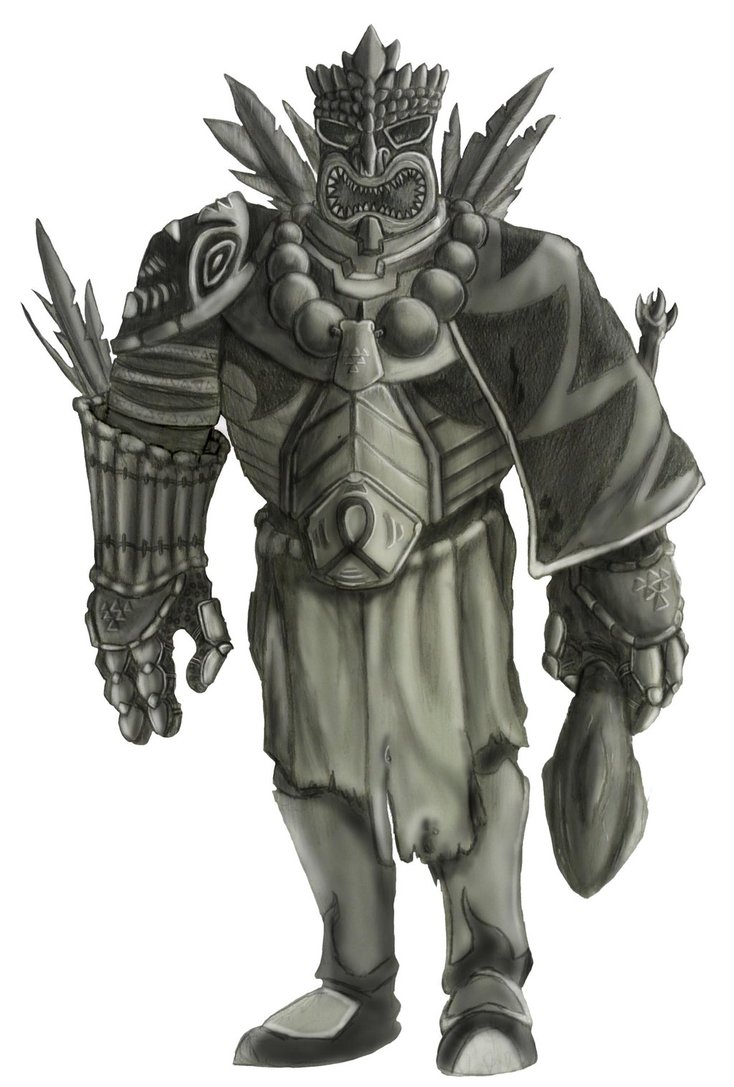
Once upon a time, according to Hawaiian legend, Kū , the war god, for reasons known only to Kū, decided to live secretly among the common folk and pass himself off as a mortal. He posed as a farmer and even went so far as to marry and have a family. Kū and his family lived quite happily, but being a war god Kū wasn’t such a hot farmer, and famine struck (as famine will). When everybody got pretty darn hungry,

Ku posing as a farmer

Kū realized it was time to shed his disguise and do some god thing. One would think his action would involve a battle of some kind, his being the god of war and all. Instead he disappeared into the ground right before his astonished family’s eyes. They were quite distressed by this, so they stood around where he had last been seen and cried day and night, thus watering the ground until a tiny green sprout emerged. The tiny sprout grew into a magnificent tree heavy with fruits that looked like big ugly green footballs. After tossing one around for a bit, they wondered if they might eat it since they were starving. They tried it, and it tasted awful. But they ate it anyway, saving themselves from starvation, and always remembering that this tree was their beloved Kū, finally providing for his family.


SEPTEMBER 8, 1892: PLEDGE, SALUTE, SING OUT THE CHORUS

Daniel Sharp Ford was a bit of a flag-waver. He thought the country needed a little more patriotism, and so launched a crusade to get flags into every school in the country. As the owner of the magazine Youth’s Companion he had a ready-made platform for the promotion of his ideas. As part of his patriotism package, he asked a socialist minister, Francis Bellamy, to create a pledge to the flag of one’s country, a pledge that could be used throughout the world.

Bellamy came up with a pledge that was simplicity itself, and Ford published it in the September 8, 1892, issue of his magazine. The Pledge of Allegiance, as it was called, read:

“I pledge allegiance to my Flag and the Republic for which it stands, one nation, indivisible, with liberty and justice for all.”

The pledge was incredibly popular, repeated in schools, public gatherings, government meetings, in Congress. However, Ford and Bellamy found it awkward that folks just stood there while pledging, so they came up with a nifty salute. Pledgers would face the flag, extend their right arm forward and slightly upward — the Bellamy Salute.

Years passed and folks were happily pledging, but then the tinkering began. In 1923, the words, “the Flag of the United States” were added, thanks to the efforts of the American Legion and the Daughters of the American Revolution who fretted that immigrant children might be confused about just which flag they were pledging allegiance to. A year later, the worriers added “of America.”

Then the Bellamy Salute came under fire; it looked a little too much like the German Nazi salute.

Come 1954, Congress got into the act, adding the words “under God” as a way of thumbing their noses at those godless communists, and giving the pledge its current form.

SING OUT THE CHORUS

BelafontecalypsoHarry Belafonte is an American singer, songwriter, actor, activist, and of course the King of Calypso. His third album, Calypso, hit the top of the charts on September 8, 1956, and had everyone singing out the chorus “Day-o.” It became the first album by a single artist to sell a million copies. In addition to “Day-o (Banana Boat Song),” the album included such calypso standards as “Jamaica Farewell,” “Man Smart,” and “Will His Love Be Like His Rum?” Discerning readers will note that some of those calypso standards serve as titles for short stories included in Calypso: Stories of the Caribbean.

MAY 26, 1755: READ HIS FRENCH LIPS

Louis Mandrin was to France what Robin Hood was to England and Rob Roy to Scotland. Having served in the war of 1740 in a light brigade noted for undertaking dangerous missions to surprise the enemy, he was left idle and without income by peace, which made a remarkable appearance in 1748. He had no way of supporting his life other than by continually risking it. Thus he came up with the idea of assembling a corps of men like himself with himself as their leader and waging war against the fermiers, collectors of royal revenues from taxes  levied on salt, tobacco, and farming. The fermiers paid an agreed upon amount to the king, but could exact unspecified sums themselves. They naturally became fat and rich in the process – and hated.

Mandrin became the master of a portion of central France, pillaging public treasuries to pay his troops, whom he also put to work forcing the wealthy to buy his stolen merchandise. He successfully warded off the many detachments of government troops sent against him, instilling fear among their numbers and in the government itself. Eventually the people came to consider him their protector against the oppression of government revenue officers.

Finally, a regiment did attack and destroy his corps, but Mandrin himself escaped into the Duchy of Savoy. From there, he continued to make forays across the border and a terrible nuisance of himself. The French government was not not happy. The fermiers entered the Duchy illegally, disguising 500 men as peasants. Mandrin was betrayed by two of his men, seized, and whisked across the border. When the King of Savoy, learned of the French intrusion into his territory, he immediately wrote to the French King, demanding that the prisoner be turned over to him. But before the message arrived, Mandrin was hurriedly tried, condemned to be broken at the wheel, and executed on May 26, 1755.


MAY 24, 1626: FOR TWO GUILDERS MORE, WE’LL THROW IN QUEENS

In what is often called the greatest real estate deal ever, Peter Minuit bought Manhattan from native Americans on May 24, 1626, for goods valued at 60 guilders. Popular history identifies these goods as baubles, bangles and bright shiny beads (celebrated in song by Alexander Borodin in his String Quartet in D, routinely hummed on special Dutch occasions, since the words were not written until 1953 for the musical Kismet which in Dutch means “we could have bought the Brooklyn Bridge for a wedge of cheese had it been built.”)


The actual figure of 60 guilders was determined in the seventeenth century using a Dutch version of Generally Recognized Accounting Practices (GRAP) – known back then as Chicanery (C). In 1846, a New York historian converted this figure to dollars and came up with an amount of $24. Since then, people have regularly tried to update the $24 amount to today’s dollars. But as Edwin G. Burrows and Mike Wallace pointed out in their history of New York,”[A] variable-rate myth being a contradiction in terms, the purchase price remains forever frozen at twenty-four dollars.” Nevertheless people continue to point out what those baubles were worth in today’s dollars, euros or guilders. All the results are rather boring.


The transaction is often viewed as one-sided and beneficial to the Dutch, although some evidence suggests that Minuit actually purchased the island from a traveling beaver hide salesman who happened to be passing through and who had never heard of, let alone owned, Manhattan. At about the same time, Minuit was involved in another land purchase, that of Staten Island, for much more mundane goods such as kettles and cloth and garden tools (hence the phrase “we’ll buy Manhattan, the Bronx and Staten Island too.”)

Strangely enough, the aforementioned Brooklyn Bridge (remember that?) was opened to traffic on this very day in 1883.  And a Dutch tourist bought it for 100 guilders from a New York cabbie who claimed to be a full-blooded Manhattan Indian.