December 22, 1864: Georgia on His Mind

A tie might have been more appropriate. But it was 1864, the country was locked in a nasty civil war and the Christmas spirit was shermanwearing a little thin, even among the Whos down in Whoville. Union General William T. Sherman had spent most of his holiday season marching from Atlanta toward the Atlantic Ocean, being quite the Grinch along the way, destroying pretty much everything in his path. “I’ll stop Christmas from coming” he was heard to frequently mutter.

Sherman and his troops reached Savannah just before Christmas and, as the story goes, his heart grew three sizes that day. He didn’t destroy Savannah. Instead he sent a junior officer all the way back to Washington D.C. to personally deliver a Christmas card to President Lincoln on December 22. A message in the card read: “I beg to present you, as a Christmas gift, the city of Savannah, with 150 heavy guns and plenty of ammunition, and also about 25,000 bales of cotton.” And a partridge in a pear tree.

christmas

December 19, 1732: The Nack and How To Get It

Filled with proverbs preaching positive virtues such as industry and prudence, Poor Richard’s Almanack debuted on this day in 1732 and was published yearly until 1757. It became one of the most popular publications in colonial America, selling an average of 10,000 copies a year. In addition to its homilies, the almanac offered seasonal weather forecasts, Heloise-style Poor_Richard's_Almanackhousehold hints, puzzles, and various other diversions.

Poor Richard, who was of course Benjamin Franklin, was modeled in part on Jonathan Swift’s Isaac Bickerstaff, a self-described philomath and astrologer who in a series of letters in 1708 and 1709, poked fun at and even predicted the imminent death of another astrologer and almanac maker,  John Partridge. Franklin’s Poor Richard followed suit and, in a running joke in the early editions, predicted and falsely reported the deaths of contemporary astrologers and almanac makers.

Poor Richard’s Almanack extolled a list of 13 virtues to live by – temperance, silence, order, resolution, frugality, industry, sincerity, justice, moderation, cleanliness, tranquility, chastity, and humility – although there’s no evidence that Franklin personally tried to practice any of them. (Wretched Richard subscribes to every one of them.)

Reflecting on Franklin and his almanac, James Russell Lowell wrote that Franklin: “was born in Boston, and invented being struck with lightning and printing and the Franklin medal, and that he had to move to Philadelphia because great men were so plenty in Boston that he had no chance, and that he revenged himself on his native town by saddling it with the Franklin stove, and that he discovered the almanac, and that a penny saved is a penny lost, or something of the kind.”

A sample of Poor Richard’s wisdom:

Three may keep a secret, if two of them are dead.

There cannot be good living where there is not good drinking.

Any society that will give up a little liberty for a little security will deserve neither and lose both.

With the old Almanack and the old Year,
Leave thy old Vices, tho ever so dear.

Fish and visitors stink after three days.

There are more old drunkards than old doctors.

dave-barry5

December 15, 2001: Lean On Me

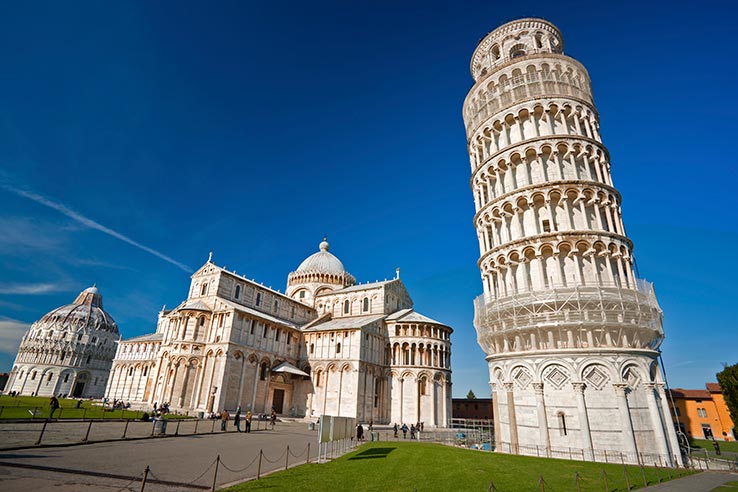
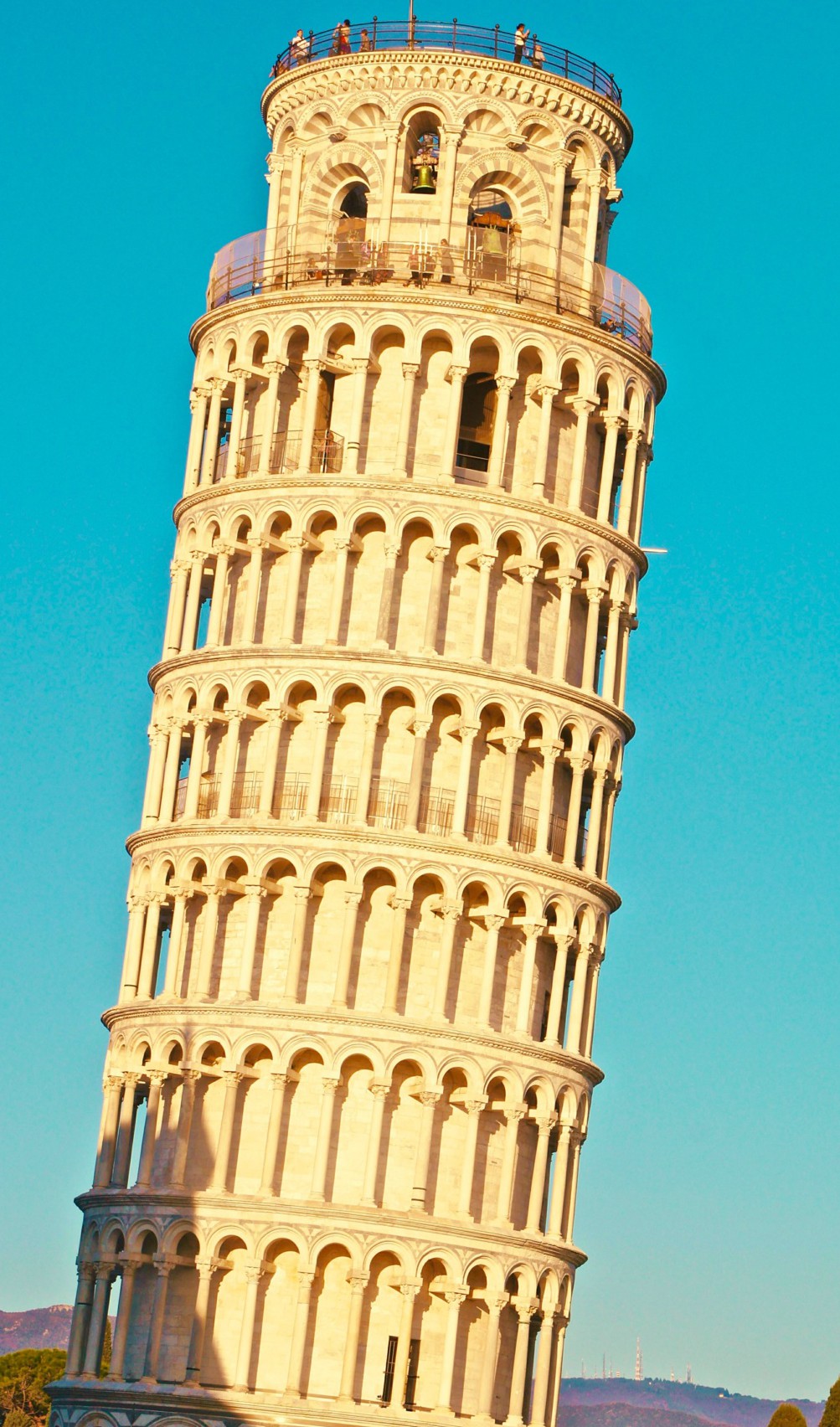
Back in the 12th century, construction began on a bell tower for a cathedral on the Arno River in western Italy, 50 miles from pisaFlorence, in a town called Pisa. With construction barely underway, the foundation of the tower began to sink into the soft, marshy ground, giving it a rakish tilt to the left (or the right, if you stood on the wrong side). The construction firm tried to compensate for the lean by making the top stories lean in the opposite direction, but that was an exercise in Italian futility. When this architectural wonder was completed in 1360, critics expected it to remain standing for a few days at most.

Six hundred years later, it was one of Italy’s most famous tourist attractions, a dramatic 190-foot high marble masterpiece that listed an amazing 15 feet off the perpendicular, predicted to fall at any second. In 1990, a million people visited the tower, climbing 293 leaning steps to the top for the somewhat unbalanced view before Italian authorities closed shop and brought in a team of archaeologists, architects and soil experts to figure out how to make the thing stand upright.

On December 15, 2001, the Leaning Tower of Pisa reopened to the public after 11 years and $27 million of fortification, and still leaning after all these years.

December 13, 1931: Which Side Are You On?

“I do not understand why I was not broken like an eggshell or squashed like a gooseberry.”

So said the man who would become a larger than life British statesman, leading Britain through World War II and  remain a major player on the world stage into the 50s.  He very nearly didn’t make it there, thanks to the perils of New York City traffic.

It was 1931 and a low point in Churchill’s career.  At the age of 57, he had been pretty much banished by his own Conservative Party and had begun to devote himself to his writing.  He had sailed to the United States to give a series of lectures on “the Pathway of the English-Speaking Peoples.” On December 13, the night before one such lecture scheduled at the Brooklyn Academy of Music, he hailed a taxi and set out to visit a friend, financier Bernard Baruch.  He got out of the cab on Fifth Avenue between 76th and 77th Streets.  He walked a bit, then attempted to cross the street against the light (which no New Yorker would ever do).  He looked to the right, just as he would were he crossing King’s Road or Carnaby Street, saw no oncoming traffic and and kept walking.  An unemployed mechanic named Mario Cantasino was just as surprised as Churchill when the car he was driving slammed into the future Prime Minister and dragged him several yards, leaving him lying in a bruised and battered heap.  Churchill took full responsibility for the incident, and Contasino was held blameless.

After a little more than a week in the hospital and a few weeks of recuperation, Churchill finally gave his Brooklyn lecture on Jan. 28.  On one bright note: the United States being subjected to the agonies of Prohibition at this time, his American doctor wrote a note to “certify that the post-accident concussion of Hon. Winston S. Churchill necessitates the use of alcoholic spirits especially at meal times.”

Following his lecture, Churchill and his wife, seeking further rest and relaxation, traveled to Jamaica, a place where folks thankfully drove on the proper side of the street.

Bet They Don’t Have One of These

Wretched Richard offers a blatantly self-serving gift idea for those who have everything:

December 5, 1933: Let the Good Times Roll

At 3:32 p.m., Mountain Standard Time, on December 5, 1933, Utah ratified the 21st Amendment to the Constitution, the 36th state to do so (close on the heels of Pennsylvania and Ohio). It was the magic number required to repeal the 18th Amendment. Booze was back. The so-called noble experiment, 13 years worth of national prohibition of alcohol in America, had ended, having been pretty much a dismal failure.

Prohibition was supposed to reduce crime and corruption, solve social problems, reduce the tax burden created by prisons and poorhouses, and improve health, hygiene and good manners throughout the country. Instead it ushered in the likes of Al Capone and made a lot of ordinarily law-abiding citizens petty criminals. We got bootlegging and speakeasies, moonshine and bathtub gin.

By the early 1930s the electorate had pretty much demonstrated a profound distaste for abstinence. When Franklin Roosevelt ran for President in 1932 pledging repeal, it was bye-bye tee-totaling Herbert Hoover. The new President celebrated with his own dirty martini.

Alas, it wasn’t freedom from sobriety for everyone. Several states continued Prohibition with state temperance laws. Mississippi didn’t join Tipplers Unanimous until 1966.

A few observations overheard on the occasion:

“I think the warning labels on alcoholic beverages are too bland. They should be more vivid. Here is one I would suggest: “Alcohol will turn you into the same asshole your father was.” ― George Carlin

“We were not a hugging people. In terms of emotional comfort it was our belief that no amount of physical contact could match the healing powers of a well made cocktail.”― David Sedaris

“I like to have a martini,
Two at the very most.
After three I’m under the table,
after four I’m under my host.”
― Dorothy Parker

“When a man who is drinking neat gin starts talking about his mother he is past all argument.” ― C.S. Forester

“In wine there is wisdom, in beer there is Freedom, in water there is bacteria.” ― Benjamin Franklin

“It’s 4:58 on Friday afternoon. Do you know where your margarita is?” ― Amy Neftzger

December 4, 1872: Took a Trip on a Sailing Ship

Was the Mary Celeste a cursed ship? Three owners of the brigantine built in Nova Scotia in 1861 didn’t fare so well; they all died during voyages. The ship also suffered a damaging fire and a collision in the English Channel. But it was the voyage from New York harbor headed for Genoa, Italy in November 1872 that is the stuff of legends.

On December 4, 1872, the Dei Gratia, a small British brig spotted the Mary Celeste, sailing marycerratically but at full sail near the Azores Islands in the Atlantic Ocean. The captain and crew of the Dei Gratia boarded the ship. The ship was seaworthy although its sails were slightly damaged and there was some water in the hold. Its cargo of 1,700 barrels of crude alcohol was mostly untouched.  Six months’ worth of food and water remained on board, and the crew’s personal belongings were still in place, including valuables. But the ten persons who had been aboard the Mary Celeste had vanished.

The Mary Celeste had sailed into nautical history as one of its most tantalizing mysteries, a classic ghost ship.

Through the years, a dearth of hard facts has created endless speculation and a host of theories as to what might have taken place. Mutiny? Piracy? Killer waterspouts? Just a few of the least bizarre explanations. In an 1884 short story, Arthur Conan Doyle suggested a capture by a vengeful ex-slave. A 1935 movie featured the irrepressible Bela Lugosi as a homicidal sailor killing off the other passengers.


The more logical speculators agree that for unknown reasons, the ten passengers (the captain, his wife and daughter, and seven crew members) abandoned the ship in the ship’s lifeboat (which was missing) and disappeared at sea. Hardcore conspiracy theorists are having none of that; they’re sticking with the Bermuda Triangle, sea monsters, and the ever-popular alien abductions.

The Mary Celeste, lived to sail another day, but presumably the curse remained. Her last owner intentionally wrecked her off the coast of Haiti in 1885 in an unsuccessful attempt at insurance fraud.


December 3, 1926: Lords of the Rings

German -born Heinrich Friedrich August Ringling and Marie Salome Juliar of France tied the knot back in the mid-19th century. Theirs was a rather productive union in the offspring department, bringing the world seven sons and a daughter.

Five of the brothers – August, Otto, Alfred, John, and Charles, who died on December 3, 1926 – were entertainers of sorts, performing skits and juggling routines in town halls and other local venues around the state of Wisconsin. They called themselves the “Ringling Brothers’ Classic and Comic Concert Company.” In 1884, they teamed up with a well-known showman, Yankee Robinson to create a one-ring circus that toured the Midwest. It was a good season for the Ringling Brothers; not so much for Yankee Robinson who died halfway through it.

The Ringlings did another circus in 1887, bigger and better, if you accepted its name: “Ringling Brothers United Monster Shows, Great Double Circus, Royal European Menagerie, Museum, Caravan, and Congress of Trained Animals.”

In 1889, they purchased railroad cars and parade equipment, allowing them to move around farther and faster, playing larger towns every day, substantially increasing their profits. On a real roll, they purchased the Barnum & Bailey Circus, running both circuses until they merged them into the Ringling Brothers Barnum and Bailey Circus – skipping right over two rings to become a three-ringer, modestly known as the Greatest Show on Earth.

November 27, 1703: What Do We Do with a Drunken Sailor?

The Eddystone Lighthouse sits atop the treacherous Eddystone Rocks off the coast of the United Kingdom. The current lighthouse is actually the fourth to hold sway there.

eddystoneThe original Eddystone Lighthouse was an octagonal wooden structure whose light first shone in November of 1698. It was destroyed just five years later on November 27 during the Great Storm of 1703. The unfortunate builder Henry Winstanley was on the lighthouse, completing additions to the structure at the time. No trace was found of him, or of the other five men in the lighthouse.

The fame of the lighthouse spread well beyond those using it for guidance in the English Channel. It became the subject of a sea shanty sung by drunken sailors around the world. Shanties are those songs sung on board ship to relieve the boredom of shipboard tasks, but during the 20th century and particularly during the mid-century folk craze, sea shanties were adopted by landlubbers everywhere. The Eddystone Light became a particular favorite of many a drunken sailor, armed with a guitar or banjo and a good supply of beer, no matter how far away the nearest navigable waters.

Oh, me father was the keeper of the eddystone light
And he slept with a mermaid one fine night
From this union there came three
A porpoise and a porgy and the other was me

Yo ho ho
The wind blows free
Oh for the life on the rolling sea

One day as I was a-trimmin’ the glim
Humming a tune from the evening hymn
A voice from the starboard shouted, “Ahoy”
And there was me mother a-sittin’ on the buoy

Yo ho ho
The wind blows free
Oh for the life on the rolling sea

Oh what has become of me children three?
Me mother then she asked of me
One was exhibited as a talking fish
The other was served in a chafing dish

Yo ho ho
The wind blows free
Oh for the life on the rolling sea

Then the phosphorus flashed in her seaweed hair
I looked again, but me mother wasn’t there
But I heard her voice echoing back through the night
The devil take the keeper of the eddystone light

Yo ho ho
The wind blows free
Oh for the life on the rolling sea

November 24, 1859: Insulting Monkeys

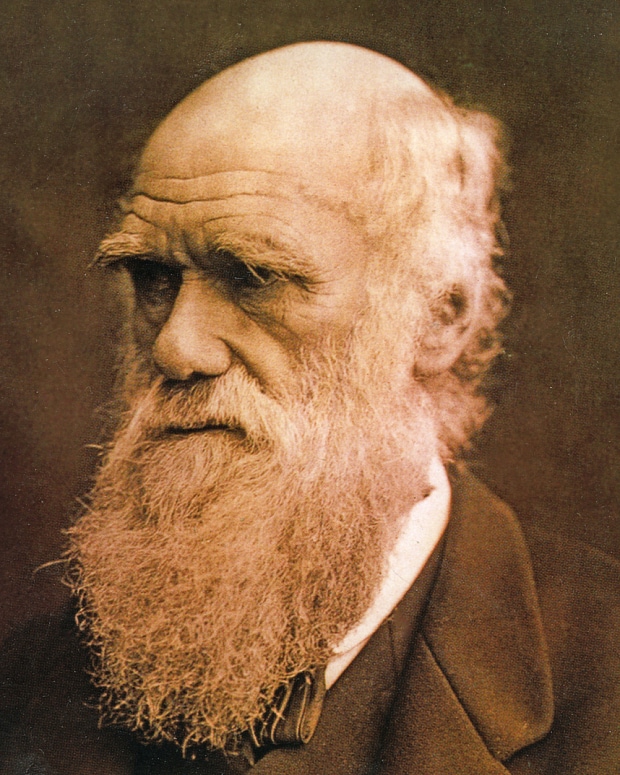
Charles Darwin was not expecting a seismic event when on November 24, 1859, he introduced a little volume with the catchy title On the Origin of Species. Although it didn’t go viral at the time, the printing run of 1,250 copies did sell out.  A few more have sold since then.

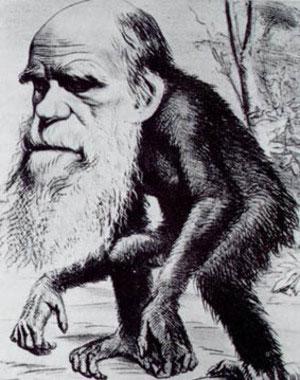
In his book, Darwin suggested that all species of life have descended over time from common ancestors.  That sounds a lot like a plug for family values, but weren’t people upset anyway.  Although Darwin’s only allusion to human evolution was a cryptic “light will be thrown on the origin of man and his history,” the title of his book might just as well have been Men from Monkeys because that’s what detractors brought away from it.  And any attempt on the part of scientists to explain that it’s not about that pretty much put people to sleep.  Even though enlightenment eventually crept into the scientific community, to many others Darwin became forever the symbol of runaway science.  Were he alive today, he’d probably be conspiring with the 99 percent of scientists involved in the vast climate change hoax.

What is Man? Man is a noisome bacillus whom Our Heavenly Father created because he was disappointed in the monkey. ― Mark Twain

New Rule: Stop asking Miss USA contestants if they believe in evolution. It’s not their field. It’s like asking Stephen Hawking if he believes in hair scrunchies. Here’s what they know about: spray tans, fake boobs and baton twirling. Here’s what they don’t know about: everything else. If I cared about the uninformed opinions of some ditsy beauty queen, I’d join the Tea Party. ― Bill Maher

It is even harder for the average ape to believe that he has descended from man. ― H.L. Mencken

Organic life, we are told, has developed gradually from the protozoan to the philosopher, and this development, we are assured, is indubitably an advance. Unfortunately it is the philosopher, not the protozoan, who gives us this assurance. ― Bertrand Russell

November 18, 1307: Fun with Apples

It is the dawn of the 14th century and the hundredth anniversary of Austrian rule over Switzerland. Every little Heidi up in Heidiville and william tellevery one of her goats are under the cruel dominion of the Habsburgs. It is November 18, 1307, and a legend is about to be born.

It’s a day of grand celebration for the Austrians (the Swiss, not so much). Soldiers sing of the glories of the Emperor and his appointed local despot Gesler. The evil Gesler has had his hat placed on top of a pole, forcing the Swiss to bow and scrape and generally pay homage to the hat – one of those silly felt things with a feather in it. Gesler also commands that there should be dancing and singing to mark the century during which the Austrian empire has dominated the 98-pound weaklings of Switzerland. Gioachino Rossini and his Italian Racals are on hand to provide appropriate music.

Among the Swiss that day is one William Tell, known among his compatriots as a strong man, a mountain climber, and a whiz with the crossbow. Well, doesn’t Tell pass right by that hat, refusing to bow to it. And doesn’t his son (like father. . .) do just the same. Gesler is really put out and has the pair arrested.  Aware of Tell’s amazing marksmanship, Gesler devises an ingenious punishment: Tell must shoot an apple off the head of his son. If he refuses, they both will be immediately executed. At this point, you can cut the tension with a Swiss Army knife. Rossini strikes up the band.  As every schoolboy knows (if you don’t know, go find a schoolboy), Tell splits the apple with a single bolt (that’s an arrow) from his crossbow. Rossini’s Rascals break into a rollicking version of the William Tell Overture. (In the Lone Ranger, this same music was used to introduce the scene where Tonto shoots an apple from kemo sabe’s head.)

Ah, but sharp-eyed Gesler notices that Tell has taken not one but two crossbow bolts from his quiver. Gesler quizzes Tell, who answers that if he had killed his son, he would have used the second bolt on Gesler himself. Well, Gesler is now pretty pissed and has Tell carted off to prison.

Crossing Lake Lucerne, prison-bound, the soldiers, afraid their boat will founder, release strongman Tell to steer. Tell escapes, tracks down Gesler, places an apple on his head, and misses it by just that much. He shouts out, “Hi yo Switzerland,” Heidis and goats frolic on hillsides, Swiss watches begin keeping perfect time, and the Swiss Confederation is born.