AUGUST 16, 1896: THERE’S BACON IN THEM THAR HILLS

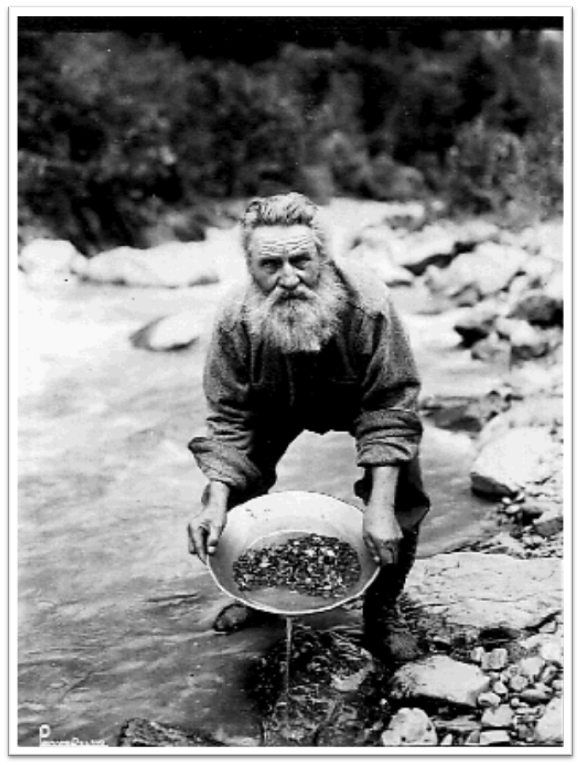
Tagish-Tlingit Packer Keish (Lone Wolf), commonly known as Jim, carried equipment and supplies for early prospectors over the mountain passes from the Alaskan seacoast to the headwaters of the klondike.previewYukon River. He earned the nickname “Skookum” (Chinook for big and strong) for his feat of carrying 156 pounds of bacon over Chilkoot Pass in a single trip. (You don’t pull the mask off the old Lone Ranger, And you don’t mess around with Jim.)

Eventually, tired of slogging other folk’s bacon, Skookum Jim formed a partnership with his sister Shaaw Tlaa (Kate), his cousin Dawson Charlie (Tagish Charlie), and Kate’s husband George Carmack (no nickname) to go look for the Big G.

On August 16, 1896, the Skookum party discovered rich gold deposits in Bonanza (Rabbit) Creek, Yukon.  Although Skookum Jim is believed to have made the actual discovery, George Carmack was officially credited for the gold discovery because the actual claim was staked in his name. The group agreed to this because they felt that an Indian’s claim would not be recognized because of the rampant racism of the time.

Well, you can just imagine what happened when word of their discovery got out. The Klondike was suddenly a “destination” for every would-be prospector who ever dreamed of the Big G. The exodus known as the Klondike Gold Rush (Yukon Gold Rush) (Alaskan Gold Rush) (The Gold Rush to End All Gold Rushes) was on.

Together our heroes worked what would become known as Discovery Claim (Look What We Found) and collectively earned nearly a million dollars. Skookum Jim built a home for his wife (the little woman) and daughter (junior) in the Yukon Territory (Tagish First Nation) where he spent the winters trapping, hunting and eating lots of bacon hauled in by others. George and Kate moved to California where he deserted her for another woman. You can’t trust anyone without a nickname.

MAY 6, 1782: YOU’VE GOT THAT MIDAS TOUCH

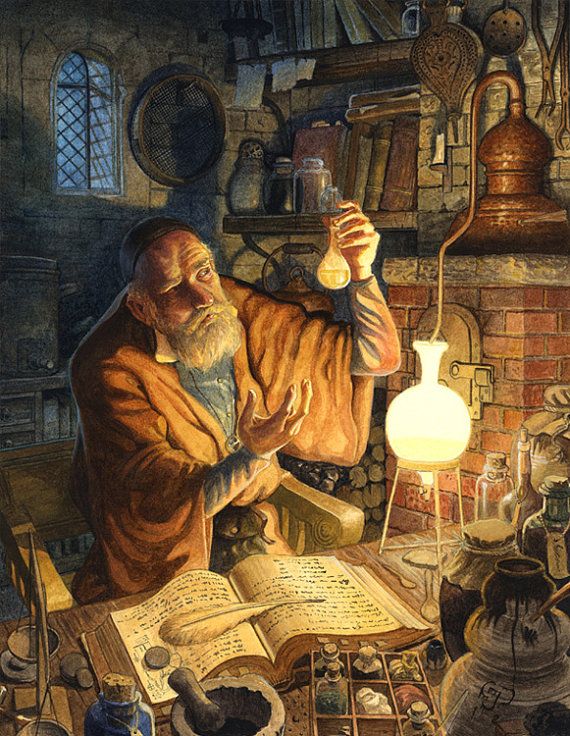
     On this day, one James Price, a distinguished amateur chemist and a Fellow of England’s Royal Society began a series of remarkable experiments. The seven experiments were witnessed by peers, baronets, clergymen. lawyers and chemists – men of unimpeachable public character. In these experiments, mercury was apparently transmuted into various quantities of gold and silver. Some of the gold was presented to His Majesty George III.

     Price became a celebrated figure, and many saw in his work the dawning of an era of unparalleled prosperity for England. Naysayers claimed that Price was merely a clever juggler or that he had deceived himself. In his favor were the facts that he was already a wealthy man and no needy adventurer and that he had already distinguished himself in chemistry.

     A fierce paper battle ensued over the veracity of the experiments, and eventually the Royal Society stepped in, calling upon Price as a Fellow of the society to prove to the satisfaction of his fellow Fellows the truth of his transmutations by repeating his experiments in their presence.

     Price dithered, making various excuses for not repeating the experiments (one of which was that it cost more to produce gold than the gold was worth).  Finally, however, he yielded to their exhortations and announced that he would leave London for his laboratory in the country to prepare for the experiment. He pledged to return in a month, but the month passed, and a second and a third. Six months passed, and even his friends had given up on him.  Just when everyone was convinced he had fled to France or some other criminal haven, he  reappeared, inviting members of the Royal Society to meet him at his laboratory for the experiment.

     Although only a year earlier they were contending for the honor of witnessing the experiments, only three society Fellows accepted his invitation. Stepping before them, Price hastily produced a flask and swallowed its contents. Noting a sudden change in his appearance, the visitors called for medical assistance, but in a few moments Price was dead.

     One thing was sure.  Price had not transmuted himself to gold.  It is speculated that in the beginning he had probably deceived himself, then in the usual slippery slope of skullduggery  attempted to deceive others, and finally,  lacking the moral courage to confess his mistake, checked himself out. In any event, the last belief in the possibility of alchemy among England’s scientific community came to an end in 1782 with Price’s death.

MAY 6, 1782: YOU’VE GOT THAT MIDAS TOUCH

On this day, one James Price, a distinguished amateur chemist and a Fellow of England’s Royal Society began a series of remarkable experiments. The seven experiments were witnessed by peers, baronets, clergymen. lawyers and chemists – men of unimpeachable public character. In these experiments, mercury was apparently transmuted into various quantities of gold and silver. Some of the gold was presented to His Majesty George III.

Price became a celebrated figure, and many saw in his work the dawning of an era of unparalleled prosperity for England. Naysayers claimed that Price was merely a clever juggler or that he had deceived himself. In his favor were the facts that he was already a wealthy man and no needy adventurer and that he had already distinguished himself in chemistry.

A fierce paper battle ensued over the veracity of the experiments, and eventually the Royal Society stepped in, calling upon Price as a Fellow of the society to prove to the satisfaction of his fellow Fellows the truth of his transmutations by repeating his experiments in their presence.

Price dithered, making various excuses for not repeating the experiments (one of which was that it cost more to produce gold than the gold was worth).  Finally, however, he yielded to their exhortations and announced that he would leave London for his laboratory in the country to prepare for the experiment. He pledged to return in a month, but the month passed, and a second and a third. Six months passed, and even his friends had given up on him.  Just when everyone was convinced he had fled to France or some other criminal haven, he  reappeared, inviting members of the Royal Society to meet him at his laboratory for the experiment.

Although only a year earlier they were contending for the honor of witnessing the experiments, only three society Fellows accepted his invitation. Stepping before them, Price hastily produced a flask and swallowed its contents. Noting a sudden change in his appearance, the visitors called for medical assistance, but in a few moments Price was dead.

One thing was sure.  Price had not transmuted himself to gold.  It is speculated that in the beginning he had probably deceived himself, then in the usual slippery slope of skullduggery  attempted to deceive others, and finally,  lacking the moral courage to confess his mistake, checked himself out. In any event, the last belief in the possibility of alchemy among England’s scientific community came to an end in 1782 with Price’s death.

AUGUST 16, 1896: THERE’S BACON IN THEM THAR HILLS

Tagish-Tlingit Packer Keish (Lone Wolf), commonly known as Jim, carried equipment and supplies for early prospectors over the mountain passes from the Alaskan seacoast to the headwaters of the klondike.previewYukon river. He earned the nickname “Skookum” (Chinook for big and strong) for his feat of carrying 156 pounds of bacon over Chilkoot Pass in a single trip. (You don’t pull the mask off the old Lone Ranger, And you don’t mess around with Jim.)

Eventually, tired of of slogging other folk’s bacon, Skookum Jim formed a partnership with his sister Shaaw Tlaa (Kate), his cousin Dawson Charlie (Tagish Charlie), and Kate’s husband George Carmack (no nickname) to go look for the Big G.

On August 16, 1896, the Skookum party discovered rich gold deposits in Bonanza (Rabbit) Creek, Yukon.  Although Skookum Jim is believed to have made the actual discovery, George Carmack was officially credited for the gold discovery because the actual claim was staked in his name. The group agreed to this because they felt that an Indian’s claim would not be recognized because of the rampant racism of the time.

Well, you can just imagine what happened when word of their discovery got out. The Klondike was suddenly a “destination” for every would-be prospector who ever dreamed of the Big G. The exodus known as the Klondike Gold Rush (Yukon Gold Rush) (Alaskan Gold Rush) (The Gold Rush to End All Gold Rushes) was on.

Together our heroes worked what would become known as Discovery Claim (Look What We Found) and collectively earned nearly a million dollars. Skookum Jim built a home for his wife (the little woman) and daughter (junior) in the Yukon Territory (Tagish First Nation) where he spent the winters trapping, hunting and eating lots of bacon hauled in by others. George and Kate moved to California where he deserted her for another woman. You can’t trust anyone without a nickname.