JUNE 20, 1890: PAINTING OUTSIDE THE LINES

Oscar Wilde’s only published novel, The Picture of Dorian Gray, appeared as the lead story in Lippincott’s Monthly Magazine in the July 1890 issue, released on June 20.

In the novel, the title character is the subject of a painting by artist Basil Hallward. Basil is impressed by Dorian’s beauty and becomes infatuated with him. Dorian is also infatuated by Dorian’s beauty, especially the beauty in the painting, and more than annoyed that the man in the painting will remain the same, while Dorian himself will get old and wrinkled and forget people’s names and so forth. Obviously the only answer is to put his soul on the market, which he does, with the purchaser (you know who) promising that the painting will age while Dorian himself stays the same.

In an apparent effort to make the painting age as quickly as possible, Dorian embarks on a life of debauchery, and each sin takes its toll on the portrait.

The book had about the same effect on British critics as Dorian’s naughtiness had on the painting. “Vulgar”, “unclean”, “poisonous” and “discreditable” were a few of their nicer comments. “A tale spawned from the leprous literature of the French Decadents – a poisonous book, the atmosphere of which is heavy with the mephitic odours of moral and spiritual putrefaction,” said the Daily Chronicle.   And this was after Wilde’s editor had already deleted a lot of “objectionable” text before it made its first appearance in Lippincott’s, eliminating titillating bits of debauchery and elements of homosexuality.

Deciding that the novel contained things that might upset an innocent woman, the editor cut further, removing many more decadent passages before the book was published in 1891.

MAN THE TOMATOES, FULL SPEED AHEAD

It’s a battlefield out there. Each morning I prepare my weaponry and fortify myself to better face the enemy.  Then it’s out into the morning mist, bellying my way through the trenches, my trusty trowel at my right, my insecticidal soap at my left. Half a league, half a league, half a league onward, into the valley of Death – mine not to reason why, mine but to do or die.  “Huzzah, huzzah,” I shout,  “Be valiant, stout and bold.”

With scant warning, they attack!  Tufts of crabgrass pop up behind every rock, aphids to the right of me, weevils to the left of me. A slug squadron advances relentlessly head on.   Japanese beetles at four o’clock.  The battle is joined.  Almost at once, I’m ambushed by an elite corps of exotic man-eating weeds, snapping at my ankles and calves, while trash-talking thistles peek out from between tomatoes, taunting me with Donald Trump slogans.

But I’ll not be intimidated.

“Forward,” I shout and storm into the mouth of Hell. I manage to free a tiny pepper plant being held prisoner by a half dozen stinging nettle goons.  Moments after I make a clearing to let the cucumbers once again see sunlight, the neighbor’s cat claims it for his own and begins his morning toilette.  He glowers at me, unflinching, as I try to encourage him to move on, his eyes saying I may not be big but I can bring down a gazelle and I can bring down you.  Enjoying the moment, knotweeds laugh merrily and loudly insult my gardenerhood.

I jump in with both feet, hacking and pulling and spraying.  When I’m done, a pile of green debris lies all around me shattered and sundered.  The day is mine.  The tomatoes, cucumbers and beans all nod in appreciation as I holster my trowel and spray bottle and ride off into cocktail time.

Later, exhausted, I’ll sleep, perchance to dream – of late potato blight.
MAY 10, 1893: THE SUPREME COURT SAYS TOMAHTO

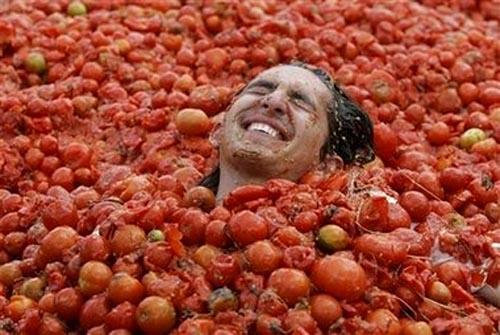
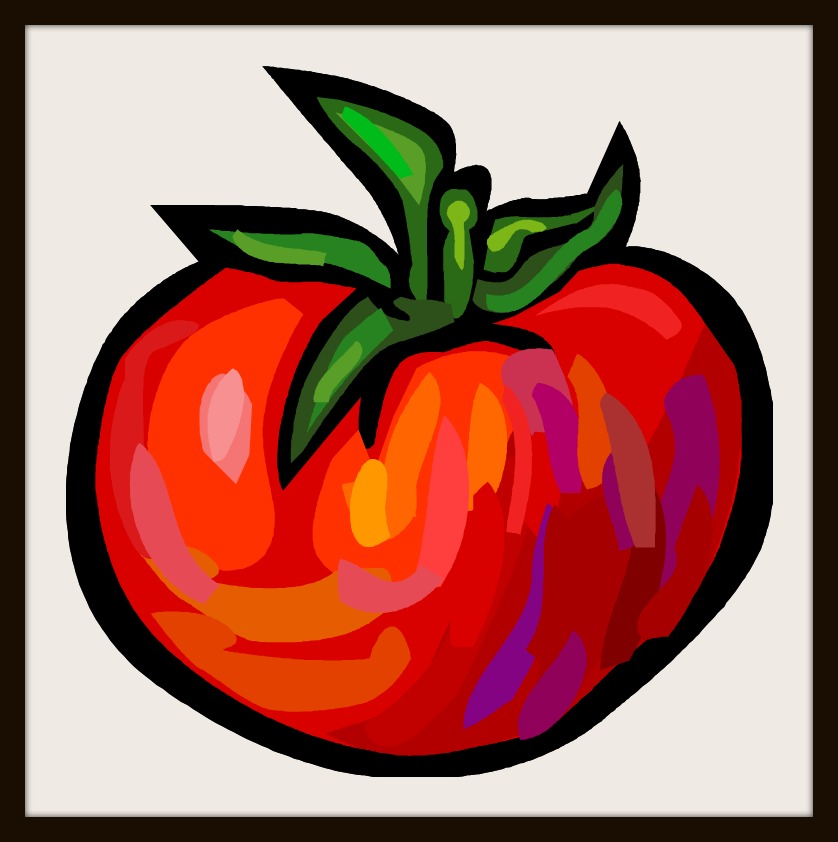
An 1883 tariff act required a tax to be paid on imported vegetables, but not fruit. The Nix family, tomato entrepreneurs, went to court to recover back duties paid to the Port of New York under protest, claiming that they owed nothing because, botanically, a tomato is a fruit, a seed-bearing structure growing from the flowering part of a plant. The case made it to the Supreme Court where, on May 10, 1893, the justices unanimously ruled that, botany be damned, a tomato is a vegetable.

At the hearing, both the plaintiffs’ counsel and the defendant’s counsel made extensive use of dictionaries. The plaintiffs’ counsel read in evidence the definitions of the word tomato, while the defendant’s counsel read the definitions of the words pea, eggplant, cucumber, squash, and pepper. In a clear case of one-upmanship, the plaintiff then read in evidence the definitions of potato, turnip, parsnip, cauliflower, cabbage, carrot and bean.

The court decided in favor of the defense and found that the tomato should be classified under the customs regulations as a vegetable, based on the ways in which it is used, and the popular perception to this end.  Justice Horace Gray, in a horticultural burst of logic, stated that:

“The passages cited from the dictionaries define the word ‘fruit’ as the seed of plants, or that part of plants which contains the seed, and especially the juicy, pulpy products of certain plants, covering and containing the seed. These definitions have no tendency to show that tomatoes are ‘fruit,’ as distinguished from ‘vegetables,’ in common speech, or within the meaning of the tariff act.”

He acknowledged that botanically, tomatoes are classified as a “fruit of the vine”; nevertheless, they are seen as vegetables because they were usually eaten as a main course instead of being eaten as a dessert. In making his decision, Justice Gray brought up another case in which the court found that although a bean is botanically a seed, in common parlance a bean is seen as a vegetable. While on the subject, Gray clarified the status of the cucumber, squash, pea, and turnip for good measure.

It would take another century to declare ketchup a vegetable.

MAY 10, 1893: THE SUPREME COURT SAYS TOMAHTO

An 1883 tariff act required a tax to be paid on imported vegetables, but not fruit. The Nix family, tomato entrepreneurs, went to court to recover back duties paid to the Port of New York under protest, claiming that they owed nothing because, botanically, a tomato is a fruit, a seed-bearing structure growing from the flowering part of a plant. The case made it to the Supreme Court where, on May 10, 1893, the justices unanimously ruled that, botany be damned, a tomato is a vegetable.

At the hearing, both the plaintiffs’ counsel and the defendant’s counsel made extensive use of dictionaries. The plaintiffs’ counsel read in evidence the definitions of the word tomato, while the defendant’s counsel read the definitions of the words pea, eggplant, cucumber, squash, and pepper. In a clear case of one-upmanship, the plaintiff then read in evidence the definitions of potato, turnip, parsnip, cauliflower, cabbage, carrot and bean.

The court decided in favor of the defense and found that the tomato should be classified under the customs regulations as a vegetable, based on the ways in which it is used, and the popular perception to this end.  Justice Horace Gray, in a horticultural burst of logic, stated that:

“The passages cited from the dictionaries define the word ‘fruit’ as the seed of plants, or that part of plants which contains the seed, and especially the juicy, pulpy products of certain plants, covering and containing the seed. These definitions have no tendency to show that tomatoes are ‘fruit,’ as distinguished from ‘vegetables,’ in common speech, or within the meaning of the tariff act.”

He acknowledged that botanically, tomatoes are classified as a “fruit of the vine”; nevertheless, they are seen as vegetables because they were usually eaten as a main course instead of being eaten as a dessert. In making his decision, Justice Gray brought up another case in which the court found that although a bean is botanically a seed, in common parlance a bean is seen as a vegetable. While on the subject, Gray clarified the status of the cucumber, squash, pea, and turnip for good measure.

It would take another century to declare ketchup a vegetable.

March 9, 1974: Lay Down Your Arms

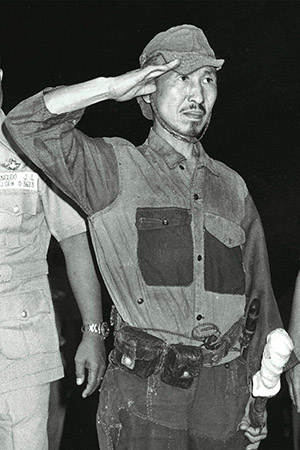
soldierLt. Hiroo Onoda, a soldier in the Japanese army, was sent to the remote Philippine island of Lubang in 1944 to conduct guerrilla warfare. Onoda was supposed to blow up the pier at the harbor and destroy the Lubang airfield. Unfortunately, his commanders, who were worried about other matters, decided not to help Onoda on his mission and soon the island was overrun by the Allies.  Time passed, the war ended, but nobody officially told Onoda; so for 29 years, Onoda remained a dedicated soldier, living in the jungle, eating coconuts and bananas and deftly evading searching parties. Hiding out in the dense jungles, Onoda ignored the leaflets, newspapers, photographs and letters from relatives dropped by planes during the years; he was convinced they were all part of an Allied plot.

In 1974, a college dropout named Norio Suzuki traveled to the Philippines, telling his friends he was out to find a panda, the Abominable Snowman and Lt. Onoda. Where others had failed, Suzuki succeeded. He found Lt. Onoda and tried to convince him that the war was over. However, Onoda refused to leave the island until his commander ordered him to do so. Suzuki traveled back to Japan and found Onoda’s former commander, who had become a bookseller. On March 9, 1974, Suzuki and the commander/bookseller met Onoda and delivered orders that all combat activity was to be ceased, and Onoda laid down his arms.

Tiny Tomato Killer Strikes Again

It is better to light a candle than curse the darkness, or so says some annoying pundit.  Likewise, I suppose, it is better to do something positive than curse the mounds of snow encircling us.  I’ve always been of the curse the darkness ilk, but occasionally I do try and rise above the winter of my discontent and light a candle in the snow.  One of the better remedies for my malaise is the old seed catalog – tiptoeing through the tulips, tomatoes and zinnias almost brings warmth to my icy heart.

If you ever order anything from a seed catalog, you will never have to worry about being without one again.  They will arrive every January just as reliably as the foot of snow they said would be an inch.  There’s Seed City, Happy Seeds, Seeds R Us and many more.  Funny thing is they all come from the same little town in the Midwest where a single little old lady – Granny Burpee – takes seeds out of great big jars and puts them in little envelopes with all those different names.

Nevertheless full seed ahead.  Seven tomato varieties, a couple of cucumbers, greens, beans, okra.  Snapdragons, sweet peas, exotic species I’ve never heard of.  “And there’s no such thing as too many sunflowers,” I’m reminded.

There is such a thing as too many seeds, however.  Granny Burpee doesn’t hold back – a hundred seeds here, two hundred there, a thousand.  I’d like to order six tomato seeds, please.  I really only need two cucumber seeds.  The theory seems to be that you must overplant, just in case some of them don’t sprout.

But they all sprout.

I wanted a couple of tomatoes.  I planted a plastic seed-starting tray, two or three seeds in each of its six cubicles.  Twenty tomato plants emerge.  Just thin out the extra plants, the catalogs advise, leaving one healthy tomato plant in each cubicle.  That’s theory again.  From over my shoulder, as I carefully pull out the runts of the seedlings:  “You’re not going to murder those little plants, are you?”

Come June, I have twenty tomato plants, a dozen cucumbers, a dozen nasturtium, I don’t know how many dozen sunflowers, a sea of seedlings that I forgot to label, and six zucchini.   With six zucchini plants, I’ll be able to place a giant zucchini on the back seat of every unlocked car in Vermont.

Maybe I’ll curse the darkness for a while.

JUNE 20, 1890: PAINTING OUTSIDE THE LINES

Oscar Wilde’s only published novel, The Picture of Dorian Gray, appeared as the lead story in Lippincott’s Monthly Magazine in the July 1890 issue, released on June 20.

In the novel, the title character is the subject of a painting by artist Basil Hallward. Basil is impressed by Dorian’s beauty and becomes infatuated with him. Dorian is also infatuated by Dorian’s beauty, especially the beauty in the painting, and more than annoyed that the man in the painting will remain the same, while Dorian himself will get old and wrinkled and forget people’s names and so forth. Obviously the only answer is to put his soul on the market, which he does, with the purchaser (you know who) promising that the painting will age while Dorian himself stays the same.

In an apparent effort to make the painting age as quickly as possible, Dorian embarks on a life of debauchery, and each sin takes its toll on the portrait.

The book had about the same effect on British critics as Dorian’s naughtiness had on the painting. “Vulgar”, “unclean”, “poisonous” and “discreditable” were a few of their nicer comments. “A tale spawned from the leprous literature of the French Decadents – a poisonous book, the atmosphere of which is heavy with the mephitic odours of moral and spiritual putrefaction,” said the Daily Chronicle.   And this was after Wilde’s editor had already deleted a lot of “objectionable” text before it made its first appearance in Lippincott’s, eliminating titillating bits of debauchery and elements of homosexuality.

Deciding that the novel contained things that might upset an innocent woman, the editor cut further, removing many more decadent passages before the book was published in 1891.

MAN THE TOMATOES, FULL SPEED AHEAD

It’s a battlefield out there. Each morning I prepare my weaponry and fortify myself to better face the enemy.  Then it’s out into the morning mist, bellying my way through the trenches, my trusty trowel at my right, my insecticidal soap at my left. Half a league, half a league, half a league onward, into the valley of Death – mine not to reason why, mine but to do or die.  “Huzzah, huzzah,” I shout,  “Be valiant, stout and bold.”

With scant warning, they attack!  Tufts of crabgrass pop up behind every rock, aphids to the right of me, weevils to the left of me. A slug squadron advances relentlessly head on.   Japanese beetles at four o’clock.  The battle is joined.  Almost at once, I’m ambushed by an elite corps of exotic man-eating weeds, snapping at my ankles and calves, while trash-talking thistles peek out from between tomatoes, taunting me with Donald Trump slogans.

But I’ll not be intimidated.

“Forward,” I shout and storm into the mouth of Hell. I manage to free a tiny pepper plant being held prisoner by a half dozen stinging nettle goons.  Moments after I make a clearing to let the cucumbers once again see sunlight, the neighbor’s cat claims it for his own and begins his morning toilette.  He glowers at me, unflinching, as I try to encourage him to move on, his eyes saying I may not be big but I can bring down a gazelle and I can bring down you.  Enjoying the moment, knotweeds laugh merrily and loudly insult my gardenerhood.

I jump in with both feet, hacking and pulling and spraying.  When I’m done, a pile of green debris lies all around me shattered and sundered.  The day is mine.  The tomatoes, cucumbers and beans all nod in appreciation as I holster my trowel and spray bottle and ride off into cocktail time.

Later, exhausted, I’ll sleep, perchance to dream – of late potato blight.