MAY 26, 1755: READ HIS FRENCH LIPS

Louis Mandrin was to France what Robin Hood was to England and Rob Roy to Scotland. Having served in the war of 1740 in a light brigade noted for undertaking dangerous missions to surprise the enemy, he was left idle and without income by peace, which made a remarkable appearance in 1748. He had no way of supporting his life other than by continually risking it. Thus he came up with the idea of assembling a corps of men like himself with himself as their leader and waging war against the fermiers, collectors of royal revenues from taxes  levied on salt, tobacco, and farming. The fermiers paid an agreed upon amount to the king, but could exact unspecified sums themselves. They naturally became fat and rich in the process – and hated.

Mandrin became the master of a portion of central France, pillaging public treasuries to pay his troops, whom he also put to work forcing the wealthy to buy his stolen merchandise. He successfully warded off the many detachments of government troops sent against him, instilling fear among their numbers and in the government itself. Eventually the people came to consider him their protector against the oppression of government revenue officers.

Finally, a regiment did attack and destroy his corps, but Mandrin himself escaped into the Duchy of Savoy. From there, he continued to make forays across the border and a terrible nuisance of himself. The French government was not not happy. The fermiers entered the Duchy illegally, disguising 500 men as peasants. Mandrin was betrayed by two of his men, seized, and whisked across the border. When the King of Savoy, learned of the French intrusion into his territory, he immediately wrote to the French King, demanding that the prisoner be turned over to him. But before the message arrived, Mandrin was hurriedly tried, condemned to be broken at the wheel, and executed on May 26, 1755.


APRIL 16, 1850: CALL ME MADAME

Madame (Marie) Tussaud is arguably the world’s most famous wax sculptor. Born in France in 1761, she began her artistic career during the French Revolution, searching through corpses to find the heads of noted guillotine victims from which she made death masks. She herself was imprisoned for three months awaiting execution, but an influential friend intervened and she was released. She and her waxwork friends toured throughout Europe for 33 years before settling into a permanent exhibition in 1835 on Baker Street in London. There she gained prosperity and fame, managing her wax museum until her death on April 16, 1850.
Throughout Madame Tussaud’s long existence, its most popular feature has been the Chamber of Horrors (as pictured here).

Where’s the Remote?

Inventor Walter Pichler is the genius behind the amazing TV helmet of 1967. This device allows a user to leave the outside world and slip into his or her own little world of information and entertainment. The user simply inserts his or her head into a capsule that resembles a small submarine and hopes that he or she doesn’t bump into something while enjoying the “virtual world” of Gilligan’s Island.

Pearl Among . . .

minnie

“How-w-w-Dee-e-e-e! I’m jes’ so proud to be here!” “Here” might have been the National Comedy Hall of Fame into which, on April 16, 1994, Minnie Pearl became the first woman inducted. But more often it was on the stage of the Grand Ole Opry in Nashville, Tennessee, where Minnie held sway as the resident Southern hillbilly for over 50 years.

Her comedy was a good-natured satire of rural Southern culture. She appeared in her trademark hat, purchased at the Surasky Bros. Department Store in Aiken, South Carolina, for $1.98 before her first stage performance in 1939, along with styleless “down home” dresses.  Her self-deprecating humor was usually about her unsuccessful attempts to get “a feller” and her ne’er-do-well relatives. She also sang novelty songs and danced with Grandpa Jones. From the opening How-w-w Dee-e-e-e to her closing “I love you so much it hurts!”, she had the Opry audience in the palm of her hand.

The Little Tramp

Sir Charles Spencer Chaplin, known to millions of film buffs as “Charlie,” was born April 16, 1889.  His working life in entertainment began as a child performer in British music halls and spanned 75 years until his death in 1977 at the age of 88.   In the United States, he became one of the most important creative personalities of the silent-film era — acting in, directing, scripting, producing and composing the music for his own films.


APRIL 13, 1360: HAIL, HAIL, THE GANG’S ALL HERE

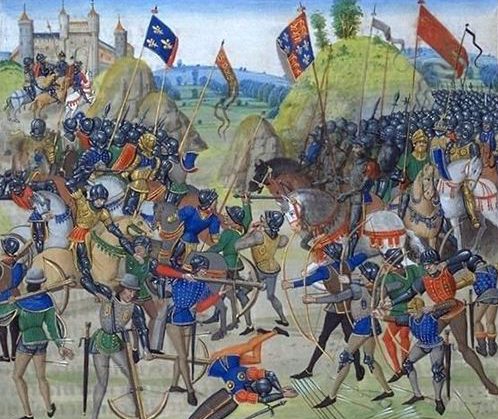
It was the 14th century and once again England was out to conquer France. The hostilities had been going on for nearly 20 years, when England’s King Edward III sailed across the Channel with a huge army — a cast of thousands.  The dead of winter set in, and the inconsiderate French refused to face the English invaders in direct combat. Instead they huddled in their warm and cozy castles, drinking cafe au lait while the English plundered the countryside and got frostbite. Come April of 1360, having lasted through the winter, Edward and his men fought and torched their way through the Paris suburbs, and readied themselves to have at Chartres.

Then, on April 13, a sudden violent storm came up. Lightning killed several soldiers, the heavens opened up, and hailstones the size of pommes de terre began hammering the hapless army, killing a thousand men. Naturally, they took this as a sign that God was annoyed. Edward declared the invasion “my bad” and negotiated a peace with the French. The English renounced all claims to the throne of France, and the French gave them croissants.

But wouldn’t you know it, a few years later, the King of France declared war on England ( this was, after all, the Hundred Years’ War, scheduled to last another 75 years or so.)

Historians assure us that this was not the origin of the phrase “Hail to the Chief.”

Ifs, Ands or Butts

Alfred Mosher Butts was born in Poughkeepsie, New York, on April 13, 1899. Who, you ask, is Alfred Mosher Butts? He became an architect when he grew up, though not a famous one. He dabbled in art to no great success. His colorful last name is worth a pathetic seven points in a certain word game that can be found in one-third of American homes. 150 million sets have been sold worldwide in 29 languages. Yes, the game is the ubiquitous Scrabble. And Al Butts is the guy who invented it.

For those who may be new to the planet, Scrabble is a game where players place tiles on a board to spell words and earn points determined by the numerical value of individual letters. Butts determined the values of the individual letters by studying how often each letter appeared on the front page of The New York Times (fake letters in fake words in fake news, some might say).

A street sign in Jackson Heights (where Butts lived when he invented the game) memorializes the creation of the game.

February 4, 1912: It’s a Bird, It’s a Plane, It’s the Flying Tailor

Born in Austria, Franz Reichelt moved to Paris in 1898 at the age of 19. There he went into business as a tailor, creating fashionable dresses for the many Austrians who visited Paris. He was quite successful at his chosen trade, but he yearned for something more. He had the mind of an inventor, and we all know what troubles that can get a person into.

As with many such dreamers in the early 20th century, he looked to the skies, which were now filled with magnificent men in their flying machines. Reichelt became obsessed with the idea of a tailor-made suit that would convert to a parachute should a hapless aviator leave his or her flying machine for some reason. Parachutes had been around for ages, but his would be sartorial as well as utilitarian.

He developed his garment and tested it on dummies dropped from his fifth floor apartment. (“Mon Dieu, here comes another falling dummy,” a Parisian pedestrian might be heard to remark.) These experiments were less than successful. What he needed was a higher perch from which to launch his dummies. A lesser man might have moved to a tenth floor apartment, but Reichelt saw the Eiffel Tower gleaming in the distance, a steel siren calling to him.

Reichelt somehow wheedled the Parisian Prefecture of Police to grant him permission to conduct a test from the tower. However, when he arrived at the tower on February 4, 1912, he was not accompanied by a dummy. It quickly became clear that he had duped them, that Reichelt himself would be the dummy. Despite all attempts to dissuade him, Reichelt, about to become known as the flying tailor, jumped from the tower platform, down to the icy ground below and into the history books. Charles Darwin strikes again.

Other Than the Previous One, That Is

In 1789, George Washington was elected president receiving 100% of the vote, the only president to ever do so.

Unfriended

On this day in 2004, Mark Zuckerberg and fellow Harvard students launched Facebook.  It was limited to Harvard students only.  Alas, it did not remain that way.

APRIL 19, 1949: SEND IN THE CLOWNS

russian

With the threat of nuclear annihilation hanging over the world, cold war adversaries were nonetheless able to find glimmers of humor. At the opening night of the Moscow Circus, noted Russian clown, Konsantin Berman, demonstrated who had the upper hand in the clown cold war, launching barb after barb in the direction of the United States.

Tossing a boomerang, he likened it to the U.S. Marshall Plan that was pumping economic recovery aid into Western Europe. “American aid to Europe,” he said, “Here is the dollar.” as the boomerang returned to his hand, delighting the audience. Producing a radio that bellowed out the sound of barking dogs, he announced: “That’s the Voice of America.”

Meanwhile American clowns were dumping buckets of water on each other and slipping on banana peels.

Speaking of Banana Peels

The Vagabond King a 1925 operetta by Rudolf Frimi was already an American success when it opened in London on April 19, 1927.  It’s success in England was probably assured given its theme of foibles of the French.  Its hero is a braggart, thief and rabble-rouser who attempts to steal an aristocratic lady from the king himself.  Not only that, he openly mocks the king, boasting about what he would do if he were king.  The angry king gives him royal powers for 24 hours — king for a day — during which he must solve all France’s problems or go to the gallows (the guillotine had not yet been invented).  He succeeds, wins the lady’s hand and lives happily ever after in exile — probably in England.  The operetta was the inspiration for a couple of movies and, of course, the popular radio and television program “Queen for a Day.”


APRIL 16, 1850: CALL ME MADAME

Madame (Marie) Tussaud is arguably the world’s most famous wax sculptor. Born in France in 1761, she began her artistic career during the French Revolution, searching through corpses to find the heads of noted guillotine victims from which she made death masks. She herself was imprisoned for three months awaiting execution, but an influential friend intervened and she was released. She and her waxwork friends toured throughout Europe for 33 years before settling into a permanent exhibition in 1835 on Baker Street in London. There she gained prosperity and fame, managing her wax museum until her death on April 16, 1850.
Throughout Madame Tussaud’s long existence, its most popular feature has been the Chamber of Horrors (as pictured here).

And It Would Help with Social Distancing

Inventor Walter Pichler is the genius behind the amazing TV helmet of 1967. This device allows a user to leave the outside world and slip into his or her own little world of information and entertainment. The user simply inserts his or her head into a capsule that resembles a small submarine and hopes that he or she doesn’t bump into something while enjoying the “virtual world” of Gilligan’s Island.

Pearl Among . . .

minnie

“How-w-w-Dee-e-e-e! I’m jes’ so proud to be here!” “Here” might have been the National Comedy Hall of Fame into which, on April 16, 1994, Minnie Pearl became the first woman inducted. But more often it was on the stage of the Grand Ole Opry in Nashville, Tennessee, where Minnie held sway as the resident Southern hillbilly for over 50 years.

Her comedy was a good-natured satire of rural Southern culture. She appeared in her trademark hat, purchased at the Surasky Bros. Department Store in Aiken, South Carolina, for $1.98 before her first stage performance in 1939, along with styleless “down home” dresses.  Her self-deprecating humor was usually about her unsuccessful attempts to get “a feller” and her ne’er-do-well relatives. She also sang novelty songs and danced with Grandpa Jones. From the opening How-w-w Dee-e-e-e to her closing “I love you so much it hurts!”, she had the Opry audience in the palm of her hand.

The Little Tramp

Sir Charles Spencer Chaplin, known to millions of film buffs as “Charlie,” was born April 16, 1889.  His working life in entertainment began as a child performer in British music halls and spanned 75 years until his death in 1977 at the age of 88.   In the United States, he became one of the most important creative personalities of the silent-film era — acting in, directing, scripting, producing and composing the music for his own films.


APRIL 13, 1360: HAIL, HAIL, THE GANG’S ALL HERE

It was the 14th century and once again England was out to conquer France. The hostilities had been going on for nearly 20 years, when England’s King Edward III sailed across the Channel with a huge army — a cast of thousands.  The dead of winter set in, and the inconsiderate French refused to face the English invaders in direct combat. Instead they huddled in their warm and cozy castles, drinking cafe au lait while the English plundered the countryside and got frostbite. Come April of 1360, having lasted through the winter, Edward and his men fought and torched their way through the Paris suburbs, and readied themselves to have at Chartres.

Then, on April 13, a sudden violent storm came up. Lightning killed several soldiers, and then the heavens opened up and hailstones the size of pommes de terre began hammering the hapless army, killing a thousand men. Naturally, they took this as a sign that God was annoyed. Edward declared the invasion “my bad” and negotiated a peace with the French. The English renounced all claims to the throne of France, and the French gave them croissants.

But wouldn’t you know it, a few years later, the King of France declared war on England ( this was, after all, the Hundred Years’ War, scheduled to last another 75 years or so.)

Historians assure us that this was not the origin of the phrase “Hail to the Chief.”

Ifs, Ands or Butts

Alfred Mosher Butts was born in Poughkeepsie, New York, on April 13, 1899. Who, you ask, is Alfred Mosher Butts? He became an architect when he grew up, though not a famous one. He dabbled in art to no great success. His colorful last name is worth a pathetic seven points in a certain word game that can be found in one-third of American homes. 150 million sets have been sold worldwide in 29 languages. Yes, the game is the ubiquitous Scrabble. And Al Butts is the guy who invented it.

For those who may be new to the planet, Scrabble is a game where players place tiles on a board to spell words and earn points determined by the numerical value of individual letters. Butts determined the values of the individual letters by studying how often each letter appeared on the front page of The New York Times (fake letters in fake words in fake news, some might say).

A street sign in Jackson Heights (where Butts lived when he invented the game) memorializes the creation of the game.

November 9, 1918: And Mona Lisa Isn’t Talking

Guillaume Apollinaire, who died on this date in 1918, was a French poet and critic of the early 20th century. He was a fan of modern art and is credited with coining the word surrealism. To the French police, however he was just another voleur, but certainly not a petty one. Seven years earlier, they had arrested and jailed him on suspicion of aiding and abetting the theft of the Mona Lisa and a number of Egyptian statuettes from the Louvre. It didn’t help his case that he had once called for the Louvre to be burnt down.

The strange case began early on a Monday morning. Before the Louvre was opened for visitors,the Mona Lisa was stolen by a thief who acted quickly when no guards were around. The theft wasn’t reported until Tuesday; guards who noticed that the painting was missing assumed it had been removed to be photographed. Once museum officials realized the truth, however, all hell broke loose. The Louvre went into lock-down. Police arrived to question the staff, re-enact the crime and dust for fingerprints, a newfangled detection technique. The French border was sealed, departing ships and trains thoroughly searched.

By the time the museum re-opened nine days later, the theft was on the front page of newspapers around the world. Tips poured in from amateur sleuths, clairvoyants and your everyday would-be experts. Thousands of people lined up at the Louvre just to see the empty spot where the painting once hung. More it seems than ever viewed the painting itself, which was not widely known outside the art world until it was stolen (Nat King Cole had not yet sung about it). Giving the whole situation a Kafkaesque touch, Franz Kafka was among those who came to view the empty space.

The plot thickened (as plots will) when a mystery man called the Paris-Journal, which was offering a reward for information about the crime. The man showed up at the newspaper’s offices with a small statue, one of several that he claimed to have stolen from the Louvre. The anonymous thief turned out to be a bisexual con man named Honoré Joseph Géry Pieret who had a questionable relationship with Apollinaire. Pieret implicated Apollinaire and he was arrested.

Under pressure, Apollinaire, admitted that Pieret had sold the pilfered works to his friend Pablo Picasso. Thinking they might have discovered a dandy crime ring, police arrested Picasso as well. Although Picasso admitted buying the objects, prosecutors couldn’t build a case that either he or Apollinaire had stolen them, much less the Mona Lisa, and both of them went free.

And what happened to the Mona Lisa? Conspiracy theorists tell us it was never found, that museum officials had to hire Leonardo DaVinci to paint a replacement. “How about a real smile this time,” they suggested.

But She’s Showing It All

This just in:  French experts have determined that a nude portrait that has been hiding at the Conde Museum at the Palace of Chantilly, north of the French capital is actually Mona Lisa herself.  She has been going under the alias Monna Vanna.  Curators have determined that Leonardo himself had a hand in the charcoal work.  Shocking!

OCTOBER 18, 1963: SPACE, THE FELINE FRONTIER

The story of cats in space is a dramatic tale indeed. It begins in an unlikely place with the 1957 Soviet launch of Sputnik 2, carrying of all felicettethings a dog named Laika. Laika was a stray found on the streets of Moscow who could have been the star of a dandy rags-to-riches shaggy dog story, except that things didn’t go all that well and the pooch perished under mysterious circumstances.

This was viewed as an early skirmish in the superpower space race to which NASA responded by sending a chimp into space and successfully returning him.

The French meanwhile had been plotting their own animal space probe. Fifteen cats had been chosen to undergo extensive training involving centrifuges, compression chambers and other medieval torture devices for a space mission in which the French would prove that they belonged at the table with the big guys and a cat would demonstrate to its fanciers everywhere that cats were superior to dogs in yet another way.

A pretty black and white Parisian chatte was eventually selected for the mission, because she was the only one who hadn’t become overweight during training, something to do with croissants most likely. On October 18, 1963, at 8:09 am, Chatte Félicette boarded a Véronique AGI 47 rocket at a base in the Algerian Sahara Desert and was blasted 97 miles into space. Fifteen minutes later, she parachuted safely to earth and pussycat immortality. Voilà!

MAY 26, 1755: READ HIS FRENCH LIPS

Louis Mandrin was to France what Robin Hood was to England and Rob Roy to Scotland. Having served in the war of 1740 in a light brigade noted for undertaking dangerous missions to surprise the enemy, he was left idle and without income by peace, which made a remarkable appearance in 1748. He had no way of supporting his life other than by continually risking it. Thus he came up with the idea of assembling a corps of men like himself with himself as their leader and waging war against the fermiers, collectors of royal revenues from taxes  levied on salt, tobacco, and farming. The fermiers paid an agreed upon amount to the king, but could exact unspecified sums themselves. They naturally became fat and rich in the process – and hated.

Mandrin became the master of a portion of central France, pillaging public treasuries to pay his troops, whom he also put to work forcing the wealthy to buy his stolen merchandise. He successfully warded off the many detachments of government troops sent against him, instilling fear among their numbers and in the government itself. Eventually the people came to consider him their protector against the oppression of government revenue officers.

Finally, a regiment did attack and destroy his corps, but Mandrin himself escaped into the Duchy of Savoy. From there, he continued to make forays across the border and a terrible nuisance of himself. The French government was not not happy. The fermiers entered the Duchy illegally, disguising 500 men as peasants. Mandrin was betrayed by two of his men, seized, and whisked across the border. When the King of Savoy, learned of the French intrusion into his territory, he immediately wrote to the French King, demanding that the prisoner be turned over to him. But before the message arrived, Mandrin was hurriedly tried, condemned to be broken at the wheel, and executed on May 26, 1755.