APRIL 10, 1953: COMIN’ AT YA

The poobahs at Hollywood’s major film studios watched with amazement and envy as the independently produced 3-D movie Bwana Devil wowed audiences in late 1952.  Columbia Pictures quickly threw together a black- and-white thriller that for an hour hurled practically every prop on the set at the beleaguered audience. It was just as quickly forgotten.  Then on April 10, 1953, Warner Brothers released its entry — in color and stereophonic sound — House of Wax, a horror film starring Vincent Price as a sculptor who kills folks, covers them with wax, dresses them up as famous historical figures, and displays them in his wax museum. Audiences loved it, making it one of the biggest hits of the year. Even critics gave it a go. And although it took a while, the Library of Congress selected it in 2014 for inclusion in the National Film Registry, deeming it “culturally, historically, or aesthetically significant.”

The film revived Vincent Price’s career, positioning him as the go-to guy when you needed a mad scientist or fiendish psychopath.  Although House of Wax had a couple of classic 3-D effects (the pitchman with a paddleball and a character who seemingly stands up in the audience and runs into the screen), it was not loaded down with them. This might have been because the director was blind in one eye and couldn’t understand what all the fuss was about.

And What Do We Suppose Jumbo the Elephant Really Was
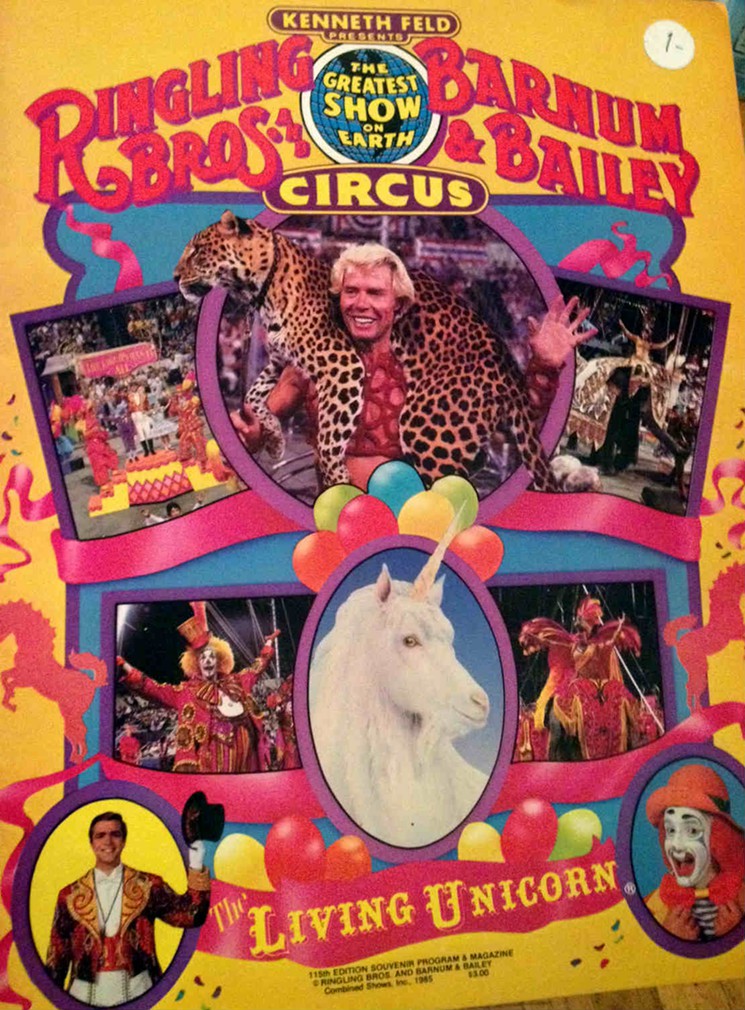
On this day in 1985, Lancelot the Unicorn who had been touring with the Ringling Brothers and Barnum and Bailey Circus — famous for outlandish attractions — was exposed as a fraud.  Audiences were appalled to learn that Lancelot wasn’t a real unicorn at all, just a goat with a horn surgically attached to its forehead.

IF IT HAD ONLY BEEN A NACHO
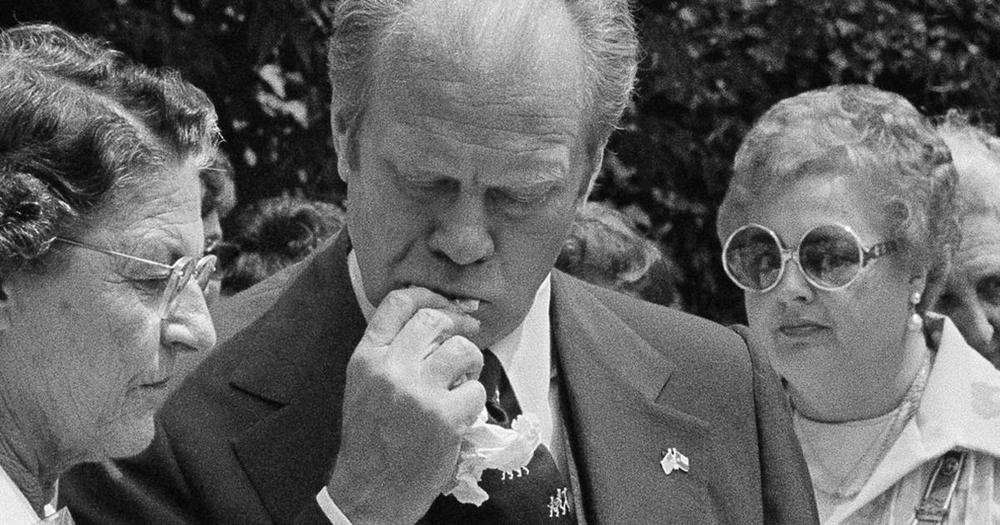
It would seem that in modern politics every president has been forced to deal with a scandal, big or small –vicuna coat, Watergate, Iran Contra, Stormy Daniels. Gerald Ford’s scandal would probably be trivial in comparison to most. But it may have cost him re-election. It was April 10, 1976, in San Antonio, Texas, at the Alamo, where a tiny faux pas morphed into the Great Tamale Incident as the President attempted to eat a tamale without removing the corn husk, playing into his reputation as a bit of a bumbler.
February 25, 1797: We Have Met the Enemy, and He’s . . .

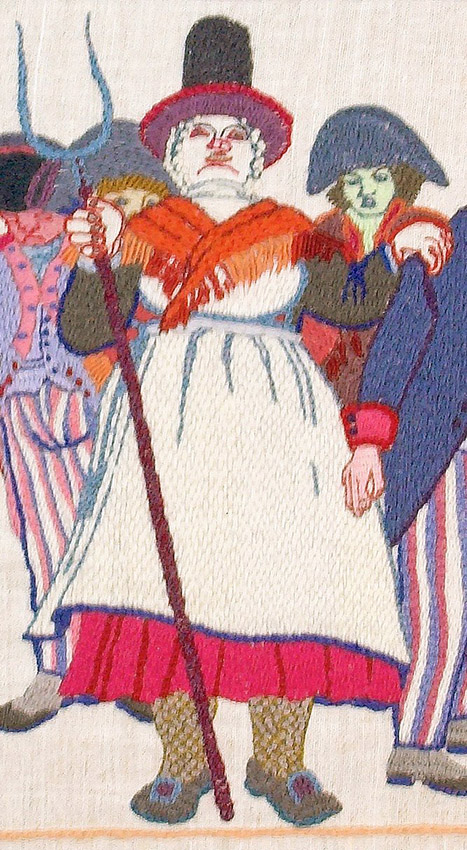
In February  1797, a French invasion force, La Légion Noire (“The Black Legion”), under the leadership of Colonel William Tate sailed into Fishguard Bay in Wales.  The somewhat less than elite fighting force of 1400 men, formed partly by emptying French jails, landed on a beach near the small village of Llanwnda.  Men, arms and gunpowder were unloaded, and the ships headed back to France.  The last invasion of England had begun.

Preparations for a battle got underway.  Unfortunately,  the invasion force, having endured years of prison food, prepared by  liberating food and wine from a grounded Portuguese ship, eating and drinking well into the wee hours.  By dawn, the invaders were too drunk to fight.  The wife of a Fishguard cobbler, Jemima Nicholas (who would become known as Jemima the Great), armed with a pitchfork, marched into the enemy camp, captured a dozen Frenchmen, marched them back to the local jail, and went back to find some more.  And the Frenchmen saw British troops, following her, advancing toward them, seemingly numbering in the thousands.  And on February 25, they surrendered.  Turns out, however, that there were no British troops.  The advancing army was actually a few hundred Welsh women dressed in traditional red outfits with tall black felt hats who had come to watch the battle.
Jemima died at the age of 82. in 1832. Her grave in Fishguard was marked with a plaque in 1897, during the invasion’s centennial.

Monkey See . . .

In what would prove to be an endless parade, the first performance by a trained monkey in the United States was said to have been in New York City on February 25. 1751. Folks paid a shilling to watch the little creature dance, cavort, walk a tightrope and generally make a human of himself. Through the years such acts have gotten steadily bigger and better — think Clyde Beatty’s trained lions, dancing elephants, King Kong.

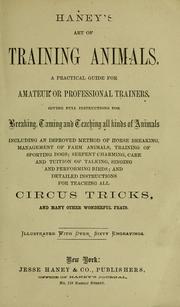
Monkeys have always been a favorite of course. As Haney’s Art of Training Animals pointed out back in 1869, monkeys have an ingrained passion for mimicking human beings (monkey see, monkey do) and they cut a fine figure in fine clothes. “Dressed in male or female apparel, the monkey’s naturally comical appearance is greatly heightened. Thus, one might be dressed to represent a lady of fashion, while another personates her footman, who, dressed in gorgeous livery supports her train. This is elaborated into quite a little scene at some exhibitions. A little barouche, drawn by a team of dogs, is driven on the stage, a monkey driving while a monkey footman sits solemn and erect on his perch behind. A monkey lady and gentleman are seated inside, she with a fan and parasol, he with a stovepipe hat. . . . Each performer is taught what he is to do, the most intelligent monkey being generally assigned the footman’s character.”

Now that’s entertainment.

February 18, 1953: Leaping from a Screen Near You

An exciting new kind of movie opened in New York City on February 18, 1953, and quickly took the entire nation by storm. It promised each and every theater patron the cinematic excitement of a lion in his or her lap. It was the latest attempt by desperate movie studios to pry people away from those insidious television sets that had popped up in living rooms everywhere, to get them back into theaters.  In a frenzy they had tried to beat the little box with Cinerama, Cinemascope and a host of other Deadly Cins.

The new kind of movie was of course 3-D, complete with those funny little glasses (sadly lacking a big nose and mustache), and this first film was called Bwana Devil. Not only did audiences have to sit through a newsreel and a featurette about folk dancing in a remote Himalayan village to get to the good stuff, they also had to endure an opening lecture on just how this modern marvel worked. A very serious scientist in a lab coat delivered this lecture. He described the 3-D process in numbing detail while the antsier members of the audience chewed Necco wafers and stared at him through those special glasses, wondering why he remained flat as a pancake in a lab coat.

Bwana Devil was a jungle flick (in case you wondered), obviously chosen so that it could feature lions and tigers and elephants and giraffes leaping from the screen onto the unsuspecting audience, causing most of the ten-year-olds to pee their pants. “Let’s see your 15 inch, black and white TV do that,” Messieurs Metro, Goldwyn and Mayer snickered.

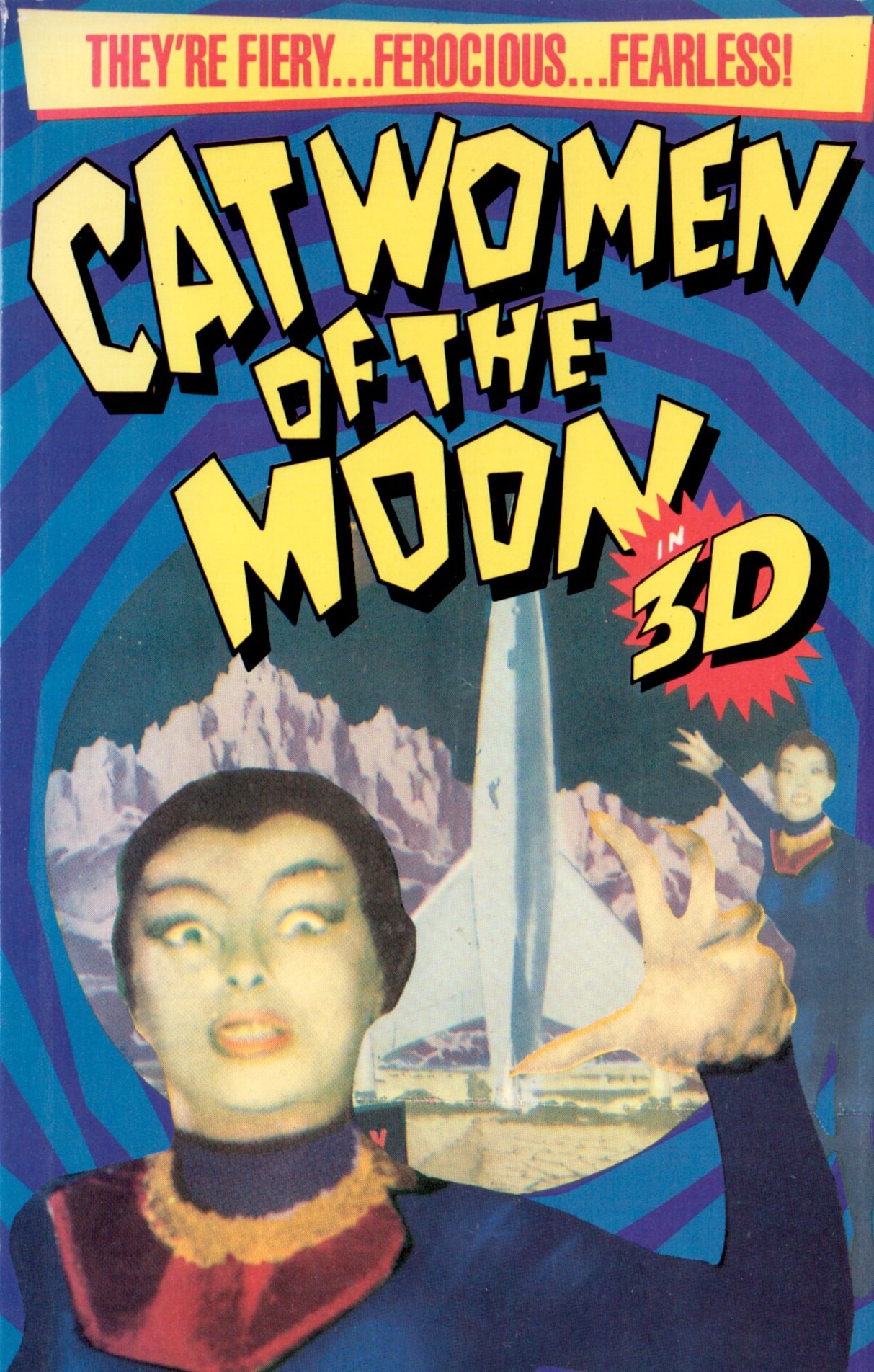
And they continued to do that, with westerns, in which Indians would shoot flaming arrows indiscriminately into the audience – one of them right into the forehead of a kid sitting in the third row. Or creepy horror films in which a mad scientist reached into the audience plucking a comely teenager by the throat, pulling her out of her seat, sucking her into the screen never to be seen again.  And Cat-Women on the Moon — sexy moon maidens in black tights leaping into the aisles and luring ogling men into the lobby for who knows what? Hollywood had struck back.

To experience the sheer terror of 3-D, tape red cellophane over your left eye and blue cellophane over your right eye.  Then look at the picture below and Omigod! Look out for the tiger!.

tiger-large

Naming Rights

Born on this day in 1745, Italian physicist Alessandro Volta, inventor of the electric battery, for whom the volt was named (not to be confused with the Volta Boatman).  There’s also Georg Ohm  and Andre-Marie Ampere, but they weren’t born on February 18.  Ernst Mach was, in 1838.  He was the Austrian physicist who gave his name to a unit of speed.  And way back in 1516, the daughter of Henry VIII,  Mary Tudor, who gave her name to the popular cocktail, the Bloody Tudor.

February 16, 1923: Beware of the Hippo

This could be the mother of all conspiracy theories. On February 16, 1923, mummy_2in Thebes, Egypt, English archaeologist Howard Carter entered the burial chamber of the Egyptian ruler King Tutankhamen — Tut to his friends and hangers on. As every schoolgirl knows, Tut died and was mummified back in 1324 B.C., give or take a year, while still a teen idol. As every schoolboy knows, anyone foolish enough to enter Tut’s burial chamber would become subject to a pretty nasty curse — involving but not limited to crocodiles, snakes and scorpions.

Tut was the first mummy found in tact and with all his wealth untouched by tomb raiders. And his discovery left scientists scratching their heads. No one knew what had caused the young king’s death. Theories have popped up during the years — genetic disorders, disease, foul play.

An Egyptologist at California State University, Dr. Benson Harer, has come up with a dandy new idea: Tut was done in by an angry hippopotamus. Well, we all know what nasty tempers hippos have. They kill more people each year than lions, gorillas, you-name-it. And ancient Egypt was lousy with hippos — capsizing boats, stomping crops, stampeding through villages, chomping people in half with a single bite.

King Tut loved to hunt hippos, and every schoolgirl knows what dummies hippo hunters can be. We can imagine Tut happening upon a baby hippo: “Isn’t he cute? Let’s get closer. I wonder if his mother’s around somewhere.” Dr. Harer has a lot of scientific stuff that goes along with his theory, but what’s most interesting is the good doctor’s speculation that a coverup took place, with authorities stonewalling and concealing the pharaoh’s death by hippo for political reasons, fearing that the common folk might see Tut as less Trumplike, more Bidenlike — or that the gods always liked hippos best. There you have it, slippery slopers — Hippogate!

When it comes to mummies, they don’t make them like this anymore:

Radio for Dummies

edgarbergenandcharliemccarthyBorn February 16, 1903, Edgar Bergen, along with his cohorts, Charlie McCarthy and Mortimer Snerd, got his start in vaudeville and one-reel movie shorts, but his real success came on radio of all places. The popularity of a ventriloquist on radio, when no one could see the dummies or even whether Bergen’s mouth moved, is a puzzler. But popular they were. Seen at a New York party by Noel Coward, who recommended them for an engagement at the famous Rainbow Room, they were discovered by two producers who booked them for a guest appearance on Rudy Vallee’s radio program. That quickly led to their own show which, under various sponsors, was on the air from 1937 to 1956.  Bergen died in 1978.  Charlie lives on at the Smithsonian.  One might be tempted to think Charlie related to Congressional Republicans because — well, for obvious reasons — but he’s not.

February 12, 1924: Now You Has Jazz

Advertised as an educational event, the “Experiment in Modern Music” drew a capacity crowd to New York City’s Aeolian Hall on the afternoon of February 12, 1924. Noted critics were in attendance as were such luminaries as John Phillip Sousa and Sergei Rachmaninoff.

Organized by the conductor of the Palais Royal Orchestra, Paul Whiteman, the concert was intended to introduce the new form of music called jazz and show audiences that it was a musical form to be reckoned with. True to its billing as educational, most of the concert had consisted of mind-numbing rather than toe-tapping music, two dozen little lessons that began to dissolve into one another as the audience grew antsier and antsier. At last (second to last, actually) a young Broadway composer sat down at the piano to perform a brand new piece written for the occasion.
His composition had been hastily created.  Just over a month earlier, whilegershwin in a Manhattan pool hall, he had read in a newspaper that he was scheduled to perform a jazz concerto at the Whiteman soiree. Painted into the proverbial corner, he set to work. The framework of his concerto came to him on a train journey: “It was on the train, with its steely rhythms, its rattle-ty bang, that is so often so stimulating to a composer – I frequently hear music in the very heart of the noise . . . And there I suddenly heard, and even saw on paper – the complete construction of the Rhapsody, from beginning to end.”

The piece opened with an “outrageous cadenza of the clarinet,” now instantly recognizable, and “Rhapsody in Blue” metamorphosed into a showstopper of American music history. George Gershwin himself would, as a New York Times critic lacking restraint put it, “go far beyond those of his ilk.”

And now you has rock

Forty years later, on February 12, 1964, New York City would again be home to musical history.  This time the venue was Carnegie Hall and the occasion a major skirmish in the British invasion as the Beatles held their first concert in the U.S.  And not everyone thought they would go far beyond those of their ilk:  “Visually they are a nightmare, tight, dandified Edwardian-Beatnik suits and great pudding bowls of hair. Musically they are a near disaster, guitars and drums slamming out a merciless beat that does away with secondary rhythms, harmony and melody.” — Newsweek
 

February 10, 2024: Year of the Dragon

Today is the beginning of the Chinese New Year, the Year of the Dragon.  It’s bound to be a bit more exciting than the departing year, that of the Rabbit.  The Rabbit makes nice, the Dragon makes noise.  To those who believe in the Chinese zodiac, dragons mean good luck, strength and power. They control the weather and water. Alas, they don’t breathe fire.  Western dragons on the other hand, all breathe fire.  They scorch, devour maidens, and whack knights.
According to those who study such things, dragons are the creations of our innate fear of snakes, big reptiles and other predators who dined on our primate ancestors. They lurked in dark caves’ deep pools and haunted forests. Their images were exaggerations of living creatures such as Komodo dragons, gila monsters, iguanas and alligators.

One of the most notable dragon legends features the dashing onward Christian soldier, St. George.  It seems that a nasty dragon was terrorizing the English countryside, demanding tribute from the local villagers.  They gave the dragon trinkets and livestock, but they eventually ran out of such stuff, so they began offering human tribute.  This worked out okay until a princess was chosen as the next offering.  St. George came to her rescue and killed that dragon.  Don’t you believe it, folks; dragons live forever, but not so little boys.  It says so right there in the song.

Here’s another take on the St. George legend:

Year of the Wolf

Struggling in the long shadow cast by his famous father, Lon Chaney, Jr. (Creighton Tull Chaney), born February 10, 1906, finally found his career in the 1930s after his father’s death. Cast mostly in small supporting roles for several years, his first major film role came in 1939, when he reprised his turn on the stage as Lennie Small in Of Mice and Men, a critical success.

Then in 1941, he starred as the tortured Larry Talbot, a role with which he would always be associated, in The Wolf Man. Like Boris Karloff and Bela Lugosi, he would be a horror film actor for the rest of his life. (Chaney was the only actor to play all four of Universal’s heavyweight creatures: Frankenstein’s monster, Dracula, the Mummy, and the Wolf Man)

Year of the Nose

Unlikely star entertainer Jimmy Durante was born February 10, 1893. Saiddurante critic Leonard Maltin about Durante: “The old ‘schnozzola’ was the living embodiment of the term ‘beloved entertainer’: Everyone adored him, but no one could ever really figure out just what it was he did. He sang, he danced, he played the piano and, of course, he clowned — but he wasn’t really great at any of these tasks. Mostly, it was the sheer force of his overbearing personality that won viewers over.”


February 9, 1909: I Make My Money with Bananas

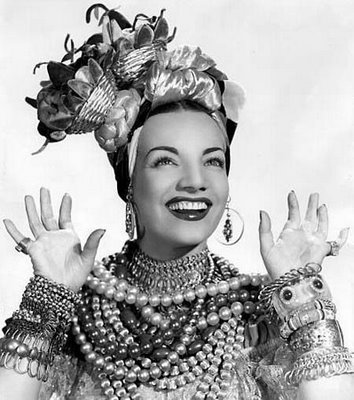
Maria do Carmo Miranda da Cunha was born February 9, 1909, in Marco de Canavazes, Portugal, not in Brazil, as is often assumed.  A year later, though, she did arrive in Rio de Janeiro, where her father opened a lucrative wholesale fruit  business, selling bananas of course.

One wouldn’t think a young girl could soak up much rhythm and culture from the good sisters of the  convent of Santa Teresinha, but by 17 she was singing in the cafes of Rio.  In 1929, using her mother’s surname to keep her career hidden from her disapproving father, Maria do Carmo made her first appearance as Carmen Miranda.  She was tiny in stature, standing only 5’1.”.  Nevertheless, she filled a stage with her Latin energy and machine gun delivery, melodic Brazilian bullets ricocheting everywhere.

She worked her way into singing on Brazilian radio and in movies.  She made her first recording, a romantic choro on one side, but oh on the other side —  a lively samba.

The samba was a lusty part of the social life of the people who lived in the hills beyond the urban refinement of Rio and its European influences.  Its rhythms were African, at once rustic and cosmopolitan, erotic and refined, measured and languorous.  And during the following years, she became the Queen of Samba (or Smiling Dictator of Samba according to one radio announcer).  Her crown an imposing tower of fruit.

She and her samba stormed the United States in 1939 – nightclubs, radio, and throughout the 40s and eary 50s, a string of movies – Down Argentine Way, That Night in Rio, Weekend in Havana, and the over-the-top Busby Berkeley musical The Gang’s All Here in which she sang “The Girl in the Tutti-Frutti Hat.” At age 36, with a salary of over $200,000, she was the highest paid woman in the nation, ninth on the Treasury Department’s salary list, ahead of Betty Grable, Bing Crosby, Bob Hope and Humphrey Bogart.

In 1955, it all ended.  After filming an appearance on the Jimmy Durante television show, at 46 years of age, she died of a heart attack.

Mama Eu Quero

An excerpt from the short story, one of 15 in Calypso, Stories of the Caribbean

The Tropicana was a frenzied, pulsating place, as animated as the tourists and Havana socialites who crowded the casino, bar, dance floor and every table, there to be entertained by a half dozen celebrities, three full orchestras and the Tropicana’s own ballet troupe. It had not been easy for Jorge to secure a table, and when he did, it was some distance from where Carmen Miranda would shortly perform. He liked the table just fine, not wanting to be conspicuous in such a place. Delia wished they were closer but couldn’t say anything, and just being here was the high point in her sixteen years plus four months. She looked as mature as any seventeen-year-old in the place, sipping the wine Jorge had bought her and wearing another bright outfit that Carmen herself might have worn, but without the tutti frutti hat, of course, for that would be presumptuous.
Miranda’s Boys broke into a spirited overture, and suddenly there was Carmen Miranda herself, bouncing to the beat of “South American Way.” Jorge turned to see the look on Delia’s face, but there was no look on Delia’s face because there was no Delia. He scanned the floor, fearing she had fainted in her excitement. Nothing. Then he spotted her, crawling on hands and knees between the tables, toward the stage. He closed his eyes afraid to watch but finally had to look again. He spotted her as she squeezed unnoticed between the chairs occupied by the sleek black-haired man and his sleek black-haired companion, disappearing under the table next to where Carmen Miranda sang and danced.


February 5, 1861: Every Peeping Tom, Dick and Harry

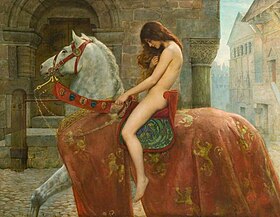
A lady rode through the streets of London on horseback, naked (the lady not the horse), and didn’t get pinched (in the law and order sense, that is).  But more of that later.

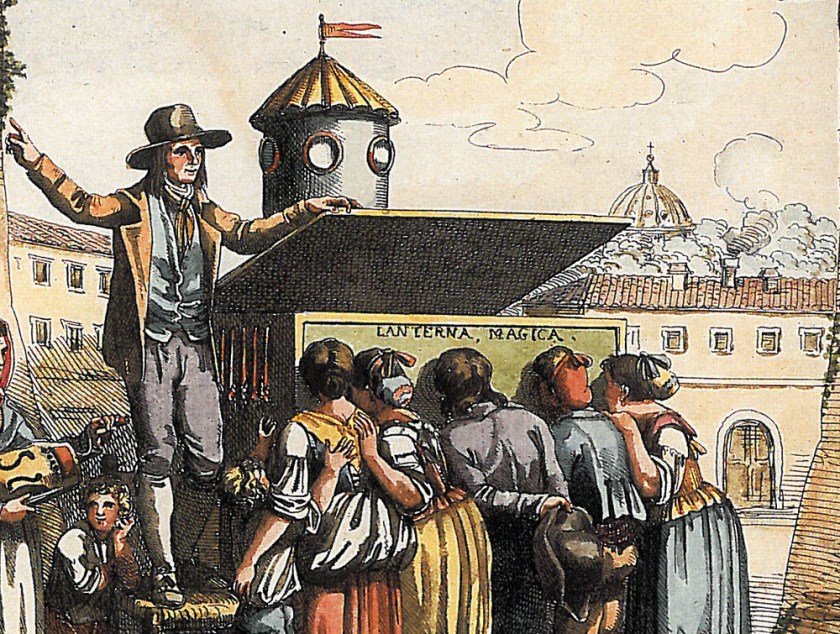
In 1861, Samuel B. Goodale who hailed from Cincinnati received a patent for a clever hand-operated stereoscope device on which still pictures were attached like spokes to an axis which revolved, causing the pictures to come to life in motion — a mechanical peep show that folks viewed through a small hole for a penny a pop.  The usual subjects for peep shows were animals, landscapes,  and theatrical scenes, high-minded, proper subjects.  Nothing naughty or titillating.  How long could that last, you ask.  Not long of course. The peep show quickly came to stand for pictures and performances involving sex.

The term peep show itself comes from Peeping Tom, a sneaky British tailor who made a hole in the shutters of his shop so he might surreptitiously spy on Lady Godiva who felt the need to ride naked naked through the streets of the city.  He was struck blind for his effort.

Collier, John; Godiva; Herbert Art Gallery & Museum

What about this Lady Godiva?  Was she for real?  Yes kids, she was.  And the performance she is famous for took place back in the 11th century.  According to her press agent, Lady Godiva was not just your ordinary exhibitionist giving the folks of Coventry, particularly the Toms, Dicks and Harrys of Coventry, their daily eyeful.  She was a noblewoman, married to the “Grim” Earl of Mercia, a nasty fellow who burdened the folks under his sway with high taxes and poor service.  Lady Godiva pleaded frequently with her husband to give the poor some relief, to no avail.  He eventually agreed to lower the taxes if she would ride through town completely naked. The Lady called his bluff.  To keep her ride from becoming something of the magnitude of a Taylor Swift concert,  the townspeople were told to shutter themselves indoors with no peeping.  Which they did, except for you know who.  In a later interview, Blind Tom said it was worth it.

That Ain’t No Cat in the Hat

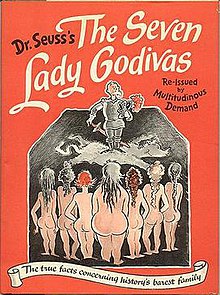
“It was all full of naked women, and I can’t draw convincing naked women.  I put their knees in the wrong places.”  What’s better than a Lady Godiva?  Two Lady Godivas.  Or how about seven?  The story of the seven Godiva sisters was penned by none other than Dr. Seuss, his fourth book and one written for adults or “obsolete children” as he called them.  The seven sisters never wear clothing, not even when they leave the seven Peeping brothers, and head off in the world to warn of the dangers of horses.

The 1939 book had a 10,000 print run with most of them remaining unsold, what Seuss called his greatest failure.  It is one of only two Dr. Seuss books allowed to go out of print.

But Please Lose That Sports Jacket

It has been endlessly debated when and with whom rock and roll actually began, but most enthusiasts have pretty much settled on a guy who cut an unlikely figure for a rock artist but who brought rock and roll into the public eye with a bang in 1955. The man was Bill Haley, along with his Comets, and the song was “Rock Around the Clock” introduced in the film Blackboard Jungle. During the next few years a string of hits including “Shake, Rattle and Roll” and “See Ya Later, Alligator” followed.

Time passes quickly and when you’re at the pinnacle of musical stardom, you’re on a slippery slope. Along comes a guy named Elvis and you’re yesterday’s sha-na-na. Who’s going to scream and carry on for a thin-haired, paunchy 30-year-old musician with a silly curl in the middle of his forehead and a garish plaid sports jacket?

The Brits, that’s who.

By 1957, Bill Haley and the Comets had already enjoyed their golden days of American super-stardom. But the battle of Britain lay ahead. When they stepped off the Queen Elizabeth in Southampton on February 5, they began the first ever tour by an American rock and roll act and launched what rock historians called the American Invasion.

When Haley and the band reached London later that same day, they were greeted by thousands in a melee the press called “the Second Battle of Waterloo.” These were the British war babies just becoming teenagers, and they were ready for American rock and roll.

February 3, 1882: You’re a Big One, Aren’t Ya

A rather large sales transaction took place on February 3, 1882: Flamboyant showman and circus entrepreneur P.T. Barnum purchased his largest performer, a single-named star who stood ten feet at the shoulders, Jumbo. Jumbo of course was an elephant, a very big elephant. He was born in the Sudan and took a rather circuitous journey north to Germany, France and finally England and the London Zoo, where he resided for 17 years, becoming famous for giving rides to zoo visitors.

Londoners were not happy about the sale. The Zoological Society was up in arms. 100,000 schoolchildren petitioned Queen Victoria to halt the sale. A lawsuit was filed against the zoo. The zoo attempted to renege on the sale, but the court sided with Barnum.

The deal was a bonanza for Barnum. He exhibited Jumbo to huge crowds at Madison Square Garden, recovering the entire cost of his investment in three weeks. With Jumbo as its main attraction, the circus earned $1.75 million for the season.

Jumbo’s circus career would be short-lived, however. In 1885, he was struck by a train and died within minutes.

What’s in a Name

While jumbo as an adjective is used today to describe everything from CDs to shrimp, the word did not have that meaning when the London zookeeper association gave it to the big fellow. Its derivation could be Indian from jambu (pronouced jumboo) a tree that grows on a mythical island whose fruits were said to be as big as elephants or Swahili from jambo (hello) or jumbe (chief). It is safe to say it has no relation to jambalaya or gumbo.

Never Forget Elephants

Although Jumbo is arguably the most famous elephant, there are many, many others who might be in the running — circus elephants, movie elephants, rescue elephants, war elephants, zoo elephants, pet elephants (Charlemagne, Pope Leo X and Henry III all had one), gift elephants (Ronald Reagan and Jimmy Carter both received one),  and very naughty elephants.  Here’s a portrait gallery from which you may choose your own favorites.

From the top: Tusko (world’s meanest elephant), Babar, Thomas Nast’s GOP, Horton, Dumbo.

He-e-e-y Abbott

Radio’s Kate Smith Hour was a mainstay during the 30s and 40s. On February 3, 1938, the comedy duo of Bud Abbott and Lou Costello made their first radio outing on the program and became regular performers. They first performed their classic “Who’s on First?” the following month.

abbott-costelloThe former vaudevillians quickly became major stars in radio, followed by movies and television. They left the Kate Smith show after two years to star in their own radio program, as well as a Broadway revue, The Streets of Paris, and their first film, One Night in the Tropics, in which, although cast in supporting roles, they stole the show with several classic comedy routines and cemented their film careers.

Universal Pictures signed them to a long-term contract. Their second film, Buck Privates, made them box-office stars and in the process saved Universal from bankruptcy. In most of their films, the plot was not much more than a framework that allowed them to reintroduce comedy routines they had first performed on stage. Universal also added glitzy production numbers to capitalize on the popularity of musical films, featuring such performers as the Andrews Sisters, Ella Fitzgerald, Martha Raye, Dick Powell and Ted Lewis and his Orchestra. The Andrews Sisters hits “Boogie Woogie Bugle Boy” and “I’ll Be With You In Apple Blossom Time” were both introduced in Buck Privates.

During the following years, Abbott and Costello “met” many other movie legends – Frankenstein, Dracula, the Wolf Man, the Invisible Man, Captain Kidd, Dr. Jekyll and Mr. Hyde, the Mummy, the Killer (Boris Karloff).  And they traveled throughout the world (and beyond): in a Harem, in the Foreign Legion, Lost in Alaska, Mexican Hayride, Mars, and Africa Screams, which featured both Clyde Beatty and Frank Buck as themselves. They made a total of 36 films.

On television, they frequently hosted the Colgate Comedy Hour and had their own syndicated television program.


They dissolved their partnership in 1957, with Lou making sporadic appearances until his death in 1959.  Bud died in 1974.

January 26, 1893: And Doubleday Created Baseball

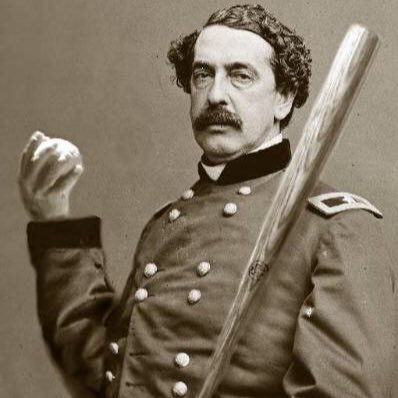
Abner Doubleday fired the first shot in the American Civil War, devised the San Francisco cable car railway, and posthumously invented the game of baseball. That’s our story and we’re sticking to it.

A brouhaha in the late 19th century on the origin of the game of baseball pitted the American faction supporting Doubleday as the true father of baseball against a British faction claiming the concept was stolen from the Brit game of rounders. Baseball fans on both sides got quite worked up. Doubleday was mum on the subject (he had been dead since January 26, 1893).

For the Americans, it was spelled out in a 1905 headline in the Beacon Journal, “Abner Doubleday Invented Base Ball.” Can’t be much more definitive than that. “Fake News,” cried the Brits. In 1908, an American commission declared Abner Doubleday to be the one true inventor of baseball (If the U.S. Post office believes this man to be Santa . . .). Doubleday could not be reached for comment.

Part of the proof offered up as evidence was a letter written by a fellow officer stating that he had seen Doubleday sketch a diagram of a baseball field way back in 1839. The diagram featured four bases and batters who attempted to bat tosses tossed by a tosser standing in a six-foot ring. Base players stood on each base. Who was on first, What was on second, I Don’t Know was on third.

And God Created Woman

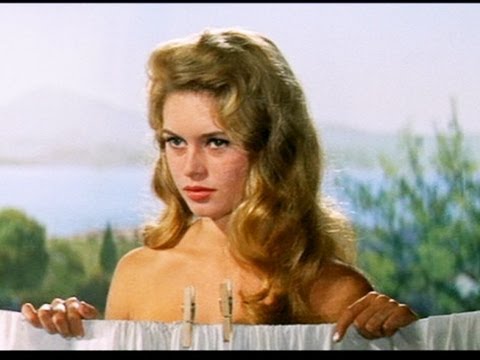
Born on January 26, 1928, Roger Vadim was a French director of lavish erotic films — most notably And God Created Woman, featuring his young bride, Brigitte Bardot, in the nude; Les Liaisons Dangereuses, featuring his young bride, Annette Stroyberg, in the nude; and Barbarella, featuring his young bride, Jane Fonda, in the nude.  All of which explains why we didn’t include a picture of Vadim.