AUGUST 15, 1935: WILL POWER

Cowboy, vaudeville performer, humorist, social commentator and motion picture actor, Will Rogers was one of the world’s best-known celebrities in the 1920s and 1930s and adored by the Will-Rogers-StampAmerican people. Known as “Oklahoma’s Favorite Son,” Rogers was born in 1879 to a prominent Cherokee Nation family in Indian Territory (now part of Oklahoma). During his amazing career, he traveled around the world three times, wrote more than 4,000 nationally-syndicated newspaper columns, and starred in 71 movies (a majority of them silent ) and several Broadway productions. He was the top-paid Hollywood movie star at the time, and in 1934, was voted the most popular male actor in Hollywood.

     As a radio broadcaster and political commentator, he was the leading political wit of the Progressive Era.  He called politics “the best show in the world” and described Congress as the “national joke factory.”

     Rogers died on August 15, 1935, with aviator Wiley Post, when their small airplane crashed in Alaska.

Never miss a good chance to shut up.


wr


There are three kinds of men. The one that learns by reading. The few who learn by observation. The rest of them have to pee on the electric fence for themselves.


We can’t all be heroes because somebody has to sit on the curb and clap as they go by.


When I die, I want to die like my grandfather who died peacefully in his sleep. Not screaming like all the passengers in his car.


Will-Rogers-Quotes-1


Ten men in our country could buy the whole world and ten million can’t buy enough to eat.


The best way to make a fire with two sticks is to make sure one of them is a match.

JULY 26, 1921: EXCELSIOR, YOU FATHEADS

To many of those who have even heard of Jean Shepherd, he is the voice of the grown-up Ralphie Parker whose childhood struggle to score an Official Red Ryder 200-Shot Range Model Air Rifle for Christmas is the subject of the holiday classic A Christmas Story. The film is based on Shepherd’s stories about growing up in Indiana.

Born July 26, 1921, Shepherd was an American raconteur, radio and TV personality, writer and actor. After several radio gigs, he settled in at WOR radio New York City in 1956 with an overnight slot on which he delighted fans by telling stories, reading poetry, and organizing listener stunts. The most famous of his stunts was the creation of a book, I, Libertine, by an 18th century author. Shepherd suggested that his listeners visit bookstores and ask for a copy of it, which led to booksellers attempting to purchase the book from their distributors.  Fans of the show also planted references to the book and author so widely that demand for the book led to its being listed on The New York Times Best Seller list even though it hadn’t been written.  Shepherd’s radio stories found their way into magazines and were later collected in the books In God We Trust, All Others Pay Cash; Wanda Hickey’s Night of Golden Memories and Other Disasters; The Ferrari in the Bedroom; and A Fistful of Fig Newtons.


“What the hell time is it?” muttered the old man. He was always an aggressive sleeper. Sleep was one of the things he did best, and he loved it. Some look upon sleep as an unfortunate necessary interruption of life; but there are others who hold that sleep is life, or at least one of the more fulfilling aspects of it, like eating or sex. Any time my old man’s sleep was interrupted, he became truly dangerous.”Wanda Hickey’s Night of Golden Memories: And Other Disasters


From A Christmas Story:

I had woven a tapestry of obscenity that as far as I know is still hanging in space over Lake Michigan.

Only I didn’t say “Fudge.” I said THE word, the big one, the queen-mother of dirty words, the “F-dash-dash-dash” word!

Now, I had heard that word at least ten times a day from my old man. He worked in profanity the way other artists might work in oils or clay. It was his true medium; a master.

And of course:  You’ll shoot your eye out, kid.

JUNE 11, 1939: Mustard, Your Majesty?

‘On behalf of the United States of America, may we offer you this tubular delight of meat, meat byproducts, curing agents and spices?’”

On June 11, 1939, on a royal visit to the United States, King George VI and Queen Elizabeth (II’s mum) joined President Roosevelt and others at his Hyde Park residence for a picnic.  There, the British monarch experienced his first ever hot dog — and his second ever hot dog, along with a beer.  It was a far cry from a typical state dinner.  No reporters, no photgraphers, no politicos.  The guest list included relatives, friends and neighbors of the Roosevelts, as well as employees and their children.

“King Tries Hot Dog and Asks For More” read the headline in The New York Times the following day, including that imagined dinner proclamation.

Werewolf? There Wolf

Actor, comedian, director, screenwriter, author and activist Gene Wilder was born on June 11, 1933.  After his first film role playing a hostage in Bonnie and Clyde, he went on to star in such memorable films as Willy Wonka & the Chocolate Factory, The Producers, Young Frankenstein and Blazing Saddles.

wilderInvention, my dear friends, is 93% perspiration, 6% electricity, 4% evaporation, and 2% butterscotch ripple.” — Willy Wonka in Willy Wonka & the Chocolate Factory

“The clue obviously lies in the word “cheddar.” Let’s see now. Seven letters. Rearranged, they come to, let me see: “Rachedd.” “Dechdar.” “Drechad.” “Chaderd” – hello, chaderd! Unless I’m very much mistaken, chaderd is the Egyptian word meaning “to eat fat.” Now we’re getting somewhere!” Sigerson Holmes in The Adventures of Sherlock Holmes Smarter Brother


“You’ve got to remember that these are just simple farmers. They’re people of the land. The common clay of the New West. You know – morons.”The Waco Kid in Blazing Saddles


wild1

“This is a nice boy. This is a good boy. This is a mother’s angel. And I want the world to know once and for all, and without any shame, that we love him. I’m going to teach you. I’m going to show you how to walk, how to speak, how to move, how to think. Together, you and I are going to make the greatest single contribution to science since the creation of fire.” – Dr. Frankenstein in Young Frankenstein


wilder2

I’m in pain and I’m wet and I’m still hysterical! – Leo Bloom in The Producers

JUNE 6, 1971: THE SHEW MUST GO ON

Ed Sullivan was to the golden age of television what Google is to searching.  He ruled Sunday night TV for 23 years – from 1948 to his very last broadcast on this day in 1971. Sullivan presented acts from the era’s biggest stars to acrobats, dancing bears, puppets, contortionists, you name it.  Ten thousand in all – if they were entertainers, an appearance on the Sullivan show was their holy grail.

Musical performances from rock to opera were a staple of the program. Even its first broadcast, when it was known as Toast of the Town, made music history as Broadway composers Richard Rodgers and Oscar Hammerstein II previewed the score of their upcoming musical, South Pacific. And after that, West Side Story, Cabaret, Man of La Mancha – if it was on Broadway, it was on Sullivan. One of those Broadway musicals, Bye Bye Birdie, was all about making it on the Sullivan show.

Sullivan also chronicled the history of rock and roll from Elvis Presley’s appearance in 1956 through the Supremes, the Beatles, the Rolling Stones, the Doors, the Mamas and the Papas, and on June 6, 1971, the last program, Gladys Knight and the Pips.

When CBS canceled the show, the network let it end with a whimper.  But in the 33 years since cancellation, numerous tribute shows and DVDs have kept Sullivan in the public eye.


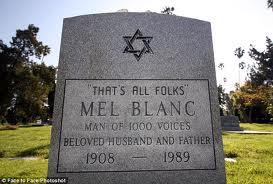
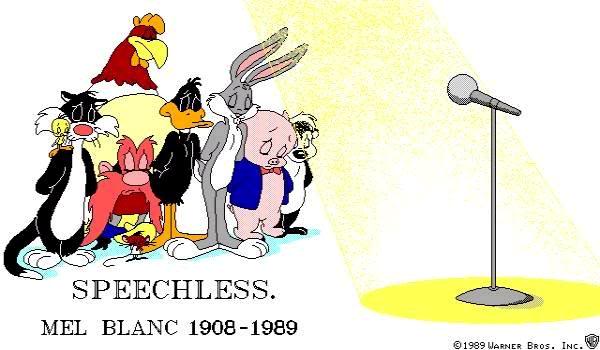
MAY 30, 1908: THAT’S ALL FOLKS

Although Mel Blanc, “the Man of a Thousand Voices,” is most often remembered as the voice of Bugs Bunny, Porky Pig, Daffy Duck, Woody Woodpecker, Tweety Bird, Sylvester, Yosemite Sam, Speedy Gonzales, Foghorn Leghorn, Pepé Le Pew, the Tasmanian Devil and many of the other characters from theatrical cartoons and Hanna-Barbera’s television cartoons, he had a long career as a comedian and character actor in radio and television. He was born on May 30, 1908, and died in 1989.

Blanc was a regular on The Jack Benny Program in various roles, and appeared on many other shows (Fibber McGee and Molly, Great Gildersleeve, Abbott and Costello, Burns and Allen), including his own which ran from September 1946 to June 1947. In the Jack Benny radio show he was Carmichael, the irascible polar bear who guarded the comedian’s underground vault; his outspoken parrot; his violin teacher, Monsieur Le Blanc; his Mexican gardener, Sy; and even his Maxwell automobile.

Blanc was easily the most prolific voice actor in the history of the industry and the first to be identified in the ending credits. In his 60-year career, he helped develop nearly 400 characters and provided voices for some 3,000 animated cartoons. During the cartoon heydays of the 1940’s and 50’s, he voiced 90 percent of the Warner Brothers cartoon empire. As movie critic Leonard Maltin said, “It is astounding to realize that Tweety Bird and Yosemite Sam are the same man!”

A gem from The Jack Benny Program:

May 17, 1620: Round and Round She Goes

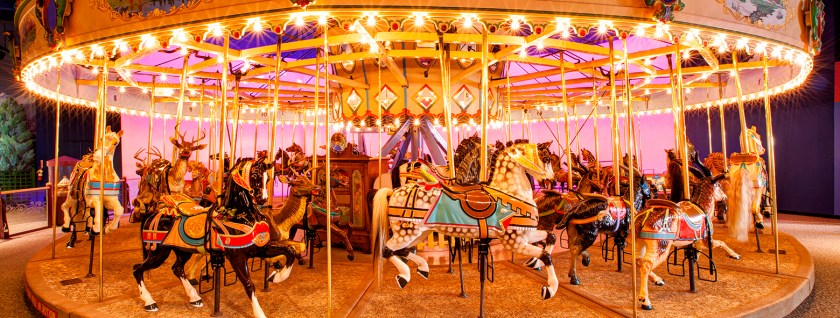
An English traveler happened upon an unusual contraption while passing through what is present-day Bulgaria on May 17, 1620. It was a circular device with seats attached to its perimeter. Children were tethered to the seats and the whole device turned round and round. The Englishman approached the device hoping to save these poor tykes. But as he drew near he heard their squealing and laughter. They were not being punished; they were being entertained. The Englishman’s account of this marvelous contraption is the earliest reference to what ultimately became known as the carousel — or merry go-round to those who disdain the French.

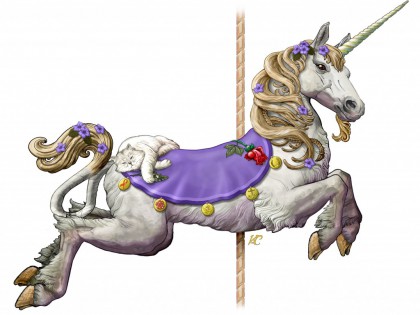
Carousels became popular throughout Europe a century later and in the United States a bit later. These carousels featured carved horses and other fanciful animals — zebras, lions, tigers, unicorns, dragons. At first they were powered by animals or people then eventually by steam engines and finally electricity. Gears and cranks gave the animals their familiar up and down motion.

Today the carousel is mostly favored by those too young or too timid to brave the more heart-pounding rides such as roller coaster, tilt-a-whirl, and loop-the-loop.


Carousels Not Heart-Pounding?

AND KEEP YOUR ELBOWS OFF THE TABLE

As first minister to France’s Louis XIII, Cardinal Richileu was a major player in the politics of the early 17th century, transforming France into a powerful centralized state. On a lesser scale, he was a noted patron of the arts. On an even lesser scale (arguably), he made a singular contribution to the etiquette of French dining, which was at the time anything but refined.

Diners used their hands to move food directly to their mouths or speared pieces of meat with the sharp point of their knives. They even used those same knives to pick their teeth. Having grown weary of these displays of gastronomical unpleasantness, Richileu had an inspiration. On May 17, 1637, he ordered the blades of all the palace dinner knives to be rounded off, thus creating what has become the modern dinner knife.

Talk about a trendsetter. The Richileu dinner knife became le dernier cri, the last word in dining. The craze spread throughout continental Europe, even to England of all places. And the American colonies!

MAY 12, 1812: POETRY WITHOUT NAUGHTY WORDS

Edward Lear, born in England in 1812, was a true dabbler — artist, illustrator, musician, author, poet. Starting off his career as an illustrator, he was employed to illustrate birds and animals first for the Zoological Society and then for Edward Stanley, the Earl of Derby, who had a private menagerie. He also made drawings during his journeys that later illustrated his travel books. and illustrations for the poetry of Alfred Lord Tennyson. As a musician, Lear played the accordion, flute, guitar, and piano (not simultaneously). He also composed music for a number of Romantic and Victorian poems, most notably those of Tennyson.

Lear is remembered chiefly for his work as a writer of literary nonsense. He might easily have been given the title Father of the Limerick for bringing the much maligned form into popularity (without the raunchiness that later found its way into the form). In 1846, he published A Book of Nonsense, a volume of limericks that went through three editions. In 1871 he published Nonsense Songs, Stories, Botany and Alphabets, which included his most famous nonsense song, The Owl and the Pussycat, which he wrote for the children of the Earl of Derby.

Lear’s nonsense books were successful during his lifetime, but he found himself fighting rumors that he was just a pseudonym and that the books were actually written by the Earl of Derby. Conspiracy theorists cited as evidence the facts that both men were named Edward, and that Lear is an anagram of Earl. A few even suggested he was born in Kenya, not England.

The Owl and the Pussy-cat went to sea
In a beautiful pea green boat,
They took some honey, and plenty of money,
Wrapped up in a five pound note.
The Owl looked up to the stars above,
And sang to a small guitar,
‘O lovely Pussy! O Pussy my love,
What a beautiful Pussy you are,
You are,
You are!
What a beautiful Pussy you are!’

Pussy said to the Owl, ‘You elegant fowl!
How charmingly sweet you sing!
O let us be married! too long we have tarried:
But what shall we do for a ring?’
They sailed away, for a year and a day,
To the land where the Bong-tree grows
And there in a wood a Piggy-wig stood
With a ring at the end of his nose,
His nose,
His nose,
With a ring at the end of his nose.

‘Dear pig, are you willing to sell for one shilling
Your ring?’ Said the Piggy, ‘I will.’
So they took it away, and were married next day
By the Turkey who lives on the hill.
They dined on mince, and slices of quince,
Which they ate with a runcible spoon;
And hand in hand, on the edge of the sand,
They danced by the light of the moon,
The moon,
The moon,
They danced by the light of the moon.

Naughty Words Without Poetry

Stand-up comedian, social critic, satirist, actor, writer/author George Carlin was born on May 12, 1937 (died 2008). Noted for his black humor as well as his thoughts on politics, the English language, psychology, religion, and various taboo subjects, he won five Grammy Awards for his comedy albums. Carlin and his classic “Seven Dirty Words” comedy routine were central to the 1978 U.S. Supreme Court case in which the justices affirmed the government’s power to regulate indecent material on the public airwaves.

In his own words:

george

Swimming is not a sport. Swimming is a way to keep from drowning. That’s just common sense!

Honesty may be the best policy, but it’s important to remember that apparently, by elimination, dishonesty is the second-best policy.

george-carlin2

The very existence of flamethrowers proves that sometime, somewhere, someone said to themselves, “You know, I want to set those people over there on fire, but I’m just not close enough to get the job done.”

Religion has convinced people that there’s an invisible man…living in the sky, who watches everything you do every minute of every day. And the invisible man has a list of ten specific things he doesn’t want you to do. And if you do any of these things, he will send you to a special place, of burning and fire and smoke and torture and anguish for you to live forever, and suffer and burn and scream until the end of time. But he loves you. He loves you and he needs money.

MAY 7, 1885: COMIN’ THROUGH THE SCREEN, SHOOTIN’ UP THE LAND

An essential player in Hollywood westerns was the leadinggabby man’s sidekick, and many sidekicks became just as famous as their starring partners: Andy Devine was Jingles to Wild Bill Hickock, Pat Buttram and Smiley Burnette were both sidekicks to Gene Autry, Jay Silverheels was Tonto to the Lone Ranger, Leo Carillo was Pancho to the Cisco Kid. The top sidekick was, of course, Gabby Hayes, born May 7, 1885. Through the 1930s and 1940s, he was sidekick to Hopalong Cassidy in 18 films and to Roy Rogers in 41.

The third of seven children, George Francis Hayes was born in an upstate New York hotel owned by his father. As a young man, he worked in a circus and played semi-pro baseball while a teenager. He ran away from home at 17, and joined a touring stock company.  He married and with his wife enjoyed a successful vaudeville career. Although he had retired in his 40s, he lost money in the 1929 stock market crash, and he felt the need to work again.  He and his wife moved to California, and he began his movie career, taking various roles until finally settling into a Western career.

Hayes first gained fame as Hopalong Cassidy’s sidekick Windy Halliday in many films between 1936-39. He left the Cassidy films in a salary dispute and was legally prevented from using the name “Windy.”   So “Gabby” Hayes was born.  He rode alongside  stars such as John Wayne, Randolph Scott, and, of course, Roy Rogers.

Offstage Hayes was the complete opposite of his screen persona – an elegant bon vivant, man-about-town and connoisseur.  He died in 1969.  On the subject of his movies: “I hate ’em. Really can’t stand ’em. They always are the same. You have so few plots – the stagecoach holdup, the rustlers, the mortgage gag, the mine setting and the retired gunslinger.”

“You’re a good-looking boy: you’ve big, broad shoulders. But he’s a man. And it takes more than big, broad shoulders to make a man.” — High Noon

“There are only two things that are better than a gun: a Swiss watch and a woman from anywhere. Ever had a good… Swiss watch?” — Red River

“A gun is a tool, Marian; no better or no worse than any other tool: an ax, a shovel or anything. A gun is as good or as bad as the man using it. Remember that.” –Shane

“You don’t look like the noble defender of poor defenseless widows. But then again, I don’t look like a poor defenseless widow.” –Once Upon a Time in the West

MAY 2, 1843: THE LITTLE TOWN THAT CRIED WOLF

     Chances are you’ve never heard of Champoeg — unless maybe you’re from Oregon which is where it is, or was. Champoeg had the historical significance of being the first American government on the West Coast, having been established by representatives of Willamette Valley settlers on May 2, 1843, by a vote of 52-50. These representatives had held a series of meetings starting back in February to entertain measures to deal with the threat of wolves. During these so-called “Wolf Meetings,” the conferees established a series of civil codes (although its doubtful the wolves paid much attention to them).

     When the Oregon Territory was created in 1848, Champoeg was cold-shouldered as upstart Oregon City became its capital. This despite the fact that Champoeg had become rather a bustling little metropolis with a steamboat landing, a ferry across the Willamette River, a stagecoach office, a granary and a warehouse. Ten streets ran north to south, crossed by six east-west thoroughfares.

     Champoeg chugged along through the years as Oregon grew and gained statehood. Then in 1861, the Willamette River reared its ugly head, rising 55 feet above its normal stage, flooding the town and destroying every structure in it with the exception of two saloons (there’s a lesson here somewhere). Champoeg was never rebuilt after the flood; all that remains is a small monument describing its place in history and a stake marking a street corner (probably the one where a saloon stood).

“Well!”

     Although he was first heard on radio as a guest of Ed Sullivan, Jack Benny debuted his own radio show for NBC on May 2, 1932. After six months he moved to CBS and then in 1933 back to NBC. Although he continued to jump back and forth on networks, his radio program lasted until 1955, some five years after his television program appeared.

     Benny was a fixture on radio and TV for three decades, and is still considered one of the best. He was a master of comic timing, creating laughter with pregnant pauses or a single expression, such as his signature “Well!

     Appearing with him over the years were Eddie “Rochester” Anderson, Don Wilson, Dennis Day, Mary Livingston, Phil Harris, Mel Blanc and Sheldon Leonard. Leonard helped Benny produce what was said to be the longest laugh in radio history. Leonard as a holdup man approached Benny and demanded “your money or your life.” Benny remained silent. Finally, Leonard said “Well!?” and Benny answered “I’m thinking it over!”

APRIL 16, 1850: CALL ME MADAME

Madame (Marie) Tussaud is arguably the world’s most famous wax sculptor. Born in France in 1761, she began her artistic career during the French Revolution, searching through corpses to find the heads of noted guillotine victims from which she made death masks. She herself was imprisoned for three months awaiting execution, but an influential friend intervened and she was released. She and her waxwork friends toured throughout Europe for 33 years before settling into a permanent exhibition in 1835 on Baker Street in London. There she gained prosperity and fame, managing her wax museum until her death on April 16, 1850.
Throughout Madame Tussaud’s long existence, its most popular feature has been the Chamber of Horrors (as pictured here).

Where’s the Remote?

Inventor Walter Pichler is the genius behind the amazing TV helmet of 1967. This device allows a user to leave the outside world and slip into his or her own little world of information and entertainment. The user simply inserts his or her head into a capsule that resembles a small submarine and hopes that he or she doesn’t bump into something while enjoying the “virtual world” of Gilligan’s Island.

Pearl Among . . .

minnie

“How-w-w-Dee-e-e-e! I’m jes’ so proud to be here!” “Here” might have been the National Comedy Hall of Fame into which, on April 16, 1994, Minnie Pearl became the first woman inducted. But more often it was on the stage of the Grand Ole Opry in Nashville, Tennessee, where Minnie held sway as the resident Southern hillbilly for over 50 years.

Her comedy was a good-natured satire of rural Southern culture. She appeared in her trademark hat, purchased at the Surasky Bros. Department Store in Aiken, South Carolina, for $1.98 before her first stage performance in 1939, along with styleless “down home” dresses.  Her self-deprecating humor was usually about her unsuccessful attempts to get “a feller” and her ne’er-do-well relatives. She also sang novelty songs and danced with Grandpa Jones. From the opening How-w-w Dee-e-e-e to her closing “I love you so much it hurts!”, she had the Opry audience in the palm of her hand.

The Little Tramp

Sir Charles Spencer Chaplin, known to millions of film buffs as “Charlie,” was born April 16, 1889.  His working life in entertainment began as a child performer in British music halls and spanned 75 years until his death in 1977 at the age of 88.   In the United States, he became one of the most important creative personalities of the silent-film era — acting in, directing, scripting, producing and composing the music for his own films.