SEPTEMBER 22, 1761: GEORGE, THE SEQUEL

With the usual pomp and circumstance, the marriage and coronation of King George III of England and Charlotte Sophia of Mecklenburg-Strelitz took place on September 22, 1761. The couple were married on the day they met, but remained married for 50 years and 15 children.  George was a notable monarch for several reasons, the most familiar being the loss of the American colonies and his supposed madness. Although many people see a link between the two, it’s a stretch. He was also the longest reigning monarch at 60 years until the reign of his granddaughter Queen Victoria.

George didn’t really lose the American colonies any more than George Washington found them. But independence “happened on his watch” a phrase Americans in the future would delight in applying to practically anything gone wrong. Also on his watch, Great Britain defeated the French in the Seven Year’s War and once again many years later the French under Napoleon at the Battle of Waterloo.

In his later life, George III had recurrent, and eventually permanent, mental illness. Finally in 1810, a regency was established, and George III’s oldest son, George (coincidentally), ruled as Prince Regent. On III’s death, George Jr. succeeded his father as George IV.

The subject of George III’s mental illness was explored in the play The Madness of George III which inspired the movie The Madness of King George. The name change was supposedly for other reasons, but some maintain that it was because American audiences would think The Madness of George III was a sequel and wonder what happened to the first two movies.

O Mighty Caesar

“He is blessed with a kind of magic truth, the uncanny ability to project the core and humanity of the character he is playing. Beneath the surface humor there is a wry commentary on the conventions and hypocrisies of life.”  Sid Caesar was born on September 22, 1922. He lit up 50s television with his incomparable humor on Your Show of Shows and Caesar’s Hour as well as many movies during his long career.

SEPTEMBER 11, 1680: THE UNFORTUNATE ROGER CRAB

Seventeenth century England was not without its share of eccentrics, folks who were not the sharpest arrows in the quiver. Roger Crab may certainly be categorized as one of them, although his misfortune at having his skull split open while serving in the Parliamentary Army might provide some excuse for his eccentricity. The unfortunate Crab was sentenced to death after the incident (for having his skull in the wrong place at the wrong time?), but his sentence was later commuted and, upon his release, he became a haberdasher of hats.

His wandering mind somehow happened upon the idea that it was sinful to eat any kind of animal food or to drink anything stronger than water. Determined to pursue a biblical way of life, Crab sold all his hats and other belongings, distributing the proceeds among the poor. He then took up residence in a makeshift hut, where he lived on a diet of bran, leaves and grass (the 16th century equivalent of a kale and edamame diet), and began to produce pamphlets on the wonders of diet.

“Instead of strong drinks and wines,” he wrote, “I give the old man (referring to his body) a cup of water; and instead of roast mutton and rabbit, and other dainty dishes, I give him broth thickened with bran, and pudding made with bran and turnip-leaves chopped together.”

mad-hatterJust as Crab persecuted his own body, others began to persecute him. He was cudgeled and put in the stocks. He was stripped and whipped. Four times he was arrested on suspicion of being a wizard. He bounced from prison to prison until his death on September 11, 1680.  Fortunately, our modern society treats its vegetarian eccentrics much more humanely.

Some scholars believe Crab was the inspiration for Lewis Carroll’s Mad Hatter.

Curb Your Carnal Enthusiasm

Sylvester Graham was ordained as a Presbyterian minister in 1826. The Reverend Graham was not your run of the mill minister. He waged a lifelong crusade against alcohol, lust, and white bread.

His disdain of alcohol was inspired by the temperance movement. white breadWhile he accepted the premise that alcohol had useful medicinal qualities, he felt that social drinking was a social danger that could lead to other social activities — namely lust. An unhealthy diet (Graham was also a vegetarian) led to wanton carnal desire, which led to poor health, which led to disease (with a capital D that rhymes with P which stands for you know what).

As one might guess, Graham, like poor Roger Crab, was ridiculed by the media and the public at large (though never cudgeled). He might have been written off as just another crackpot zealot and soon forgotten had it not been for his campaign against white bread. White bread was a bit of a status symbol at the time. Its paleness and the fact that it was purchased rather than homemade separated sophisticates from those bumpkins who made their own dark bread.

Graham thought the use of chemical additives such as alum and chlorine somehow made white bread less than wholesome. Nutritionists tended to agree with him. The whiter the bread, the sooner you’re dead, became their battle cry. Graham went on to create a healthier flour, a healthier bread and — you’ve been waiting for this — the graham cracker.

Sylvester Graham died on September 11, 1851. He probably would not have approved of s’mores.

How To Make S’mores

You’ll need: Wood, matches, graham crackers, chocolate squares (smaller than the graham cracker and fairly thin), marshmallows, a s'morepointy stick.

1. Start a campfire.

2. Break a graham cracker along it’s perforation to create two perfect squares.

3. Place a chocolate square on one of the graham cracker squares.

4. Place a marshmallow on the pointy stick and hold it over the fire until it is a nice golden brown (unless you like your marshmallows almost black).

5. Carefully slip the marshmallow off the pointy stick and onto the chocolate graham cracker stack.

6. Place the other graham cracker on top of the marshmallow and press down until the marshmallow just starts to ooze out. This may require some practice.

7. Cleanse your palette with the alcoholic beverage of your choice.

8. Eat the S’more.

9. Cleanse your palette again.

SEPTEMBER 9, 1754: ET TU, FLETCHER?

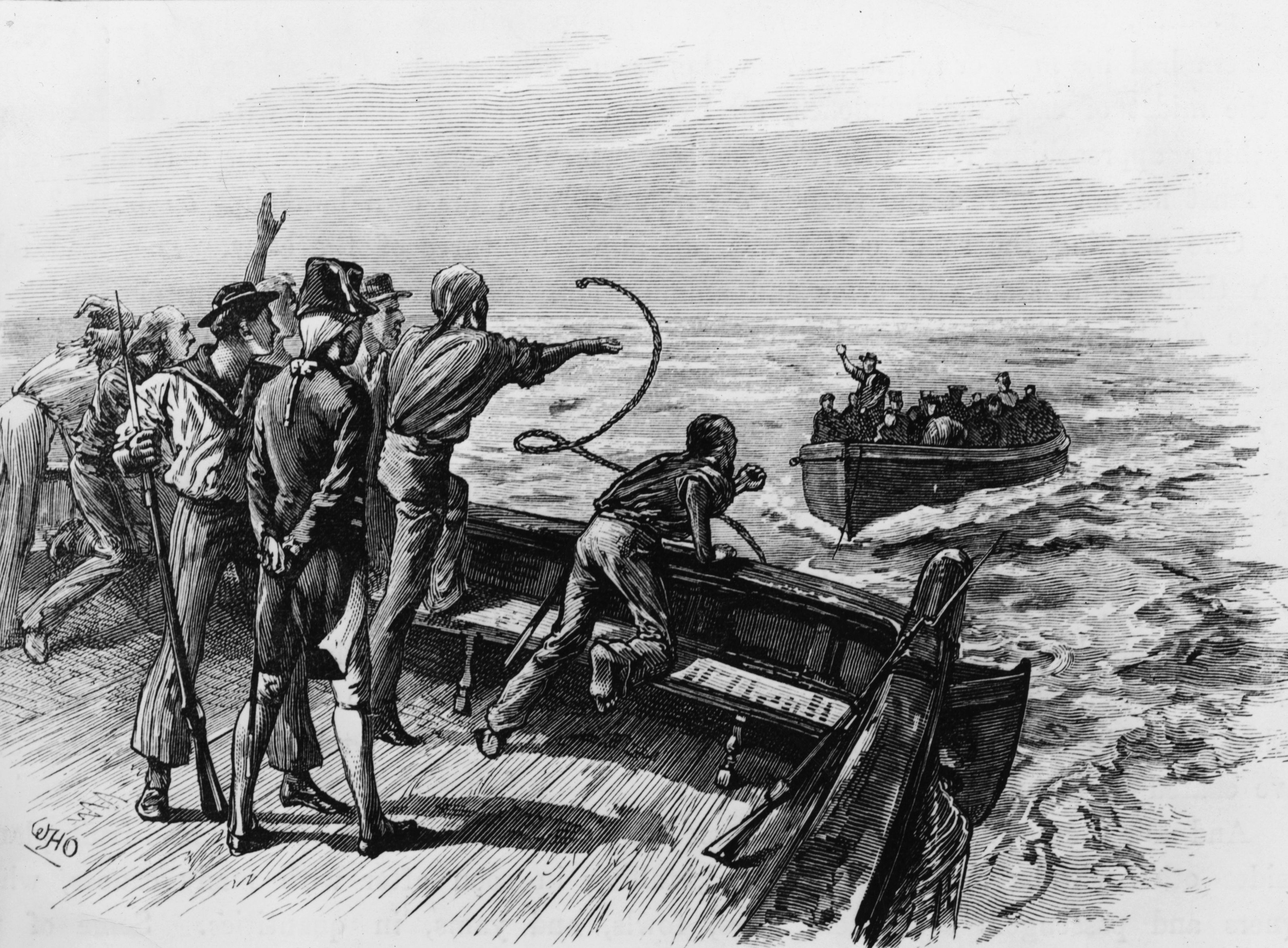
When little Billy Bligh, born on September 9, 1754, joined the British Royal Navy at the tcirca 1817: English naval officer and victim of the celebrated mutiny on the bounty William Bligh (1754 - 1817) is cast adrift. (Photo by Hulton Archive/Getty Images)ender age of seven, he certainly never thought he’d grow up to haul breadfruit around the world. At sixteen, he became an able seaman, then a year later a midshipman. And in 1787, Bligh became Captain of the Bounty.

The Royal Society was offering special prizes to those who would travel to Tahiti, pick up a bunch of breadfruit trees and haul them back to the Caribbean as a source of cheap high-energy food for slaves. It sounded simple enough on paper, but getting there was far from half the fun. First, there was Cape Horn. The Bounty tried to get round it for a month before giving up and taking a longer route. Then Bligh and his crew had to sit around in the tropical sunshine for five months waiting for the little breadfruit babies to get big enough to travel. And when finally they set off for the Caribbean, didn’t Fletcher Christian and his cohorts, having grown fond of the Tahitian ambiance, up and mutiny.

Bligh and his loyalists were loaded into a launch with nary a breadfruit tree and set adrift. Amazingly, they survived and sailed over 4,000 miles to Timor, from where they returned to England. And two years later Bligh headed another expedition and this time successfully carried a load of trees to the Caribbean. However, the slaves refused to eat the breadfruit, wanting no part of a fruit that tasted like day-old bread.

The Ballad of Breadfruit

Once upon a time, according to Hawaiian legend, Kū , the war god, for reasons known only to Kū, decided to live secretly among the common folk and pass himself off as a mortal. He posed as a farmer and even went so far as to marry and have a family. Kū and his family lived quite happily, but being a war god Kū wasn’t such a hot farmer, and famine struck (as famine will). When everybody got pretty darn hungry,

Ku posing as a farmer

Kū realized it was time to shed his disguise and do some god thing. One would think his action would involve a battle of some kind, his being the god of war and all. Instead he disappeared into the ground right before his astonished family’s eyes. They were quite distressed by this, so they stood around where he had last been seen and cried day and night, thus watering the ground until a tiny green sprout emerged. The tiny sprout grew into a magnificent tree heavy with fruits that looked like big ugly green footballs. After tossing one around for a bit, they wondered if they might eat it since they were starving. They tried it, and it tasted awful. But they ate it anyway, saving themselves from starvation, and always remembering that this tree was their beloved Kū, finally providing for his family.


SEPTEMBER 7, 1978: IT’S NOT THE UMBRELLAS THAT KILL . . .

Mary Poppins used her umbrella to fly. The artist Christo used giant umbrellas to decorate a California mountain pass. The mysterious Agent Piccadilly used his to assassinate Bulgarian dissident writer Georgi Markov in a fantastic Cold War spy drama that took place on September 7, 1978, during a bustling London rush hour.

Markov, who had defected several years earlier, was on his way to work at the BBC. Standing in a crowd of commuters on Waterloo Bridge, he felt a sudden pain in the back of his thigh, something like the sting of a nasty insect. A heavy set man standing nearby stooped to pick up an umbrella from the ground and mumbled “I’m sorry” with a thick foreign accent. The man hurried off and jumped into a taxi.

Markov later discovered a painful red bump on the back of his leg. During the day he became ill and grew steadily worse. That evening he was hospitalized with a high fever, and he died four days later.

The case, which has never been closed, came to be known as the Umbrella Murder. Scotland Yard has long suspected the Bulgarian secret service, perhaps with Russian involvement. The weapon is now called a Bulgarian Umbrella.

In a recent documentary, Markov’s wife said:“I wish, that, when people talk about it in the west, they wouldn’t say ‘Oh the guy, that got stuck by an umbrella’, they’d say ‘oh the great writer’, you know. The writer was so brave, that he risked his life to tell the truth, this would be fantastic.”

RETURN OF THE KILLER UMBRELLAS

Perhaps umbrellas and death don’t go hand in hand, but you wouldn’t want to stand under an umbrella in an open field during a lightning storm.  Those 500-pound umbrellas that the artist Christo stretched across a California mountain pass turned deadly with one breaking loose and killing a woman.  And Mary Poppins had a mean streak as well as a mean umbrella.

Rain1a

MAY 27, 1936: PROUD MARY KEEP ON BURNIN’

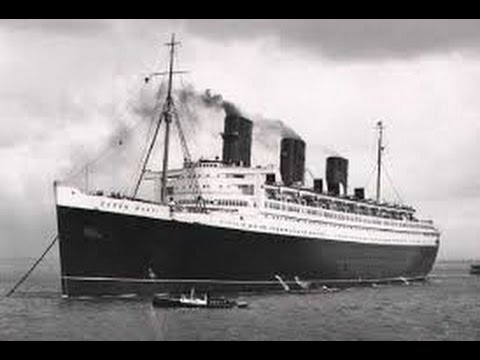
Although, out of superstition, women were banned from the workplace during the construction of the ocean liner Queen Mary, she was christened by a woman in September 1934.  By a queen actually — Queen Mary herself, the wife of George V who had died earlier that year and queen mother to Kings Edward VIII and George VI.

On May 27, 1936, throngs of cheering spectators looked on as the 80,000-ton liner, “the most beautiful ship afloat,” departed Southhampton on her maiden transatlantic crossing.. She carried 2,100 passengers who were pampered by a crew of 1,100. The passengers were as stylish as the ship’s Art Deco interior as they strutted through ballrooms, promenaded on deck, frolicked in the swimming pool, and occasionally visited their children in the nursery or their dogs in the kennel. Along with an amazing amount of food (50,000 pounds of meat), the Queen Mary carried over 14,000 bottles of wine and 25,000 cigarette packs.

The Queen Mary pretty much ruled the Atlantic for the rest of the decade until elegance gave way to utility as she was refitted as a troop ship during World War II. After the war the Queen Mary was returned to passenger service and along with her sister ship the Queen Elizabeth dominated transatlantic travel until 1967 when she left Southhampton on her last voyage arriving in Long Beach, California, where she was permanently moored.

Converted to a hotel, the Queen Mary has the dubious distinction of giving tourists a taste of transatlantic travel without ever leaving dry land. Yippee!

Don’t Stop the Carnival

Pulitzer Prize winner Herman Wouk was born in 1915. His books include The Caine Mutiny, The Winds of War, War and Remembrance, andMarjorie Morningstar.   Don’t Stop the Carnival, a must-read for anyone interested in the Caribbean, was written in 1965. In the following excerpt, Norman and Henny Paperman have embarked on a new Caribbean enterprise and, at a party, they tell their friends about it:

During this evening, nearly every person there told Norman or Henny, usually in a private moment, that they were doing a marvelous, enviable thing. The Russians at the time were firing off new awesome bombs in Siberia, and the mood in New York was jittery, but there was more than that behind the wistfulness of their friends. All these people were at an age when their lives were defined, their hopes circumscribed. Nothing was in prospect but plodding the old tracks until heart disease, cancer, or one of the less predictable trap-doors opened under their feet. To them, the Papermans had broken out of Death Row into green April fields, and in one way or another they all said so.

Wouk died in 2019.

MAY 23, 1701: HERE’S LOOKING AT YOU, KIDD

William “Captain” Kidd was a Scottish sailor who was tried and executed for piracy on May 23, 1701. Some modern historians consider his reputation unjust, suggesting that Kidd acted only as a privateer, not a pirate. A pirate plundered ships; a privateer, under government authorization,  plundered ships belonging to another government. (See the difference?) Pirate or privateer, Kidd was among the most famous of his lot and one of the handful that people today can name – unusual because he was not the most successful nor the most bloodthirsty. Perhaps it’s because he did bury treasure, an important undertaking for any pirate worth his sea salt.

Several English nobles engaged Kidd to attack pirates or French vessels, sharing his earnings for their investment. He had substantial real estate holdings in New York, a wife and children, a membership in an exclusive club.   In short, he was respectable. But, foolish man, he decided to engage in one more privateering mission. Kidd set sail for Madagascar and the Indian Ocean, then a hotbed of pirate activity, but found very few pirate or French vessels to take. About a third of his crew died of diseases, and the rest were getting out of sorts for the lack of plunder. In 1697, he attacked a convoy of Indian treasure ships, an act of piracy not in his charter. Also, about this time, Kidd killed a mutinous gunner named William Moore by hitting him in the head with a heavy wooden bucket, also a no-no.

In 1698, he and his men took an Armenian ship loaded with satins, muslins, gold, and silver. When this news reached England, it confirmed Kidd’s reputation as a pirate, and naval commanders were ordered to “pursue and seize the said Kidd and his accomplices” for acts of piracy.

Pursued, seized, and hanged he was.   After his death, the belief that Kidd had left a large buried treasure contributed considerably to the growth of his legend. This belief made its contributions to literature in Edgar Allan Poe’s “The Gold-Bug”, Washington Irving’s The Devil and Tom Walker, and Robert Louis Stevenson’s Treasure Island. It also gave rise to never-ending treasure hunts in Nova Scotia, Long Island in New York, and islands off Connecticut and in the Bay of Fundy.

Sept 5, 1786: Watch it with that Thing, You’ll Poke Someone’s Eye Out

Jonas Hanway who died on September 5, 1786, was well-know in several British spheres — a vice president of the Foundling Hospital, founder of Magdalen Hospital, revolutionizing London birth registration and in charge of “victuallizing” the Navy. On the other hand, he was also known for tirades against tipping and tea-drinking and his support for the concept of solitary confinement.

But what he is most remembered for is bringing the umbrella to Britain. Now the umbrella had been around for a long time. It was invented in China back in the 11th century B.C. It was popular in Greece and Egypt as a sunshade. It was also used in Rome, but when the empire declined and fell, so did use of the umbrella. It was finally reintroduced in the 15th century, and by the 17th century had become quite popular among sophisticated women in France and even some British women. But a man?

Hanway is credited with being the first male Londoner to carry an umbrella, much to the chagrin of hackney coachmen who thought it their proprietary right to protect Londoners from rainfall. For years, they jeered at him with vigor as being a feminine sissy and even worse, a French sissy. But by the time of his death, umbrellas were commonplace throughout London.

Brolliology is of course the study of umbrellas. Of course. Does anyone actually know a brolliologist? What inspires someone to become one? What are their conventions like? We will study the umbrella a little further on September 7, the date of another noted umbrella in history.

Taxi Dancers and Tango Pirates

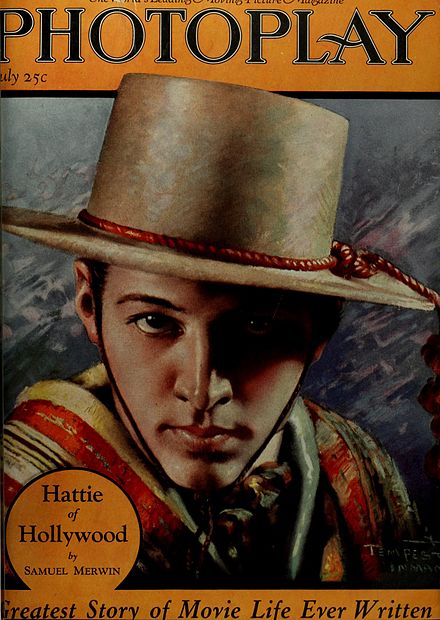
As America roared through the 20s, Hollywood’s fledgling film industry was itself roaring, the screen filled with stars such as Charlie Chaplin, Rudolph_ValentinoDouglas Fairbanks, Greta Garbo, and the roaring MGM lion. Come 1926, a new star would jump to the top of the heap, blazing a trail of sex and seduction. It almost didn’t happen.

Italian born Rodolfo Alfonso Rafaello Pierre Filibert Guglielmi di Valentina D’Antonguolla arrived at Ellis Island in 1913, at the age of 18. The young man who would eventually be known as the Latin Lover Rudolph Valentino took up residence in Central Park and on the streets of New York City. He found work as a taxi dancer (think “ten cents a dance”)at Maxim’s and became a”tango pirate,” a gigolo who sought out wealthy women at dances who were willing to pay for the company of handsome young men.

Valentino developed a relationship with a Chilean heiress who was unhappily married to a wealthy businessman. When she sued for divorce in 1915, Valentino testified that he had evidence of the husband’s having had multiple affairs. The ex-husband didn’t let bygones be bygones and on September 5, 1916, at his instigation, Valentino was arrested and charged with luring a young man into a whorehouse for white slavery. Valentino was jailed for several days before being cleared and released. A short time later the heiress shot her husband, and Valentino thought it wise to exit the scene. He headed to the opposite coast and began his meteoric rise to stardom.


Speaking of Tangoing Pirates

Another devilishly clever segue.

And it only takes one to tango here.

AUGUST 30, 1794: PENNY WISE, POUND FOOLISH

In the late 1800s, many of the unfortunates who found themselves in English prisons were there as a result of debts they could not pay. Benjamin Pope had a different story; he found his way to prison for a debt he could easily have paid. Pope was a tanner and quite successful in his trade, enough so that he gave up tanning and became a money-lender and mortgagee. He proved successful at this endeavor as well, earning the nickname “Plum Pope.”

     Alas, his good fortune began to desert him, in no small part because of his greed. His grasping ways in the lending of money led him afoul of the usury laws, and he was frequently brought before the court. In one particularly blatant case, he was fined £10,000.

Instead of paying the fine, he stole away to France with all his property. There, he complained bitterly to anyone who would listen about the unfairness of the English laws. The French naturally commiserated. Nevertheless, he eventually returned to England, but still refused to pay the fine. He went to prison instead. At one point, he could have secured his release by paying just £1000 of the £10,000 fine. Not Plum Pope.

     While in prison, he carried on his avocation as a money lender, albeit on a more limited and cautious scale. While always a penny-pincher, he became more so and more eccentric about it. He would drink beer with anyone who would give it to him, but would never buy it. He would not eat meat unless it was given to him. He chewed his gum twice. When he died on August 30, 1794, after 12 years in prison, he still owed the debt that had sent him there, even though he left behind more than enough to pay it.

Any man who would walk five miles through the snow, barefoot, just to return a library book so he could save three cents — that’s my kind of guy. — Jack Benny

AUGUST 29, 1769: WICKED WITCH OF THE WHIST

In 1769 London, a gentleman died at the ripe old age of 97. Although little is known about the gentleman himself, his name has traveled down through the years and is more familiar to us today than to those who might have rubbed elbows with the man back in the eighteenth century. His name was Edmond Hoyle, and although he was a barrister by trade, he is now known for law only as it applies to games of chance. And he is much more recognized by his nickname ‘According to.”

     Hoyle laid down the law for the game of Whist in a widely circulated treatise on the subject. He also had a great deal to say about backgammon, quadrille, piquet, and chess. He was, we might surmise, one of those wet blankets who must rain on card-game parades (to jumble metaphors, about which Hoyle had nothing to say) with their whining “but the rules say” or “according to Hoyle.”

     But Whist was his long suit. This venerable game provides ample material on which to pontificate, and pontificate Hoyle did. A forerunner of Bridge, Whist is all about taking tricks. Who takes them, and when and how and why gives the game a wide variety of flavors from which to choose. There’s Knockout Whist, a game in which a player who wins no trick is eliminated, sent to stand in a corner; Solo Whist, a game where individuals can bid to win 5, 9 or 13 tricks or to lose every trick; Kleurenwiezen, an elaborate Belgian version of the game, filled with Gallic mischief; Minnesota Whist, played to win tricks or to lose tricks (talk about flexibility); Romanian Whist, a game in which players try to predict the exact number of tricks they will take; German Whist for two very aggressive players who take tricks from Poland without prior warning; Bid Whist in which players bid to determine trump and one player is a dummy who sits out the hand; and Danish Whist, in which the dummy brings pastries to the other players.  But England lays claim to most of the true Whist players. It is easy to imagine a group of eighteenth century British aristocrats at their club. “Shall we have a go at a spot of Whist?” “Capital idea.” “Jolly.” “According to Hoyle . . .”


AUGUST 24, 1850: MEET ME AT THE FAIR

London’s Bartholomew Fair, a wild celebration on the eponymous saint’s anniversary, died not with bartha bang but a whimper after enduring for more than seven centuries, Although originally established for legitimate business purposes, the fair had become all eating, drinking and amusement (for shame!) and a bit of a public nuisance with rowdiness and mischief.

Serious pursuits, uplifting exhibits, and dramatic entertainments had given way to shows and exhibits catering to the lowest common denominator of British fair-goers tastes – conjurers, wild beasts, monsters, learned pigs, dwarfs, giants. A prodigious monster with one head and two distinct bodies, a woman with three breasts, a child with three legs. A mermaid with a monkey’s head and the tail of a fish. Puppet shows, pantomimes, and coarse melodramas. A pig-faced lady and a potato that looked like King Henry VIII.

Eventually the fair grew less curiouser and curiouser, and on August 24, 1850, when the mayor went as usual to proclaim the opening of the fair, he found nothing to make it worth the trouble. No mayor went after that, and in 1855 the fair rolled over and expired.

I went to the animal fair,

The Birds and the Beasts were there.
The big baboon, by the light of the moon,
Was combing his auburn hair.
The monkey, he got drunk,
And sat on the elephant’s trunk.
The elephant sneezed and fell on his knees,
And what became of the monk, the monk?
The monk, the monk, the monk.

— Minstrel Song