December 6, 1882: The Postman Always Writes Twice

Born in 1815, Anthony Trollope had a successful career as one of the most prolific English novelists of the Victorian era. Some of his best-loved works, collectively known as the Chronicles of Barsetshire, revolve around the imaginary county of that name. He also wrote novels on political, social, and gender issues, and on other topical matters. He simultaneously enjoyed a successful career with the General Post Office.

This dual career makes Trollope a role model for would-be writers everywhere.

Trollope’s postal career began somewhat ignominiously in 1834 as a postal clerk, and the first seven years of his official life, during which he gained a reputation for unpunctuality and insubordination, were, according to him, “neither creditable to myself nor useful to the public pillarservice.”

A move to Ireland altered his postal career and began his writing career.

Given a fresh start, Trollope became a model employee. And, having decided to become a novelist, he began writing on the numerous long trips around Ireland his postal duties required. Writing on a rigid schedule from 5 a.m. To 8 a.m. every day, his output was prodigious. He wrote his earliest novels during this time, occasionally dipping into the “lost-letter” box for ideas.

In 1851, Trollope returned to England to reorganize rural mail delivery in southwestern England and southern Wales. The two-year mission took him over much of Great Britain, often on horseback. Trollope describes this time as “two of the happiest years of my life”.

During these travels, he conceived the plot of The Warden, the first of the six Barsetshire novels. The novel was published in 1855, bringing him to the attention of the novel-reading public. He immediately began work on Barchester Towers, the second Barsetshire novel and probably his best-known work. Trollope ‘s postal career was also going well.  By the mid-1860s, he had reached a senior position within the Post Office. He made postal history with his introduction of the pillar box, the ubiquitous bright red mail-box, thousands of which were found in the United Kingdom and throughout the British Empire of the time.

Trollope also aspired to a political career; he had long dreamed of a seat in the House of Commons. He agreed to become a Liberal candidate, and in the election of 1868, he finished number four of four candidates. Trollope called his short-lived dip into political waters “the most wretched fortnight of my manhood”.

Trollope died on December 6, 1882, having written 47 novels as well as numerous short stories, nonfiction works and plays – three hours a day, every day.

November 27, 1703: What Do We Do with a Drunken Sailor?

The Eddystone Lighthouse sits atop the treacherous Eddystone Rocks off the coast of the United Kingdom. The current lighthouse is actually the fourth to hold sway there.

eddystoneThe original Eddystone Lighthouse was an octagonal wooden structure whose light first shone in November of 1698. It was destroyed just five years later on November 27 during the Great Storm of 1703. The unfortunate builder Henry Winstanley was on the lighthouse, completing additions to the structure at the time. No trace was found of him, or of the other five men in the lighthouse.

The fame of the lighthouse spread well beyond those using it for guidance in the English Channel. It became the subject of a sea shanty sung by drunken sailors around the world. Shanties are those songs sung on board ship to relieve the boredom of shipboard tasks, but during the 20th century and particularly during the mid-century folk craze, sea shanties were adopted by landlubbers everywhere. The Eddystone Light became a particular favorite of many a drunken sailor, armed with a guitar or banjo and a good supply of beer, no matter how far away the nearest navigable waters.

Oh, me father was the keeper of the eddystone light
And he slept with a mermaid one fine night
From this union there came three
A porpoise and a porgy and the other was me

Yo ho ho
The wind blows free
Oh for the life on the rolling sea

One day as I was a-trimmin’ the glim
Humming a tune from the evening hymn
A voice from the starboard shouted, “Ahoy”
And there was me mother a-sittin’ on the buoy

Yo ho ho
The wind blows free
Oh for the life on the rolling sea

Oh what has become of me children three?
Me mother then she asked of me
One was exhibited as a talking fish
The other was served in a chafing dish

Yo ho ho
The wind blows free
Oh for the life on the rolling sea

Then the phosphorus flashed in her seaweed hair
I looked again, but me mother wasn’t there
But I heard her voice echoing back through the night
The devil take the keeper of the eddystone light

Yo ho ho
The wind blows free
Oh for the life on the rolling sea

November 22, 1928: Au Fou, Au Fou

Russian dancer and actress Ida Rubenstein convinced her friend Maurice Ravel to write her a Spanish flavored ballet in 1928. The composer had long considered the idea of structuring an entire composition around a single theme. The theme came to him on a vacation a few month’s later. He sat at a piano playing a melody with one finger. As he played, he said to a friend: ‘Don’t you think that has an insistent quality? I’m going to try to repeat it a number of times without any development, gradually increasing the orchestra as best I can.”

Bolero was born. It was performed on November 22, 1928, at the Paris Opera. The 15-minute work was received with thunderous acclaim — cheering, shouting, foot stomping. One woman was heard screaming “Au fou, au fou!” (the madman, the madman). Ravel’s reaction, when told of it: “That lady, she understood.”

Rarely staged as a ballet in later years, Bolero became Ravel’s most popular work, although he considered it one of his least important. “Once the idea of using only one theme was discovered,” he said, “any conservatory student could have done as well.”

Time Flies Like an Arrow

Robin Hood has been celebrated through story, song and film as that charming rogue who, along with his merry men, robbed from the 1 percent and gave to the 99 percent, a nobleman cheated out of his birthright by the nasty Sheriff of Nottingham, a patriot in service to Richardrobin hood the Lionhearted, fighting the villainy of that usurper Prince John.

To the consternation of the authorities, Robin Hood and his merry gang carried out their trade for a number of years.  But as Robin Hood ushered in his 87th year, his arrows began to get a little wobbly and off-target. He increasingly felt the infirmities of his age, and was eventually convinced to seek medical attention at the local nunnery. The prioress evidently took an instant dislike to the merry old man, which she vented by opening up an artery and allowing him to bleed to death. The date of his demise is reckoned to be November 22, 1247.

But before he turned his toes completely up, Robin realized that he was the victim of treachery (flowing blood will do that), and he blew a blast on his bugle (kept handily at his bedside for just such a situation). This summoned his compatriot Little John who forced his way into the chamber in time to hear his chief’s last request. “Give me my bent bow in my hand,” he said. “And an arrow I’ll let free, and where that arrow is taken up, there let my grave digged be.” Rhyming right to the end. Which came just after he shot the arrow through an open window, selecting the spot where he should be buried. Which he was.

November 5, 1975: And Stop Calling Me Dopey

On November 5, 1975, Travis Walton and a half dozen co-workers had finished up their day’s work in the Apache-Sitgreaves National forest near Snowflake, Arizona. As they departed the forest in a pickup truck, they found themselves facing a huge hovering subject blocking the road a hundred feet ahead of them and making an unfriendly buzzing sound. It was of course saucer-shaped.

Travis, evidently the bravest of the bunch, jumped out of the truck and approached the saucer. It is unclear whether he planned to welcome it to Earth, say take me to your leader or tell them to get the hell out of the way before he called in the army with its grenade launchers, bazookas and itchy trigger fingers. It really didn’t matter because before he could say anything that saucer up and zapped him with a nasty beam of light that knocked him unconscious.

Naturally his coworkers ran to his aid. Not really. Actually, they turned that truck around and sped off.

Travis was missing for five days. During those five days, he says, he awoke in what appeared to be a hospital being poked and prodded by three creatures that looked a lot like Dopey of the Seven Dwarfs. They were little, so Travis attempted to beat them up, but was himself subdued by a big guy in a helmet. The big guy and several cohorts forced a plastic mask over Travis’ face and he once again passed out. He awoke on a lonely stretch of highway with the saucer speeding off into the twilight.

Fortunately for Travis, a $5,000 National Enquirer prize for the best true account of an alien abduction took some of the sting out of his unpleasant experience.

Please To Remember, the Fifth of November

As if the juvenile delinquents of the world couldn’t get in enough trouble on Halloween, they get another opportunity to misbehave, at least in England, on Guy Fawkes Day. On this day, November 5, it has long been customary to dress up a scarecrow figure and, sitting it in a chair, parade it through the streets. Those unlucky enough to be passers by are solicited for cash contributions with shouts of “Pray remember Guy” which the passers by hear as “Your money or your life.” Once the revelers have extorted enough money, they built a big bonfire and merrily burn their scarecrow, pretending it is Guy Fawkes or the Pope or the Prime Minister or their history teacher.

Who Is Guy Fawkes, You Ask

Guy Fawkes was a protester some four hundred years ago, a member of a group of English Catholics who were dismayed at having a Protestant as King of England.  Their protests eventually moved beyond the verbal assaults (“Hi de hay, hi de ho, King James the First has got to go”) down the slippery slope to gunpowder, treason and plot.

Guy Fawkes was born in England in 1570 but as a young man went off to Europe to fight in the Eighty Years’ War (not the entire war, of course) on the side of Catholic Spain.  He hoped that in return Spain would back his Occupy the Throne movement in England.  Spain wasn’t interested.

Guy  returned to England and fell in with some fellow travelers.  Realizing that the Occupy the Throne movement required removing the person who was currently sitting on it, the group plotted to assassinate him.  They rented a spacious undercroft beneath Westminster Palace  where they amassed a good supply of gunpowder.  Guy Fawkes was left in charge of the gunpowder.

Unfortunately, someone snitched on them and Fawkes was captured on November 5.  Subjected to waterboarding and other enhanced interrogation methods, Fawkes told all and was condemned to death. (Evidently, James I was not amused.)  Just before his scheduled execution, Fawkes jumped from the scaffold, breaking his neck and cheating the English out of a good hanging.

Since then the English have celebrated the failure of the Gunpowder Plot in 1605 with the November 5 celebration, an integral part of which is burning Guy Fawkes (and sometimes others) in effigy.  Seems like a long time to hold a grudge.

November 1, 1609: I Was Just Drinking a Health and Wound Up Debauched and Drunk

Sir Matthew Hale, born November 1, 1609, was an influential English legal scholar, barrister and judge throughout a good part of the 17thhealth1 century. Perhaps he was a bit of a stick in the mud as well. When he died, he left a rather unusual bit of advice for his grandchildren: “I will not have you begin or pledge any health, for it is become one of the greatest artifices of drinking, and occasions of quarreling in the kingdom. If you pledge one health, you oblige yourself to pledge another, and a third, and so onwards; and if you pledge as many as will be drank, you must be debauched and drunk.”

A fellow Englishman Charles Morton agreed, going so far as to dedicate a book to the subject: The great evil of health-drinking, or, A discourse wherein the original evil, and mischief of drinking of healths are discovered and detected, and the practice opposed with several remedies and antidotes against it, in order to prevent the sad consequences thereof. Catchy title, but most people probably just asked their booksellers for that book by Morton.

The French chimed in with their thoughts as well, the writer/philosopher Voltaire saying that “the custom arose among barbarous nations” (England) and that drinking to the health of one’s guests was “an absurd custom, since we may drink four bottles without doing them the least good.”

And of course they were all right. The slippery slope led to toasting any number of things on any number of occasions in addition to one’s health. The word toast, incidentally, crept into the language as a result of putting pieces of toast in the drinks (to make them healthier?).

One of the earliest known toasts or healths was ancient Saxon. At a banquet hosted by one Hengist, a mercenary in the employ of King Vortigern, the beautiful daughter of Hengist lifted a glass of wine to the king and said: “Lauerd kining, wacht heil” (Lord King your health). The king then drank and replied: “Drine heil” (Here’s looking at you, kid).

OCTOBER 29, 1636: HERMIT OF GRUB STREET

Henry Welby was a gentleman of fortune, education and popularity in England during the reign of Queen Elizabeth who suddenly secluded himself from all public life – not as a hermit off in the wilderness but right in the middle of London. His irrevocable resolution to live a solitary life followed an incident in which his younger brother, displeased over some trifle or another, attempted to shoot him at close range, certainly with the intent to kill.

To fulfill his resolution, Henry took a house at one end of Grub Street, known primarily for bohemians and impoverished hack writers. He occupied three rooms himself – one for dining, one for sleeping and one for study. The rest of the house was given over to his servants. A technical quibble here perhaps: can a man truly be a hermit with servants?  But it would seem that he managed. While his food was set on his table by his cook, he would wait in his bedroom. And while his bed was being made, he would retire into his study, and so on – thus avoiding any actual contact with his servants.

He ate only a salad of greens and herbs in the summer and a bowl of gruel in the winter. He drank no wine or spirits, only water or an occasional cheap beer. Occasionally, on a special day, he might eat an egg yolk, no white, or a piece of bread, no crust. Yet he provided a bountiful table for his servants.

And in these three rooms, he remained – for forty-four years, never ever leaving them until he was carried out on a gurney.  Not one of his relatives or acquaintances ever laid another eye on him – only his elderly maid Elizabeth ever saw his face. And she didn’t see much of it because it was overgrown by hair and beard. Elizabeth died just a few days before Henry’s death on October 29, 1636.

Books were his companions for those forty-four years, and not once did one of them shoot at him.

So Round, So Firm, So Fully Packed

Sir Walter Raleigh was one of the most notable figures of the Elizabethan era. A favorite of Queen Elizabeth herself, he was during his life an aristocrat, statesman, courtier, soldier, explorer, spy and poet. He established an English colony on Roanoke Island in Virginia, he led expeditions in search of the legendary City of Gold, El Dorado, and popularized the use of tobacco in England.

When Raleigh returned to England from the New World in 1586, he brought with him corn, potatoes and tobacco. This largesse was viewed with a good amount of skepticism — especially those potatoes. They were deemed unfit for human consumption, possibly poisonous and perhaps even the creation of witches or devils.

Tobacco, on the other hand, was seen as beneficial and even healthful (“more doctors smoke Camels than any other cigarette”). It could relieve toothaches and halitosis, and the smoking of it in those elaborately carved pipes was oh so sophisticated.

One story has it that the first time one of his servants saw Raleigh smoking, he thought Raleigh was on fire and doused him with a bucket of water. Nevertheless, once dry, Raleigh resumed the practice and even convinced Elizabeth to give it a go. She did, and so did the rest of the country. Within a few decades, the English were importing 3 million pounds a year from Virginia, this in spite of James I, Elizabeth’s successor and the surgeon general of his time, calling smoking loathsome to the eye, hateful to the nose, harmful to the brain, dangerous to the lungs with a black and stinking fume.

Raleigh was executed for treason on October 29, 1618. It had nothing to do with tobacco.

OCTOBER 27, 1666: I DID IT WITH MY BOX OF MATCHES

I DID IT WITH MY BOX OF MATCHES

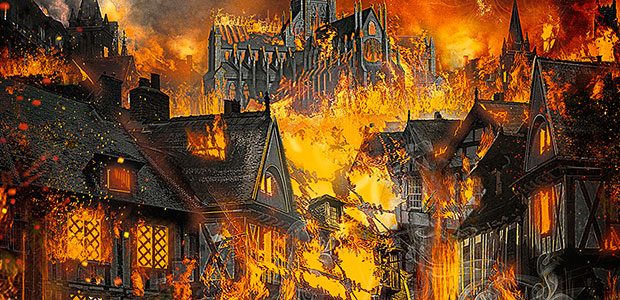
When the ashes settled after the great Chicago Fire, folks looked to assign blame and pointed their fingers at a cow.  The English were fire-of-londonalso looking to fix blame for a fire some two centuries earlier.  In early September 1666, a major fire broke out in Pudding Lane in the City of London and within days had destroyed 80 percent of the old city.
Accusations were flying in all directions — strangers, the Spanish, Dutch, Irish and most particularly the French, Catholics, even King Charles II.

Enter one Robert Hubert.  Hubert was a simple watchmaker who wasn’t quite wound up  — and he was a French Catholic.  He obligingly confessed to being the culprit, telling authorities he deliberately started the fire in Westminster.  He was arrested, but one little problem cropped up: the fire hadn’t even reached Westminster, let alone started there.

When confronted with the fact that the fire originated in a Pudding Lane bakery.  Hubert adjusted his story, saying that he had actually started the fire there, tossing a fire grenade through an open window.  What’s more, he did it because he was a French spy in service of the Pope.

Hubert was hauled before the court.  His story turned out to be riddled with problems.  The bakery had no windows, and Hubert was judged to be so crippled that he could not have thrown the grenade.  An even bigger problem:  he was not in England when the fire started, according to the testimony of the captain of a Swedish ship who had landed him on English soil two days after the outbreak of the fire.

Nevertheless, the court found Hubert guilty, and on October 27, 1666, he was hanged at Tyburn, London.  A year later, the cause of the fire was quietly changed to ‘the hand of God, a great wind and a very dry season.’

Don’t You Be a Meanie

Oh, Mr. Paganini
Please play my rhapsody
And if you cannot play it won’t you sing it?
And if you can’t sing you simply have to . . .

Mr. Paganini, aka (If You Can’t Sing It) You’ll Have to Swing It became a paganinifixture in Ella Fitzgerald’s repertoire back in the 1930s. The Mr. Paganini to whom she refers is composer and violin virtuoso Niccolo Paganini who was born on October 27, 1782. During the height of his career, the legendary “devil violinist”  set all of nineteenth-century Europe into a frenzy. He was a headliner in every major European city.  His technical ability was legend, and so was his willingness to flaunt it. His fame as a violinist was equaled by his reputation as a gambler and womanizer.

Alas, his grueling schedule and extravagant lifestyle took their toll, and he suffered from ever increasing health problems. He died in 1840.

October 21, 2011: Was It Big and Slimy?

They lurk in the watery depths — fearsome creatures beyond imagination created by radioactivity from atomic bomb tests, scientific experimentation, or man’s inhumanity to man. Like the Creature from the Black Lagoon, Orca, orscreamw IT Came from beneath the Sea, most of us have only seen them in movies, but we know they’re down there and we know they wish us harm. Now after an October 21, 2011, discovery we can add to the list of terrors keeping us awake at night, Attack of the Giant Xenophyphores.

These guys are way down there — more than 6 miles in the depths of the Mariana Trench.  And they weren’t discovered by a couple of drunk fishermen or something. They were discovered by a crack team of scientists from the Scripps Institute of Oceanography in La Jolla, California.

They may not be gigantic in absolute terms, but for single-celled animals — think amoebas — these guys are mammoth at 20 cm. in diameter. There are thousands of them, lying about on the ocean floor, sucking in food from the mud around them, secreting slimy (and most likely deadly) goo all over the place and attaching bits of dead things to themselves (in fact their scientific name means “bearer of foreign bodies”).

Don’t go near the water.

Beware the Frubious Sea-Bishop

The Elizabethan era was a time of fertile travel, abounding in discoveries that required very little exaggeration to carry them into the realm of the marvelous. And, unlike today, folks would clamor to see anything that was strange, fantastic, beyond belief. This taste for the wonderful was catered to by adventurers returning from voyages with tales of bizarre creatures, monsters even.

sea-monkSure, many of the “monsters” would not seem at all unusual today – a shark or an octopus in the possession of a fast-talking charlatan could easily separate country folk from their money. In fact inland people who had never experienced the sea were thought capable of believing just about anything.

Narrations by sixteenth century authors each attempted to outdo each other describing the oddities taken from the sea. One account from 1632, described a creature that, although a fish, bore a striking resemblance to a bishop. And there were drawings to prove its existence. The author pointed out that this was meant to assure us that bishops were not confined to land alone, but that the sea also has the advantage of their blessed presence. This particular sea-bishop was taken before the king and after a conversation expressed his wish to be returned to his own element. The king so ordered and the sea-bishop was cast back into the sea.

No sooner had the creature disappeared than another author in the best tradition of oneupsmanship (and perhaps a bow to evolution) showed us that any sea that possessed a sea-bishop must certainly have a sea-monk!


October 19, 1936: Girl Around the World

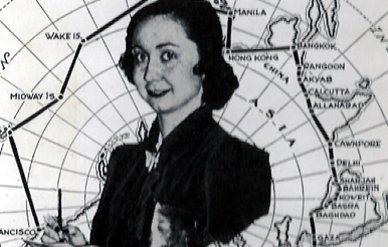
Reporters Leo Kieran of the New York Times and Herbert Ekins of the World-Telegram were out to demonstrate that air travel was shrinking the world and that it was pretty much in the reach of most people. They would do this by means of a race around the globe using kilgallen2commercial transportation available to anyone with the price of a ticket. When the race started on the evening of September 30, 1936, they had been joined by a last-minute participant from the Evening Journal — a 23-year-old rookie crime reporter named Dorothy Kilgallen.

A fierce rainstorm kept the three contestants out of the air for the first leg of the race — a short hop to Lakehurst, New Jersey, to catch the airship Hindenburg. Kilgallen almost missed the flight, but the crew delayed departure until she boarded.

Ekins quickly proved to be the savviest traveler as well as the most competitive. Arriving late in Frankfurt, Germany, he quickly boarded a KLM DC-2, a plane that had finished second in an air race from London to Melbourne. Kilgallen and Kieran, on the other hand, headed to Brindisi, Italy, by train to catch a flight from there to Hong Kong on a British carrier, Imperial Airways. The train was excruciatingly slow, and the flight was delayed for seven hours because of wind.

When the two reporters arrived at a stopover in Bangkok, Siam, Kilgallen opted to hire a single-engine plane whose pilot lost his way in Indochina and made a frightening landing in the middle of a field before finding his way to Hong Kong.

Waiting to board a steamship headed from Hong Kong to Manila and the Pan Am China Clipper for the flight back to the States, Kieran and Kilgallen learned that Ekins had come and gone. He had talked his way onto a Pan Am trial flight as a crew member. Although taking the no-passenger flight was cheating, Ekins was pronounced the winner, having completed his journey on October 19.

With just the tiniest bit of grousing, the two defeated reporters acknowledged his victory in a cable from Manila while waiting for a typhoon to pass. They completed the journey in 24 days. In some ways, Kilgallen was the real winner, despite her second-place finish. Her accounts of the journey, cabled back to the Evening Journal each day, filled with descriptions of exotic lands, jungles full of dangerous beasts and shark-infested waters, made her a celebrity. It also launched her successful career which ended abruptly in 1965 with her mysterious death (a story for another day).

Bad Bad John

England’s King John, who has no number because he was the only royal John, reigned from 1199 until his death on October 19, 1216. Most historian’s agree he was a so-so monarch who had his share of disagreeable traits — belligerence, pettiness, narcissism, cruelty and strange orange hair.

Perhaps John suffered by comparison to his brother Richard I (although he was not I until Richard II came along a century or two later). Mom (Eleanor of Aquitane) always liked Richard best. Richard was tall and lionhearted; John was short and weasely.

Historians began picking on John almost immediately. And then the writers chimed in. Shakespeare gave him a bad rep, Sir Walter Scott goosed it along in Ivanhoe, and Howard Pyle really skewered him in The Merry Adventures of Robin Hood, portraying him as the unmerriest of villains who, along with his loathsome pal the Sheriff of Nottingham, doubled down on atrocity. Even A. A. Milne mostly known for warmth and fuzziness got his licks in with the poem King John’s Christmas:

King John was not a good man—
He had his little ways.
And sometimes no one spoke to him
For days and days and days.
And men who came across him,
When walking in the town,
Gave him a supercilious stare,
Or passed with noses in the air—
And bad King John stood dumbly there,
Blushing beneath his crown.

OCTOBER 17, 1814: THIS ROUND’S ON ME

An unfortunate incident involving beer – aged porter to be precise – occurred in London back in 1814.

The central London parish of St Giles was, as slums go, one of the slummiest.  Although it has since been rather gentrified with theaters, Covent Garden and the British Museum nearby, it was then mostly squalid housing where immigrants crowded into its ramshackle buildings, often more than one family to a room. Near one end of the parish stood the massive Meux and Company Horse Shoe Brewery, its giant vats filled with thousands of gallons of aging porter.

One particular vat which held over 135,000 gallons had seen better days. Like the shanties surrounding the brewery, it suffered from age, and on October 17 it succumbed, bursting and letting loose enough precious liquid to give all of St. Giles and then some a pretty good buzz, although the fury with which it was released made tippling difficult. Like giant shaken cans of beer, nearby vats ruptured and joined the game of dominoes.

Within minutes the brick structure that was the Meux and Company Horse Shoe Brewery was breached, and the deluge roared down Tottenham Court Road, flinging aside or burying in debris anyone or anything in its path.

Homes caved in. A busy pub crumbled, burying a buxom barmaid and her ogling patrons for several hours.  All in all, nine people were killed by drink that day. Those who didn’t lose their lives lost everything they owned to evil alcohol. Soon after the suds subsided, survivors rushed in to save what they could of the precious brew, collecting one or more for the road in pots and cans.

St. Giles smelled like the morning after a particular robust party for weeks. The brewery was later taken to court over the accident, but they pleaded an “Act of God,” and the judge and jury bought it, leaving them blameless. The brewery even received reparations from the government.  God, it would seem, has a soft spot for brewers.

I am a firm believer in the people. If given the truth, they can be depended upon to meet any national crisis. The great point is to bring them the real facts, and beer. ~ Abraham Lincoln