APRIL 17, 1610: SOMEWHERE A RIVER BEARS YOUR NAME

Back at the dawn of the 17th century, the holy grail among explorers was the Northwest halfPassage, that elusive sea route that Europeans had been seeking ever since they discovered that North America stood right in the middle of their way to China. (For some reason, they longed to go west to China even though it was a lot closer going east.)

On April 17, 1610, intrepid British explorer Henry Hudson. already famous for having discovered and explored a river that just happened to share his last name, set sail on his latest attempt to find the passage that would at last allow Europeans to take (as the popular song tells us) a slow boat to China.

It was his fourth expedition, financed by adventurers from England. Sailing across the Atlantic, slipping between Greenland and Labrador, he entered the Hudson Strait (another remarkable coincidence) and soon reached (you’re not going to believe this) Hudson Bay. Unfortunately after all this seeming good luck, the expedition took a nasty turn.  After three months dawdling around the bay, Hudson was surprised by the onset of winter. Why winter north of Labrador in November would be a surprise is anyone’s guess. Nevertheless, Hudson and his crew were forced to set up a winter camp. The next few months were not pleasant, and many of the crew members were not amused. They grumbled and held their tongues throughout the winter until June. But once they were sailing again, they up and mutinied, setting Hudson, his son and seven friends adrift.  Although Hudson was never seen again, England laid claim to everything that shared his name — river, strait, bay and even a funny looking vehicle that seemed to have no useful purpose.


APRIL 16, 1850: CALL ME MADAME

Madame (Marie) Tussaud is arguably the world’s most famous wax sculptor. Born in France in 1761, she began her artistic career during the French Revolution, searching through corpses to find the heads of noted guillotine victims from which she made death masks. She herself was imprisoned for three months awaiting execution, but an influential friend intervened and she was released. She and her waxwork friends toured throughout Europe for 33 years before settling into a permanent exhibition in 1835 on Baker Street in London. There she gained prosperity and fame, managing her wax museum until her death on April 16, 1850.
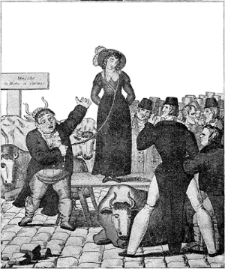
Throughout Madame Tussaud’s long existence, its most popular feature has been the Chamber of Horrors (as pictured here).

And It Would Help with Social Distancing

Inventor Walter Pichler is the genius behind the amazing TV helmet of 1967. This device allows a user to leave the outside world and slip into his or her own little world of information and entertainment. The user simply inserts his or her head into a capsule that resembles a small submarine and hopes that he or she doesn’t bump into something while enjoying the “virtual world” of Gilligan’s Island.

Pearl Among . . .

minnie

“How-w-w-Dee-e-e-e! I’m jes’ so proud to be here!” “Here” might have been the National Comedy Hall of Fame into which, on April 16, 1994, Minnie Pearl became the first woman inducted. But more often it was on the stage of the Grand Ole Opry in Nashville, Tennessee, where Minnie held sway as the resident Southern hillbilly for over 50 years.

Her comedy was a good-natured satire of rural Southern culture. She appeared in her trademark hat, purchased at the Surasky Bros. Department Store in Aiken, South Carolina, for $1.98 before her first stage performance in 1939, along with styleless “down home” dresses.  Her self-deprecating humor was usually about her unsuccessful attempts to get “a feller” and her ne’er-do-well relatives. She also sang novelty songs and danced with Grandpa Jones. From the opening How-w-w Dee-e-e-e to her closing “I love you so much it hurts!”, she had the Opry audience in the palm of her hand.

The Little Tramp

Sir Charles Spencer Chaplin, known to millions of film buffs as “Charlie,” was born April 16, 1889.  His working life in entertainment began as a child performer in British music halls and spanned 75 years until his death in 1977 at the age of 88.   In the United States, he became one of the most important creative personalities of the silent-film era — acting in, directing, scripting, producing and composing the music for his own films.


APRIL 13, 1360: HAIL, HAIL, THE GANG’S ALL HERE

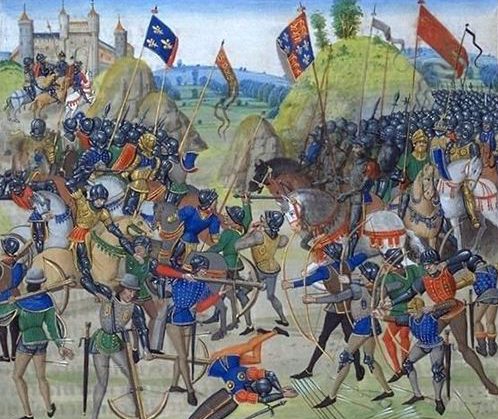
It was the 14th century and once again England was out to conquer France. The hostilities had been going on for nearly 20 years, when England’s King Edward III sailed across the Channel with a huge army — a cast of thousands.  The dead of winter set in, and the inconsiderate French refused to face the English invaders in direct combat. Instead they huddled in their warm and cozy castles, drinking cafe au lait while the English plundered the countryside and got frostbite. Come April of 1360, having lasted through the winter, Edward and his men fought and torched their way through the Paris suburbs, and readied themselves to have at Chartres.

Then, on April 13, a sudden violent storm came up. Lightning killed several soldiers, and then the heavens opened up and hailstones the size of pommes de terre began hammering the hapless army, killing a thousand men. Naturally, they took this as a sign that God was annoyed. Edward declared the invasion “my bad” and negotiated a peace with the French. The English renounced all claims to the throne of France, and the French gave them croissants.

But wouldn’t you know it, a few years later, the King of France declared war on England ( this was, after all, the Hundred Years’ War, scheduled to last another 75 years or so.)

Historians assure us that this was not the origin of the phrase “Hail to the Chief.”

Ifs, Ands or Butts

Alfred Mosher Butts was born in Poughkeepsie, New York, on April 13, 1899. Who, you ask, is Alfred Mosher Butts? He became an architect when he grew up, though not a famous one. He dabbled in art to no great success. His colorful last name is worth a pathetic seven points in a certain word game that can be found in one-third of American homes. 150 million sets have been sold worldwide in 29 languages. Yes, the game is the ubiquitous Scrabble. And Al Butts is the guy who invented it.

For those who may be new to the planet, Scrabble is a game where players place tiles on a board to spell words and earn points determined by the numerical value of individual letters. Butts determined the values of the individual letters by studying how often each letter appeared on the front page of The New York Times (fake letters in fake words in fake news, some might say).

A street sign in Jackson Heights (where Butts lived when he invented the game) memorializes the creation of the game.

APRIL 8, 1832: TAKE MY WIFE . . . PLEASE

Earlier centuries saw a great many practices that were commonplace then but which would be considered inappropriate in our more enlightened age. Nowhere was this truer than in (merry old) England — purchasing a plump Irish child for special dinner occasions in the 18th century, for instance, or in the 19th century, selling a spouse one had grown weary of.  One such sale took place on April 8, 1832, an account of which was recorded for the amusement of generations that followed.  Joseph Thompson, a farmer, had been married for three unhappy years when he and his wife decided to call it quits.  As was customary, Thompson took his wife to town and set her up for public auction.  At noon, the sale commenced with Thompson delivering a short speech:

“Gentlemen, I have to offer to your notice my wife, Mary Ann Thomson . . . whom I mean to sell to the highest and fairest bidder.  Gentlemen, it is her wish as well as mine to part for ever.  She has been to me only a born serpent.  I took her for my comfort, and the good of my home; but she became my tormentor, a domestic curse, a night invasion, and a daily devil.  Gentlemen, I speak truth from my heart when I say — may God deliver us from troublesome wives and frolicsome women!  Avoid them as you would a mad dog, a roaring lion, a loaded pistol, cholera morbus, Mount Etna, or any other pestilential thing in nature.”

What a sales pitch!  This guy could sell anything. The asking price for Mary Ann was 50 shillings. Eventually, the price was knocked down and a deal was made — 20 shillings and a Newfoundland dog.

Everyone satisfied, they parted company, Mary Ann and a gentleman named Henry Mears in one direction, Joseph and the dog in the other.

APRIL 6, 1722: AND TWO RUBLES FOR A FIVE 0’CLOCK SHADOW

In 1722, Peter the Great of Russia abolished a tax he had introduced some twenty years earlier, it having proved to be a rather hairy source of national income. The tax had been the result of an 18-month European tour to seek the aid of European monarchs, and to observe how other militias and armies were trained. During the tour, he learned that many European customs and styles were far superior to the antiquated ways in Russia. One of the first rulings he made upon his return was that all of his courtiers and officials shave off their long beards, as being clean-shaven was the European style. Anyone who kept their beard was subject to an annual Beard Tax of 100 rubles. Upon payment of the tax, bearded Russians were given a token; on one side of the token was an image of the lower part of a face with a full beard and the inscription “the beard is a superfluous burden.”

The idea of a beard tax had a bit of a history. Nearly 200 years earlier, King Henry VIII of England, who wore a beard himself, had introduced a tax on beards, although he probably didn’t pay the tax himself (it’s good to be the king). The tax was a graduated tax, varying with the wearer’s social position, not the length of his beard. Some years later, his daughter, Elizabeth I, reintroduced the beard tax, taxing every beard of more than two weeks’ growth, although she probably didn’t pay the tax herself (it’s good to be the queen).

APRIL 3, 1667: THE LIONS ARE COMING, THE LIONS ARE COMING

In addition to being a member of the British peerage, Edward, Marquis of Worcester, who died on April 3, 1667, was a bit of a dabbler, a sort of ersatz inventor, and author of an odd little book called A Century of Inventions. The book, written some ten years earlier, describes, as the title suggests, a hundred speculative projects, none of them, however, detailed enough to allow a reader to actually put them into practice: secret writing with peculiar inks, explosive devices that would sink any ship, ships that would resist any explosive devices, floating gardens, a method to prevent sands from shifting, automatic assault pistols and cannons, a timer for lighting candles at any time during the night, a hundred-foot pocket ladder, flying machines.

Although many of his ideas foreshadowed later inventions, it is unclear whether he had thought through the methods by which they would work. One idea was put to work with success although unusually so. As the owner of Raglan Castle, he had constructed some hydraulic engines and wheels for bringing water from the moat to the top of the castle tower.  During the Civil War, Roundheads had approached the castle with not the best of intentions. The Marquis had his waterworks put into play. “There was such a roaring,” he later wrote, “that the unwelcome visitors stood transfixed, not knowing what to make of it.” On cue, one of the Marquis’ men came running toward them shouting that the lions were loose. The intruders tumbled over one another down the stairs in an effort to escape, never looking back until the castle was out sight.

Fifty more clever ideas

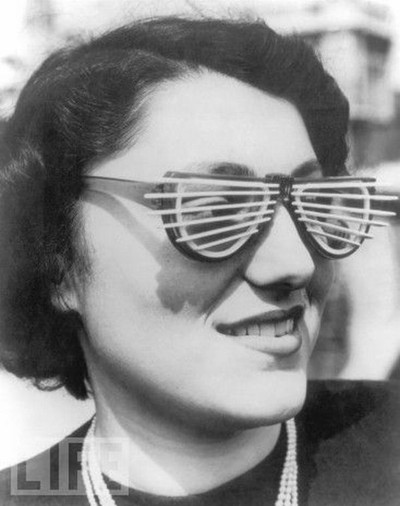
The Marquis’ 100 nifty inventions most likely did not inspire Time Magazine to create its list of inventions at the turn of this century, although it could have.  The Time list heralded fifty creations that it called the worst of all time.  Wretched Richards Almanac has visited some of these in the past and will visit others in the future (like on April 5).  The list includes such sure-fire ideas as Hair in a Can, Tanning Beds, Venetian-Blind Sunglasses, Smell-o-Vision, Hula Chair and many more.


MARCH 20, 689: SOME FOLKS JUST WON’T STAY BURIED

Back in the 7th century on an island in northern Britain, the very holy St. Cuthbert gave up the ghost. The exact date of his departure was March 20, 689. Not only was Cuthbert very holy, he was, you might say, holier than thou, or at least holier than all his peers. He devoted his entire life to converting the half-savage heathens (and there were quite a few half-savage heathens at the time) and praying — lots of praying. Such was his devotion that those about him often wondered if he were not a man but an angel.

Cuthbert was duly shrouded and buried, remaining at rest for some 11 years until some curious monks dug him up to have a peek. They found Cuthbert in perfect condition, which they accepted as miraculous proof of his saintly character. They placed him in a new coffin, leaving him above ground so he might perform miraculous cures.

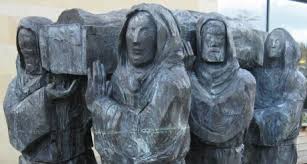
Another 174 years passed and, with Britain facing an invasion by the Danes, the monks (different monks) carried Cuthbert’s still perfect body away and wandered with it from place to place for many years.

Finally in the 11th century, Cuthbert’s body found a permanent home where it was enshrined and enriched with offerings of gold and jewelry from the faithful (there were a lot more of them now). In 1104, the body was inspected again and found still fresh. Another 400 years and another inspection.

Three hundred years. It’s 1827 and Cuthbert is past due for inspection. This time, however, the inspectors were much more rigorous, and it was discovered that Cuthbert was an ordinary skeleton swaddled up to look whole, including plaster balls to plump out the eye holes. It would appear that some monks along the way had been quite naughty. St. Cuthbert himself serves as a fine example of a person who was far more interesting dead than alive.

Deciders Unite

The Whigs didn’t last long as as political party. Formed in the 1830s out of annoyance with Andrew Jackson, they gave us four presidents — William Henry Harrison, John Tyler, Zachary republicanTaylor and Millard Fillmore, commonly known by their shared nickname, Who? (not to be confused with the rock group of the same name). As is the case with many political parties, they had disagreements over tents, finding themselves unable to deal with the concept of big ones, and eventually tore themselves asunder with internal disagreements.

The semi-official date of the party’s actual death was March 20, 1854. On that date, a number of don’t wanna-be Whigs met in Ripon, Wisconsin, and the result of that meeting was the birth of the Republican party, which lasted until 2016.


March 7. 1766: Gentlemen Rhymesters Out on a Spree

A certain Miss Molly Mogg of the Rose Tavern in Wokingham, England, turned up her dainty toes on March 7, 1766, at the age of 66. Some 40 years earlier she had been the subject of an amusing ballad written by “two or three men of wit.” The ballad, perhaps to the surprise of its authors, became quite popular. Literary historians have determined that the “men of wit” were Alexander Pope, Jonathan Swift, and John Gay and that the three were probably quite drunk when they penned the tribute to the pretty Molly.

It begins:

The schoolboy delights in a play-day,

The schoolmaster’s delight is to flog;

The milkmaid’s delight is in May-day,

But mine is in sweet Molly Mogg.

and continues on for eleven verses each ending with “sweet Molly Mogg. This, of course required the three rhymesters to come up with 11 words to rhyme with Mogg. Which they did.  In addition to the aforementioned flog, there’s bog, cog, frog, clog, jog, fog, dog, log, eclogue and agog — bypassing hog and Prague.

Cogito Airgonaut

Jean-Pierre Blanchard, the noted 18th century “Airgonaut,” made his first successful balloon flight in Paris back  in 1784, in a hydrogen gas balloonballoon4 launched from the Champ de Mars. Blanchard’s flight nearly ended in disaster, when one spectator slashed at the balloon’s mooring ropes and oars with his sword after being refused a place on board. Observer Horace Walpole wrote of the flight that the Airgonauts were just like birds; they flew through the air, perched in the top of a tree, and some passengers climbed out of their nest to look around.

Nevertheless, these early balloon flights set off a public “balloonomania”, with clothing, hairstyles and various objects decorated with images of balloons or styled to resemble a balloon. In 1793, Blanchard scored another first — the first balloon flight in North America, ascending in Philadelphia and landing in New Jersey. Witnesses to the flight included President George Washington, and future presidents John Adams, Thomas Jefferson, James Madison, and James Monroe. Some say Washington threw a silver dollar at the balloon.

Now famous, our  Airgonaut  married Marie Madeleine-Sophie Armant in 1804. But his run of fame, fortune and good luck came to a sudden end four years later, when Blanchard had a heart attack while ballooning above the Hague. He fell from his balloon and died of his injuries on March 7, 1809. His widow Sophie inherited everything including the ballooning bug which would be her undoing as well: she continued to support herself with ballooning demonstrations until it also killed her.  In 1819, she became the first woman to be killed in an aviation accident when, during an exhibition in the Tivoli Gardens in Paris, she launched fireworks that ignited the gas in her balloon. Her balloon crashed on the roof of a house, and she fell to her death.  Don’t try ballooning at home.

December 30, 1865: You’re a Better Man Than I Am

On this the sixth day of Christmas True Love is back to his bird fixation with a gift of six geese a-laying — and presumably a-honking.  The sixth ghost of Christmas has prepared a thoughtful, if lengthy, power point presentation, vividly detailing every zit suffered by the adolescent Scrooge.

Rudyard Kipling was one of the most popular writers in England, in both prose and verse, in the late 19th and early 20th centuries Born in Bombay, India, on December 30, 1865, Kipling is best known for his works of fiction, especially The Jungle Book (a collection of short stories which includes “Rikki-Tikki-Tavi”), Just So Stories, Kim, “The Man Who Would Be King” and such poems as “Gunga Din,” “Mandalay,” and “The White Man’s Burden.” He is considered a major “innovator in the art of the short story,” and his children’s books have become true classics.

Kipling became synonymous with the concept of British “empire” and as a result his reputation fluctuated and his place in literary and cultural history inspired passionate disagreement during most of the 20th century.  Nevertheless, critics agree that he was a skilled interpreter of how empire was experienced.

Young Rudyard’s earliest years in Bombay were blissfully happy, in an India full of exotic sights and sounds. But at the age of five he and his sister were sent back to England, as was the custom, to be educated. In his autobiography, published 65 years later, Kipling recalled the stay with horror, and wondered ironically if the combination of cruelty and neglect he suffered from his foster family might not have hastened the onset of his literary life: “I have known a certain amount of bullying, but this was calculated torture—religious as well as scientific. Yet it made me give attention to the lies I soon found it necessary to tell: and this, I presume, is the foundation of literary effort.”

Kipling traveled extensively throughout the world, and his travels included a stay of several years in Brattleboro, Vermont, an unlikely spot in which to create The Jungle Book, although he did, along with Captains Courageous.

During his long career, he declined most of the many honors offered him, including a knighthood, the Poet Laureateship, and the Order of Merit, but in 1907 he accepted the Nobel Prize for Literature. He died in 1936 in England (even though a few years earlier he had written “Never again will I spend another winter in this accursed bucketshop of a refrigerator called England.”)

December 13, 1931: Which Side Are You On?

“I do not understand why I was not broken like an eggshell or squashed like a gooseberry.”

So said the man who would become a larger than life British statesman, leading Britain through World War II and  remain a major player on the world stage into the 50s.  He very nearly didn’t make it there, thanks to the perils of New York City traffic.

It was 1931 and a low point in Churchill’s career.  At the age of 57, he had been pretty much banished by his own Conservative Party and had begun to devote himself to his writing.  He had sailed to the United States to give a series of lectures on “the Pathway of the English-Speaking Peoples.” On December 13, the night before one such lecture scheduled at the Brooklyn Academy of Music, he hailed a taxi and set out to visit a friend, financier Bernard Baruch.  He got out of the cab on Fifth Avenue between 76th and 77th Streets.  He walked a bit, then attempted to cross the street against the light (which no New Yorker would ever do).  He looked to the right, just as he would were he crossing King’s Road or Carnaby Street, saw no oncoming traffic and and kept walking.  An unemployed mechanic named Mario Cantasino was just as surprised as Churchill when the car he was driving slammed into the future Prime Minister and dragged him several yards, leaving him lying in a bruised and battered heap.  Churchill took full responsibility for the incident, and Contasino was held blameless.

After a little more than a week in the hospital and a few weeks of recuperation, Churchill finally gave his Brooklyn lecture on Jan. 28.  On one bright note: the United States being subjected to the agonies of Prohibition at this time, his American doctor wrote a note to “certify that the post-accident concussion of Hon. Winston S. Churchill necessitates the use of alcoholic spirits especially at meal times.”

Following his lecture, Churchill and his wife, seeking further rest and relaxation, traveled to Jamaica, a place where folks thankfully drove on the proper side of the street.

Bet They Don’t Have One of These

Wretched Richard offers a blatantly self-serving gift idea for those who have everything: