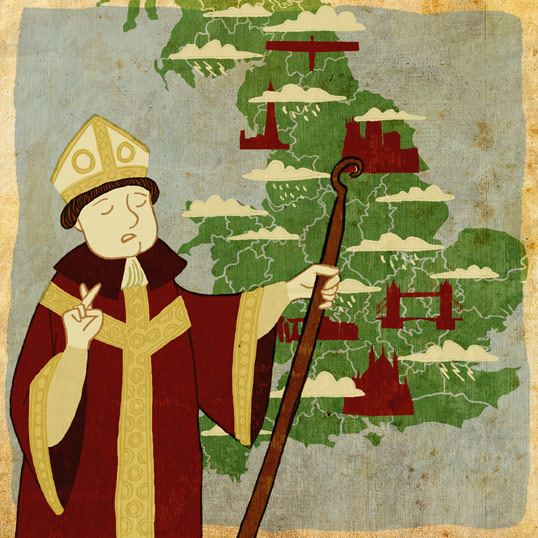
JULY 15, 971: JUST LYING IN THE RAIN

‘St. Swithin’s day if thou dost rain
For forty days it will remain
St. Swithin’s day if thou be fair
For forty days ’twill rain nae mair.’

     St. Swithin is the British counterpart to America’s Puxatawney Phil, except that the former is a ninth century bishop and the latter is a ground hog.  And just how did the good St. Swithin get his meterological stripes?  Here’s how:

ST-SWITHIN-DUDLEY-MAXIMS     St. Swithin was noted for his great humility, a quality that some may say he carried to excess. On his deathbed, he asked to be buried, not in the church or in some shrine, but outside where his corpse might be watered by rain from the church eaves and his grave stomped on by passers-by. Folks rolled their eyes a bit but complied with his request.

     And his remains lay wet and walked on for a good hundred years, until a more modern generation of clergy (those 10th century radicals!) took umbrage at one of their own resting in such a lowly spot. They decided at once to relocate Swithin, who could not object, to a great cathedral.  However, on July 15, 971,  just as a ceremony with great pomp and circumstance was about to begin, as if on cue, a heavy rain burst forth and continued with nary a break for 40 days (40 days is a popular duration for great rainfalls).

     The monks interpreted this tempest as a not-so-subtle warning from on high that their nasty little undertaking was a bit of blasphemy.  They immediately abandoned the project. And even without the help of modern social media, word spread throughout the land, and a tradition was born: if it rained on St. Swithin’s Day, it would rain for 40 days.

    St. Swithin also planted apple trees (like Johnny Appleseed, who never predicted weather) leading to the popular description of rain: “St Swithin is christening the apples

JULY 6, 1189: IT’S GOOD TO BE THE KING II

Known as Cœur de Lion or the Lionheart because of his reputation as a great military leader and warrior, Richard I became King of England on July 6, 1189, and ruled until his death ten years later.  He was the stuff of which legends were made, particularly in the story of Robin Hood, although he’s strictly an offstage presence, being held prisoner in a far-off land until the very end and his triumphant return. Robin, you will remember, battled the evil Prince John who was doing his best to usurp Richard’s throne in his absence. Eventually, Richard returns triumphantly to England, but in a bit of a slap in the face to Robin, he forgives John and names him his heir to the throne. Robin is abandoned to Sherwood Forest and his “merry men” (see Robin Hood – Men in Tights).

     In reality, Richard, it seems, was a rather lackluster king, spending only six months of his ten-year reign in England (“hates London, it’s cold and it’s damp”) preferring to spend his time on crusades, battling Saladin, and waging wars throughout the world (“who would Jesus invade?”).

     He died as a result of an arrow wound (live by the arrow, die by the arrow).  According to a 13th century bishop, Richard was required to spend 33 years in purgatory atoning for his many sins before finally being allowed into heaven in March 1232.

     Richard III also began his reign on July 6, nearly 300 years later in 1483.  He took the crown shortly after having his nephew 12-year-old King Edward V declared a bastard and sent to the Tower.  His only accomplishment as king seems to have been the murder of his two nephews (and a number of scholars would take that away from him too).  Bishops have not said how many years he had to spend in purgatory before joining his ancestors up above, but we can guess it was quite a few.


JUNE 23, 1626: ANOTHER FISH STORY

A codfish was brought to market in Cambridge, England, on this day in 1626. Codfish were probably brought to market every day in 1626 – and in 1627 and throughout the centuries, but this was a rather unusual fish. Upon being opened, it was found to have a book in its stomach.  There are plenty of  fish in books, but how many books in fish are there?

The book had seen better days, but it remained readable. It had been written by one John Frith and included several essays on religious subjects evidently written by Frith when in prison. Oddly enough, he had been confined in a fish cellar where many of his fellow prisoners died from smelling too much salt cod. Frith got past the salt cod but was eventually taken to the Tower, and in 1533 was burned at the stake for unacceptable religious beliefs.  How he got his essays – which were no doubt inflammatory – into that cod is still a mystery.

The folks at Cambridge reprinted the work, which had been totally forgotten for a hundred years until it turned up inside the fish.  The reprint was called Vox Piscis, which would translate to “voice of the fish.”  There’s definitely a morale booster for writers here:  When Random House says no, go find yourself a big fish.

JUNE 22, 1774: RUN SILENT, RUN DEEP

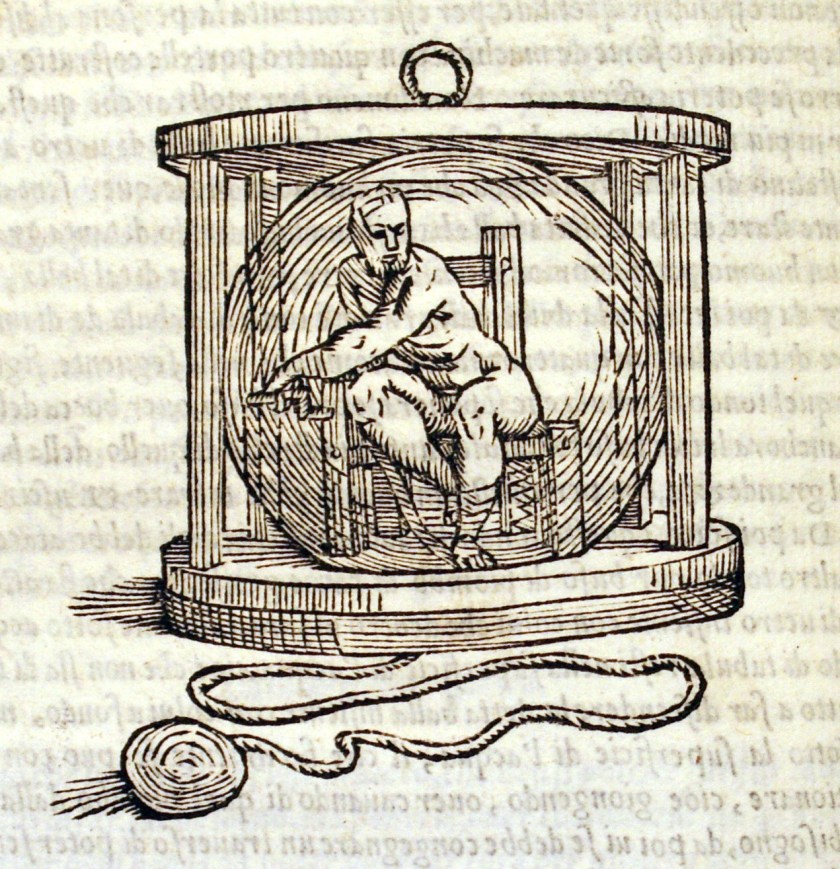
In 1774, John Day, an ignorant but ingenious English millwright, fancied that he had devised a plan by which he could remain completely underwater at any depth for at least 24 hours. The contraption he had devised for this feat would afford him a degree of comfort until, at his leisure, he returned to the surface.  Day could think of no useful purpose for his invention other than making money by wagering on his feat. He therefore contacted a local gambler who agreed to furnish funds for the construction of Day’s diving machine for a lion’s share of all the bets gained by it.

If nothing else, Day’s plan had the virtue of simplicity. His machine was merely a watertight box attached to a weight by means of screws. After entering the box and sealing the entrance, the vessel would be sunk and would remain underwater until, at the designated time, Day would remove the screws and he and the box would rise to the surface.

The machine was finished, bets were taken, and everyone convened at a designated spot on Plymouth Sound where the water was 132 feet deep. Day entered the compartment with a comfortable chair, a watch, some biscuits, a bottle of water and a candle.  Perhaps had he taken a basic science book with him — it may have enlightened him (if he read fast enough) but at that point it wouldn’t have helped.   The box was tightly closed and sunk 132 feet to the bottom from where neither it nor the unfortunate John Day ever arose.


June 14, 1789: The Ballad of Breadfruit

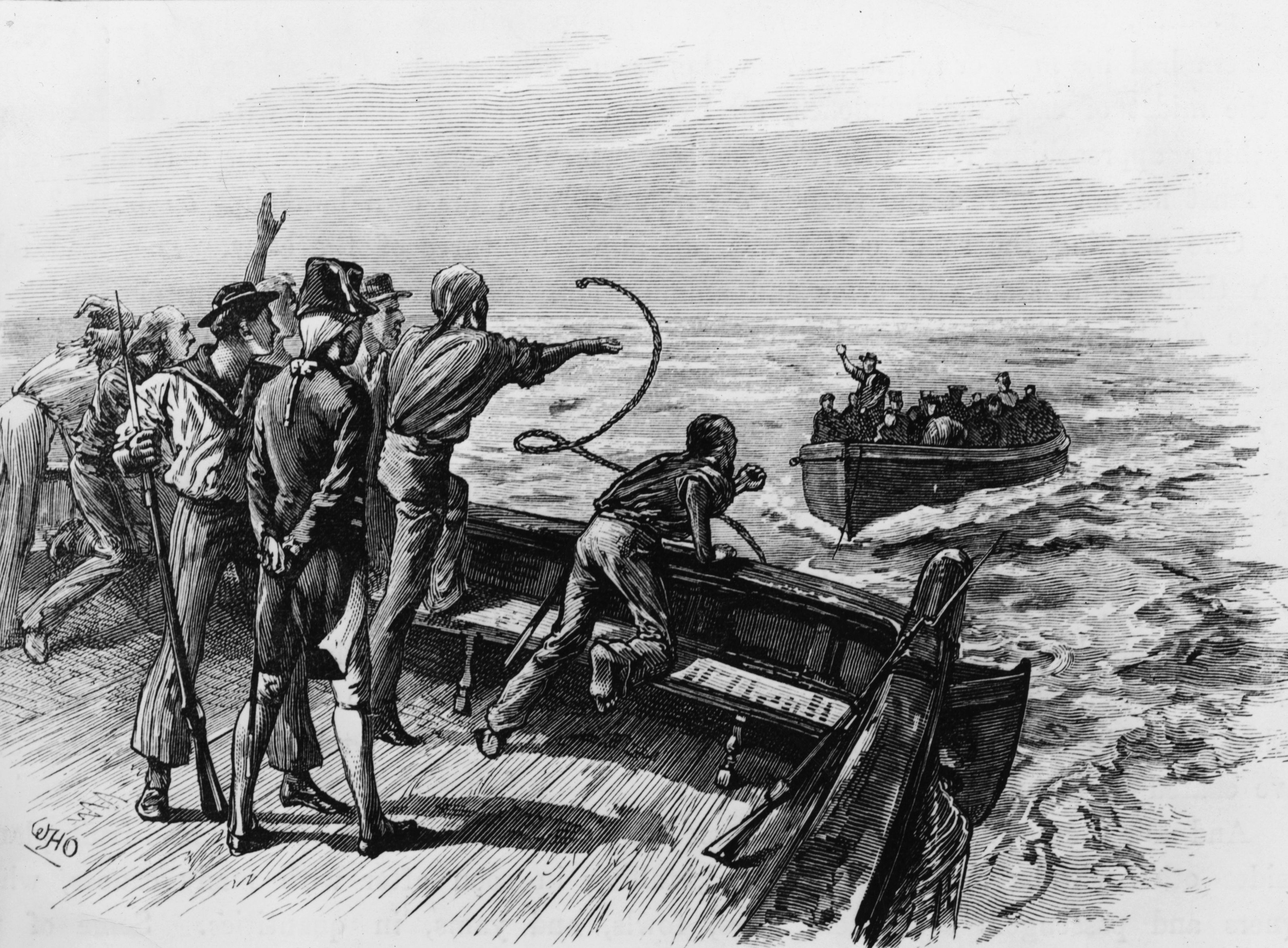
When little Billy Bligh joined the British Royal Navy at the tcirca 1817: English naval officer and victim of the celebrated mutiny on the bounty William Bligh (1754 - 1817) is cast adrift. (Photo by Hulton Archive/Getty Images)ender age of seven, he certainly never thought he’d grow up to haul breadfruit around the world. At sixteen, he became an able seaman, then a year later a midshipman. And in 1787, Bligh became Captain of the Bounty.

The Royal Society was offering special prizes to those who would travel to Tahiti, pick up a bunch of breadfruit trees and haul them back to the Caribbean as a source of cheap high-energy food for slaves. It sounded simple enough on paper, but getting there was far from half the fun. First, there was Cape Horn. The Bounty tried to get round it for a month before giving up and taking a longer route. Then Bligh and his crew had to sit around in the tropical sunshine for five months waiting for the little breadfruit babies to get big enough to travel. And when finally they set off for the Caribbean, didn’t Fletcher Christian and his cohorts, having grown fond of the Tahitian ambiance, up and mutiny.

Bligh and his loyalists were loaded into a launch with nary a breadfruit tree and set adrift. Amazingly, they survived and sailed over 4,000 miles, arriving in Timor on June 14, 1789, from where they returned to England. And two years later Bligh headed another expedition and this time successfully carried a load of trees to the Caribbean. However, the slaves refused to eat the breadfruit, wanting no part of a fruit that tasted like day-old bread.

Et Tu, Ku

Once upon a time, according to Hawaiian legend, the war god Kū, for reasons known only to Kū, decided to live secretly among the common folk and pass himself off as a mortal. He posed as a farmer and even went so far as to marry and have a family. Kū and his family lived quite happily, but being a war god Kū wasn’t such a hot farmer, and famine struck (as famine will).

Ku posing as a farmer

When everybody got pretty darn hungry, Kū realized it was time to shed his disguise and do some god thing. One would think his action would involve a battle of some kind, his being the god of war and all. Instead he disappeared into the ground right before his astonished family’s eyes. They were quite distressed by this, so they stood around where he had last been seen and cried day and night, thus watering the ground until a tiny green sprout emerged. The tiny sprout grew into a magnificent tree heavy with fruits that looked like big ugly green footballs. After tossing one around for a bit, they wondered if they might eat it since they were starving. They tried it, and it tasted awful. But they ate it anyway, saving themselves from starvation, and always remembering that this tree was their beloved Kū, finally providing for his family.


JUNE 12, 1349: IF YOU OUTLAW BOWS AND ARROWS . . .

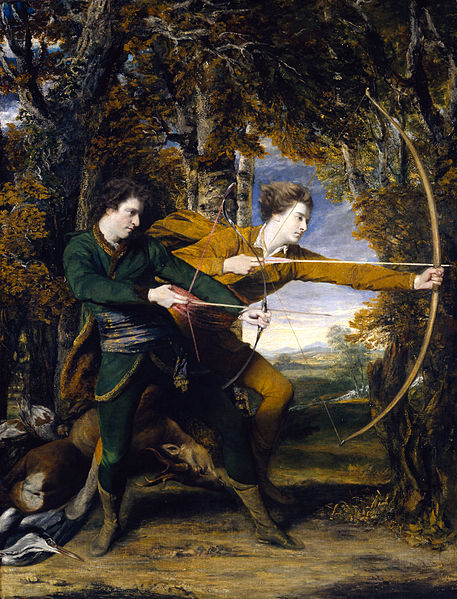
. . . only knaves will have bows and arrows.  In a letter dated June 12, 1349, England’s King Edward III wrote how the people of his realm, archboth rich and poor, had in previous times exercised their skill at shooting arrows and how that practice had brought honor and profit to the kingdom. But, he continued, that skill had been laid aside in favor of other pursuits. Therefore he commanded sheriffs throughout the realm to proclaim that every able citizen in their leisure time use their bows and arrows, and learn and exercise the art of archery.   And furthermore, they should not in “any manner apply themselves to the throwing of stones, wood, or iron, handball, football, bandyball, cambuck, or cockfighting”  or any other such trivial pursuits (that includes golf).

     A hundred years later, Edward IV continued the tradition, decreeing that all Englishmen, other than clergymen or judges, should own  bows their own height, keeping them always ready for use and providing practice for  sons age seven or older. Fines were levied for failing to shoot every Sunday.

     Sir Wayne of LaPierre complained that the law did not go far enough, that it lacked a provision that citizens should carry concealed bows and arrows and quivers with more than a ten-arrow capacity.  And a ban on background checks for potential archers, of course.


JUNE 10, 2000: ALL TOGETHER NOW, SWAY TO THE RIGHT

An air of excitement certainly gripped London on June 10, 2000, as 90,000 people queued up to cross the first new bridge to span the Thames River in over a hundred years, a bridge for pedestrians only, stretching from the Globe Theatre to St. Paul’s Cathedral, aptly named the London Millennium Footbridge. It didn’t take long for the bridge to become more known by its nickname, the Wobbly Bridge.
     Seems the designers had not given enough attention to a phenomenon with the catchy title, synchronous lateral excitation. Even if you’ve never heard of it, it doesn’t sound like anything you’d want to be on a bridge with.
     People, according to engineers, sway when they walk. People walking and swaying cause sideways oscillations in lightweight bridges. These, in turn, cause the people (some two thousand on the bridge at any given time) to sway even more to keep from falling over. And they all sway at the same time. It’s as if two thousand Londoners were doing the tango above the Thames. Result? Wobbly.
     Access to the bridge was limited later in the day, and two days after it opened, the bridge closed for modifications.  It reopened in 2002 (with tango forbidden).  It was again closed in 2007 because of strong winds and a worry that pedestrians foolish enough to cross might be blown off the bridge.
     The footbridge was not the only British millennial faux pas: a little number called the Millennium Dome elicited this derision from MP Bob Marshall-Andrews: “At worst it is a millennial metaphor for the twentieth century. An age in which all things, like the Dome itself, became disposable. A century in which forest and cities, marriages, animal species, races, religions and even the Earth itself, became ephemeral. What more cynical monument can there be for this totalitarian cocksure fragile age than a vast temporary plastic bowl, erected from the aggregate contribution of the poor through the National Lottery. Despite the spin, it remains a massive pantheon to the human ego . . .”

At the Zoo

Originally created as a royal herb garden in the 1600s, the Jardin des Plantes opened in 1793. During the following year a ménagerie was added, the world’s first and, still in existence, today the world’s oldest.  The 58-acre botanical garden and zoo is located in the center of Paris, next to the Seine.

The zoo was founded during the height of the French Revolution and the Reign of Terror. The National Assembly decreed that exotic animals  in private hands – rare antelopes, tigers, Louis XIV, and the like — were to be donated to the menagerie or guillotined, stuffed and donated to the natural scientists of the Jardin des Plantes . The Jardin was free for all visitors and tourists right from its inception.

While the menagerie at first was just provisional, it grew in the first three decades of the 19th century to be the largest exotic animal collection in Europe – as they describe it in France (or somewhere): monkey honnete, girafe pas sincere, elephant plein mais stupide, orang-outang sceptical, zebre reactionaire, antilope missionaire.

A well-run place, but this being France the menagerie gardiens are usually quite fond of their aperitifs.

Someone told me it’s all happening at the zoo.Paul Simon


JUNE 7, 1827: BEES IN THEIR BONNETS

640239 Insect Bumble Bee

Local newspapers reported an amazing altercation in the village of Cargo in Cumberland, England, in 1827, a battle really (or a battle royal), between two opposing hordes – of bees. The home bees, it seems, were happily hived in the village, going about their bee business when, on June 7, a swarm from a neighboring village flew over the garden in which the first hive was situated. Without warning or so much as a by-your-leave, the interlopers darted down upon the hive and completely covered it, then began to enter the hive, pouring into it in such numbers that it soon became as crowded as happy hour at the local pub.

     Then the terrible struggle began. With ear-splitting humming, two armies of combatants rushed forth, besiegers and besieged alike spilling out of the beleaguered hive into the open air. The bee-on-bee battle raged with such fury that the ground below was soon strewn with corpses. Not until the visiting swarm was vanquished and driven away did the battle end. The victors resumed possession of the hive.

     The local chronicle did not attempt to explain the motivations involved, but naturalists, adding a scientific perspective, suggested that sometimes bees fight.

Rodgers and Hammerstein Are Frauds.  Irving Berlin Too.

Julie Andrews and Von Trapps running from killer bees

It’s spring, and the hills of Vermont are alive with the sound of seventy degree temperatures, giving us a chance to venture out into the great outdoors.  A little maintenance, clean out a flower bed or two, rake.  Our resident swarm of bees had the same idea — without the raking.  We’ve long debated whether these bees are honey bees or some less desirable species.

I have ended the debate.  They are killer bees — murderous, cutthroat, bloodthirsty killer bees.  And one of their crack snipers got me.  I was tending to a bed, not threatening them in any way, and he swooped in and stung me on my eyelid.   Before long I looked like I had caught a baseball with my right eye.  I tried to recall what I had seen or heard about treating a bee sting and the Rodgers and Hammerstein cure came to me.  I spent the rest of the day remembering my favorite things, even drinking a couple of them.  It did nothing for me.

I spent a while standing out in front, stooped over, looking very much like Quasimodo, frightening away passing neighborhood children.  But I soon tired of this game.

Eventually I toddled off to bed.  But sleep wouldn’t come.  Finally I remembered Irving Berlin’s prescription for insomnia and began methodically counting my blessings instead of sheep.  As it turns out, one’s blessings and one’s favorite things are pretty much the same.  Three a.m.  I’m on my 137th blessing and wide awake.  I won’t bore you with the details of my 137 blessings, but I

Waiting for passers by

will tell you that Rodgers and Hammerstein and bees are not among them.

Today I will perch atop the rock wall out front on hands and knees pretending to be a radiation-mutated giant bullfrog, croaking at passers by.  Life goes on.

Be my little baby bumble bee.  Buzz around.  Buzz around.  Keep abuzzing round.

MAY 27, 1936: PROUD MARY KEEP ON BURNIN’

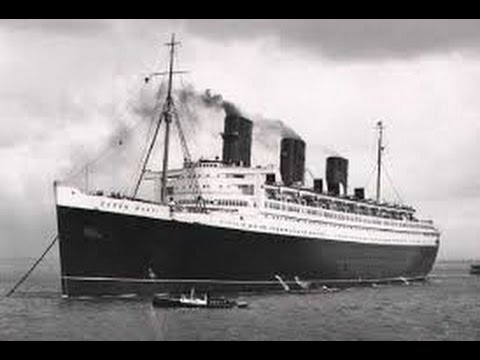
Although, out of superstition, women were banned from the workplace during the construction of the ocean liner Queen Mary, she was christened by a woman in September 1934.  By a queen actually — Queen Mary herself, the wife of George V who had died earlier that year and queen mother to Kings Edward VIII and George VI.

On May 27, 1936, throngs of cheering spectators looked on as the 80,000-ton liner, “the most beautiful ship afloat,” departed Southhampton on her maiden transatlantic crossing.. She carried 2,100 passengers who were pampered by a crew of 1,100. The passengers were as stylish as the ship’s Art Deco interior as they strutted through ballrooms, promenaded on deck, frolicked in the swimming pool, and occasionally visited their children in the nursery or their dogs in the kennel. Along with an amazing amount of food (50,000 pounds of meat), the Queen Mary carried over 14,000 bottles of wine and 25,000 cigarette packs.

The Queen Mary pretty much ruled the Atlantic for the rest of the decade until elegance gave way to utility as she was refitted as a troop ship during World War II. After the war the Queen Mary was returned to passenger service and along with her sister ship the Queen Elizabeth dominated transatlantic travel until 1967 when she left Southhampton on her last voyage arriving in Long Beach, California, where she was permanently moored.

Converted to a hotel, the Queen Mary has the dubious distinction of giving tourists a taste of transatlantic travel without ever leaving dry land. Yippee!

Don’t Stop the Carnival

Pulitzer Prize winner Herman Wouk was born in 1915. His books include The Caine Mutiny, The Winds of War, War and Remembrance, Marjorie Morningstar, and    Don’t Stop the Carnival, a must-read for anyone interested in the Caribbean. In the following excerpt, Norman and Henny Paperman have embarked on a new Caribbean enterprise and, at a party, they tell their friends about it:

During this evening, nearly every person there told Norman or Henny, usually in a private moment, that they were doing a marvelous, enviable thing. The Russians at the time were firing off new awesome bombs in Siberia, and the mood in New York was jittery, but there was more than that behind the wistfulness of their friends. All these people were at an age when their lives were defined, their hopes circumscribed. Nothing was in prospect but plodding the old tracks until heart disease, cancer, or one of the less predictable trap-doors opened under their feet. To them, the Papermans had broken out of Death Row into green April fields, and in one way or another they all said so.

Wouk died in 2019, ten days short of his 104th birthday.

MAY 23, 1701: HERE’S LOOKING AT YOU, KIDD

William “Captain” Kidd was a Scottish sailor who was tried and executed for piracy on May 23, 1701. Some modern historians consider his reputation unjust, suggesting that Kidd acted only as a privateer, not a pirate. A pirate plundered ships; a privateer, under government authorization,  plundered ships belonging to another government. (See the difference?) Pirate or privateer, Kidd was among the most famous of his lot and one of the handful that people today can name – unusual because he was not the most successful nor the most bloodthirsty. Perhaps it’s because he did bury treasure, an important undertaking for any pirate worth his sea salt.

Several English nobles engaged Kidd to attack pirates or French vessels, sharing his earnings for their investment. He had substantial real estate holdings in New York, a wife and children, a membership in an exclusive club.   In short, he was respectable. But, foolish man, he decided to engage in one more privateering mission. Kidd set sail for Madagascar and the Indian Ocean, then a hotbed of pirate activity, but found very few pirate or French vessels to take. About a third of his crew died of diseases, and the rest were getting out of sorts for the lack of plunder. In 1697, he attacked a convoy of Indian treasure ships, an act of piracy not in his charter. Also, about this time, Kidd killed a mutinous gunner named William Moore by hitting him in the head with a heavy wooden bucket, also a no-no.

In 1698, he and his men took an Armenian ship loaded with satins, muslins, gold, and silver. When this news reached England, it confirmed Kidd’s reputation as a pirate, and naval commanders were ordered to “pursue and seize the said Kidd and his accomplices” for acts of piracy.

Pursued, seized, and hanged he was.   After his death, the belief that Kidd had left a large buried treasure contributed considerably to the growth of his legend. This belief made its contributions to literature in Edgar Allan Poe’s “The Gold-Bug”, Washington Irving’s The Devil and Tom Walker, and Robert Louis Stevenson’s Treasure Island. It also gave rise to never-ending treasure hunts in Nova Scotia, Long Island in New York, and islands off Connecticut and in the Bay of Fundy.