JUNE 10, 2000: ALL TOGETHER NOW, STEP TO THE RIGHT

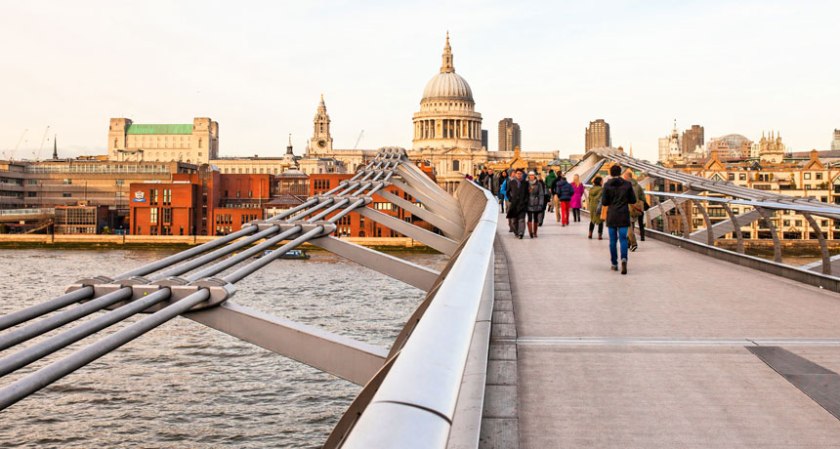
An air of excitement certainly gripped London on June 10, 2000, as 90,000 people queued up to cross the first new bridge to span the Thames River in over a hundred years, a bridge for pedestrians only, stretching from the Globe Theatre to St. Paul’s Cathedral, aptly named the London Millennium Footbridge. It didn’t take long for the bridge to become more known by its nickname, the Wobbly Bridge.
     Seems the designers had not given enough attention to a phenomenon with the catchy title, synchronous lateral excitation. Even if you’ve never heard of it, it doesn’t sound like anything you’d want to be on a bridge with.
     People, according to engineers, sway when they walk. People walking and swaying cause sideways oscillations in lightweight bridges. These, in turn, cause the people (some two thousand on the bridge at any given time) to sway even more to keep from falling over. And they all sway at the same time. It’s as if two thousand Londoners were doing the tango above the Thames. Result? Wobbly.
     Access to the bridge was limited later in the day, and on June 12 the bridge closed for modifications.  It reopened in 2002 (with tango forbidden).  It was again closed in 2007 because of strong winds and a worry that pedestrians foolish enough to cross might be blown off the bridge.
     The footbridge was not the only British millennial faux pas: a little number called the Millennium Dome elicited this derision from MP Bob Marshall-Andrews: “At worst it is a millennial metaphor for the twentieth century. An age in which all things, like the Dome itself, became disposable. A century in which forest and cities, marriages, animal species, races, religions and even the Earth itself, became ephemeral. What more cynical monument can there be for this totalitarian cocksure fragile age than a vast temporary plastic bowl, erected from the aggregate contribution of the poor through the National Lottery. Despite the spin, it remains a massive pantheon to the human ego . . .”

At the Zoo

Originally created as a royal herb garden in the 1600s, the Jardin des Plantes opened in 1793. During the following year a ménagerie was added, the world’s first and, still in existence, today the world’s oldest.  The 58-acre botanical garden and zoo is located in the center of Paris, next to the Seine.

The zoo was founded during the height of the French Revolution and the Reign of Terror. The National Assembly decreed that exotic animals  in private hands – rare antelopes, tigers, Louis XIV, and the like — were to be donated to the menagerie or guillotined, stuffed and donated to the natural scientists of the Jardin des Plantes . The Jardin was free for all visitors and tourists right from its inception.

While the menagerie at first was just provisional, it grew in the first three decades of the 19th century to be the largest exotic animal collection in Europe – as they describe it in France (or somewhere): monkey honnete, girafe pas sincere, elephant plein mais stupide, orang-outang sceptical, zebre reactionaire, antilope missionaire.

A well-run place, but this being France the menagerie gardiens are usually quite fond of their aperitifs.

Someone told me it’s all happening at the zoo.Paul Simon


JUNE 7, 1827: BEES IN THEIR BONNETS

640239 Insect Bumble Bee

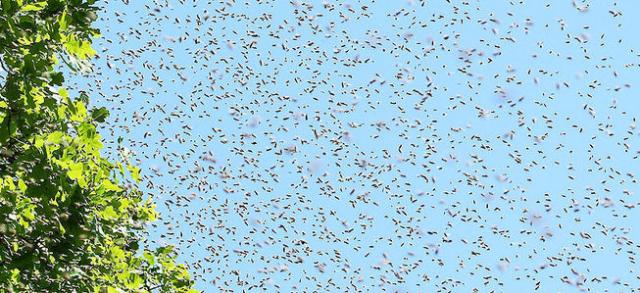
Local newspapers reported an amazing altercation in the village of Cargo in Cumberland, England, in 1827, a battle really (or a battle royal), between two opposing hordes – of bees. The home bees, it seems, were happily hived in the village, going about their bee business when, on June 7, a swarm from a neighboring village flew over the garden in which the first hive was situated. Without warning or so much as a by-your-leave, the interlopers darted down upon the hive and completely covered it, then began to enter the hive, pouring into it in such numbers that it soon became as crowded as happy hour at the local pub.

     Then the terrible struggle began. With ear-splitting humming, two armies of combatants rushed forth, besiegers and besieged alike spilling out of the beleaguered hive into the open air. The bee-on-bee battle raged with such fury that the ground below was soon strewn with corpses. Not until the visiting swarm was vanquished and driven away did the battle end. The victors resumed possession of the hive.

     The local chronicle did not attempt to explain the motivations involved, but naturalists, adding a scientific perspective, suggested that sometimes bees fight.

Rodgers and Hammerstein Are Frauds.  Irving Berlin Too.

Julie Andrews and Von Trapps running from killer bees

It’s barely spring, and the hills of Vermont are alive with the sound of seventy degree temperatures, giving us a chance to venture out into the great outdoors.  A little maintenance, clean out a flower bed or two, rake.  Our resident swarm of bees had the same idea — without the raking.  We’ve long debated whether these bees are honey bees or some less desirable species.

I have ended the debate.  They are killer bees — murderous, cutthroat, bloodthirsty killer bees.  And one of their crack snipers got me.  I was tending to a bed, not threatening them in any way, and he swooped in and stung me on my eyelid.   Before long I looked like I had caught a baseball with my right eye.  I tried to recall what I had seen or heard about treating a bee sting and the Rodgers and Hammerstein cure came to me.  I spent the rest of the day remembering my favorite things, even drinking a couple of them.  It did nothing for me.

I spent a while standing out in front, stooped over, looking very much like Quasimodo, frightening away passing neighborhood children.  But I soon tired of this game.

Eventually I toddled off to bed.  But sleep wouldn’t come.  Finally I remembered Irving Berlin’s prescription for insomnia and began methodically counting my blessings instead of sheep.  As it turns out, one’s blessings and one’s favorite things are pretty much the same.  Three a.m.  I’m on my 137th blessing and wide awake.  I won’t bore you with the details of my 137 blessings, but I

Waiting for passers by

will tell you that Rodgers and Hammerstein and bees are not among them.

Today I will perch atop the rock wall out front on hands and knees pretending to be a radiation-mutated giant bullfrog, croaking at passers by.  Life goes on.

Be my little baby bumble bee.  Buzz around.  Buzz around.  Keep abuzzing round.

MAY 27, 1936: PROUD MARY KEEP ON BURNIN’

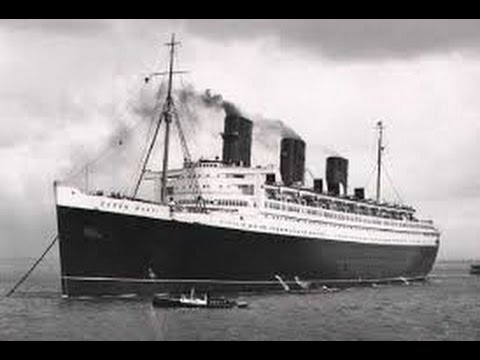
Although, out of superstition, women were banned from the workplace during the construction of the ocean liner Queen Mary, she was christened by a woman in September 1934.  By a queen actually — Queen Mary herself, the wife of George V who had died earlier that year and queen mother to Kings Edward VIII and George VI.

On May 27, 1936, throngs of cheering spectators looked on as the 80,000-ton liner, “the most beautiful ship afloat,” departed Southhampton on her maiden transatlantic crossing.. She carried 2,100 passengers who were pampered by a crew of 1,100. The passengers were as stylish as the ship’s Art Deco interior as they strutted through ballrooms, promenaded on deck, frolicked in the swimming pool, and occasionally visited their children in the nursery or their dogs in the kennel. Along with an amazing amount of food (50,000 pounds of meat), the Queen Mary carried over 14,000 bottles of wine and 25,000 cigarette packs.

The Queen Mary pretty much ruled the Atlantic for the rest of the decade until elegance gave way to utility as she was refitted as a troop ship during World War II. After the war the Queen Mary was returned to passenger service and along with her sister ship the Queen Elizabeth dominated transatlantic travel until 1967 when she left Southhampton on her last voyage arriving in Long Beach, California, where she was permanently moored.

Converted to a hotel, the Queen Mary has the dubious distinction of giving tourists a taste of transatlantic travel without ever leaving dry land. Yippee!

Don’t Stop the Carnival

Pulitzer Prize winner Herman Wouk was born in 1915. His books include The Caine Mutiny, The Winds of War, War and Remembrance, Marjorie Morningstar, and his most recent, which he says will be his last, Sailor and Fiddler: Reflections of a 100-Year-Old Author, released in 2016.    Don’t Stop the Carnival, a must-read for anyone interested in the Caribbean, was written in 1965. In the following excerpt, Norman and Henny Paperman have embarked on a new Caribbean enterprise and, at a party, they tell their friends about it:

During this evening, nearly every person there told Norman or Henny, usually in a private moment, that they were doing a marvelous, enviable thing. The Russians at the time were firing off new awesome bombs in Siberia, and the mood in New York was jittery, but there was more than that behind the wistfulness of their friends. All these people were at an age when their lives were defined, their hopes circumscribed. Nothing was in prospect but plodding the old tracks until heart disease, cancer, or one of the less predictable trap-doors opened under their feet. To them, the Papermans had broken out of Death Row into green April fields, and in one way or another they all said so.

Wouk died ten days ago.  He would have been 104 today.