MARCH 26, 47 BC: WITH A LITTLE BIT OF LUCK

Ptolemy XIII was Pharaoh of Egypt from 51 to 47 BC (remember we’re counting backwards here), his reign pretty much demonstrating the bad luck associated with the number thirteen (in fact he could have been nicknamed Ptolemy the Unlucky or Friday the XIII).

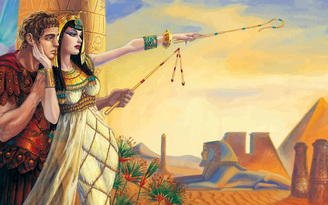
Ptolemy XIII succeeded his father Ptolemy XII, becoming co-ruler by marrying Cleopatra who was his older sister at the time. She was Cleopatra VII, but she was the Cleopatra we all know about — the one of Antony and Caesar and the asp and all that. Since XIII was only 11 at the time, he had a regent — and should you be thinking about the regent’s duties vis-à-vis Cleopatra, we’ll point out that the regent’s name was Pothinus the Eunuch.

Still with us?

Cleopatra, it turns out, was a bit of a grandstander, strutting about as Queen, putting her image on coins, and generally hogging the Egyptian spotlight. Thus in 48 BC, XIII and his eunuch tried to depose her, but she ran off to Syria and raised herself an army.

Enter Roman general Pompey, seeking sanctuary from Julius Caesar.  XIII pretended to welcome Pompey but had him murdered instead.  When Caesar arrived, XIII gave him Pompey’s head as a little welcoming gift. Caesar was unimpressed and took Cleopatra as his welcoming gift instead, giving XIII a cold Roman shoulder and killing his eunuch for good measure.

While Caesar and Cleopatra kept busy trysting the night away, XIII in cahoots with another sister (it’s great to be able to toss in another sibling when things are beginning to slow down) tried again to dump Cleopatra.

XIII and his other sister were no match for Caesar and Cleopatra and in the ensuing Battle of the Nile, XIII was forced to flee. Unfortunately, Ptolemy the Unlucky was drowned as he attempted to cross the Nile.


February 16, 1923: Beware of the Hippo

This could be the mother of all conspiracy theories. On February 16, 1923, mummy_2in Thebes, Egypt, English archaeologist Howard Carter entered the burial chamber of the Egyptian ruler King Tutankhamen — Tut to his friends and hangers on. As every schoolgirl knows, Tut died and was mummified back in 1324 B.C., give or take a year, while still a teen idol. As every schoolboy knows, anyone foolish enough to enter Tut’s burial chamber would become subject to a pretty nasty curse — involving but not limited to crocodiles, snakes and scorpions.

Tut was the first mummy found in tact and with all his wealth untouched by tomb raiders. And his discovery left scientists scratching their heads. No one knew what had caused the young king’s death. Theories have popped up during the years — genetic disorders, disease, foul play.

An Egyptologist at California State University, Dr. Benson Harer, has come up with a dandy new idea: Tut was done in by an angry hippopotamus. Well, we all know what nasty tempers hippos have. They kill more people each year than lions, gorillas, you-name-it. And ancient Egypt was lousy with hippos — capsizing boats, stomping crops, stampeding through villages, chomping people in half with a single bite.

King Tut loved to hunt hippos, and every schoolgirl knows what dummies hippo hunters can be. We can imagine Tut happening upon a baby hippo: “Isn’t he cute? Let’s get closer. I wonder if his mother’s around somewhere.” Dr. Harer has a lot of scientific stuff that goes along with his theory, but what’s most interesting is the good doctor’s speculation that a coverup took place, with authorities stonewalling and concealing the pharaoh’s death by hippo for political reasons, fearing that the common folk might see Tut as less Trumplike, more Bidenlike — or that the gods always liked hippos best. There you have it, slippery slopers — Hippogate!

When it comes to mummies, they don’t make them like this anymore:

Radio for Dummies

edgarbergenandcharliemccarthyBorn February 16, 1903, Edgar Bergen, along with his cohorts, Charlie McCarthy and Mortimer Snerd, got his start in vaudeville and one-reel movie shorts, but his real success came on radio of all places. The popularity of a ventriloquist on radio, when no one could see the dummies or even whether Bergen’s mouth moved, is a puzzler. But popular they were. Seen at a New York party by Noel Coward, who recommended them for an engagement at the famous Rainbow Room, they were discovered by two producers who booked them for a guest appearance on Rudy Vallee’s radio program. That quickly led to their own show which, under various sponsors, was on the air from 1937 to 1956.  Bergen died in 1978.  Charlie lives on at the Smithsonian.  One might be tempted to think Charlie related to Congressional Republicans because — well, for obvious reasons — but he’s not.

MARCH 26, 47 BC: WITH A LITTLE BIT OF LUCK

Ptolemy XIII was Pharaoh of Egypt from 51 to 47 BC (remember we’re counting backwards here), his reign pretty much demonstrating the bad luck associated with the number thirteen (in fact he could have been nicknamed Ptolemy the Unlucky or Friday the XIII).

Ptolemy XIII succeeded his father Ptolemy XII, becoming co-ruler by marrying Cleopatra who was his older sister at the time. She was Cleopatra VII, but she was the Cleopatra we all know about — the one of Antony and Caesar and the asp and all that. Since XIII was only 11 at the time, he had a regent — and should you be thinking about the regent’s duties vis-à-vis Cleopatra, we’ll point out that the regent’s name was Pothinus the Eunuch.

Still with us?

Cleopatra, it turns out, was a bit of a grandstander, strutting about as Queen, putting her image on coins, and generally hogging the Egyptian spotlight. Thus in 48 BC, XIII and his eunuch tried to depose her, but she ran off to Syria and raised herself an army.

Enter Roman general Pompey, seeking sanctuary from Julius Caesar.  XIII pretended to welcome Pompey but had him murdered instead.  When Caesar arrived, XIII gave him Pompey’s head as a little welcoming gift. Caesar was unimpressed and took Cleopatra as his welcoming gift instead, giving XIII a cold Roman shoulder and killing his eunuch for good measure.

While Caesar and Cleopatra kept busy trysting the night away, XIII in cahoots with another sister (it’s great to be able to toss in another sibling when things are beginning to slow down) tried again to dump Cleopatra.

XIII and his other sister were no match for Caesar and Cleopatra and in the ensuing Battle of the Nile, XIII was forced to flee. Unfortunately, Ptolemy the Unlucky was drowned as he attempted to cross the Nile.


September 12, 1878: Threading Cleo

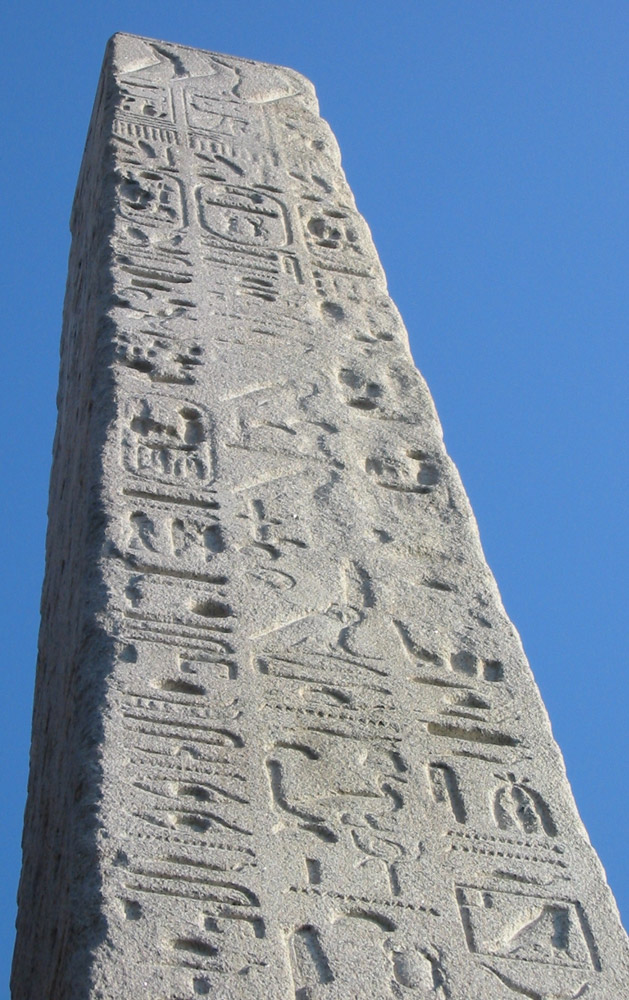
Cleopatra’s needle is not really a needle. Nor did it belong to Cleopatra. It is actually an obelisk, which at some 70 feet is a lot longer than most needles. This tall hunk of granite was first erected by Egypt’s Thutmose III in 1450 BC, give or take a few years. It was erected once again in London on September 12, 1878, after a rather curious 3,000-year history.

The obelisk was moved from its first site at Heliopolis to Alexandria during the reign of Augustus Caesar. It was toppled several years later by persons unknown and left face down in the shifting, whispering sands. After the obelisk lay there, collecting dust for 2,000 years, the Egyptian ruler Muhammad Ali came up with a great idea — they’d give it to the British in commemoration of some battle or another. And so they did, in1819.

The Brits were tickled, of course, but they let the big gift lie there for another 58 years, not quite tickled enough to foot the bill for a trip to England. Finally a private citizen agreed to pay for its transportation in a specially built ship named coincidentally, the Cleopatra, towed by another ship, the Olga. A storm at sea almost put a disastrous end to the venture, as the Cleopatra began rocking violently. Six men were killed trying to bring the her under control, and she was finally reported “abandoned and sinking.”

But Cleo didn’t sink. She was found drifting four days later by Spanish trawlers, then towed to Spain by a Glasgow steamer. Several months later, after repairs, she was finally towed to England where the was erected on the Victoria Embankment, flanked by two faux sphinxes.

Voila!, He Barked

On a beautiful afternoon in 1940, un chien Francaise named Robot was out for a walk in the Dordogne region of southwestern France, sans leash. Monsieur Dog, skipping away from his handler, 18-year-old

Marcel, found himself a big beautiful hole in the ground. Naturally, he bounded right in, not giving a moment’s thought to the enormity of the hole and the possible enormity of the creature who might have dug it.

Robot returned from the depths of the hole, uneaten, and Marcel sought the aid of some fellow teenagers to explore the hole. The four boys entered the hole, not giving a moment’s thought to the possibility that the creature found Robot too small a snack to be bothered with.

The hole stretched for 65 feet, qualifying itself as a cave, with not a single creature in it. These boys discovered that some other naughtier boys appeared to have painted graffiti all over the walls. Being good boys, and wondering if they should somehow wash down the walls, they sought adult guidance.

Well, didn’t the graffiti turn out to be 17,000 to 20,000 years, some 2,000 images of animals and strange prehistoric symbols that became famous as the Lascaux cave paintings But not one dog in the whole bunch. Robot remained unimpressed.