February 14, 278: Roses Are Red, Etc., Etc.

How did St. Valentine’s Day become a day associated with hearts and flowers and all things romantic? One account puts a definitely sinister spin on the origin of this holiday. It begins back in the third century with a fellow named Claudius the Cruel. As you might guess, Claudius is not going to be the hero of this tale.

Claudius (II, if you’re counting) was the Emperor of Rome, a barbarian who proved that any young boy can grow up to be emperor if he believes. Valentinus, or Valentine, was not a saint at the time, but he was a holy priest.

Claudius, in addition to his barbarianism and cruelty, was a bit of a warmonger. Continually involved in bloody campaigns to destroy upstart nations throughout the region, Claudius needed to maintain a strong army.  But it was a constant battle to keep his military at full strength what with Christianity gaining a toehold and everyone  into family values. The men for their part were unwilling to be all they could be in the army because of their annoying attachment to wives and families.

Claudius had a fairly simple solution; he banned all marriages and engagements in Rome. Valentine, part of whose livelihood was the performing of marriages, thought this decree unjust and defied the emperor by continuing to marry young lovers on the sly.  Claudius, as emperors will, got wind of Valentine’s doings and, true to his name, ordered that Valentine be put to death. Valentine was arrested and condemned to be beaten about the head, and then have said head cut off. The sentence was carried out on February 14, 278.

Legend has it that while in jail, Valentine left a farewell note for the jailer’s daughter, with whom he had had a brief relationship (that will not be explored here), and signed it “From Your Valentine.”  There may have been other cute little Valentine poems as well,  but they have been lost to history.

For this, Valentine was named a saint and had a holiday created after him, though not a legal one with school closings and such. Conspiracy theorists will naturally jump up and down, saying there were several St. Valentines and the holiday could have been named after any one of them. Or it could have come from the pagan festival Lupercalia, a day of wanton carrying on. They should mind their own business.

February 13, 1862: Thaw Out the Holly

With the giving and getting of gifts growing to a crescendo in late December, it is to many a glass of cold water in the face when the merriment suddenly gives way to a bleak long winter with scarcely a box or a bow in sight. The people of Norwich, a city on England’s east coast, a couple of centuries ago found a way to keep on giving by elevating February 13, St. Valentine’s Eve to a Christmas-like celebration.

According to an 1862 account, this Victorian tradition was evidently peculiar to Norwich: visitors to the city were often puzzled to find the shop windows crammed with gifts in early February and newspapers full of advertisements for ‘Useful and Ornamental Articles Suitable for the Season’ available from local retailers.

As soon as it got dark on St. Valentine’s Eve, the streets were swarming with folks carrying baskets of treasures to be anonymously dropped on doorsteps throughout the city. They’d deposit a gift, bang on the door, and rush away before anyone inside could reach the door. Indoors there were excited shrieks and shouts, flushed faces, sparkling eyes and laughter, a rush to the door, examination of the parcels.

Practical jokers  were everywhere as well, ringing doorbells and running off, leaving mock parcels that were pulled away by string when someone attempted to pick them up. Large parcels that dwindled to nothing as the recipient fought through layer after layer of wrapping, and even larger parcels containing live boys who would jump out, steal a kiss, and run away.

As with most holidays that involve children out after dark and mischief, the celebration of St. Valentine’s Eve fell out of favor, to be replaced by the Hallmark-inspired and saintless Valentine’s Day.

No Valentine, This One

Hal Foster had been drawing the Tarzan comic strip based on the books by Edgar Rice Burroughs for several years, but itched to create his own original strip. He began work on a feature called Derek, Son of Thane, set in Arthurian England. Before the strip had its coming out party on February 13, 1937, it had gone through a couple of name changes, first to Prince Arn and eventually to Prince Valiant.

Prince Valiant was five years old when his story began, a continuous story that has been told through 4,000 Sunday episodes. Without a whole lot of deference to historical accuracy, Val’s adventure’s take him throughout Europe, Africa, the Far East and even the Americas in a time frame covering hundreds of years. He does battle with Huns, Vikings, Sorcerers, witches and a slew of monsters from prehistoric to modern, but always big.

Foster drew the strip until 1971 and wrote the continuity until 1980. Since then, other artists have kept it alive. Foster died in 1982, at age 89.

Fore, I mean duck

Golf is thought of as relatively safe sport.  But for the safety of others, there are just some people who should not be allowed on a golf course.  Vice President Spiro Agnew had the dubious distinction of beaning not just one but three spectators on this day in 1971 during the Bob Hope Desert Classic.  On his very first drive, he sliced into the crowd for a two-bagger, bouncing off a man to nail his wife as well.  On his next shot, he hit a woman, sending her to the hospital.  The previous year, Agnew had managed to hit his partner in the back of the head.


February 8, 1983: A Horse Is a Horse Of Course

As a horse, Shergar had it pretty good.  He’d earned his place in the sun.  The Irish racehorse, a bay colt with a distinctive white blaze, won the Epsom Derby in 1981 by ten lengths— the longest winning margin in the race’s history. He was named European Horse of the Year that year and was retired from racing in September after winning £436,000 in prize money for his owners.

A month later, Shergar arrived in Newbridge, greeted by the town band and cheering, flag-waving throngs as he paraded up main street on his way to begin his stud career. It was another successful career for Shergar who produced 35 foals that season. His second season was looking good as well, with 55 mares on hand.

“A clue… that is what we haven’t got,” Chief Superintendent “Spud” Murphy told reporters shortly after the evening of February 8, 1983, when Shergar disappeared. Sherlock Holmes fans might by forgiven if they start claiming this scenario is right out of the great detective’s adventure, Silver Blaze.   Perhaps the perpetrators read Arthur Conan Doyle.

In any event, at 8.30 pm, Shergar’s groom,  James Fitzgerald thought he heard a car in the yard. He listened, heard nothing more, and forgot about it. Ten minutes later, there was a knock at the door and his son answered it. The uniformed caller asked the boy to fetch his father, but when he turned his back, the visitor hit him from behind, knocking him to the floor. Fitzgerald entered the room to see a pistol pointed at him. Three more armed men, one carrying a sub-machine gun, pushed their way into the house. They held the family at gunpoint while Fitzgerald led two more thieves to Shergar’s stall. Fitzgerald was forced to help the thieves load Shergar into a horse trailer, and the horse was towed away. Fitzgerald was driven around in another vehicle for several hours before being thrown out of the car having been given a password the thieves would use in ransom negotiations.

The investigation and the negotiations were a lesson in ineptitude on all sides, featuring detection by psychics and diviners, demands, counter demands, botched meetings, all amid rumors that the horse was already dead or that the owners were only negotiating to buy time with no intention of paying ransom.

Whatever the truth, after four days the thieves called no more.  Officials blamed the Irish Republican Army for the crime.  Shergar has never been found.  Sherlock Holmes fared better with Silver Blaze.  Unfortunately, he was no longer available.


These Guys Would Have Been Prepared

William D. Boyce was an American newspaper man, entrepreneur, publisher and a bit of an explorer. In 1909, Boyce happened to be exploring the streets of London. It was, as they say, a foggy day in London town. It may not have had him low, had him down, but it did have him lost, or so the legend goes.

As he wandered through the pea soup, haunted by thoughts of Jack the Ripper perhaps, a young lad stepped out of the haze and led him to his destination. Boyce tried to reward they boy who had come to his aid, but the boy would not accept a tip, explaining that he had merely done his duty as a Boy Scout.

The Boy Scout departed, off to help another poor soul lost in the fog, and Boyce returned to the United States, but not before he had visited London’s Boy Scout headquarters, where he immersed himself in scouting lore, starting campfires, tying knots.

Four months later on February 8, 1910, Boyce trustworthily, loyally, helpfully, friendlily, courteously, kindly, obediently, cheerfully, thriftily, bravely, cleanly and reverently founded the Boy Scouts of America.

A Clever Segue

“So here we are, stuck on Gilligan’s Island – Chickenshit Crusoe and his faithless companion, Good Friday.”

“I was a Boy Scout for two weeks,” Paul offered.

“What a relief. And to think I was starting to get worried. But you obviously know how to start a fire without matches, forage for food, and carve a comfortable existence out of the cruel jungle.”

“Well I did learn how to tie a square knot.”

“Well there you are. You little rascals are always prepared, aren’t you? And kind and reverent and true and God-fearing and above all helpful. If we only had a little old lady, you could help her back and forth across the beach.”

A brief bit from Voodoo Love Song, fun and adventure for you good little scouts, boy or girl, while you’re being prepared.  You can find it here.

February 5, 1861: Every Peeping Tom, Dick and Harry

A lady rode through the streets of London on horseback, naked (the lady not the horse), and didn’t get pinched (in the law and order sense, that is).  But more of that later.

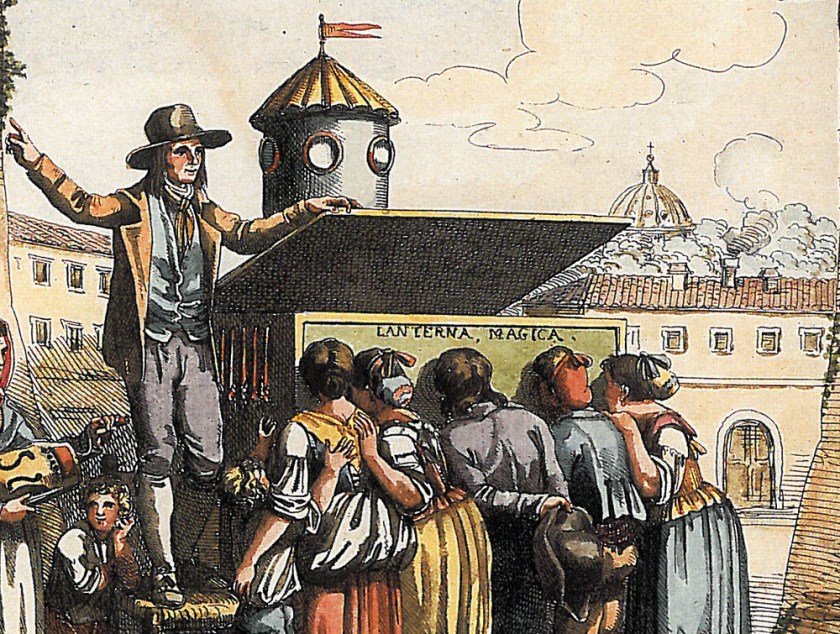
In 1861, Samuel B. Goodale who hailed from Cincinnati received a patent for a clever hand-operated stereoscope device on which still pictures were attached like spokes to an axis which revolved, causing the pictures to come to life in motion — a mechanical peep show that folks viewed through a small hole for a penny a pop.  The usual subjects for peep shows were animals, landscapes,  and theatrical scenes, high-minded, proper subjects.  Nothing naughty or titillating.  How long could that last, you ask.  Not long of course. The peep show quickly came to stand for pictures and performances involving sex.

The term peep show itself comes from Peeping Tom, a sneaky British tailor who made a hole in the shutters of his shop so he might surreptitiously spy on Lady Godiva who felt the need to ride naked naked through the streets of the city.  He was struck blind for his effort.

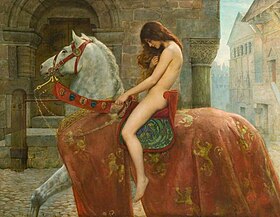
Collier, John; Godiva; Herbert Art Gallery & Museum

What about this Lady Godiva?  Was she for real?  Yes kids, she was.  And the performance she is famous for took place back in the 11th century.  According to her press agent, Lady Godiva was not just your ordinary exhibitionist giving the folks of Coventry, particularly the Toms, Dicks and Harrys of Coventry, their daily eyeful.  She was a noblewoman, married to the “Grim” Earl of Mercia, a nasty fellow who burdened the folks under his sway with high taxes and poor service.  Lady Godiva pleaded frequently with her husband to give the poor some relief, to no avail.  He eventually agreed to lower the taxes if she would ride through town completely naked. The Lady called his bluff.  To keep her ride from becoming something of the magnitude of a Taylor Swift concert,  the townspeople were told to shutter themselves indoors with no peeping.  Which they did, except for you know who.  In a later interview, Blind Tom said it was worth it.

That Ain’t No Cat in the Hat

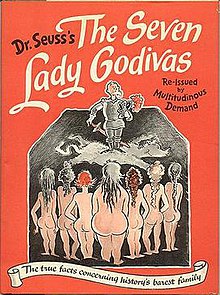
“It was all full of naked women, and I can’t draw convincing naked women.  I put their knees in the wrong places.”  What’s better than a Lady Godiva?  Two Lady Godivas.  Or how about seven?  The story of the seven Godiva sisters was penned by none other than Dr. Seuss, his fourth book and one written for adults or “obsolete children” as he called them.  The seven sisters never wear clothing, not even when they leave the seven Peeping brothers, and head off in the world to warn of the dangers of horses.

The 1939 book had a 10,000 print run with most of them remaining unsold, what Seuss called his greatest failure.  It is one of only two Dr. Seuss books allowed to go out of print.

But Please Lose That Sports Jacket

It has been endlessly debated when and with whom rock and roll actually began, but most enthusiasts have pretty much settled on a guy who cut an unlikely figure for a rock artist but who brought rock and roll into the public eye with a bang in 1955. The man was Bill Haley, along with his Comets, and the song was “Rock Around the Clock” introduced in the film Blackboard Jungle. During the next few years a string of hits including “Shake, Rattle and Roll” and “See Ya Later, Alligator” followed.

Time passes quickly and when you’re at the pinnacle of musical stardom, you’re on a slippery slope. Along comes a guy named Elvis and you’re yesterday’s sha-na-na. Who’s going to scream and carry on for a thin-haired, paunchy 30-year-old musician with a silly curl in the middle of his forehead and a garish plaid sports jacket?

The Brits, that’s who.

By 1957, Bill Haley and the Comets had already enjoyed their golden days of American super-stardom. But the battle of Britain lay ahead. When they stepped off the Queen Elizabeth in Southampton on February 5, they began the first ever tour by an American rock and roll act and launched what rock historians called the American Invasion.

When Haley and the band reached London later that same day, they were greeted by thousands in a melee the press called “the Second Battle of Waterloo.” These were the British war babies just becoming teenagers, and they were ready for American rock and roll.

January 31, 1696: Gobsmacked by a Dutch Undertaker

One would not think of undertakers as having particularly fiery dispositions.  Especially Dutch undertakers. They’d probably look at a current corpse  and realize they had it better than that poor bloke.  The most you might expect would be a mild oath such as “Go stick your finger in a dike.”  Thus it comes as a surprise that Dutch undertakers rose up in revolt on January 31, 1696.  On that day, they rioted in the streets 0f Amsterdam.

The cause of their dudgeon was a death tax, a tax on the burial of people, and since the person being buried would not be paying the tax, the undertakers got stiffed.  Not only that, the Amsterdam City Council reduced the number of official undertakers allowed from 300 to 72.  (They also reduced the number of political commentators to 1, but no one seemed to care.) The petulant undertakers stormed right up to the house of the Mayor of Amsterdam.  Someone in the crowd (most likely an undercover government operative) shouted “We’ll huff and we’ll puff and we’ll blow your house down.”  Which they did.  And they carried off the Mayor and tossed him into the Zuider Zee, wooden shoes and all.  Sailors and Dutch Uncles joined the revolt which moved on to the houses of the City Captain, Burgomasters and other city elite who also received their comeuppance.

Then as quickly as it had started, the riot ended.  Some say the undertaker’s hearts grew three sizes that day; others say it was cocktail time.  Nevertheless the Aansprekersoproer (that’s the official title of the event) ended, and shortly afterward the death tax was repealed.


Glasnost on a Sesame Seed Bun

Muscovites lined up on January 31, 1990, to try a most unRussian guilty pleasure. The Soviet Union might be crumbling around them, but that icon of Western decadence was riding high. McDonald’s had come to town.

Those Big Macs, with fries and shakes might cost a day’s wages, but the people of Moscow were eating them up. The notorious golden arches of capitalism were signs that times they were a’changing in the Soviet Union – in fact, within two years the Soviet Union would dissolve. A Soviet journalist saw no great political earthquake but rather an “expression of pragmatism toward food.” Could the Quarter Pounder be the ultimate example of the People’s Food?

Photographer: Andrey Rudakov/Bloomberg via Getty Images

Located in Pushkin Square, this McDonald’s was the world’s largest, boasting 28 cash registers and a seating capacity of 700. Its opening day broke a McDonald’s record with more than 30,000 customers served.

Moscow resident Natalya Kolesknikova told Russian State Television that when out-of-town guests came to visit, she showed them two things, McDonald’s and the McKremlin.

In 2022, there were 850 McDonald’s in Russia. Then Russia invaded Ukraine.  And McDonald’s is pulling out of a market it’s been a part of for 32 years, “de-arching” and selling every one of its restaurants.


January 13, 1930: Day of the Mouse

He’s short with big ears, a big nose and a skinny tail.  He’s nattily attired in red shorts with two big buttons, big yellow shoes and white gloves.  He hails from Florida these days where he has his own kingdom and is a woke Robin Hood to the state’s evil governor.  Back in 1930 when he made his debut he wasn’t quite so colorful, his venue being a black and white comic strip.  Mickey Mouse was already well known when his comic strip first appeared, having been a film star since his first appearance in 1928 in the cartoon Plane Crazy.  Created by Walt Disney and Ub Iwerks, he has grown in stature through the years to become the face of the Walt Disney organization.

The first comic strip sequence was a reprise of the Plane Crazy cartoon in which Mickey dreams of following in the footsteps of his idol Charles Lindbergh, flying into adventure in his own homemade plane, along with his girlfriend Minnie.

The governor of Florida would probably fare better against a less formidable Disney character.  A DeSantis/Donald Duck debate would be priceless.

If Only It Had Wings

On January 13, 1854,  musical inventor Anthony Foss received a patent for his accordion, a strange device shaped like a box with a bellows that is compressed or expanded while pressing buttons or keys which cause pallets to open and air to flow across strips of brass or steel, creating something that vaguely resembles music. It is sometimes called a squeezebox. The person playing it is called an accordionist (or squeezeboxer?)

The harmonium and concertina are cousins. And, yes, there is a World Accordion Day.

If Only She’d Had a Squeezebox

Born in Russia on January 13, 1887, “the Last of the Red Hot Mamas,” Sophie Tucker immigrated to the United States as an infant and began her long career shortly afterward, singing for tips in her parents’ restaurant. Between taking orders and serving customers, Sophie would stand in a narrow space by the door and belt out songs with all the drama she could muster. “At the end of the last chorus,” she remembered, “between me and the onions, there wasn’t a dry eye in the place.”

She gained stardom using a combination of comic risque and “fat girl” songs such as “Nobody Loves a Fat Girl, But Oh How a Fat Girl Can Love.” Her signature song, however, was “Some of These Days.” She became one of the most popular entertainers in America, following her vaudeville and burlesque career with movies through the 30’s and 40’s and television in the 50’s and 60’s.  She influenced many female performers, including such larger than life performers as Mae West and Bette Midler.

Sophie Tucker continued performing until her death in 1966.

JANUARY 12, 1896: I CAN SEE CLEARLY NOW

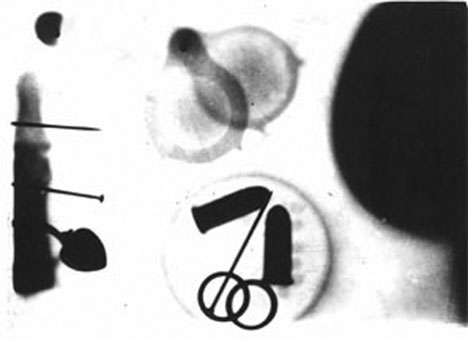
x-rayDr. Henry Louis Smith was a professor of physics at Davidson College in North Carolina where he was pioneering the use of X-rays in America. He planned to duplicate the work of the German physicist who discovered x-rays.  Smith made the mistake of telling his students about his plans.  On the night of January 12, 1896, three of Smith’s students bribed a janitor to let them into the medical laboratory on campus, where they played around until the wee hours, finally producing an X-ray photograph of two .22 caliber rifle cartridges, two rings and a pin inside a pillbox,some pills, a magnifying glass and a human finger they had sliced from a cadaver with a pocketknife — a historical first in the United States (the x-ray photograph not the finger).  Smith went on to create his own images and to spread the use of x-rays throughout the medical community.  The students kept their little adventure a secret until years later when they decided they would probably be forgiven for their naughtiness if they revealed their part in making history.

Surely There’s Some Noble Use for X-rays

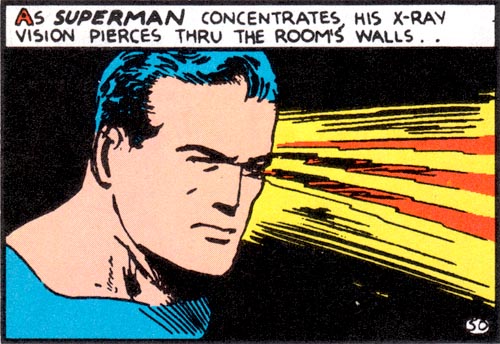
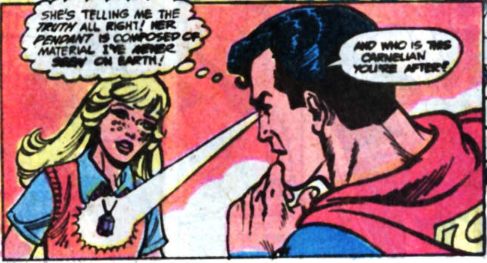
X-rays have since then become an important tool in medicine, saving many lives and other such noble stuff, but what has been more important to generations of boys is the concept of x-ray vision — the xrayvision1ability to see what’s on the other side of a wall, in a box, or under various articles of clothing.  Most boys learned about x-ray vision from Superman, easily the most famous employer of the art.  Superman only used his powers of x-ray vision for completely innocent pursuits such as the apprehension of bad guys.  However, those bad boys who sent for the x-ray spectacles advertised in comic books are quite another story.xspecs

A Man’s Home Is His Stonehenge

Stonemason, sculptor and oddball Edward Leedskalnin was born on January 12, 1887, in Latvia. He left Latvia for the United States at the age of 26 after 16-year-old Agnes Skuvst broke their engagement on the day before they were to be married.

Edward eventually purchased a parcel of land in Florida City and began what would become his life’s work — the construction of a massive structure he called “Rock Gate” and which he dedicated to his lost love Agnes. Working alone, he quarried and sculpted 1,100 tons of limestone into the titanic structure that came to be known as The Coral Castle and which was often called America’s stonehenge.

When asked how he moved all that heavy stone by himself, he answered: “I understand the laws of weight and leverage and I know the secrets of the people who built the pyramids.” He eventually opened his castle to the public, charging ten cents admission.

Ever the eccentric, he lived as a recluse and existed on a diet of crackers and sardines. He also published several pamphlets, the first being a dissertation on morality with text only on the left-hand pages so that his readers might offer their own opinions on the right. He got particularly worked up on the subject of teenage lust: “. . . everybody knows there is nothing good that can come to a girl from a fresh boy. When a girl is sixteen or seventeen years old, she is as good as she ever will be, but when a boy is sixteen years old, he is then fresher than in all his stages of development.”

And he probably owns x-ray glasses.

JANUARY 4, 390: COME DOWN, COME DOWN FROM YOUR IVORY TOWER

As we work our way through the twelve days of Christmas, we reach a point where True Love’s gifts are somewhat over the top.  Today is no exception — eleven pipers piping, each armed with a monkey wrench, applying their noble trade to clogged pipes and leaking faucets — at time and a half.  It is Christmastide, you know.  The eleventh ghost of Christmas introduces Scrooge to Tiny Tim.  Scrooge takes an instant dislike to the lad until he learns that Tiny Tim whacks his schoolmates with his crutch and takes their milk money.

In addition to celebrating plumbers, the eleventh day celebrates a saint, as many of the twelve days do. Day eleven is dedicated by those folks who dedicate such things to Saint Simeon Stylites also known as Saint Simeon Stylites the Elder to distinguish him from Simeon Stylites the Younger. He is known primarily for spending 37 years on a platform atop a pillar outside of Aleppo in what is now Syria (one could make a pretty good case that in Syria on top of a pillar might be a good place to be).

Why did Simeon choose to live up there like an Arabian Rapunzel, you ask? Simeon was very likely a wise man or at least people thought he was, because they kept coming to him for advice. Many folks would be honored to be sought out for guidance. Not Simeon. Seekers annoyed him. He wanted to be left alone to pray his private prayers and possibly entertain other thoughts as well.

So he went out and found a pillar. His first pillar was a mere nine feet tall and he soon realized that people could easily shout their entreaties to him. He thus began a series of relocations, each pillar being taller than its predecessor. His final pillar was really up there, some 50 feet above the ground and its many pests.

January 2, 1921: A Nice Robot Is a Happy Robot

As every child of five knows, Karel Capek penned the play R.U.R. which premiered on January 2, 1921, and took the world by storm. Okay, maybe every Czech child of five, since Capek was a Czech writer which, of course, makes R.U.R. a Czech play. Maybe every nerdy Czech child of five who loves science fiction knows that R.U.R. stands for Rossumovi Univerzální Roboti . You’ll want to make special note of that because it’s what the following is all about.

The English translation of R.U.R. is Rossum’s Universal Robots, and it was the first ever use of the word robot, coined by Karel’s brother Josef. The play takes place in a factory that fashions faux people from bits of leftover organic matter. These are not your metallic robots that we know and love today. These are living creatures that look a lot like humans and have minds of their own.  More like Frankenstein’s monster than Robby the Robot.  At first they’re happy slaving away for their masters, but eventually they realize they’re doing all the work and the one percent are reaping all the benefits, so up they rise and destroy every last human.

R.U.R. was quite successful and influential in the science fiction world. Within two years, it had been translated into 30 languages. And an army of famous robots followed.

Isaac Asimov, born coincidentally on January 2, back in 1920, contributed to the robot milieu during the 1930s in his short-story collection I, Robot.  Asimov created rules of etiquette for well-behaved robots, one of which is “don’t destroy your creator.”


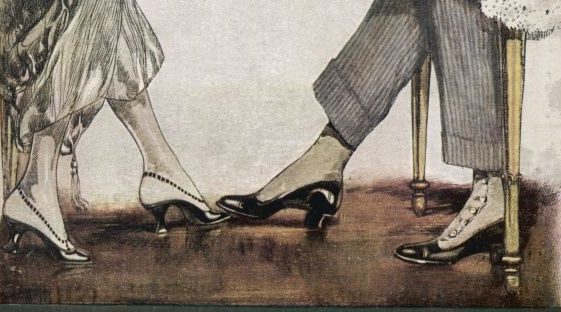
An elegant couple play footsie under a lacy tablecloth.

January 2, 1822:  Good Robots Don’t Presseth and Treadeth on the Feet of Maidens

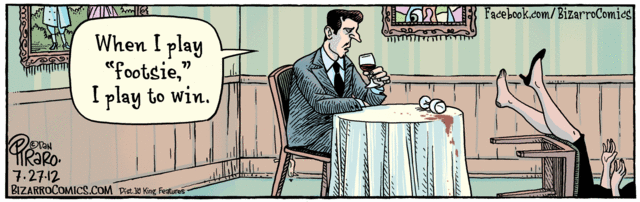
On this day, the Times of London described an unusual new method of courtship: “When a young man hath the felicity to be invited of the same party with the maiden who hath won his affections, then doth he endeavour to sit opposite her at the table, where he giveth himself up not to those unseemly oglings and gazing . . . but putting forth his foot, he presseth and treadeth on the feet and toes of the maiden; whereupon if she do not roar forth, it is a sign that his addresses are well received, and the two come in due course before the minister.  This form of attack is known by the name of Footie, and the degree of pressure doth denote the warmth of the passion.”

An Italian court ruled in 2000 that footsie is not sexual harassment.

On the ninth day of Christmas True Love sent a gift of nine ladies dancing.  Unfortunately, they were doing the bunny hop.  And they even brought their own bunnies.  This ushered in a new feature of True Love’s gifts: noise, noise, noise.  Unfortunately for Scrooge, the ninth ghost of Christmas had a rather mean sense of humor.  He returned Scrooge to his wedding day on which his bride-to-be, the girl of his dreams, didn’t show because her grandmother had died, she had a hangnail, or she was grounded for her unseemly interest in football players.

MAY 10, 1893: THE SUPREME COURT SAYS TOMAHTO

An 1883 tariff act required a tax to be paid on imported vegetables, but not fruit. The Nix family, tomato entrepreneurs, went to court to recover back duties paid to the Port of New York under protest, claiming that they owed nothing because, botanically, a tomato is a fruit, a seed-bearing structure growing from the flowering part of a plant. The case made it to the Supreme Court where, on May 10, 1893, the justices unanimously ruled that, botany be damned, a tomato is a vegetable.

At the hearing, both the plaintiffs’ counsel and the defendant’s counsel made extensive use of dictionaries. The plaintiffs’ counsel read in evidence the definitions of the word tomato, while the defendant’s counsel read the definitions of the words pea, eggplant, cucumber, squash, and pepper. In a clear case of one-upmanship, the plaintiff then read in evidence the definitions of potato, turnip, parsnip, cauliflower, cabbage, carrot and bean.

The court decided in favor of the defense and found that the tomato should be classified under the customs regulations as a vegetable, based on the ways in which it is used, and the popular perception to this end.  Justice Horace Gray, in a horticultural burst of logic, stated that:

“The passages cited from the dictionaries define the word ‘fruit’ as the seed of plants, or that part of plants which contains the seed, and especially the juicy, pulpy products of certain plants, covering and containing the seed. These definitions have no tendency to show that tomatoes are ‘fruit,’ as distinguished from ‘vegetables,’ in common speech, or within the meaning of the tariff act.”

He acknowledged that botanically, tomatoes are classified as a “fruit of the vine”; nevertheless, they are seen as vegetables because they were usually eaten as a main course instead of being eaten as a dessert. In making his decision, Justice Gray brought up another case in which the court found that although a bean is botanically a seed, in common parlance a bean is seen as a vegetable. While on the subject, Gray clarified the status of the cucumber, squash, pea, and turnip for good measure.

It would take another century to declare ketchup a vegetable.