JUNE 3, 1956: I KNOW SUGGESTIVE STIMULATING AND TANTALIZING MOTIONS WHEN I SEE THEM

A dance party in the beach town of Santa Cruz, California, a quiet oasis 70 miles south of San Francisco, back in 1956 (years before it became a counterculture capital),  led to a bit of overreaction by the town’s conservative adult authorities. Two hundred teenagers had taken over the Santa Cruz Civic Auditorium on a Saturday night to dance to the music of a group called Chuck Higgins and his Orchestra, regional favorites with a few hit rock recordings. Shortly after midnight, Santa Cruz police entered the auditorium to check on the event, and didn’t like what they saw: a crowd “engaged in suggestive, stimulating and tantalizing motions induced by the provocative rhythms of an all-negro band.” Although that sounds like a pretty good endorsement for the affair, the police did not view it as a positive. Without so much as a “save the last dance for me,” they shut the place down and sent everyone home to bed.

And they didn’t stop there. On the following day, June 3, city fathers further endeared themselves to city teenagers and captured national attention when they announced a total ban on the playing of rock and roll and other forms of “frenzied music” at public gatherings (the other forms probably meant to pull Wayne Newton into the loop).  Such music was, they said, “detrimental to both the health and morals of our youth and community.”

Not everyone saw this as an absurdity, it’s concern with “undesirable elements” not so subtly racial, and an effort that was bound to fail. Within two weeks, similar bans were enacted in Asbury Park, New Jersey, and in San Antonio, Texas.  But in spite of such valiant efforts, rock and roll would soon dominate the Billboard Hot 100, and teenagers everywhere would be singing “It’s got to be rock-roll music, if you want to dance with me.”


JUNE 2, 1855: GIVE ME A MARTINI OR GIVE ME DEATH

In the early 1850s, the city of Portland, Maine, with a population of 21,000 might be called a sleepy little burg. But that was about to change thanks to a Maine law enacted in 1851 outlawing the manufacture and sale of alcohol anywhere in the state, except for medicinal and mechanical purposes.

Portland Mayor Neal S. Dow was an outspoken prohibitionist who fully supported the law, so much so that he was dubbed the “Napoleon of Temperance. ” However, Dow had authorized a large shipment of “medicinal and mechanical alcohol” that was being stored in the city vaults for distribution to pharmacists and doctors (authorized under the law). The good citizens of Portland got wind of this cache of alcohol and suspected the worst, that Dow was a hypocrite and a secret sot.

The Maine law had an interesting little clause allowing any three voters to apply for a search warrant if they suspected someone was selling liquor illegally. Three men did just that, appearing before a judge who issued a search warrant.

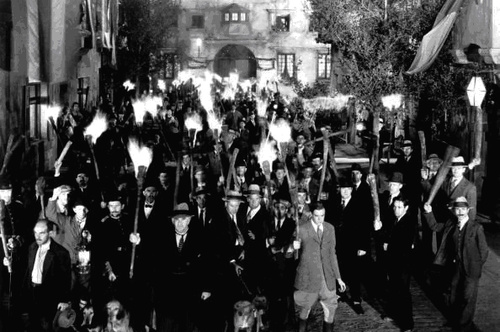
On the afternoon of June 2, a crowd of several hundred people, already irate over the law coming between them and their Harvey Wallbangers, gathered outside the building where the alcohol was being held. The crowd grew larger and surlier as it became obvious that the police were not going to seize the booze. As the crowd swelled, jostling became shoving, and the hurling of angry words became the hurling of rocks. The infamous Portland Rum Riot of 1855 was in full swing.

Police were unable to control the mob, and Mayor Dow called out the militia. When the protesters ignored the order to disperse, the militia, on Dow’s orders, fired into the crowd killing one man and wounding several others.

Dow was widely criticized for his strong-arm tactics during the incident and was later prosecuted for improperly acquiring the alcohol but was acquitted. The Maine Law was repealed the following year.


MAY 29, 1913: ILL-MANNERED FACTIONS? IN PARIS?

On the evening of May 29, 1913, the Theatre des Champs-Elysees, the newest venue in Paris, open for just over a month, was packed.  According to a newspaper report: “Never. . . has the hall been so full, or so resplendent; the stairways and the corridors were crowded with spectators eager to see and to hear.” What they were eager to see and to hear was a ballet program celebrating the works of many of the leading composers of the day. Ticket sales were priced accordingly.

Parisian ballet audiences of the time fell into two distinct groups: the wealthy and fashionable set, who would be expecting to see a traditional performance with beautiful music, and a “Bohemian” group favoring anything new and nontraditional because it would annoy the snobs in the boxes.

The evening began tranquilly with Les Sylphides, in which Vaslav Nijinsky and Tamara Karsavina danced the main roles, followed by the premiere of Stravinsky’s The Rite of Spring (Pictures of Pagan Russia in Two Parts) in which, after various primitive rituals celebrating the advent of spring, a young girl is chosen as a sacrificial victim and dances herself to death.

There is a consensus among eyewitnesses and commentators that the disturbances in the audience began during the Introduction, which was greeted by derisive laughter, and grew into a crescendo when the curtain rose on the “Augurs of Spring” with its pipers piping and dancers stomping. The terrific uproar, along with the on-stage noises, pretty much drowned out the performers.  The two factions in the audience began attacking each other, but their anger was soon diverted toward the orchestra, and anything not tied down was quickly thrown in its direction. The plucky orchestra played on. Forty or so of the most energetic offenders were forcefully ejected by the police who had arrived somewhere toward the end of Part I. Throughout all this the performance continued without interruption.

Things grew somewhat quieter during Part II, and by some accounts the final “Sacrificial Dance” was watched in reasonable silence, albeit with a certain amount of muttering.  At the end there were several curtain calls (as opposed to catcalls) for the dancers, the orchestra, and Stravinsky before the evening’s program continued.

Press reviews called the work “a laborious and puerile barbarity” on one hand and “superb, with the disturbances, being merely a rowdy debate between two ill-mannered factions” on the other.

Paris survived.  The Rite of Spring became a classic.  And puerile barbarity is alive and well.


MAY 25, 2006: GEEK NIRVANA

2006 marked the very first celebration of Día del orgullo friki in Spain, local at first but now celebrated in such far-ranging places as Halifax, Nova Scotia; Timisoara, Romania; and San Diego, California; making it a truly international, sort of, event. The date commemorates the release of the first Star Wars film on May 25, 1977. (This was the second such commemoration for the movie; the first, Star Wars Day,  held on May 4 so celebrants could say “May the fourth be with you.”). The latest fest was the brainchild of a Spanish blogger known as Senor Buebo.


In 2008, the “holiday”was officially celebrated for the first time in the U.S., sporting its English translation, Geek Pride Day, its goal having become the promotion of geek culture. Today it has a manifesto and everything. Imagine if you will 300 proud geeks coming together to form a human pacman or, better still, a prime-number float in a Fifth Avenue parade.


As if this celebration wasn’t heady enough all by itself, Geek Pride Day shares the same date as two other similar fan “holidays”: Towel Day, for fans of The Hitchhiker’s Guide to the Galaxy on which true believers carry about a favorite towel, and the Glorious 25th of May for fans of Terry Pratchett’s Discworld.

Dinner Leaps This Way

An English gentleman who identified himself only as a friend to the Poor wrote a letter to the Public Advertiser on May 25, 1772, describing a novel idea. The idea had occurred to him after reading a passage in a guidebook about a town in France: “There are three small rivers that run through the town, one of which is much frequented by frogs, though one would imagine that in time they would be destroyed, as they commonly compose a dish or two at each meal at the tables of both rich and poor; the latter mostly living on them.”

Your entree

The letter went on to suggest that the poor of England could avoid the high cost of most kinds of food by procuring frogs as food for themselves, since the ponds and ditches of England were full of them. Although the letter writer had never personally tasted a frog, he had been assured that when fried in butter and parsley one could not distinguish it from fricassee of chicken. To those that worried that the ignorant might mistakenly eat a toad, he pointed out that the frog is light brown whereas the toad is almost black, that frogs leap, toads creep.
The gentlemen closed by saying let those that can afford it have roast beef every day, but to those poor wretches who cannot he offers this hint for their benefit.

MAY 21, 1819: DON’T TAKE ANY WOODEN BICYCLES

     In 1819, the first bicycle in the U.S. appeared in New York City.  And it started a craze that was to overtake the city for the rest of the summer. Actually it was a sort of a bicycle. It didn’t have any pedals. And you didn’t sit on it. It did have two wheels, but no one called it a bicycle. People variably called it a “velocipede” (Latin for fast foot), “swift walker,” “hobby horse” or its most popular name “dandy horse,” referring to the dandy who usually rode it.

     The dandy horse and the craze that it caused had been imported from London, although the contraption was actually invented in Germany. It was propelled by the rider pushing along the ground with the feet as in regular walking or running. The front wheel and handlebar assembly were hinged to allow steering. One major drawback of the dandy horse was that it had to be made to measure, manufactured to conform with the height and the stride of its rider. And it had wooden wheels which were okay for the smooth pavement of the city but any other surface made for an extremely uncomfortable ride.

     The dandy horse fad was short-lived. Perhaps it was the constant ridicule or the rocks thrown by ruffians. And with riders preferring the smooth sidewalks to the rough roads, many pedestrians began to feel threatened by the machines. As a result, laws were quickly enacted prohibiting their use on sidewalks.

     It was another 40 years before velocipedes came back into fashion – equipped this time around with pedals – when a French company began to mass-produce them. The French design was sometimes called the boneshaker, since it was also made entirely of wood and was still a very uncomfortable ride.

MAY 20, 1899: LEADFOOTED IN THE BIG APPLE

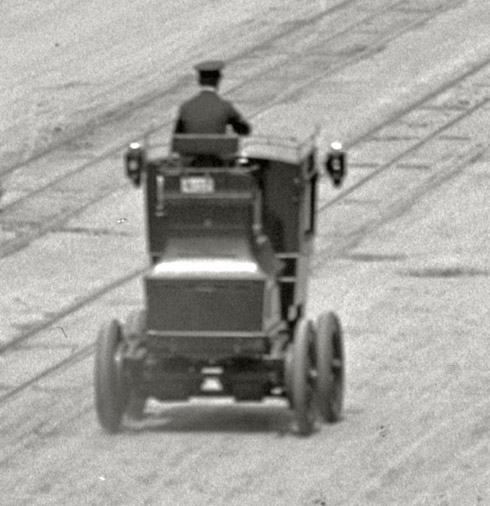
     Jacob German, a New York City taxi driver, earned the dubious distinction of being the first person to be cited for speeding in the United States when he was pulled over for barreling down Lexington Avenue in Manhattan. The scofflaw was “clocked” at a speed of 12 miles per hour by a police officer who, with persistent pedaling of his bicycle, managed to overtake him. German was imprisoned in the East 22nd Street station house. He did not have to surrender his registration and license because there were no such things in 19th century New York.

     The speed limit was claimed to be (although it was not posted) 8 mph on straights and 4 mph through turns. German was driving an electric vehicle. Records don’t indicate whether or not he was on duty or carrying a fare.

     A fair number of drivers have been issued speeding tickets since. The US Census Bureau tells us that 100,000 people per day are cited for speeding in the United States. At an average fine of $150 per ticket, that’s $15 million daily, a nice source of income for various municipalities – particularly in Ohio where the most tickets are issued (followed by Pennsylvania and New York). And certainly an award must go to tiny Summersville, WV. The town, with a population of 3,200, gives out 18,000 to 19,000 speeding tickets annually.

Texas claims the ticket for the fastest speed – 242 mph in a 75 mph zone. That driver was not pulled over by a police officer on a bicycle.

May 17, 1620: Round and Round She Goes

An English traveler happened upon an unusual contraption while passing through what is present-day Bulgaria on May 17, 1620. It was a circular device with seats attached to its perimeter. Children were tethered to the seats and the whole device turned round and round. The Englishman approached the device hoping to save these poor tykes. But as he drew near he heard their squealing and laughter. They were not being punished; they were being entertained. The Englishman’s account of this marvelous contraption is the earliest reference to what ultimately became known as the carousel — or merry go-round to those who disdain the French.

Carousels became popular throughout Europe a century later and in the United States a bit later. These carousels featured carved horses and other fanciful animals — zebras, lions, tigers, unicorns, dragons. At first they were powered by animals or people then eventually by steam engines and finally electricity. Gears and cranks gave the animals their familiar up and down motion.

Today the carousel is mostly favored by those too young or too timid to brave the more heart-pounding rides such as roller coaster, tilt-a-whirl, and loop-the-loop.


Carousels Not Heart-Pounding?

AND KEEP YOUR ELBOWS OFF THE TABLE

As first minister to France’s Louis XIII, Cardinal Richileu was a major player in the politics of the early 17th century, transforming France into a powerful centralized state. On a lesser scale, he was a noted patron of the arts. On an even lesser scale (arguably), he made a singular contribution to the etiquette of French dining, which was at the time anything but refined.

Diners used their hands to move food directly to their mouths or speared pieces of meat with the sharp point of their knives. They even used those same knives to pick their teeth. Having grown weary of these displays of gastronomical unpleasantness, Richileu had an inspiration. On May 17, 1637, he ordered the blades of all the palace dinner knives to be rounded off, thus creating what has become the modern dinner knife.

Talk about a trendsetter. The Richileu dinner knife became le dernier cri, the last word in dining. The craze spread throughout continental Europe, even to England of all places. And the American colonies!

MAY 16, 1988: ONE MAN’S TRASH

trashcan

In 1984, the Laguna Beach Police Department learned from unnamed sources that one Billy Greenwood had a little home-based business selling illegal drugs. An investigator asked the neighborhood’s regular trash collector to turn over to police the plastic garbage bags he collected from the front of Greenwood’s house. In the garbage, the investigator found tell-tale signs of drug use. Using that information, police obtained a warrant to search Greenwood’s home. Lo and behold, when officers searched the house, they found cocaine and marijuana along with dirty dishes and other signs of poor housekeeping. Greenwood was promptly arrested.


California courts ruled that searching the trash was a no-no under both federal and state law. The matter found its way to the U.S. Supreme Court.  On May 16, 1988, the Court reversed lower courts and ruled by a 6–2 vote that no warrant was necessary to search the trash because Greenwood had no reasonable expectation of privacy having put it right out on the curb like that.  No matter that he had put the trash in opaque plastic bags whose contents could not be seen without opening and that he expected it to be on the street only a short time before being taken to the dump.  The Court said it was “common knowledge” that garbage at the side of the street is “readily accessible to animals, children, scavengers, snoops, and other members of the public,” none of whom might have search warrants. Not only that, Greenwood had left the trash there expressly so that the trash collector, a perfect stranger, could take it, and do with it as he pleased.


In dissent, Justice Brennan reasoned that the possibility the police or other “unwelcome meddlers” might rummage through the trash bags “does not negate the expectation of privacy in their contents any more than the possibility of a burglary negates an expectation of privacy in the home.”  Under existing law, the bags could not have been searched without a warrant if Greenwood had been carrying them around in public. Merely leaving them on the curb for the garbage man to collect, Brennan argued, should not be found to remove that expectation of privacy any more than leaving an unattended bag in an airport terminal would. “Scrutiny of another’s trash is contrary to commonly accepted notions of civilized behavior.”


And one person’s trash is another person’s treasure.

MAY 10, 1893: THE SUPREME COURT SAYS TOMAHTO

An 1883 tariff act required a tax to be paid on imported vegetables, but not fruit. The Nix family, tomato entrepreneurs, went to court to recover back duties paid to the Port of New York under protest, claiming that they owed nothing because, botanically, a tomato is a fruit, a seed-bearing structure growing from the flowering part of a plant. The case made it to the Supreme Court where, on May 10, 1893, the justices unanimously ruled that, botany be damned, a tomato is a vegetable.

At the hearing, both the plaintiffs’ counsel and the defendant’s counsel made extensive use of dictionaries. The plaintiffs’ counsel read in evidence the definitions of the word tomato, while the defendant’s counsel read the definitions of the words pea, eggplant, cucumber, squash, and pepper. In a clear case of one-upmanship, the plaintiff then read in evidence the definitions of potato, turnip, parsnip, cauliflower, cabbage, carrot and bean.

The court decided in favor of the defense and found that the tomato should be classified under the customs regulations as a vegetable, based on the ways in which it is used, and the popular perception to this end.  Justice Horace Gray, in a horticultural burst of logic, stated that:

“The passages cited from the dictionaries define the word ‘fruit’ as the seed of plants, or that part of plants which contains the seed, and especially the juicy, pulpy products of certain plants, covering and containing the seed. These definitions have no tendency to show that tomatoes are ‘fruit,’ as distinguished from ‘vegetables,’ in common speech, or within the meaning of the tariff act.”

He acknowledged that botanically, tomatoes are classified as a “fruit of the vine”; nevertheless, they are seen as vegetables because they were usually eaten as a main course instead of being eaten as a dessert. In making his decision, Justice Gray brought up another case in which the court found that although a bean is botanically a seed, in common parlance a bean is seen as a vegetable. While on the subject, Gray clarified the status of the cucumber, squash, pea, and turnip for good measure.

It would take another century to declare ketchup a vegetable.

APRIL 29, 1946: Are You Looking for a Smiting?

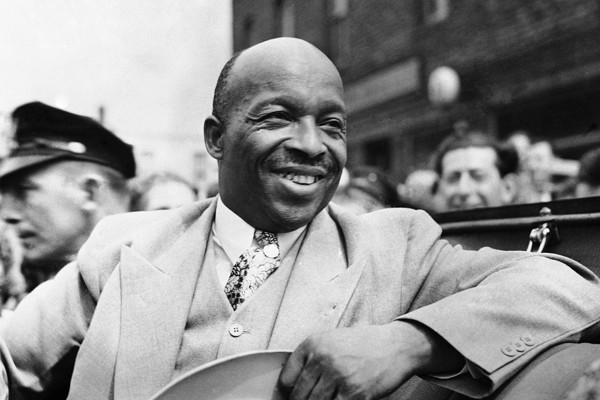
God was married on this day in 1946. For the second time. He was 70 at the time; she was 21 and, he claimed, a reincarnation of his first wife.

Unlike many other religious leaders who claimed to have God’s ear, Reverend Major Jealous Divine, (1876 – 1965) claimed to be God. Some contemporaries – jealous’ themselves perhaps – claimed he was more charlatan than god. Earlier in his life, before he became God, he was simply the Messenger. He founded what some have called a cult and oversaw its growth into a multiracial and international church.

Father Divine preached extensively in the south where, in 1913, he ran afoul of local ministers and was sentenced to 60 days jail time. While he was serving his sentence, several prison inspectors were injured in an auto accident, which, Father Divine pointed out, was the direct result of their disbelief.

Upon his release, he attracted a following of mostly women in Georgia. In 1914, several of his followers’ husbands and local preachers had Divine arrested for lunacy. This did not have the desired effect; it actually expanded his ministry. Father Divine was found mentally sound in spite of “maniacal” beliefs. When arrested, he had refused to give his name and was tried as John Doe (aka God).

After moving north and attracting a New York following — just as you were saying with a smirk, it could only happen in Georgia — Father Divine was arrested again, this time for disturbing the peace. At his 1932 trial, the jury found him guilty but asked for leniency. Ignoring this request, the judge called him a menace to society and sentenced him to one year in prison and a $500 fine. The 55-year-old judge died of a heart attack a few days later. Father Divine told-you-soed thusly: “I hated to do it. I did not desire Judge Smith to die . . . I did desire that my spirit would touch his heart and change his mind that he might repent and believe and be saved from the grave.”

In 1944, singer/songwriter Johnny Mercer attended one of his sermons – the subject, “You got to accentuate the positive and eliminate the negative.” Mercer was impressed. He returned to Hollywood and, with songwriter Harold Arlen, wrote “Ac-cent-tchu-ate The Positive”, which was recorded by Mercer himself and the Pied Pipers in 1945. It was also recorded by Bing Crosby with the Andrews Sisters.  And probably sung a year later at God’s wedding.