JULY 7, 1104: IT’S OUR PLEASURE, YOUR BACON

England is not without its share of quaint ceremonies, many dating back to medieval times. One of the more unusual of these is the Dunmow Flitch which had its inception in Little Dunmow, Essex, during the 13th century and gravitated from there to Great Dunmow (a larger venue perhaps). The custom was a celebration of marital bliss in which a lucky couple who could satisfy judges of their own would be rewarded with a flitch of bacon, basically half a pig.

To win the flitch, the couple must prove that they had lived for a full year in a state of wedded euphoria, never uttering a harsh or quarrelsome word, nor shooting even a nasty glance in the other’s direction. No negative thought or a hint of regret could enter their minds. And if they had the opportunity to do it all over — well, you get the drift. If the judges were convinced:

“A whole gammon of bacon you shall receive,
And bear it hence with love and good leave:
For this is our custom at Dunmow well known,
Tho’ the pleasure be ours, the bacon’s your own.”

The happy couple were then paraded around town with their flitch of bacon and a lot of ballyhoo.

Were you to think this a very difficult way to procure a flitch of bacon, you’d be spot on. From the 13th century until the 18th century when the custom died out, there were, strangely enough, only six recorded winners. And according to an unreliable source, one of the early winning couples was a ship’s captain and his wife who hadn’t actually laid eyes on each other for the year after their wedding. Another couple, successful at first, had the flitch taken away from them after they began to argue about how it should be dressed. Yet another couple failed when the husband, who took part reluctantly, had his ears boxed by his wife during the questioning.

The custom has been reintroduced sporadically over the years. It is currently held every four years, coincidentally in the same years as American presidential elections.  Perhaps we could learn from it.

Maybe If They Hadn’t Had To Slice Their Own Bread

“The greatest thing since sliced bread” is high praise indeed, denoting the ultimate in ingenuity, a hallmark of good old American know-how, a real “Wonder,” if you will. Sliced bread? Really? How important can sliced bread be?

White bread, we just can’t quit you.

Well, for example, in 1943, U.S. officials imposed a ban on sliced bread as a wartime conservation measure for reasons known primarily to U.S. officials. Why not just cut off everyone’s right arm? A letter from a frantic housewife to The New York Times was typical of the reaction:

I should like to let you know how important sliced bread is to the morale and saneness of a household. My husband and four children are all in a rush during and after breakfast.  Without ready-sliced bread, I must do the slicing for toast—two pieces for each one—that’s ten. For their lunches I must cut by hand at least twenty slices, for two sandwiches apiece. Afterward I make my own toast. Twenty-two slices of bread to be cut in a hurry!

Sliced bread, specifically a loaf of bread pre-sliced by a machine and packaged for consumer convenience, made its debut on July 7, 1928, and was hailed as “the greatest forward step in the baking industry since bread was wrapped” (they couldn’t really call it the greatest thing since sliced bread). It was produced by the Chillicothe Baking Company of Chillicothe, Missouri, as “Kleen Maid Sliced Bread.”

Kleen Maid was followed by the Holsum Bread brand, used by various independent bakers around the country. And in 1930, Wonder Bread started marketing sliced bread (or a plastic replica of it) nationwide, and the rest, as they say in the bread world, is history.

JULY 5, 1937: SPAM CONQUERS THE UNIVERSE

Chopped pork shoulder meat, with ham meat added, salt, water, modified potato starch just for spam2fun, and sodium nitrite to give it chemical balance – who in 1937 would have thought such ingredients might add up to one of the most ubiquitous meat products known to the world. In 2007, the seven billionth serving was sold. Sure, McDonald’s has sold more burgers, but they don’t come in a can. Spam do.

Known in some circles as a precooked luncheon meat product and in others as mystery meat, Spam has probably been the butt of more food jokes than any other product. Its pervasiveness led to the lending of its name to junk email.

World War II saw a huge increase in the use of Spam. Replacing fresh meat, it was served for breakfast, lunch, and dinner and called “ham that didn’t pass its physical” or “meatloaf without basic training.”  After the war, a troupe of former servicewomen, the Hormel Girls, toured the country promoting the eating of Spam as being downright patriotic. The show went on to become a radio program all about selling Spam.  Hawaiians eat the most Spam per capita in the United States. It’s even sold at Burger King and McDonald’s.  Hawaii holds an annual Spam Jam in Waikiki during the last week of April.

In 1963, Spam was introduced to schools in South Florida as cheap food and was even used for art sculptures. It was so successful that Hormel Foods introduced Spam in school colors, the first being a blue and green variety that is still used today.

The North American home of Spam is Austin, Minnesota – “Spam Town USA.”   It’s home to the Spam Museum, celebrating the history of the Hormel company, the origin of Spam and its place in world culture.  Austin is also the location of final judging in the national Spam recipe competition. Competing recipes are collected from winning submissions at the top forty state fairs in the nation. And there’s a restaurant with a menu devoted exclusively to Spam – Johnny’s SPAMarama.

Don’t you want to run right out and buy a can?

We’d be remiss if, after the foregoing adulation, we didn’t give you a Spam recipe.  Here’s a nice easy one:

Hawaiian Spamburger

  • 1 (12-ounce) can Spam cut into 8 slices
  • 1 (8-ounce) can pineapple rings, drained
  • 4 hamburger buns, split and toasted
  • 4 slices American cheese

Brown the Spam slices in a skillet.

  1. Place 2  slices on each bottom half of a hamburger bun.
  2. Top with a pineapple ring and cheese slice.
  3. Cover sandwich with top half of bun.
  4. Don a lei and dive right in.

Born July 5, 1958, Bill Watterson:

ch-academia

July 4, 1883: Cartoonist (A) Draws Invention (B)

He is probably the patron saint of inventors everywhere – or at least their idol – for his uncanny ability to devise an incredibly convoluted method to carry out the simplest tasks. In fact the Merriam-Webster dictionary adopted his name as an adjective in 1931 meaning just that, to accomplish something simple through complex means.

Reuben Garrett Lucius (Rube) Goldberg was born on July 4, 1883.  He died in 1970, at the age of 87, leaving a legacy for inventors and cartoonists alike. He was a founding member and first president of the National Cartoonists Society and is the namesake of its Reuben Award for Cartoonist of the Year. In 1948, he won his own Pulitzer Prize for his political cartooning.  And he is the inspiration for many competitions challenging would-be inventors to create machines using his scientific principles.

Professor Butts and the Self-Operating Napkin offers a typical scenario for a Rube Goldberg invention: A soup spoon (A) is raised to the mouth, pulling string (B) and thereby jerking a ladle (C), which throws cracker (D) past parrot (E). Parrot jumps after cracker and perch (F) tilts, upsetting seeds (G) into pail (H). Extra weight in pail pulls cord (I), which opens and lights automatic lighter (J), setting off skyrocket (K), which causes sickle (L) to cut string (M) and allow the pendulum with the attached napkin to swing back and forth, wiping the user’s chin.

rube3

rube1

rube2

THE DAY WE MOVED OUT

On July 4, 1776, the Continental Congress adopted the Declaration of Independence stating that the thirteen American colonies regarded themselves as a new nation, the United States of America, and were no longer part of the British Empire.

“When in the Course of human events, it becomes necessary for one people to dissolve the political bands which have connected them with another, and to assume among the powers of the earth, the separate and equal station to which the Laws of Nature and of Nature’s God entitle them, a decent respect to the opinions of mankind requires that they should declare the causes which impel them to the separation.

We hold these truths to be self-evident, that all men are created equal, that they are endowed by their Creator with certain unalienable Rights, that among these are Life, Liberty and the pursuit of Happiness. . .”

july4framed

JUNE 24, 1947: BAD DREAM AT 9,000 FEET

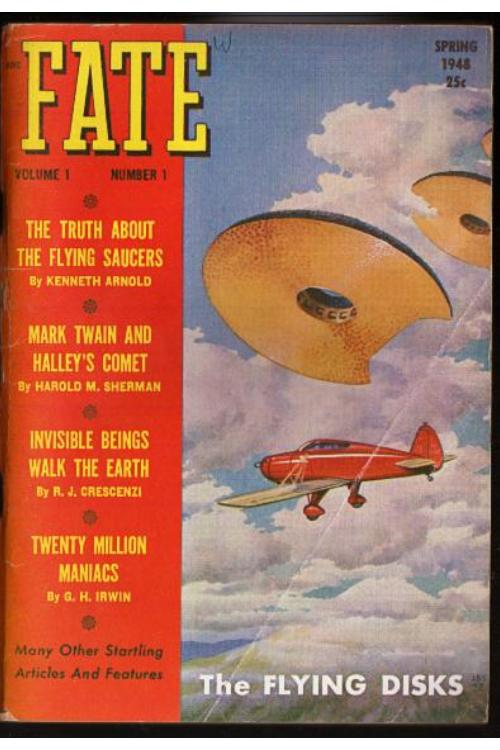
At about three in the afternoon on June 24, 1947, Kenneth Arnold, a recreational private pilot, was heading toward Yakima, Washington. Flying at 9,000 feet, Arnold saw nine objects flying in formation out of the side window of his airplane. He watched them bob, weave, and dart about – showing off at an incredible speed. These strange craft were not your traditional flying machine shape; they had no nose or tail, but rather were perfectly round, metallic and highly polished.  Arnold radioed in his sighting. It must have been a slow news day for when he landed at the Pendleton Field in Oregon, he found a full news conference waiting for him. It was there that Arnold used the words that found legs with scary space phenomena enthusiasts everywhere. He said that these strange flying objects looked like saucers skipping across water.

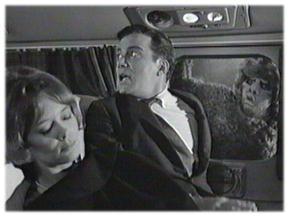
In addition to being the first use of the term ‘flying saucers,’ it is generally considered to be the first widely reported UFO sighting in the United States. There was a corroborative sighting ten days later.  A United Airlines crew also spotted five to nine disk-like objects over Idaho that paced their plane for 10 to 15 minutes before suddenly disappearing. (This may have been the very flight on which William Shatner saw one of the actual aliens chewing on the wing – but that’s an allusion for another day.)

The United States Air Force officially classified Arnold’s sighting as a mirage.

And some ufologists (yes, ufologists) began to express doubts about the psychology of the man when he reported several other UFO sightings in the years that followed, particularly his report of two living transparent UFOs that he characterized as space animals with the ability to change their density.  And a fondness for chewing on the wings of airplanes.


JUNE 15, 1937: REEFER MADNESS

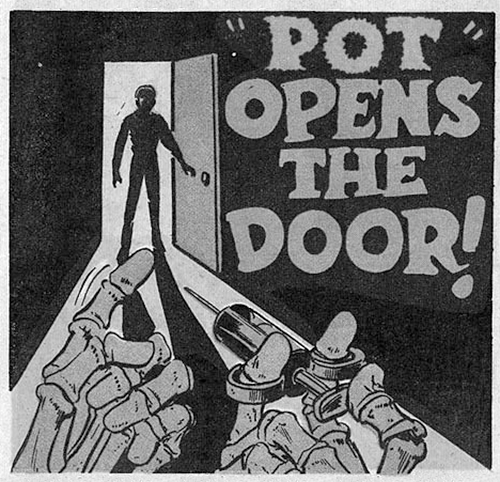
In 1937, Congress passed the Marihuana Tax Act which levied a tax of one dollar on anyone who dealt commercially in marijuana. The bill had been written using the slang term “marihuana” throughout, obscuring the fact that it covered the plant’s legitimate uses in medicine, where it was broadly known as cannabis and in the fiber industry as hemp. The Act did not itself criminalize their possession, but regulations and restrictions on the sale of cannabis as a drug had been around since the previous century.  In effect, the bill made it impossible for anyone to deal with call it what you will in any form.

     Conspiracy theorists maintained that business tycoons Andrew Mellon, Randolph Hearst, and the Du Pont family were behind passage of the Act as a way to reduce the size of the hemp industry. Hemp had became a very cheap substitute for the paper marijuana-propagandapulp that was used in the newspaper industry and as such was a threat to Hearst’s extensive timber holdings. Mellon had invested heavily in the Du Pont family’s new synthetic fiber nylon that was competing with hemp.  The campaign that Hearst’s newspapers had been staging against the dangers of the recreational use of the”powerful narcotic in which lurks MURDER! INSANITY! DEATH!” was therefore disingenuous. (‘Beware the evils of hemp’ didn’t quite cut it.   “Reading newspapers printed on hemp will lead to degradation and reading the New York Post.”)

     The legislation effectively killed the hemp industry and the medical use of cannabis, and the ensuing years of “reefer madness” completed its evolution to the abominable recreational drug it became through the rest of the century.

JUNE 10, 2000: ALL TOGETHER NOW, SWAY TO THE RIGHT

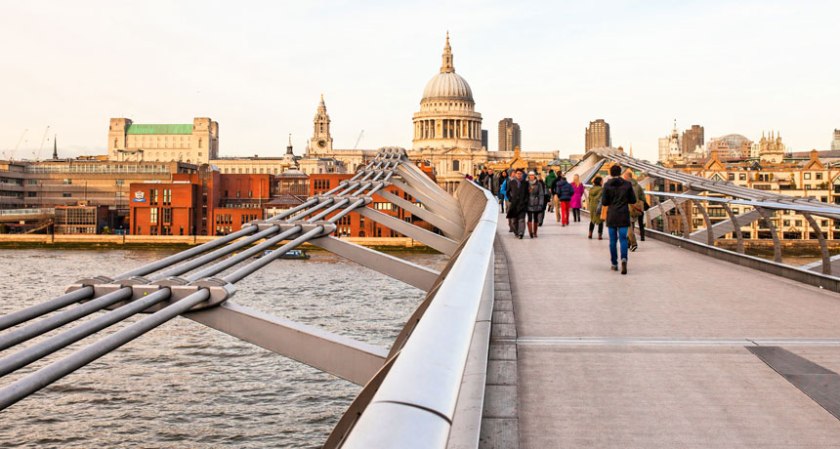
An air of excitement certainly gripped London on June 10, 2000, as 90,000 people queued up to cross the first new bridge to span the Thames River in over a hundred years, a bridge for pedestrians only, stretching from the Globe Theatre to St. Paul’s Cathedral, aptly named the London Millennium Footbridge. It didn’t take long for the bridge to become more known by its nickname, the Wobbly Bridge.
     Seems the designers had not given enough attention to a phenomenon with the catchy title, synchronous lateral excitation. Even if you’ve never heard of it, it doesn’t sound like anything you’d want to be on a bridge with.
     People, according to engineers, sway when they walk. People walking and swaying cause sideways oscillations in lightweight bridges. These, in turn, cause the people (some two thousand on the bridge at any given time) to sway even more to keep from falling over. And they all sway at the same time. It’s as if two thousand Londoners were doing the tango above the Thames. Result? Wobbly.
     Access to the bridge was limited later in the day, and two days after it opened, the bridge closed for modifications.  It reopened in 2002 (with tango forbidden).  It was again closed in 2007 because of strong winds and a worry that pedestrians foolish enough to cross might be blown off the bridge.
     The footbridge was not the only British millennial faux pas: a little number called the Millennium Dome elicited this derision from MP Bob Marshall-Andrews: “At worst it is a millennial metaphor for the twentieth century. An age in which all things, like the Dome itself, became disposable. A century in which forest and cities, marriages, animal species, races, religions and even the Earth itself, became ephemeral. What more cynical monument can there be for this totalitarian cocksure fragile age than a vast temporary plastic bowl, erected from the aggregate contribution of the poor through the National Lottery. Despite the spin, it remains a massive pantheon to the human ego . . .”

At the Zoo

Originally created as a royal herb garden in the 1600s, the Jardin des Plantes opened in 1793. During the following year a ménagerie was added, the world’s first and, still in existence, today the world’s oldest.  The 58-acre botanical garden and zoo is located in the center of Paris, next to the Seine.

The zoo was founded during the height of the French Revolution and the Reign of Terror. The National Assembly decreed that exotic animals  in private hands – rare antelopes, tigers, Louis XIV, and the like — were to be donated to the menagerie or guillotined, stuffed and donated to the natural scientists of the Jardin des Plantes . The Jardin was free for all visitors and tourists right from its inception.

While the menagerie at first was just provisional, it grew in the first three decades of the 19th century to be the largest exotic animal collection in Europe – as they describe it in France (or somewhere): monkey honnete, girafe pas sincere, elephant plein mais stupide, orang-outang sceptical, zebre reactionaire, antilope missionaire.

A well-run place, but this being France the menagerie gardiens are usually quite fond of their aperitifs.

Someone told me it’s all happening at the zoo.Paul Simon


JUNE 9, 1909: DRIVING MS. RAMSEY

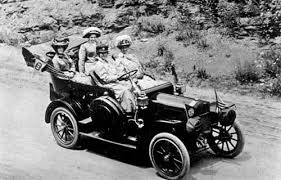
In 1909, a diminutive 22-year-old housewife from Hackensack, New Jersey, hopped into her dark green, four-cylinder, 30-horsepower Maxwell touring car and headed west. Alice Huyler Ramsey and her companions, two older sisters-in-law and a 16-year-old friend, were beginning a 59-day, 3,600-mile transcontinental odyssey that would end on August 9 in San Francisco, California.

It was an easy journey. After all, 152 miles of the roads were paved. The trip required only 11 tire changes, some new spark plugs and a brake pedal replacement. Most nights they were able to sleep in beds, although on one occasion in Wyoming they shared them with bedbugs.

And they had maps covering part of the journey, although for a good portion of the route they relied on printed guides giving directions using local landmarks that weren’t always that up-to-date.  In one case, they were supposed to make a turn at a yellow house and barn, but it seems the owner, not an automobile enthusiast, had repainted them green.

In Ohio, they reached the breakneck speed of 42 miles per hour.  But in Iowa, they encountered mud and flooded out roads. In Nebraska, a manhunt for a killer. And in Nevada a group of heavily armed Native Americans, who fortunately were not on the warpath but hunting.

But in the end, Ramsey and her friends arrived to cheering crowds in San Francisco.  And Ramsey drove into history, the first woman to drive coast to coast. She was named the “Woman Motorist of the Century” by AAA in 1960.  She repeated the trip another 30 times — in shorter periods of time — before her death on September 10, 1983, at the age of 96.

JUNE 7, 1827: BEES IN THEIR BONNETS

640239 Insect Bumble Bee

Local newspapers reported an amazing altercation in the village of Cargo in Cumberland, England, in 1827, a battle really (or a battle royal), between two opposing hordes – of bees. The home bees, it seems, were happily hived in the village, going about their bee business when, on June 7, a swarm from a neighboring village flew over the garden in which the first hive was situated. Without warning or so much as a by-your-leave, the interlopers darted down upon the hive and completely covered it, then began to enter the hive, pouring into it in such numbers that it soon became as crowded as happy hour at the local pub.

     Then the terrible struggle began. With ear-splitting humming, two armies of combatants rushed forth, besiegers and besieged alike spilling out of the beleaguered hive into the open air. The bee-on-bee battle raged with such fury that the ground below was soon strewn with corpses. Not until the visiting swarm was vanquished and driven away did the battle end. The victors resumed possession of the hive.

     The local chronicle did not attempt to explain the motivations involved, but naturalists, adding a scientific perspective, suggested that sometimes bees fight.

Rodgers and Hammerstein Are Frauds.  Irving Berlin Too.

Julie Andrews and Von Trapps running from killer bees

It’s spring, and the hills of Vermont are alive with the sound of seventy degree temperatures, giving us a chance to venture out into the great outdoors.  A little maintenance, clean out a flower bed or two, rake.  Our resident swarm of bees had the same idea — without the raking.  We’ve long debated whether these bees are honey bees or some less desirable species.

I have ended the debate.  They are killer bees — murderous, cutthroat, bloodthirsty killer bees.  And one of their crack snipers got me.  I was tending to a bed, not threatening them in any way, and he swooped in and stung me on my eyelid.   Before long I looked like I had caught a baseball with my right eye.  I tried to recall what I had seen or heard about treating a bee sting and the Rodgers and Hammerstein cure came to me.  I spent the rest of the day remembering my favorite things, even drinking a couple of them.  It did nothing for me.

I spent a while standing out in front, stooped over, looking very much like Quasimodo, frightening away passing neighborhood children.  But I soon tired of this game.

Eventually I toddled off to bed.  But sleep wouldn’t come.  Finally I remembered Irving Berlin’s prescription for insomnia and began methodically counting my blessings instead of sheep.  As it turns out, one’s blessings and one’s favorite things are pretty much the same.  Three a.m.  I’m on my 137th blessing and wide awake.  I won’t bore you with the details of my 137 blessings, but I

Waiting for passers by

will tell you that Rodgers and Hammerstein and bees are not among them.

Today I will perch atop the rock wall out front on hands and knees pretending to be a radiation-mutated giant bullfrog, croaking at passers by.  Life goes on.

Be my little baby bumble bee.  Buzz around.  Buzz around.  Keep abuzzing round.

JUNE 6, 1971: THE SHEW MUST GO ON

Ed Sullivan was to the golden age of television what Google is to searching.  He ruled Sunday night TV for 23 years – from 1948 to his very last broadcast on this day in 1971. Sullivan presented acts from the era’s biggest stars to acrobats, dancing bears, puppets, contortionists, you name it.  Ten thousand in all – if they were entertainers, an appearance on the Sullivan show was their holy grail.

Musical performances from rock to opera were a staple of the program. Even its first broadcast, when it was known as Toast of the Town, made music history as Broadway composers Richard Rodgers and Oscar Hammerstein II previewed the score of their upcoming musical, South Pacific. And after that, West Side Story, Cabaret, Man of La Mancha – if it was on Broadway, it was on Sullivan. One of those Broadway musicals, Bye Bye Birdie, was all about making it on the Sullivan show.

Sullivan also chronicled the history of rock and roll from Elvis Presley’s appearance in 1956 through the Supremes, the Beatles, the Rolling Stones, the Doors, the Mamas and the Papas, and on June 6, 1971, the last program, Gladys Knight and the Pips.

When CBS canceled the show, the network let it end with a whimper.  But in the 33 years since cancellation, numerous tribute shows and DVDs have kept Sullivan in the public eye.


JUNE 4, 1411: THE CHEESE STANDS ALONE

Even in 1411, the people of Roquefort-sur-Soulzon had been making cheese as long as anyone could remember.  And all because a young man was lured away from his lunch by a fair young maiden. Or so the story goes.

The cheese-making folks of Roquefort-sur-Soulzon were probably the only ones making the tangy, crumbly sheep’s milk cheese with its distinctive veins of green mold. Nevertheless on June 4, 1411, French King Charles VI granted them a monopoly for the ripening of the Roquefort cheese.

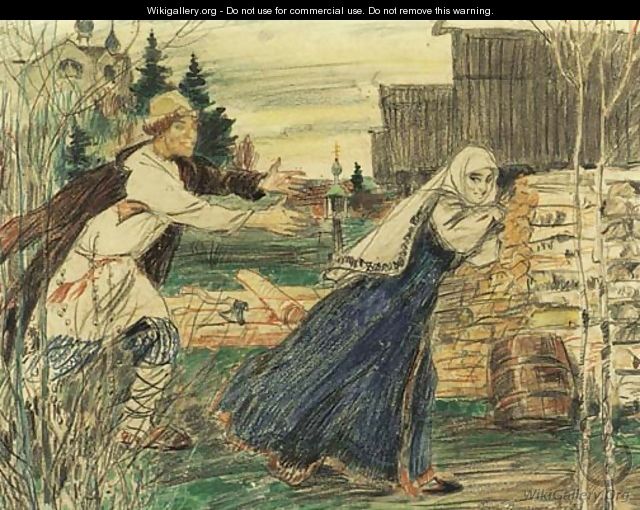
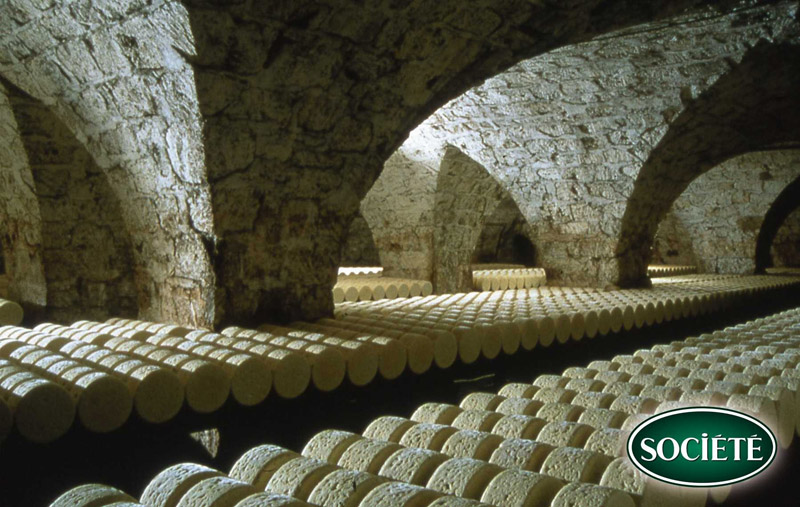
What makes Roquefort Roquefort is its aging in the Combalou caves of Roquefort-sur-Soulzon. Popular legend suggests that the cheese was discovered when a young man eating his lunch of bread and ewe’s milk cheese spied a hot young woman in the distance. Naturally, he ran off to pursue her, leaving his lunch in the cave. Legend leaves the results of his amorous pursuit to our imaginations, but his appetite must have been somehow satisfied since he didn’t return to the cave for several months. When he did, the mold present in the cave – Penicillium roqueforti to be exact – had done an ugly duckling number on his lump of cheese transforming it into a cheese of beauty. The bread, however, was another story.

The French take their wine and their cheese seriously. A ruling in 1961 decreed that although the Roquefort-sur-Soulzon method for the manufacture of the cheese could be followed across the south of France, only those cheeses ripened in the natural caves of Mont Combalou could bear the name Roquefort. Today, its production involves some 4,500 people who herd special ewes on 2,100 farms in a carefully defined grazing area. In 2008, 19,000 tons were produced, with 80% of it consumed in France.  It’s a laborious process — 4,500 folk dropping their 4,500 lumps of ewe’s milk cheese and running off in hot amorous pursuit of 4,500 other folk.