JUNE 4, 1411: THE CHEESE STANDS ALONE

Even in 1411, the people of Roquefort-sur-Soulzon had been making cheese as long as anyone could remember.  And all because a young man was lured away from his lunch by a fair young maiden. Or so the story goes.
The cheese-making folks of Roquefort-sur-Soulzon were probably the only ones making the tangy, crumbly sheep’s milk cheese with its distinctive veins of green mold. Nevertheless on June 4, 1411, French King Charles VI granted them a monopoly for the ripening of the Roquefort cheese.

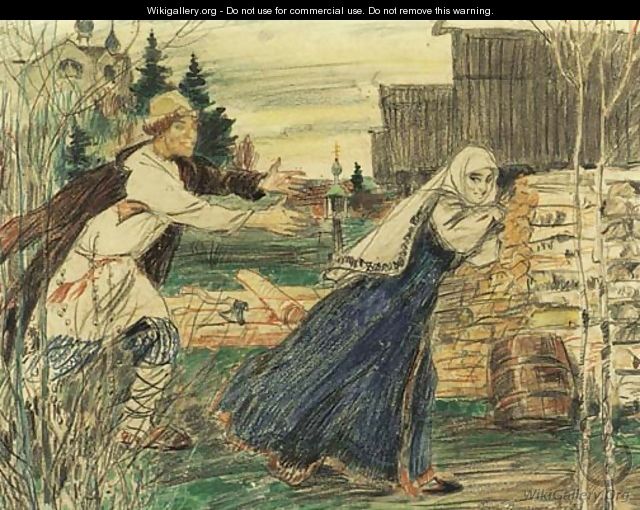
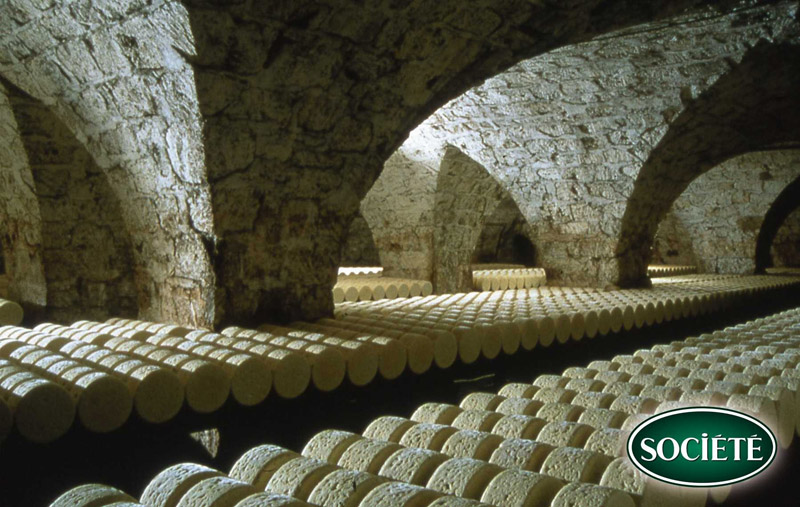
What makes Roquefort Roquefort is its aging in the Combalou caves of Roquefort-sur-Soulzon. Popular legend suggests that the cheese was discovered when a young man eating his lunch of bread and ewe’s milk cheese spied a hot young woman in the distance. Naturally, he ran off to pursue her, leaving his lunch in the cave. Legend leaves the results of his amorous pursuit to our imaginations, but his appetite must have been somehow satisfied since he didn’t return to the cave for several months. When he did, the mold present in the cave – Penicillium roqueforti to be exact – had done an ugly duckling number on his lump of cheese transforming it into a cheese of beauty. The bread, however, was another story.

The French take their wine and their cheese seriously. A ruling in 1961 decreed that although the Roquefort-sur-Soulzon method for the manufacture of the cheese could be followed across the south of France, only those cheeses ripened in the natural caves of Mont Combalou could bear the name Roquefort. Today, its production involves some 4,500 people who herd special ewes on 2,100 farms in a carefully defined grazing area. In 2008, 19,000 tons were produced, with 80% of it consumed in France.  It’s a laborious process — 4,500 folk dropping their 4,500 lumps of ewe’s milk cheese and running off in hot amorous pursuit of 4,500 other folk.


JUNE 3, 1956: I KNOW SUGGESTIVE STIMULATING AND TANTALIZING MOTIONS WHEN I SEEM THEM

A dance party in the beach town of Santa Cruz, California, a quiet oasis 70 miles south of San Francisco, back in 1956 (years before it became a counterculture capital),  led to a bit of overreaction by the town’s conservative adult authorities. Two hundred teenagers had taken over the Santa Cruz Civic Auditorium on a Saturday night to dance to the music of a group called Chuck Higgins and his Orchestra, regional favorites with a few hit rock recordings. Shortly after midnight, Santa Cruz police entered the auditorium to check on the event, and didn’t like what they saw: a crowd “engaged in suggestive, stimulating and tantalizing motions induced by the provocative rhythms of an all-negro band.” Although that sounds like a pretty good endorsement for the affair, the police did not view it as a positive. Without so much as a “save the last dance for me,” they shut the place down and sent everyone home to bed.

And they didn’t stop there. On the following day, June 3, city fathers further endeared themselves to city teenagers and captured national attention when they announced a total ban on the playing of rock and roll and other forms of “frenzied music” at public gatherings (the other forms probably meant to pull Wayne Newton into the loop).  Such music was, they said, “detrimental to both the health and morals of our youth and community.”

Not everyone saw this as an absurdity, it’s concern with “undesirable elements” not so subtly racial, and an effort that was bound to fail. Within two weeks, similar bans were enacted in Asbury Park, New Jersey, and in San Antonio, Texas.  But in spite of such valiant efforts, rock and roll would soon dominate the Billboard Hot 100, and teenagers everywhere would be singing “It’s got to be rock-roll music, if you want to dance with me.”


JUNE 2, 1855: GIVE ME A MARTINI OR GIVE ME DEATH

In the early 1850s, the city of Portland, Maine, with a population of 21,000 might be called a sleepy little burg. But that was about to change thanks to a Maine law enacted in 1851 outlawing the manufacture and sale of alcohol anywhere in the state, except for medicinal and mechanical purposes.

Portland Mayor Neal S. Dow was an outspoken prohibitionist who fully supported the law, so much so that he was dubbed the “Napoleon of Temperance. ” However, Dow had authorized a large shipment of “medicinal and mechanical alcohol” that was being stored in the city vaults for distribution to pharmacists and doctors (authorized under the law). The good citizens of Portland got wind of this cache of alcohol and suspected the worst, that Dow was a hypocrite and a secret sot.

The Maine law had an interesting little clause allowing any three voters to apply for a search warrant if they suspected someone was selling liquor illegally. Three men did just that, appearing before a judge who issued a search warrant.

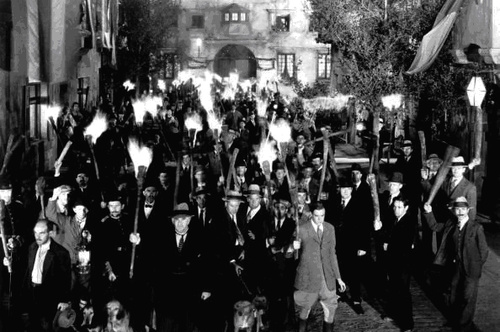
On the afternoon of June 2, a crowd of several hundred people, already irate over the law coming between them and their Harvey Wallbangers, gathered outside the building where the alcohol was being held. The crowd grew larger and surlier as it became obvious that the police were not going to seize the booze. As the crowd swelled, jostling became shoving, and the hurling of angry words became the hurling of rocks. The infamous Portland Rum Riot of 1855 was in full swing.

Police were unable to control the mob, and Mayor Dow called out the militia. When the protesters ignored the order to disperse, the militia, on Dow’s orders, fired into the crowd killing one man and wounding several others.

Dow was widely criticized for his strong-arm tactics during the incident and was later prosecuted for improperly acquiring the alcohol but was acquitted. The Maine Law was repealed the following year.


MAY 29, 1913: ILL-MANNERED FACTIONS? IN PARIS?

On the evening of May 29, 1913, the Theatre des Champs-Elysees, the newest venue in Paris, open for just over a month, was packed.  According to a newspaper report: “Never. . . has the hall been so full, or so resplendent; the stairways and the corridors were crowded with spectators eager to see and to hear.” What they were eager to see and to hear was a ballet program celebrating the works of many of the leading composers of the day. Ticket sales were priced accordingly.

Parisian ballet audiences of the time fell into two distinct groups: the wealthy and fashionable set, who would be expecting to see a traditional performance with beautiful music, and a “Bohemian” group favoring anything new and nontraditional because it would annoy the snobs in the boxes.

The evening began tranquilly with Les Sylphides, in which Vaslav Nijinsky and Tamara Karsavina danced the main roles, followed by the premiere of Stravinsky’s The Rite of Spring (Pictures of Pagan Russia in Two Parts) in which, after various primitive rituals celebrating the advent of spring, a young girl is chosen as a sacrificial victim and dances herself to death.

There is a consensus among eyewitnesses and commentators that the disturbances in the audience began during the Introduction, which was greeted by derisive laughter, and grew into a crescendo when the curtain rose on the “Augurs of Spring” with its pipers piping and dancers stomping. The terrific uproar, along with the on-stage noises, pretty much drowned out the performers.  The two factions in the audience began attacking each other, but their anger was soon diverted toward the orchestra, and anything not tied down was quickly thrown in its direction. The plucky orchestra played on. Forty or so of the most energetic offenders were forcefully ejected by the police who had arrived somewhere toward the end of Part I. Throughout all this the performance continued without interruption.

Things grew somewhat quieter during Part II, and by some accounts the final “Sacrificial Dance” was watched in reasonable silence, albeit with a certain amount of muttering.  At the end there were several curtain calls (as opposed to catcalls) for the dancers, the orchestra, and Stravinsky before the evening’s program continued.

Press reviews called the work “a laborious and puerile barbarity” on one hand and “superb, with the disturbances, being merely a rowdy debate between two ill-mannered factions” on the other.

Paris survived.  The Rite of Spring became a classic.  And puerile barbarity is alive and well.


MAY 25, 2006: GEEK NIRVANA

2006 marked the very first celebration of Día del orgullo friki in Spain, local at first but now celebrated in such far-ranging places as Halifax, Nova Scotia; Timisoara, Romania; and San Diego, California; making it a truly international, sort of, event. The date commemorates the release of the first Star Wars film on May 25, 1977. (This was the second such commemoration for the movie; the first, Star Wars Day,  held on May 4 so celebrants could say “May the fourth be with you.”). The latest fest was the brainchild of a Spanish blogger known as Senor Buebo.


In 2008, the “holiday”was officially celebrated for the first time in the U.S., sporting its English translation, Geek Pride Day, its goal having become the promotion of geek culture. Today it has a manifesto and everything. Imagine if you will 300 proud geeks coming together to form a human pacman or, better still, a prime-number float in a Fifth Avenue parade.


As if this celebration wasn’t heady enough all by itself, Geek Pride Day shares the same date as two other similar fan “holidays”: Towel Day, for fans of The Hitchhiker’s Guide to the Galaxy on which true believers carry about a favorite towel, and the Glorious 25th of May for fans of Terry Pratchett’s Discworld.

Dinner Leaps This Way

An English gentleman who identified himself only as a friend to the Poor wrote a letter to the Public Advertiser on May 25, 1772, describing a novel idea. The idea had occurred to him after reading a passage in a guidebook about a town in France: “There are three small rivers that run through the town, one of which is much frequented by frogs, though one would imagine that in time they would be destroyed, as they commonly compose a dish or two at each meal at the tables of both rich and poor; the latter mostly living on them.”
The letter went on to suggest that the poor of England could avoid the high cost of most kinds of food by procuring frogs as food for themselves, since the ponds and ditches of England were full of them. Although the letter writer had never personally tasted a frog, he had been assured that when fried in butter and parsley one could not distinguish it from fricassee of chicken. To those that worried that the ignorant might mistakenly eat a toad, he pointed out that the frog is light brown whereas the toad is almost black, that frogs leap, toads creep.
The gentlemen closed by saying let those that can afford it have roast beef every day, but to those poor wretches who cannot he offers this hint for their benefit.