November 12, 1933: It Came from Beneath the Sea

Hugh Gray was walking along a loch after church when he spotted a brouhaha in the nearby water. As he looked on a massive creature rose up from the lake. The quick-thinking Scotsman took several pictures of it (why he had a camera when he had been to church is anyone’s guess). Only one of the pictures he took on November 12, 1933, turned out; it looked a lot like a plesiosaur frolicking in the water. Some naysayers suggest it looked more like a dog carrying a stick swimming towards the camera, but the legend of the Loch Ness Monster was born nevertheless, as was the science of cryptozoology, the study of animals that don’t exist (such as Bigfoot and Rudy Giuliani).

While Nessie, as those on a first-name basis call it, is a bona fide cryptid, the monster that showed up on a beach just south of Florence, Oregon, on November 12, 1970, was not. It was the real thing – an 8-ton, 45-foot-long sperm whale. For a while the creature, which had been dead for some time, was a curiosity for locals and visitors alike, something more dramatic than the typical flotsam and seashells they usually found on the beach. But then it began to smell.

The task of dealing with the carcass fell to the state Highway Division, and it presented a monster problem. If the carcass were buried, it would simply be uncovered by the ocean tides. Oregon officials consulted U.S. Navy officials (division of cetacean disposal) and hatched the ingenious plan to blast the behemoth into a billion bits of blubber using a bunch of dynamite – little morsels that would then be devoured by seagulls.

The engineer in charge of the operation said that he wasn’t exactly sure how much dynamite would be needed, but a half ton of dynamite was finally applied to the carcass. Walter Umenhofer, a military veteran with explosives training, happened to be beachcombing at the scene. He warned the engineer that the amount of dynamite he was using was a tad excessive – 20 sticks was about right, not the 20 cases that were being used. Umenhofer said the engineer was not interested in his advice.

Needless to say, the explosion didn’t go as planned. The blast pulverized only part of the whale, sending pieces soaring — not toward the ocean, as hoped, but toward people watching from the dunes. No onlookers were seriously hurt, but they were pelted by bits of smelly blubber. And as an added thanks for butting in, Walter Umenhofer’s brand-new Oldsmobile was flattened by a chunk of falling blubber after the blast. He had just bought the Ninety-Eight in Eugene, during a “Get a Whale of a Deal” promotion.

After onlookers scurried away, the Highway Division crew buried the remaining whale. The seagulls who were supposed to dine on whale tidbits were found wandering in a daze in Utah and Wyoming.
November 10, 1801: Offenders Offending the Offended

Americans in the 18th and 19th centuries had little use for European customs. One European practice they could cozy up to, however, was dueling — a practice that brought a veneer of sophistication to killing another person. The hoi polloi didn’t duel, only gentlemen dueled.

It was all very civilized. It even had it’s own ‘according to Hoyle’ rule book, the Code Duello, imported from Ireland, which spelled out 26 specific do’s and don’ts, right down to the hours during which duel challenges could be made and the number of wounds necessary to satisfy one’s honor.

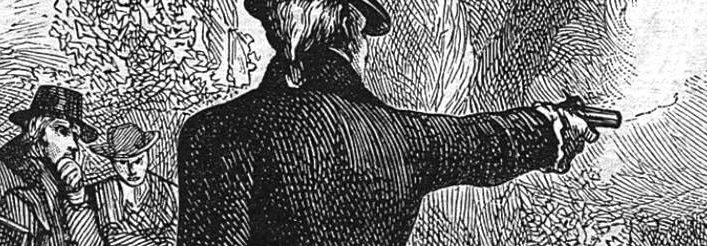
The typical duel played out in this manner: An offended party would send a challenge to the offender (through a second, of course; the two primaries were not allowed to speak to each other lest they might resort to ungentlemanly name-calling). If the offender apologized, the matter ended, at least until the offender once again offended which he usually did.  If the offender refused to make nice, he chose the weapons and the time and place of the duel.  An apology could stop the proceedings at any time right up to the pulling of the trigger or the thrusting of the rapier or whatever.

As sophisticated as dueling was, it nevertheless began to annoy people. And on November 10, 1801, Kentucky (of all places) became the first state to adopt a law “to prevent the evil practice of dueling.” Dueling would bring a fine of $500 (about $15,000 today). Still, dueling persisted, so in 1849 a provision was added to the Kentucky state constitution requiring all public officeholders and all members of the bar to take an oath, swearing they had never, nor would they ever, take part in a duel.

We all know that once something worms its way into a constitution it pretty much stays there forever. And so it is today a source of amusement and/or embarrassment that anyone taking an oath of office in Kentucky must affirm (speaking the words right out loud) that he or she has “not fought a duel with deadly weapons within this State nor out of it, nor have I sent or accepted a challenge to fight a duel with deadly weapons, nor have I acted as second in carrying a challenge, nor aided or assisted any person thus offending, so help me God.”

November 1, 1609: I Was Just Drinking a Health and Wound Up Debauched and Drunk

Sir Matthew Hale, born November 1, 1609, was an influential English legal scholar, barrister and judge throughout a good part of the 17thhealth1 century. Perhaps he was a bit of a stick in the mud as well. When he died, he left a rather unusual bit of advice for his grandchildren: “I will not have you begin or pledge any health, for it is become one of the greatest artifices of drinking, and occasions of quarreling in the kingdom. If you pledge one health, you oblige yourself to pledge another, and a third, and so onwards; and if you pledge as many as will be drank, you must be debauched and drunk.”

A fellow Englishman Charles Morton agreed, going so far as to dedicate a book to the subject: The great evil of health-drinking, or, A discourse wherein the original evil, and mischief of drinking of healths are discovered and detected, and the practice opposed with several remedies and antidotes against it, in order to prevent the sad consequences thereof. Catchy title, but most people probably just asked their booksellers for that book by Morton.

The French chimed in with their thoughts as well, the writer/philosopher Voltaire saying that “the custom arose among barbarous nations” (England) and that drinking to the health of one’s guests was “an absurd custom, since we may drink four bottles without doing them the least good.”

And of course they were all right. The slippery slope led to toasting any number of things on any number of occasions in addition to one’s health. The word toast, incidentally, crept into the language as a result of putting pieces of toast in the drinks (to make them healthier?).

One of the earliest known toasts or healths was ancient Saxon. At a banquet hosted by one Hengist, a mercenary in the employ of King Vortigern, the beautiful daughter of Hengist lifted a glass of wine to the king and said: “Lauerd kining, wacht heil” (Lord King your health). The king then drank and replied: “Drine heil” (Here’s looking at you, kid).

OCTOBER 31, LONG AGO: THE DEVIL MADE HIM DO IT

One might assume that the carving of jack-o’-lanterns was a clever promotion by the Association of Pumpkin Growers because there just weren’t enough pumpkin pies being eaten in this world. But as it turns out, folks have been making jack-o’-lanterns at Halloween for centuries. And that there’s a proper legend to explain the practice.

It all started with an Irish fellow called Stingy Jack. In addition to being cheap, Jack was a drunkard and a ne’er-do-well. During one of Jack’s benders, the Devil came calling on him with every intention of claiming his miserable soul. As a last request, Jack asked the Devil to have a  drink with him. (It’s a relief to learn the Devil drinks; Hell might not be so bad after all.)

Naturally, Stingy Jack being Stingy Jack had no intention of paying for the drinks, so he convinced the Devil to turn himself into a coin that Jack could use to buy their drinks, and the Devil agreed. (It would appear that the Devil is not the brightest candle in Hell.) Once the Devil had changed himself into a coin, Jack stuffed him into his pocket next to a crucifix, which prevented the Devil from changing back into his original form. Jack, now having all the chips in this game, agreed to free the Devil, on the condition that he would not bother Jack for ten years and that, should Jack die during this time, he would not claim his soul. (Jack wasn’t all that shrewd either.)

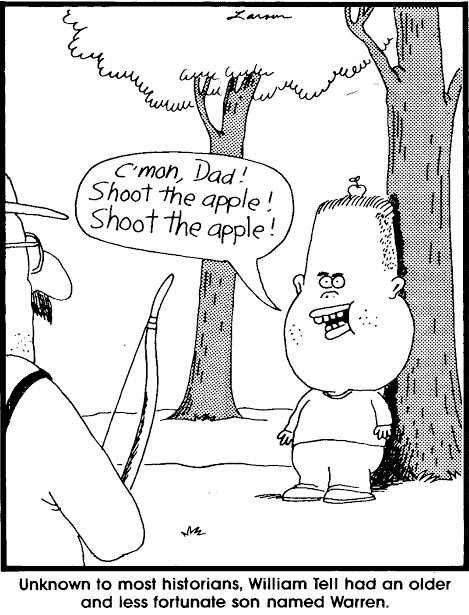
Drunkenness tends to make time fly, and before Jack knew it, ten years had passed.   And the Devil, ever prompt, came calling for Jack’s soul once again. And no last drink this time, the Devil said. Then perhaps just one small apple before I go, Jack begged. The Devil acquiesced. Jack lamented that he was in no condition to climb the apple tree, and would the Devil be so kind as to fetch the apple for him? (The Devil is a lot like Charlie Brown and his football. You’d think, being the Evil One, he wouldn’t be so trusting.) So the Devil climbed the tree, and while he was up in the tree, Jack carved a sign of the cross into the tree’s bark. To earn his release this time, the Devil agreed never to take Jack’s soul.

Wouldn’t you know, little time passed before Jack turned up his toes. Jack’s soul foolishly made it’s way toward Heaven where everyone had a good laugh before telling him to get lost. Then Jack journeyed to the Gates of Hell where the Devil, finally wise to Jack’s tricks,  also sent him packing —  to roam the world between good and evil, with only a burning ember inside a hollowed out turnip to light his way.  Jack of the Lantern. Obviously, the Association of Turnip Growers botched this one. Had they been on their toes, we’d all be celebrating Halloween with carved-out rutabagas.


halloween

OCTOBER 30, 1938: JUST ME AND MY RADIO

It’s easy from the comfort of our 21st century recliners to dismiss the mass hysteria of an earlier generation as so many Chicken Littles or Turkey Lurkeys, afraid of their own shadows. We’ve seen it all, any horror one can imagine, right there on the screen in front of us, and should it become too squirmy, well we can always just hit a button. The remote is there to protect us.

But what if you were at home, alone perhaps, on that October night back in 1938. It’s dark out; Halloween and all its spookiness is just a day away. But there’s the radio to keep you company. Like millions of other Americans, you’ll tune in to Edgar Bergen and Charlie McCarthy. That should lighten up a dark night. They finish their comedy routine at ten after eight. A singer you’ve never heard of follows so, like millions of Americans, you surf the radio stations (Wasn’t there supposed to be a dramatic program on?) pausing to hear an unenthusiastic announcer: “. . . the Meridian Room in the Hotel Park Plaza in downtown New York, where you will be entertained by the music of Ramon Raquello and his orchestra.” You listen for a minute; it’s not that great. You’re all set to surf again when the announcer interrupts, reporting that a Professor Farrell of the Mount Jenning Observatory has detected explosions on the planet Mars. The music returns, but only for a minute. The announcer is back with the news that a large meteor has crashed into a farmer’s field in Grovers Mills, New Jersey.

Now your ears are glued to the radio, as announcement after announcement confirms the impossible – a Martian invasion. “Good heavens, something’s wriggling out of the shadow like a gray snake. Now here’s another and another one and another one. They look like tentacles to me … I can see the thing’s body now. It’s large, large as a bear. It glistens like wet leather. But that face, it… it … ladies and gentlemen, it’s indescribable. I can hardly force myself to keep looking at it, it’s so awful. The eyes are black and gleam like a serpent. The mouth is kind of V-shaped with saliva dripping from its rimless lips that seem to quiver and pulsate.”

Now’s the time to surf the radio. If you do, you’ll quickly realize that everything is normal on other radio stations, that you’ve been listening to a realistic but fictional radio drama. But if you don’t, chances are you’ll join the thousands of people jamming highways, trying to flee the alien invasion.

Orson Welles was just 23 years old when his Mercury Theater company broadcast its update of H.G. Wells’ War of the Worlds with no idea of the uproar it would cause. He employed sophisticated sound effects and top notch acting to make the story believable.

And believed it was. In Indianapolis, a woman ran into a church where evening services were being held, yelling: “New York has been destroyed! It’s the end of the world! Go home and prepare to die!”

When the actors got wind of the panic, Welles went on the air as himself to remind listeners that it was just fiction. Afterward, he feared that the incident would ruin his career, but three years later he was in Hollywood working on Citizen Kane.

OCTOBER 26, 2010: WELL-ARMED SOOTHSAYER

Paul the Oracle was somewhat of a child prodigy, demonstrating a marked intelligence right from the get-go. “There was something about the way he looked at our visitors,” said the adult in Paul’s early life. “It was so unusual, so we tried to find out what his special talents were.”

Paul was hatched from an egg at the Sea Life Centre in Weymouth, England, then moved to his permanent home, a tank at a center in Oberhausen, Germany.  Paul took his name from a German children’s poem, Der Tintenfisch Paul Oktopus. He quickly became a celebrity by virtue of his divination of the outcome of international football matches, choosing the winners through a stratagem typical of German engineering in its complexity — picking boxes of oysters emblazoned with competing nations’ flags.

Octopuses are some of the most intelligent of invertebrates, with complex thought processes, memory, and different personalities (good octopus, bad octopus). They can use simple tools, learn through observation, and are particularly sensitive to pain. This according to PETA, the animal rights group. PETA argued that it was cruel to keep Paul in permanent confinement. Sea Life Centres contended that releasing him would be dangerous, because being born in captivity, he was only accustomed to sitting around a tank, popping oysters and using a remote, not fending for himself.

Paul’s accurate choices for the 2010 World Cup, broadcast live on German television, made him a star. Paul predicted the winners of each of seven matches that the German team played, against Australia, Serbia, Ghana, England, Argentina, Spain, and Uruguay. His prediction that Argentina would lose prompted Argentine chef Nicolas Bedorrou to post an octopus recipe on Facebook.

“There are always people who want to eat our octopus,” said Paul’s keeper. “He will survive.”

Paul’s correct prediction of the outcome of the semi-final, with Germany losing to Spain, led to death threats. Spain’s prime minister offered to give Paul safe haven in Spain.

Paul died on October 26, 2010, at the age of two-and-a-half, a normal lifespan for an octopus.  German attempts to find other oracles have never fared well. The animals at the Chemnitz Zoo were wrong on all their predictions.  Leon the porcupine incorrectly picked Australia, Petty the pygmy hippopotamus failed to be swayed by Serbia’s pile of hay topped with apples , and Anton the tamarin mistakenly ate a raisin representing Ghana.

The E-ri-e Was Arisin’

Back at the beginning of the 19th century, shipping goods from one end of New York to the other was a costly and cumbersome. Thereerie2 was no railroad, no trucking, no Thruway — just a two-week ordeal by stagecoach to get from New York City to Buffalo. The New York State Legislature leaped into this transportation breach. They proposed and Governor DeWitt Clinton enthusiastically endorsed a proposal to build a canal from Buffalo, at the eastern point of Lake Erie, to Albany, and the Hudson River. By 1817, they had authorized $7 million for the construction of what would laughingly be referred to as Clinton’s Ditch, 363 miles long, 40 feet wide, and four feet deep.

Work began in August 1823. Teams of oxen plowed the ground, and Irish workers did the digging, using only basic hand tools. It was a lot of work for $10 a month, but officials cleverly left barrels of whiskey alsong the route as an added inducement.

Governor Clinton opened the 425-mile Erie Canal on October 26, 1825, sailing from Buffalo in the Seneca Chief.  News of his departure was relayed to New York City by cannons placed along the entire length of the canal and river, each within hearing distance of the next cannon. The firing of each signaled the next to fire. It took 81 minutes to get the word to New York— the fastest communication the world had yet known. Clinton arrived in New York on September 4, where he ceremoniously emptied a barrel of Lake Erie water into the Atlantic Ocean — the “Marriage of the Waters” of the Great Lakes and the Atlantic.

The canal put New York on the map as the Empire State, transformed New York City into the nation’s principal seaport, and opened the interior of North America to settlement. It has been in continuous operation longer than any other constructed transportation system on the North American continent.

October 13, 1947: Before There Were Muppets

The name Frances Allison probably doesn’t ring a bell with most people. In the days of live programming and test patterns, the radio comedienne and singer became well known to those who huddled around the TV set early evenings to watch the misadventures of the Kuklapolitan Players.  She was better known simply as Fran, and she was one-third of the trio Kukla, Fran and Ollie.

Created by puppeteer Burr Tillstrom, the show got its start as Junior Jamboree locally in Chicago, on October 13, 1947. Renamed Kukla, Fran and Ollie, it began airing nationally on NBC in early 1949.  Although the show, all puppets except for Fran, was originally targeted to children, it was soon watched by more adults than children. It was entirely ad-libbed.

Fran assumed the role of big sister and cheery voice of reason as the puppets engaged each other in life’s little ups and downs. It was a Punch and Judy kind of show but with less slapstick and more character development. Kukla was the nerdy leader of the amateur acting troupe, plucky and earnest, and Ollie (short for Oliver J. Dragon) was his complete opposite, a devilish one-toothed dragon who would roll on his back when sucking up or slam his chin on the stage when annoyed. Joining them were Madame Oglepuss, a retired opera diva; Beulah, a liberated witch; Fletcher Rabbit, a fussy mailman, and several others.

KFOs fan base included Orson Welles, John Steinbeck, Tallulah Bankhead, and Adlai Stevenson among many others.  James Thurber wrote that Tillstrom and the program were “helping to save the sanity of the nation and to improve, if not even to invent, the quality of television.”

Kukla, Fran and Ollie ran for ten years until 1957.  Mister, we could use a Kukla, Fran and Ollie today.

To Swazzle or Not To Swazzle

Kukla and Ollie didn’t come on the scene until the mid-20th century; but puppets has already been around for some 4,000 years. And they come in many different flavors: marionettes, finger puppets, rod puppets. The Tillstrom characters are glove puppets, controlled by a hand inside the puppet.

Punch and Judy are the most famous of this type of puppet. Their first recorded appearance in England was during the Restoration when King Charles II replaced wet blanket Oliver Cromwell and the arts began to thrive. Punch and Judy shows generally feature the fine art of slapstick with characters hitting each other as frequently as possible.

Punch speaks with a distinctive squawk, created by means of a swazzle, an instrument held in the mouth while speaking. Punch’s cackle is deemed so important in Punch and Judy circles (yes, there are Punch and Judy circles) that a non-swazzled Punch is considered no Punch at all.

“I knew Punch. Punch was a friend of mine. Senator, you’re no Punch.”


OCTOBER 11, 1983: DON’T YANK THE CRANK

The title refers to a movement that took place in Maine back in 1981. Movement is probably a pretty strong word for laid-back Maine where crankdemonstrators tend not to get worked up into a chanting frenzy over things. And even less so in a sleepy little town like Woodstock whose population squeaked by 1,200 a couple of years ago.

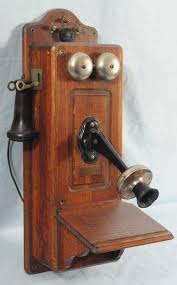
Bryant Pond is Woodstock’s largest settlement and as much of an urban center as you’re likely to find. It captured its fifteen minutes of national fame and media attention during the mid1970s when its family-owned Bryant Pond Telephone Company became the last telephone exchange in the United States to use hand-cranked phones. Then in 1981, the two-position magneto switchboard in the living room of the owners was purchased by the Oxford County Telephone & Telegraph Company, a larger company in the Maine neighborhood. The Bryant Pond Telephone Company was swallowed like so many krill off the shores of Maine.

Two Bryant Pond residents started the “Don’t Yank The Crank” movement to save their crank telephones, financed by the sale of tee shirts – a valiant effort but nonetheless futile. At a meeting in the local school gymnasium warmed by a wood stove, townsfolk spoke out. “We have the oldest pay station in the United States,” said one resident, either complaining or bragging. “You put in a nickel and wind it up.” “You are a person instead of a number.” And did they mention no robocalls?

Alas, to no avail. The last “crank calls” took place on October 11, 1983, and the beloved telephones slipped into history like so much Americana.

Just Put Your Lips Together

Harry “Steve” Morgan and his alcoholic sidekick, Eddie, are a couple of ne’er-do-wells crewing a boat for hire on the island of Martinique. to_have_and_have_not_1944_film_posterLife is okay, but World War II is happening all around them, doing a number on the tourist trade and thus their livelihood. Howard Hawks’ film To Have and Have Not which premiered in New York on October 11, 1944, was notable for bringing together what would become one of Hollywood’s hottest couples, Humphrey Bogart and Lauren Bacall.

The film takes the title from the book by Ernest Hemingway but not much else. Hawks was a Hemingway fan but thought this particular book was a “bunch of junk.” Even so, Hemingway worked with Hawks on the screenplay, in which Bogart once again gives up his professed neutrality in the war to thwart the Nazis. The plot is well thickened by the stormy relationship between Bogart and Bacall who plays Slim, a saucy singer in the club where Morgan drinks away his days.

Another notable member of the cast is Hoagy Charmichael who appears as the club piano player, Cricket. He and Bacall perform several Charmichael songs: “How Little We Know,” “Hong Kong Blues,” and “The Rhumba Jumps.” Bacall does her own singing, even though persistent rumors would have a 14-year-old Andy Williams singing for her.

The most memorable take away from the film is one line of dialogue delivered seductively by Bacall: “You know how to whistle, don’t you, Steve? You just put your lips together and . . . blow . . .”

SEPTEMBER 27 1937: ONLY 89 DAYS UNTIL CHRISTMAS

Miracle on 34th Street is arguably the best ever Christmas movie. Early in the film, an indignant Kris Kringle, played by Edmund Gwenn, chides the Macy’s Thanksgiving Day parade Santa for being drunk on duty. The inebriated Santa was not Charlie Howard. The movie was made in 1947; Charlie was the Macy’s parade Santa from 1948 to 1965.

Even before his Macy’s gig, Charlie was already the most famous and sought after Santa in the nation, having played the jolly old elf since his 4th grade Christmas pageant. He began passing his Santa skills on to other would-be Santas on September 27, 1937, when the Charles W. Howard Santa Claus School opened its doors in Albion, NY. The campus was actually Charlie’s home, until in the late 1940s he opened Christmas Park right next door. There fledgling Santas could practice their ho-ho-hos on actual little children.

Now in its 84th year (Charlie Howard died in 1966), the school promises a well-rounded Santa education covering such topics as the history of St. Nicholas and Santa Claus, the proper use of the red Santa suit and Santa make-up, working with reindeer, and flying sleigh lessons. Tuition is $550.  Students may major in either Santa or Mrs. Santa Claus. But hurry — classes begin in late October.


SEPTEMBER 26, 1849: DROOLING FOR SCIENTIFIC PROGRESS

There’s a certain something that makes the scientific mind differ from the ordinary mind.

An example: We are in the habit of walking into our dog’s room (it’s a hypothetical room, okay?) at cocktail time and feeding Rover (becausepavlov he looks like a Rover, okay?) (and he’s hypothetical too). This makes Rover quite happy. One day we walk in, drinking our cocktail but forgetting Rover’s food. No, he doesn’t bite us (an angry look, maybe). But he salivates even though there’s no food. What do we do? We beat Rover, clean up his drool, drink our cocktail, and get on with our lives.

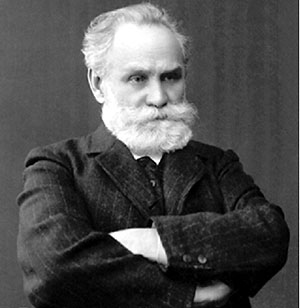
But a scientist? He’d stare at that saliva, ponder it, apply a little scientific method and possibly come up with a bunch of new scientific ideas. Ivan Pavlov, born on September 26, 1849, did just that. He saw his Rover drool, and he developed a major branch of learning called classical (or Pavlovian) conditioning with theories and laws and all sorts of scientific accoutrements. This in turn led to concepts such as comparative psychology, behavior modification and Brave New World.

Ever the scientist, even on his death bed, Pavlov engaged a student to sit with him and take notes as he died. He did not salivate. We don’t know if the student did.

I’ll be with you in apple blossom time

The animated 1948 film Melody Time, from Walt Disney Studios features a 19-minute segment with Dennis Day as an apple farmer who sees others going west, wishing he was not tied down by his johnny-appleseedorchard, until an angel appears, singing a happy apple song, setting him on a mission. When he treats a skunk kindly, all animals everywhere thereafter trust him. The cartoon features lively tunes, and a simplistic message of goodness, and probably helped to cement the image of Johnny Appleseed firmly in American lore.

John Chapman, the flesh and blood Johnny Appleseed, was born in Massachusetts on September 26, 1774.   At the age of 18, he persuaded his 11-year-old half-brother Nathaniel to go west with him to live the lives of carefree nomadic wanderers – rolling stones gathering no moss. Eventually Nathaniel grew up and quit the rambling around to gather moss and help his father farm. Johnny didn’t.

Johnny embarked on a career as an orchardist, apprenticing to a man who had apple orchards. Eventually, he returned to roaming, and the popular accounts have him spreading apple seeds randomly, everywhere he went. He actually planted nurseries, built fences around them, left the nurseries in the care of a neighbor who sold trees on shares, and returned every year or two to tend the nursery.

And Johnny Appleseed was against grafting. Therefore his apples were of a sour variety and used primarily for hard cider and apple jack. “What Johnny Appleseed was doing and the reason he was welcome in every cabin in Ohio and Indiana was he was bringing the gift of alcohol to the frontier. He was our American Dionysus.”

Johnny also spread the Swedenborgian word of God, preaching as he traveled. The Swedenborgian movement was a popular new religion of the time promoting repentance, reformation, and regeneration of one’s life.   Johnny would tell stories to children and lay the gospel on adults, receiving a floor to sleep on and supper in return.  Said one of his converts: “We can hear him read now, just as he did that summer day, when we were busy quilting upstairs, and he lay near the door, his voice rising denunciatory and thrillin’—strong and loud as the roar of wind and waves, then soft and soothing as the balmy airs that quivered the morning-glory leaves about his gray beard.”

And a wee bit of apple jack didn’t hurt either.