December 3, 1926: Lords of the Rings

German -born Heinrich Friedrich August Ringling and Marie Salome Juliar of France tied the knot back in the mid-19th century. Theirs was a rather productive union in the offspring department, bringing the world seven sons and a daughter.

Five of the brothers – August, Otto, Alfred, John, and Charles, who died on December 3, 1926 – were entertainers of sorts, performing skits and juggling routines in town halls and other local venues around the state of Wisconsin. They called themselves the “Ringling Brothers’ Classic and Comic Concert Company.” In 1884, they teamed up with a well-known showman, Yankee Robinson to create a one-ring circus that toured the Midwest. It was a good season for the Ringling Brothers; not so much for Yankee Robinson who died halfway through it.

The Ringlings did another circus in 1887, bigger and better, if you accepted its name: “Ringling Brothers United Monster Shows, Great Double Circus, Royal European Menagerie, Museum, Caravan, and Congress of Trained Animals.”

In 1889, they purchased railroad cars and parade equipment, allowing them to move around farther and faster, playing larger towns every day, substantially increasing their profits. On a real roll, they purchased the Barnum & Bailey Circus, running both circuses until they merged them into the Ringling Brothers Barnum and Bailey Circus – skipping right over two rings to become a three-ringer, modestly known as the Greatest Show on Earth.

December 2, 1941: Here’s Looking at You, Kid *

World War II had engulfed most of Europe and refugees everywhere were searching for the exits. The most popular way out was through Lisbon, Portugal, but getting there was a bit of a do. A long, roundabout refugee trail led desperate refugees from Paris to Marseilles, across the Mediterranean to Algeria, then by train or auto or even by foot across northern Africa to Casablanca in French Morocco.

Once in Casablanca, those with enough cash or influence could scare up exit visas and scurry off to Lisbon, then the Americas. Ah, but those unlucky ones, those without means, would wait in Casablanca “and wait and wait and wait.”

casablanca2

Picture yourself in an open-air city market, dripping with intrigue, teeming with black marketeers, smugglers, spies, thieves, double agents, and assorted ne’er-do-wells, all loudly engaged in their business activities. And of course there’s the aforementioned refugees attempting to deal and double-deal their way out. It’s December 2, 1941. The news spreads quickly through the market that two German couriers on their way to Casablanca have been murdered. They were carrying “letters of transit” allowing the bearers to travel freely around German-controlled Europe and to neutral Portugal. You better believe these papers are to kill for.

Now walk into a cafe owned by an American expatriate named Rick. It’s the place in Casablanca where everybody and everything eventually show up. And right on cue, the letters of transit do, in the possession of Ugarte, the town weasel. And so does everyone else who is anyone else: There’s Czech resistance leader, Victor Lazlo, Norwegian Ilsa Lund (Rick’s former lover), nasty German Major Strasser, Vichy syncophant Louis Renault, rival club owner and black marketeer Senor Ferrari, Sam the piano player, and a cast of, if not thousands, dozens. Of course, all of this is taking place not in Casablanca but on the lot of Warner Brothers studio in Hollywood, California.

The story line is well-known by most movie-goers, and the cast is like one large dysfunctional family. If you haven’t seen Casablanca during its first seven decades, chances are you never will. But if you have, you’ll probably see it again and again. And you probably have your favorite scene. Maybe it was this one:

* No.5 on the AFI list of top movie quotes

December 1, 1929: Gimme a B, Gimme an I . . .

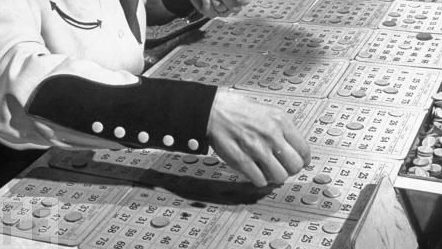
Edwin Lowe is credited as being the Father of the game Bingo but it’s abingo murky paternity. Lowe was a toy merchandiser in the late 1920s. At a traveling carnival near Atlanta, on December 1, 1929, he noticed players involved tooth and nail in a game called Beano in which they placed beans on numbers on a card as the numbers were called by an official number caller. Lowe took the idea back to New York with him where he amazed his friends with it. It’s popularity grew, and Lowe’s finances grew with it. The name Bingo was said to have originated when an excited player yelled “Bingo” instead of “Beano,” although some conspiracy theorists say the word had been used in England for some 150 years.

Further clouding the picture are the French (as the French will do). They created a similar game called Le Lotto back in in 1778. And they probably plagiarized the Italian Il Giuoco del Lotto d’Italia from the 1500s.

For those who may be in the Bingo dark, today’s typical game uses the numbers 1 through 75 arranged on a card in five columns headed by the letters B – I -N- G – O. Each column has five numbers arranged vertically The B’ column contains only numbers between 1 and 15, the ‘I’ column contains 16 through 30 and so on. When a player covers five numbers, horizontally, vertically or diagonally, the lucky devil shouts “Bingo!” to the great dismay of everyone else.

The game is now pretty much the province of little old ladies who command dozens of Bingo cards and whom you’d better not mess with if you know what’s good for you. Last year an 18-year-old Kentucky lad was barred by a judge from uttering the word “bingo” for six months after he falsely did that while working security at a Bingo hall. A police officer arrested him for his disorderly conduct which delayed the game by several minutes, causing alarm and real consternation to patrons. Chances are, he was taken into protective custody when the patrons, primarily elderly women, began yelling, cussing and threatening him. The officer explained that you can’t shout “out” in a ballpark or “fire” in a crowded theater.

And in England, two grandmothers were permanently banned from a local Bingo club after an argument over a ‘lucky’ seat led to a broken nose and two black eyes.

November 28, 1922: Ghost Writers in the Sky

It didn’t take long after the advent of flying for crafty marketing types to come up with a way to use it for advertising.   Skywriting was the way showing the most promise: a small airplane spits out magic smoke during a flight, creating text able to be read by someone on the ground.sky Messages naturally run the gamut from the inane to the weighty. Advertisers had a field day.

The first use of skywriting for advertising came on November 28, 1922, when Captain Cyril Turner of the Royal Air Force flew over New York City, spelling out, “Hello USA. Call Vanderbilt 7200.” Within just a few hours, 47,000 people had done just that. And of course operators were standing by at Vanderbilt 7200 to take their orders although no one had any idea what was being sold.

Pepsi-Cola became the first major brand to use skywriting as a medium to reach a mass market with thousands of flights through the 1930s into the mid-1940s. During the following years, skywriting became more sophisticated with the use of coordinated flights by fleets of planes that could deliver longer and more clearly written text messages.

At one point, rumor has it, an ambitious skywriter produced Pride and Prejudice in its entirety, but most observers fell asleep during the first three paragraphs.

November 26, 1865: O Frabjous Day

On a summer afternoon boat trip in the early 1860s the Reverend Charles Lutwidge Dodgson told the three Liddell sisters – Lorina, Alice and Edith – a story that featured a bored little girl named Alice who goes looking for an adventure. The girls loved the story, and ten-year-old Alice asked Dodgson to write it down for her. In November of 1864, Dodgson gave Alice the handwritten manuscript of the story called Alice’s Adventures Under Ground, with his own illustrations, dedicated as “A Christmas Gift to a Dear Child in Memory of a Summer’s Day”.

A year later on November 26, 1865, he gave the book to the world with a new title, Alice’s Adventures in Wonderland, published under the pseudonym Lewis Carroll.  The book in which Alice falls down a rabbit hole into a world filled with outlandish anthropomorphic characters was not a big success at the time; it has since become a giant of “children’s” literature and Lewis Carroll’s language and logic have become fixtures in modern culture and literature.

Alice as depicted by Rev. Dodgson

“I can’t explain myself, I’m afraid, sir,” said Alice, “because I’m not myself, you see.”

From the original by Tenniel
From the original by John Tenniel

“Begin at the beginning,” the King said, very gravely, “and go on till you come to the end: then stop.”

Alice by Arthur Rackham

“Would you tell me, please, which way I ought to go from here?”
“That depends a good deal on where you want to get to,” said the Cat.
“I don’t much care where –” said Alice.
“Then it doesn’t matter which way you go.”

alice charles pears
Alice by Charles Pears

They drew all manner of things — everything that begins with an M . . . such as mousetraps, and the moon, and memory, and muchness — you know you say things are much of a muchness.

Alice by Charles Robinson

The hurrier I go, the behinder I get.

Alice by George Soper

The rule is, jam tomorrow and jam yesterday-but never jam today

Alice by Harry Rountree
alice disney
By Disney Studios

Speak roughly to your little boy
and beat him when he sneezes!
he only does it to annoy,
because he knows it teases!

By Mervyn Peake
By Mervyn Peake


November 20, 1952: Hi, I’m a Stranger in These Parts

George Adamski had his first close encounter of the weird kind in November 1952 when he and a few friends were out in California’s Colorado Desert. There they saw what appeared to be a George_Adamski_ship_1large submarine hovering in the sky. Adamski for some reason believed the ship was looking for him (or maybe for an ocean) and, leaving his friends, went off to greet it.

A bit later, Adamski returned to report that the ship had landed, and its pilot had disembarked and greeted him. The visitor was an outgoing alien who introduced himself as a Venusian named Orthon. He did not ask to be taken to Adamski’s leader. Orthon was a humanoid of medium height with long blond hair and sported a great tan for the time of year. He wore reddish-brown Thom McAns and rather unfashionable trousers.

Adamski said Orthon chatted using telepathy and hand signals while talking very loudly, each assuming the other was deaf. Then the engaging Orthon took Adamski on a quick sightseeing trip of the Solar System, including his home planet Venus, where the late Mrs. Adamski just happened to have been reincarnated. Ever the tourist, Adamski tried to take pictures, but Orthon turned all camera shy and refused to allow himself to be photographed. But he agreed to take a blank photographic plate and promised to return with an autographed picture.  True to his word, Orthon returned the plate a few weeks later, but it only contained a bunch of strange symbols. Piqued, Adamski surreptitiously took a picture of Orthon’s space ship, a photo that afterward became famous in ufology circles.

Although Adamski’s tale seemed a bit much for some naysayers, Adamski had a letter he received in 1957 from the Cultural Exchange Committee of the U.S. State Department corroborating that Adamski had spoken to extraterrestrials in a California desert in 1952. Adamski frequently waved this letter around to support his claims.

Unfortunately, in 2002 some spoil-sport ufologist revealed that the letter was a hoax, that it had probably been written by those Communists who were everywhere in the State Department during the 50s.

November 19, 2001: Thomas Crapper Would Be Proud

This is true stuff; the Almanac does not make this stuff up.  November 19 is World Toilet Day. The day was chosen because it is the anniversary of the founding of the World Toilet Organization (WTO), a global non-profit organization committed plunging-toiletto improving toilets worldwide. Founded in 2001 with just 15 visionary members, WTO now boasts 151 member organizations in 53 countries working to eliminate the suppression of toilet talk in polite circles and to bring the toilet out of the shadows of sinks and bathtubs, giving it its own well-deserved recognition.


Sad but true: more money is spent throughout the world on toiletries than is spent on toilets. (Toiletries are not off-trail facilities for hikers.)


In 2005, WTO created the World Toilet College (WTC), the only institution of higher education devoted to toilet design, maintenance, sanitation and use. The WTC is the first and only institution that addresses the needs of both urban and rural toilets (outhouses, presumably) in a holistic manner. The college also seeks to foster a positive image of toilets everywhere, eschewing the use of such mealy-mouthed euphemisms as lavatory, latrine, water closet, rest room, comfort station, powder room and little boys’ and girls’ rooms.

Annual WTO conventions are surely a laugh a minute.

In 2009, a new website was launched dedicated to the celebration of World Toilet Day. Its 2012 slogan was “I give a shit, do you?

November 15, 1492: According to the Surgeon General

Rodrigo de Jerez secured his place in history as a trailblazer way back in 1492. He and a companion, Luis de Torres were crewmen who sailed to the Americas aboard the Santa Maria as part of Christopher Columbus’ first voyage.

While in Cuba, which members of the voyage assumed to be China (Columbus knew the world was round but thought it rather tiny), Rodrigo and Luis, hoping to meet the great Khan of Cathay, ran into some native Cubans. Perhaps they had never actually seen a native of China or perhaps, to Spaniards, everyone else in the world looked alike. Nevertheless, they were columbus_tobaccobefriended by the Cubans, never realizing they might just as easily have been eaten.

The Cubans were taking a smoke break, and they invited Rodrigo and Luis to join them. According to Rodrigo, they had wrapped some dried leaves in something that looked sort of like a paper musket. To the Spaniards’ surprise, they lit one end with a flame and pushed the thing into their mouths, “drinking the smoke” from the other end. Luis wanted nothing to do with it, finding it a filthy habit, most likely addictive, and socially repugnant. But Rodrigo being, as previously mentioned, a trailblazer, jumped right in, thereby becoming, right there on November 15, 1492, the first European to ever smoke tobacco.

The natives believed that tabacos, as they called it, was a gift from the Creator and that the exhaled tobacco smoke was capable of carrying one’s thoughts and prayers to heaven. Rodrigo just thought smoking was sophisticated and cool.  Almost immediately, he became a confirmed two-pack-a-day man.

Rodrigo brought the habit back to his hometown (despite signs posted all over the Santa Maria saying Thank you for not smoking), but the cloud of smoke billowing from his mouth and nose gave his neighbors such a fright that the holy inquisitors imprisoned him for seven years. By the time he left prison, smoking was de rigueur.

November 14, 2006: Wings on a Pig

When the first Pig Stand opened, it was a restaurant like no other that had gone before. The year was 1921, the onset of the Roaring Twenties. Americans were in love with their pigstandautomobiles. More than eight million Fords and Oldsmobiles and Pierce Arrows roamed newly created highways.

Located on a Texas highway between Dallas and Fort Worth, the Pig Stand catered to those automobile folks – the first drive-in restaurant in the United States. The restaurant’s owner, Dallas entrepreneur Jessie Kirby, reckoned that all those drivers would flock to a roadside barbecue where they could drive up, fill their faces with good Texas vittles, and drive off, without ever stepping out of their automobile. “People with cars are so lazy,” said Kirby, “they don’t want to get out of them.”

Kirby was a showman who knew how to attract customers. The Pig Stand had a red-tiled pagoda-like roof set on a rectangular building framed of wood and covered in stucco. As a customer was pulling in, teenage boys in spiffy white shirts and black bow ties would dash over to the car, hop onto the running board, and take an order – before the driver even came to a stop. For this derring-do, the servers were given the nickname carhops. Food historians credit the Pig Stand with the introduction of deep-fried onion rings, chicken-fried steak sandwiches, Texas Toast and high cholesterol.

The Pig Stand was a big hit with hungry drivers, and it soon became a chain, through one of the first franchising arrangements in restaurant history. Pig Stands popped up everywhere. By 1934, there were more than 130 of them in nine states, sporting the slogan “America’s Motor Lunch.” And dinner – Pig Stands boasted that more than 5,000 people enjoyed pig sandwich dinners every evening in Dallas alone. Pig Stand drive-ins soon replaced male carhops with attractive young women on roller skates, but maintained the formula that had got them this far: good-looking young carhops, tasty food, and speedy service – all in the comfort of your automobile.

Wartime gasoline and food rationing took its toll on the Pig Stand chain. And then came McDonald’s.  And Burger King.  And Wendy’s. By the end of the 1950s, all of the Pig Stand franchises outside of Texas had closed. And by 2005, only six remained in the state. Then on November 14, 2006, state officials closed the last two Pig Stands restaurants for unpaid sales taxes. And an icon oinked off into the Texas sunset.


November 13, 1953: When Red, Red Robin Comes Bobbin’ Along

In the early 50s, folks worked themselves up into a real dither searching for Bolsheviks here, there, wherever they may be hiding. There was a commie round every corner; any person you met might be a secret pinko, hoping to lead you down the slippery slope to socialism and the dreaded one world.

We remember Joseph McCarthy and the infamy of his search for traitors in the State Department, Hollywood and the PTA. But there were many McCarthy wannabes – good folk just itching to unveil a neighbor or loved one’s clandestine proclivities and nefarious schemes to indoctrinate the unaware.

Mrs. Thomas J. White of the Indiana Textbook Commission, was a bit of a zealot when it came to finding Communist propaganda in the seemingly innocent written word. On November 13, 1953, she announced an amazing discovery in textbooks used by the state’s schools. She called for the banning of the book Robin Hood and any references to it.

There was, she said, “a Communist directive in education now to stress the story of Robin Hood because he robbed the rich and gave it to the poor. That’s the Communist line. It’s just a smearing of law and order and anything that disrupts law and order is their meat.” On somewhat of a roll, she went on to attack Quakers because they “don’t believe in fighting wars.” This philosophy, she argued, played into communist hands.

Not everyone in Indiana jumped on her bandwagon. Reacting to criticism, White claimed that she never argued for the actual removal of offensive texts, but reiterated her position that the “take from the rich and give to the poor” theme was the Communist’s favorite policy. “Because I’m trying to get Communist writers out of textbooks, my name is mud. Evidently I’m drawing blood or they wouldn’t make such an issue out of it.” The response to Mrs. White’s charges was mixed.

Indiana’s governor defended the Quakers, but sidestepped the textbook issue. The superintendent of education, having it both ways, said that the book should not be banned, but agreed that Communists had twisted the meaning of the Robin Hood legend. Commentators throughout the world were thoroughly amused. The “enrollment of Robin Hood in the Communist Party can only make sensible people laugh,” said the Russians. Even the current sheriff of Nottingham chimed in: “Robin Hood was no Communist.”

Robin Hood was spared, free to rob from the rich another day. Other books during the Red Scare were not so fortunate: The Grapes of Wrath, Civil Disobedience, 1984, Johnny Got His Gun to name a few. Hollywood also felt the pressure to produce pro-American stories. And then there was that other obviously Communist-inspired phenomenon, rock and roll.  We won’t even mention those merry men.