MAY 5, 1862: VAMOS A CELEBRAR

Today is Cinco de Mayo. It is sometimes mistakenly thought of as a major Mexican holiday; it is, rather, a celebration of Mexican heritage and pride by people of Mexican descent living mostly in the United States – and, of course, non-Mexicans looking for an excuse to drink tequila.

In Mexico, Cinco de Mayo is celebrated primarily in the state of Puebla where it is called El Día de la Batalla de Puebla (The Day of the Battle of Puebla) observed to commemorate the Mexican army’s unlikely victory over French forces at the Battle of Puebla on May 5, 1862. France, under the leadership of Napoleon Number Three, sought to establish a Gallic empire in Mexico (possibly because things had gone so well for Napoleon Number One in Russia back in 1812). In 1861, a large French force landed at Veracruz sending the Mexican government into retreat. Moving toward Mexico City, the French army encountered heavy resistance near Puebla from a poorly equipped Mexican army of 4,500 men. The Mexicans were able to soundly defeat the 8,000-strong French army, considered the best in the world.

MAY 1, 1931: TALL BUILDING WITH APE

US President Herbert Hoover pushed a button in Washingtonempire D .C. turning on the lights of a building in New York City. On May 1, 1931, the world’s tallest building (102 stories with a total height of 1,454 feet), one of the seven wonders of the modern world, and soon to become an American icon, the Empire State Building, was open for business.

Commanding the intersection of Fifth Avenue and West 34th Street, the Art Deco masterpiece had taken just over a year to complete. It remained the tallest building in the world for 40 years, and is still a celebrated symbol of American culture. It has been a featured star in over 250 movies and many other forms of entertainment for its entire existence – An Affair to Remember, Sleepless in Seattle, Elf and, probably the most famous, the one with that giant ape clinging to its spire, battling modern technology.

Although jumping (or attempting to) from the Empire State Building is a much depicted form of suicide, just 30 people have pulled it off. The most noted is the 1947 death of a young woman who landed on a United Nations limousine parked at the curb. A photo taken minutes after her death was featured in Life magazine as “The Most Beautiful Suicide” and was later used by Andy Warhol in his print Suicide (Fallen Body).

Notable failures included a woman who jumped from the 86th floor observation deck, only to be blown back onto the 85th floor by a gust of wind and left with a broken hip, and a man who jumped or fell from the 86th floor but landed alive on an 85th floor ledge from which he was rescued suffering only minor injuries.


APRIL 29, 1946: GOD’LL GET YOU FOR THAT

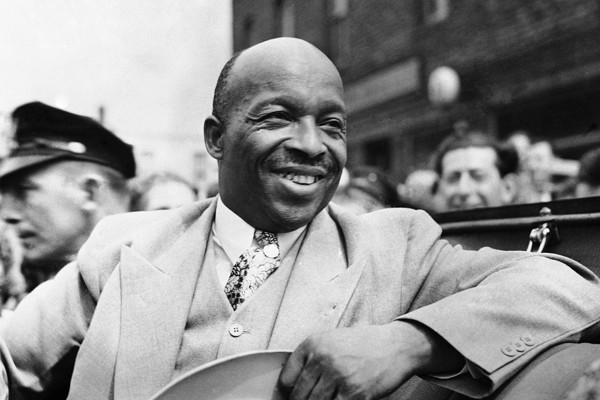
God was married on this day in 1946. For the second time. He was 70 at the time; she was 21 and, he claimed, a reincarnation of his first wife.

Unlike many other religious leaders who claimed to have God’s ear, Reverend Major Jealous Divine, (1876 – 1965) claimed to be God. Some contemporaries – jealous’ themselves perhaps – claimed he was more charlatan than god. Earlier in his life, before he became God, he was simply the Messenger. He founded what some have called a cult and oversaw its growth into a multiracial and international church.

Father Divine preached extensively in the south where, in 1913, he ran afoul of local ministers and was sentenced to 60 days jail time. While he was serving his sentence, several prison inspectors were injured in an auto accident, which, Father Divine pointed out, was the direct result of their disbelief.

Upon his release, he attracted a following of mostly women in Georgia. In 1914, several of his followers’ husbands and local preachers had Divine arrested for lunacy. This did not have the desired effect; it actually expanded his ministry. Father Divine was found mentally sound in spite of “maniacal” beliefs. When arrested, he had refused to give his name and was tried as John Doe (aka God).

After moving north and attracting a New York following — just as you were saying with a smirk, it could only happen in Georgia — Father Divine was arrested again, this time for disturbing the peace. At his 1932 trial, the jury found him guilty but asked for leniency. Ignoring this request, the judge called him a menace to society and sentenced him to one year in prison and a $500 fine. The 55-year-old judge died of a heart attack a few days later. Father Divine told-you-soed thusly: “I hated to do it. I did not desire Judge Smith to die . . . I did desire that my spirit would touch his heart and change his mind that he might repent and believe and be saved from the grave.”

In 1944, singer/songwriter Johnny Mercer attended one of his sermons – the subject, “You got to accentuate the positive and eliminate the negative.” Mercer was impressed. He returned to Hollywood and, with songwriter Harold Arlen, wrote “Ac-cent-tchu-ate The Positive”, which was recorded by Mercer himself and the Pied Pipers in 1945. It was also recorded by Bing Crosby with the Andrews Sisters.  And probably sung a year later at God’s wedding.


APRIL 28, 2004: IT WAS SHEAR PLEASURE

Some folks will go to great lengths to avoid sitting in a barber’s chair. So it seems will some animals. A New Zealand Merino sheep named Shrek — not to be confused with the bald green guy of the same name — really didn’t want to be shorn. So he went on the lam in the late 90’s, living as a fugitive, hiding in caves, always looking back over his shoulder.  He avoided capture for six years but alas someone finally fingered him and he was apprehended in April 2004. And on April 28, the now incredibly woolly Shrek went under the shears. It took a mere 20 minutes to denude him, and the entire indignity was nationally televised. The suddenly svelte Shrek gave up 60 pounds of wool, enough to suit 20 New Zealanders.

Now famous, he took tea with the Prime Minister on his tenth birthday and was allowed to spurn the shears for another 30 months before being shorn on an iceberg off the New Zealand coast (certainly a jumping the shark event). Shrek bought the sheep farm in 2011.

Sardine in Honorable Tin Can
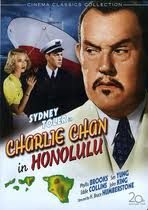
Following the death of Warner Oland, who had successfully brought the character of Charlie Chan to the screen in 16 films, Twentieth Century Fox began the search for a new Chan. Sidney Toler, who was born in Warrensburg, Missouri, on April 28, 1874, was chosen to play the detective, and filming began less then a week later on Charlie Chan in Honolulu. Through four years and eleven films, Toler played Charlie Chan for Twentieth Century Fox. Fox terminated the series in 1942, following the completion of Castle in the Desert. Sidney Toler went on to star in eleven more Charlie Chan films for Monogram Pictures. Very ill during the filming of his last two Chan pictures in 1946, Toler died in 1947.

The character of Charlie Chan was created for the novel The House Without a Key in 1925 by Earl Derr Biggers. Biggers loosely based Chan on a real-life Honolulu detective named Chang Apana. He conceived of the heroic Chan as an alternative to the many stereotypical villains such as Fu Manchu that typified the so-called Yellow Peril, a prevailing vision of the menace of Asia. Sounding like a turn-of-the-century Donald Trump, Horace Greeley, editor of the New York Tribune intoned: “The Chinese are uncivilized, unclean, and filthy beyond all conception without any of the higher domestic or social relations; lustful and sensual in their dispositions; every female is a prostitute of the basest order.” Luckily, Greeley is remember more for urging young men to go west.

Over four dozen films featuring Charlie Chan were made, beginning in 1926. Movie-goers took to Chan, but in later years critics found that in spite of his good qualities he too was an Asian stereotype. Many also objected to the fact that he was played by Caucasian actors in yellowface (although Keye Luke who played Chan’s number one son in 7 films was a bona fide Chinese-American actor).

In addition to his great detection, Charlie Chan was noted for the aphorisms sprinkled liberally throughout the films. A handful of the very many:

Accidents can happen, if planned that way. (Dark Alibi)

Action speak louder than French. (Charlie Chan at Monte Carlo)

Bad alibi like dead fish – cannot stand test of time. (Charlie Chan in Panama)

Detective without curiosity is like glass eye at keyhole – no good. (Charlie Chan in the Secret Service)

Even wise fly sometimes mistake spider web for old man’s whiskers. (Charlie Chan’s Chance)


chan


APRIL 26, 1970: FLAUNT YOUR INTELLECTUAL PROPERTY

Shine up your sneakers, grab your party hats and noisemakers. It’s a day to cast off your inhibitions and get wild and crazy. Yes, today is World Intellectual Property Day, the day set aside to “raise awareness of how patents, copyright, trademarks and designs impact on daily life” and “to celebrate creativity, and the contribution made by creators and innovators to the development of societies across the globe.” And get pleasantly pickled of course.

It’s not quite as over the top as say Fat Tuesday but it’s close. Celebrating the contributions of creators and innovators with two guys in clown suits and a person of unknown gender wearing nothing but a rubber chicken puts a fair amount of zest into a gray day in late April. And coming as it does on the heels of World Book and Copyright Day – well, it’s not for the faint of heart.

Why April 26 you ask? Because it’s the date on which the Convention Establishing the World Intellectual Property Organization was established in 1970.  Perhaps you missed it.  What is intellectual property you ask? That’s the beautiful part. It’s anything you want it to be. What you are reading here at this moment by very elastic definition could be considered intellectual property – especially after three Harvey Wallbangers. So live it up; National Defense Transportation Day is nearly a month away.

These Aren’t Your Ordinary Old Bottle Rockets

An announcement in a London newspaper on April 26, 1792, described an upcoming special event in breathless anticipation: fireworks to celebrate the birthday of her royal highness the Duchess of York.

The fireworks display would depict the eruption and lava flow of Mount Etna on a scale never before seen. Under the mountain would be shown the cavern of Vulcan with the Cyclops at work forging the armor of Mars as portrayed in Virgil’s Aeneid. Music courtesy of Gluck, Haydn, Giardini and Handel.

As the work progresses, Venus and Cupid arrive to request armor for Aeneas. Mars arrives for his armor and is amorously distracted by Venus, annoying Vulcan. But at this moment the smoke thickens above, the crater on top of Etna vomits forth flames, and lava flows dreadfully down the side of the mountain. This continues with increasing violence until there is a prodigious eruption, punctuated by a tremendous explosion.

Coffee and tea are included.

APRIL 22, 1886: BUT WILL YOU RESPECT ME IN THE MORNING?

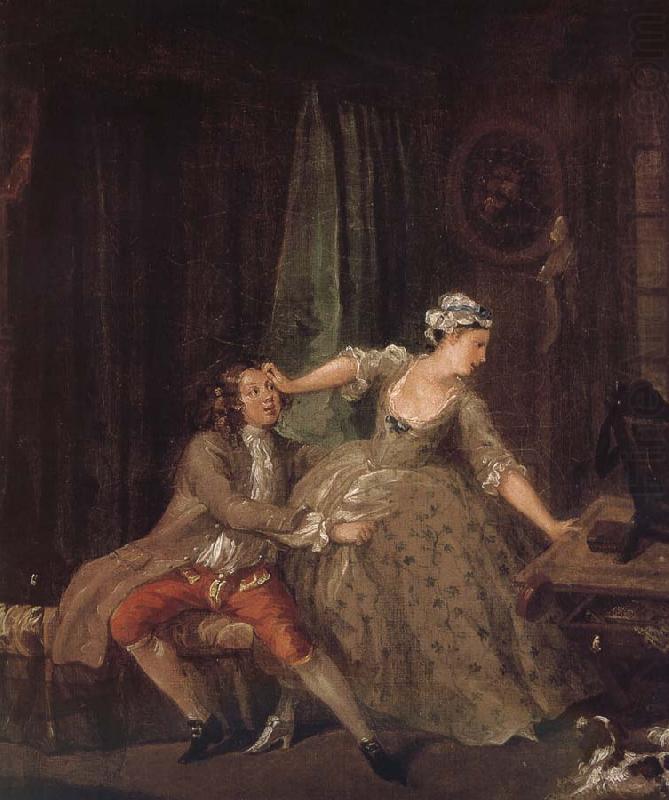
In a blow to lounge lechers everywhere, the state of Ohio passed a law making seduction unlawful. Covering any man seduction1over 18, it prohibited sex, consensual or not, with a woman of any age if the woman were being taught or instructed by the man. It covered all subject matter, leaving a lot of room for interpretation.  Other states jumped on the anti-seduction bandwagon. In Virginia, he’d better not try to engineer an “illicit connexion with any unmarried female of previous chaste character” using the promise of marriage. In Georgia, he couldn’t “seduce a virtuous unmarried female and induce her to yield to his lustful embraces.” In some jurisdictions, however, a woman could not press charges on her own behalf; only the father could do so based on his property interests in his daughters’ chastity.

Naturally, such laws were enforced with varying degrees of fervor. An unfortunate man trapped by the law in New York was headed for certain conviction until he proposed to his victim during the trial. Just to make certain, he didn’t back out, the judge brought in a minister and had the ceremony performed then and there.

A court in Michigan, on the other hand, went out of its way to favor the accused male. On three charges of seduction, two were thrown out because the woman was no longer virtuous after the first seduction. The other was tossed when the court ruled that her claim that they had sex in a buggy was physically impossible.

APRIL 19, 1949: SEND IN THE CLOWNS

russian

With the threat of nuclear annihilation hanging over the world, cold war adversaries were nonetheless able to find glimmers of humor. At the opening night of the Moscow Circus, noted Russian clown, Konsantin Berman, demonstrated who had the upper hand in the clown cold war, launching barb after barb in the direction of the United States.

Tossing a boomerang, he likened it to the U.S. Marshall Plan that was pumping economic recovery aid into Western Europe. “American aid to Europe,” he said, “Here is the dollar.” as the boomerang returned to his hand, delighting the audience. Producing a radio that bellowed out the sound of barking dogs, he announced: “That’s the Voice of America.”

Meanwhile American clowns were dumping buckets of water on each other and slipping on banana peels.

Speaking of Banana Peels

The Vagabond King a 1925 operetta by Rudolf Frimi was already an American success when it opened in London on April 19, 1927.  It’s success in England was probably assured given its theme of foibles of the French.  Its hero is a braggart, thief and rabble-rouser who attempts to steal an aristocratic lady from the king himself.  Not only that, he openly mocks the king, boasting about what he would do if he were king.  The angry king gives him royal powers for 24 hours — king for a day — during which he must solve all France’s problems or go to the gallows (the guillotine had not yet been invented).  He succeeds, wins the lady’s hand and lives happily ever after in exile — probably in England.  The operetta was the inspiration for a couple of movies and, of course, the popular radio and television program “Queen for a Day.”


APRIL 9, 1940: YOUR SHOPPING CART IS EMPTY

Sylvan Goldman was an idea man. One of his more persistent ideas led to his choice of careers. Actually, it was more than an idea — a concept, an eternal truth perhaps. “The wonderful thing about food is that everyone uses it — and uses it only once.”

Born in the Oklahoma Territory, he and his brother went into wholesale produce only to be wiped out by plunging oil prices.  After studying all the latest methods for retailing groceries, they bounced back with a chain of self-service stores featuring woven baskets for  carrying groceries. The stores were a big success, and they were bought out by the Safeway chain. Once again hard luck hit; their Safeway stock tanked during the Depression. And once again they bounced back; by the mid-30s they were half owners of the Piggly Wiggly chain.

Goldman continued to dream about customers moving more and more groceries. And one night in 1936 he had a eureka moment — inspired by a wooden folding chair. Put wheels on the legs and a big basket on the seat and you have a shopping cart.

Goldman and a mechanic friend began tinkering. They devised a metal cart with not one but two wire baskets. For efficient storage, the carts could be folded and the baskets nested. Goldman called his invention a folding basket carrier, receiving a patent on April 9, 1940.

When the carriers were introduced to the public, Goldman encountered one tiny problem. Customers didn’t want to use them. Men thought they would look like sissies pushing a cart. Women felt like they were pushing a baby carriage.  And older shoppers thought it made them look helpless. Goldman was always ready with another idea. He hired attractive models, both men and women, to push the carts around, as well as charming greeters urging customers to take one for a spin.

By the 1940s, the carts had become so much a part of the American shopping experience that the Saturday Evening Post devoted its cover to them. And they got bigger and bigger until they got tiny as little icons on websites everywhere.

Goldman’s Folding Carrier Basket Company is still in business today. Goldman isn’t. He died in 1984.

APRIL 8, 1832: TAKE MY WIFE . . . PLEASE

Earlier centuries saw a great many practices that were commonplace then but which would be considered inappropriate in our more enlightened age. Nowhere was this truer than in (merry old) England — purchasing a plump Irish child for special dinner occasions in the 18th century, for instance, or in the 19th century, selling a spouse one had grown weary of.  One such sale took place on April 8, 1832, an account of which was recorded for the amusement of generations that followed.  Joseph Thompson, a farmer, had been married for three unhappy years when he and his wife decided to call it quits.  As was customary, Thompson took his wife to town and set her up for public auction.  At noon, the sale commenced with Thompson delivering a short speech:

“Gentlemen, I have to offer to your notice my wife, Mary Ann Thomson . . . whom I mean to sell to the highest and fairest bidder.  Gentlemen, it is her wish as well as mine to part for ever.  She has been to me only a born serpent.  I took her for my comfort, and the good of my home; but she became my tormentor, a domestic curse, a night invasion, and a daily devil.  Gentlemen, I speak truth from my heart when I say — may God deliver us from troublesome wives and frolicsome women!  Avoid them as you would a mad dog, a roaring lion, a loaded pistol, cholera morbus, Mount Etna, or any other pestilential thing in nature.”

What a sales pitch!  This guy could sell anything. The asking price for Mary Ann was 50 shillings. Eventually, the price was knocked down and a deal was made — 20 shillings and a Newfoundland dog.

Everyone satisfied, they parted company, Mary Ann and a gentleman named Henry Mears in one direction, Joseph and the dog in the other.

APRIL 5, 1951: FIRST CAME THE WHEEL

Inventors are born every day, and April 5, 1951, was no exception. Dean Kamen was an inventor as well as a master of hype. Among his inventions are the iBOT an all-terrain electric wheelchair and a device that uses compressed air to launch SWAT teams to the roofs of tall buildings in a single bound.  Interestingly enough, Kamen’s father was an illustrator for Mad and Weird Science.

The most famous of his inventions by far was a closely guarded secret that he claimed would change the world when made public.  Among those touting its revolutionary potential was Apple’s Steve Jobs. Unveiled in 2001, the Segway is an electric, self-balancing human transporter. It has two parallel wheels and is controlled by the shifting of the operator’s body weight. Its computerized gyroscopes make it almost impossible to tip over (although George W. Bush did in a test drive).

Consumer reaction was more a whimper than a bang. About the only groups it caught on with are mall and airport security personnel. Adding to the insult, Time Magazine included the Segway in its list of the 50 worst inventions.

British entrepreneur Jimi Heseleden bought the Segway company in 2010. He died that same year when he fell off a cliff while riding his Segway.

Back Before the Wheel

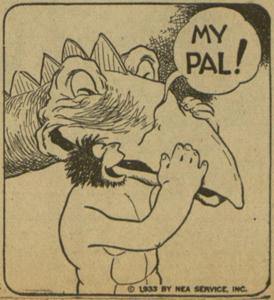
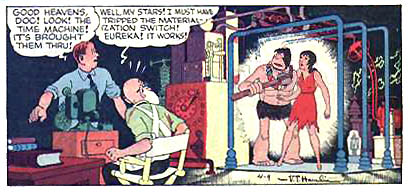
Another important invention made its debut on April 5, 1939 — Dr. Elbert Wonmug’s time machine. Oh, there had been time machines before this, but this would be the first to transport an honest-to-goodness caveman from way back in the Bone Age right into the 20th century. The caveman was none other than Alley Oop, beamed in from the kingdom of Moo where for the past seven years he had been doing typical caveman things — riding around on his pet dinosaur in a furry loincloth, brandishing his big club at his many enemies, and courting the lovely Ooola.
But once in the 20th century with a time machine to beam him about, Oop was no longer bound by prehistoric limitations. He became a roving ambassador, traveling to such destinations as ancient Egypt, Arthurian England and the American frontier, rubbing elbows with such folks as Robin Hood, Cleopatra, Ulysses, Shakespeare and Napoleon. At one point he even visited the moon. Pretty impressive for a Neanderthal.