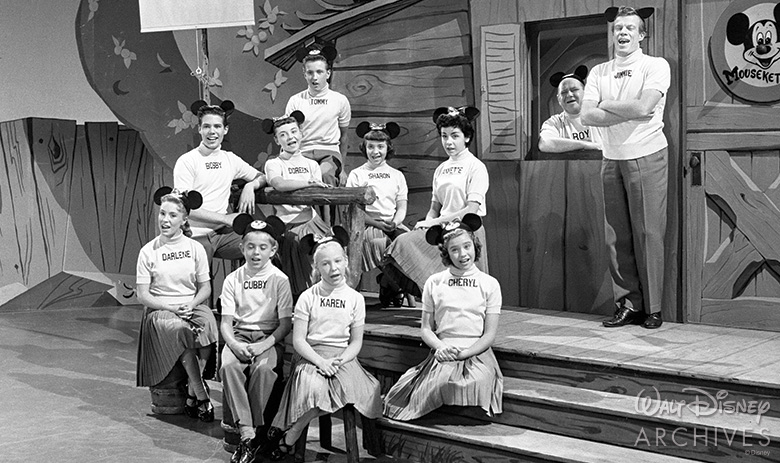
Jimmie Dodd, who was born on March 28, 1910, was an American actor who had small parts in movies during the early 50s. His specialty seemed to be playing taxi drivers (You can check him out in Easter Parade.) His big break came in 1955 when he became the fearless leader of a gang of young teenagers who all performed on TV five times weekly sporting mouse ears.
Dodd was, of course, the head mouseketeer on the Mickey Mouse Club. Dodd also penned the infamous “Mickey Mouse Club March” as well as other songs which he performed on the program accompanying himself on his “mouse-guitar.” It must have been embarrassing enough for teenagers, wearing those mouse ears, but for a guy in his forties — well, chances are he drank heavily.
Kingdoms Can Be Magic or They Can Be Wild
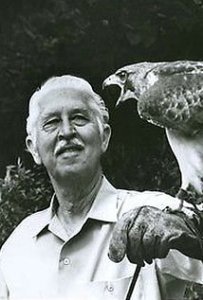 Herding teenagers in mouse ears is one thing, but being chased by wild animals week after week was quite another. It was, however bread and butter for Marlin Perkins, born on this date in 1905. For 35 years beginning in 1950, Perkins was insulted, chased, bitten and stung, first on Zoo Parade and then on Wild Kingdom. Perkins eventually got smart and let his sidekick Jim Fowler interact with the animals while he narrated from a safe distance.
The Maine and Spain
On March 28, 1898, the United States Naval Court of Inquiry found that the American battleship Maine, which had been blown up in February while on an observation visit, was destroyed by a submerged mine.
William Randolph Hearst had already decided the Spanish were to blame and meant to do something about it. He ran a series of articles pushing for war with Spain. Headlines proclaimed “Spanish Treachery!” and “Destruction of the War Ship Maine Was the Work of an Enemy!” Hearst’s New York Journal offered a $50,000 award for the “detection of the Perpetrator of the Maine Outrage.”
 Several months earlier, Hearst had sent Western artist Frederick Remington to get sketches of the brave Cuban insurgents fighting for independence. When Remington sent a report stating that everything was quiet — rum, conch fritters and siestas — that there would be no war, Hearst famously responded. “Please remain. You furnish the pictures and I will furnish the war.”
His hyperbolic and breathless accounts of “atrocities” committed by the Spanish in Cuba and his leading role in inciting the war, earned Hearst the nickname Father of Yellow Journalism (a title not really up there with Father of Quantum Physics or Father of the Bride), yellow journalism being the presentation of news of questionable legitimacy using exaggeration, sensationalism and eye-catching headlines to sell more newspapers. Unless it’s true — then it’s called fake news.
The Nays of Texas
On March 28, 1845, Mexico had a diplomatic temper tantrum over the territory of Texas and broke off relations with the United States. (Either both countries wanted Texas or neither country wanted Texas.) Said the Mexican president: “We’re going to build a big, beautiful wall, and the United States is going to pay for it.”
Wretched Richard’s Little Literary Lessons — No. 5
rep·ar·tee
ˌrepərˈtē,ˌrepˌärˈtē,ˌrepˌärˈtā/
noun
 Conversation or speech characterized by quick, witty comments or replies; amusing and usually light sparring with words
For example:
“So here we are,” said Huey. “stuck on Gilligan’s Island – Chickenshit Crusoe and his faithless companion, Good Friday.”
“I was a Boy Scout for two weeks,” Paul offered.
“What a relief. And to think I was starting to get worried. But you obviously know how to start a fire without matches, forage for food, and carve a comfortable existence out of the cruel jungle.”
“Well I did learn how to tie a square knot.”
“Well there you are. You little rascals are always prepared, aren’t you? And kind and reverent and true and God-fearing and above all helpful. If we only had a little old lady, you could help her back and forth across the beach.”
“Are you through?”
“Probably not.” She sat down next to him.
“Since we may be spending the rest of our lives together, we should probably learn to be cordial.”
“Sure, I know your type, Crusoe,” said Huey. “First you get a girl stranded on an island. Then you want to be cordial. And then – ”
And then?


 befriended by the Cubans, never realizing they might just as easily have been eaten.



 Wretched Richard's Almanac