November 6, 1982: Antifreeze and Old Lace

In Arsenic and Old Lace, a delightfully dark stage play adapted into a movie by Frank Capra, Mortimer Brewster (Cary Grant) has an eccentric family that includes two brothers – one of whom thinks he’s Theodore Roosevelt digging the Panama Canal in the basement, the other a killer who’s had plastic surgery to make him look like Boris Karloff – and two spinster aunts who have taken to murdering lonely old men by poisoning them with home-made elderberry wine laced with arsenic, strychnine, and “just a pinch” of cyanide. Generally, poisoners aren’t as sweet as these two old ladies.

Take the case of Shirley Allen, arrested on November 6, 1982, charged with murdering her sixth husband Lloyd. Shirley certainly wasn’t as sweet as the two old ladies, nor nearly as successful. Her first attempt at poisoning was believed to be an early husband, Joe Sinclair, back in 1968. When his coffee began to taste odd, he didn’t buy the idea that it was the newest flavor of the month, reasoning that Juan Valdez Free Trade Almond Praline Decaf should not give him internal injuries.  Joe went to the police, but no charges were filed. He filed for divorce, however.

Another husband, John Gregg, was not so lucky. He died a year after he married Shirley. He must have sensed that something was amiss because he changed the beneficiary of his insurance policy shortly before he died. Shirley got nothing. As you might guess, she was miffed. A pink-haired, large-bosomed barfly was rather happy, however.

Lloyd Allen was Shirley’s sixth husband. He began to complain of a strange taste in his beer. When Shirley said that it was an iron supplement that would put a tiger in his tank, Lloyd believed her and promptly died. This time she was named as beneficiary of a $25,000 life insurance, but alas her daughter told police about the doctored beers. Toxicology reports confirmed that Lloyd’s body tissue contained a lethal amount of ethyl glycol – antifreeze. Shirley went to prison for life. She was never allowed to work in the prison cafeteria.


JULY 28, 1948: THOSE MAGNIFICENT MEN WITH NO FLYING MACHINES

A fog had settled over London on July 28, 1948.  All was quiet and seemingly normal. But of course it wasn’t. Visualize if you will a large shipment of gold bullion awaiting transport at London Airport. A gang of evildoers determined to make off with it.  And an elite throng of intrepid crimestoppers known as the Metropolitan Police Flying Squad. You have all the ingredients in place for the adventure known as the “Battle of London Airport.”  Talk about fodder for a summer blockbuster action-adventure movie or at least a page turner to take to the beach.


You’d certainly be forgiven for picturing a major confrontation with flying aces swooping in for a pitched battle with the bad guys.  But this is England. 1948. More likely a bevy of bobbies pedaling in on their bicycles or on foot, with nightsticks drawn, like so many Keystone Cops.

In fact, The Metropolitan Police Flying Squad didn’t have a flying machine to its name. Formed back at a time when the Wright Brothers and other dreamers were still tinkering with air travel, the Squad — known at the time as the Mobile Patrol Experiment —  consisted of a dozen members of Scotland Yard. Their original mission was to chase down pickpockets by hiding in a horse-drawn carriage with peep holes cut in the canvas top.


During the 1920s, the squad expanded to forty officers, under the command of a Detective Superintendent and was authorized to carry out duties anywhere in London without observing the normal policing divisions, thus earning the name “Flying Squad.” It was also given the nickname “the Sweeney” (as in Sweeney Todd) for reasons that remain obscure.


The 1948 Battle of London Airport was the Squad’s crowning achievement, thwarting the attempted theft of £15 million in gold and jewelry.  During the 70s and 80s, however, the Squad came under fire for its close ties with the criminal world (always part of its operating strategy). Bribery and corruption scandals surfaced, and the squad’s commander was jailed for eight years. Twelve other officers were also convicted and many more resigned.

The Flying Squad had lost its wings.

A flying squad without wings is as lost as pirates without a ship.  Speaking of pirates, Terry and the Pirate is available all over the place in both paperback and electronic versions. Check it out at Amazon, Barnes and Noble, Apple.

JULY 8, 1898: SQUEAKY CLEAN IN SKAGWAY

Soapy Smith, “king of the frontier con men” died in a gunfight celebrated as the Shootout on Juneau Wharf on the evening of July 8, 1898. His last words, while not particularly memorable and certainly not effective, were nevertheless appropriate to the situation: “My God, don’t shoot!”

Soapy’s career began soon after the death of his mother in Fort Worth, Texas. He formed a highly disciplined cadre of ne’er-do-wells to work for him, and rose rapidly to criminal super stardom. He built three major evil empires: in Denver, Colorado, from 1886 to 1895; Creede, Colorado in 1892; and Skagway, Alaska, from 1897 to 1898. It was in Skagway that he finally made his dramatic exit.

Starting off with small-time cons such as three-card monte and shell games, he eventually employed the big con that gave him his nickname. On a busy street corner, Smith would go into an ordinary sales pitch extolling the wonders of his soap cakes. But he proceeded to wrap money around the cakes of soap – ones, tens, a hundred dollar bill.   He then wrapped plain paper around them to hide the money.

He mixed the money-wrapped packages with bars containing no money and began selling the soap for a dollar a cake. Immediately, one of his shills would buy a bar, tear it open, and begin waving around the money he had supposedly won.  People began buying soap, usually several bars. Every few minutes, someone would shout that he had won, always a confederate. Eventually, Smith would announce that the hundred-dollar bill remained unpurchased and began auctioning off the remaining soap bars to the highest bidders. Naturally, the only money was “won” by members of the gang.

Smith used this swindle successfully for twenty years. The proceeds from this scam and others gave him the money to pay graft to police, judges, and politicians, and live as a somewhat shady swell until his comeuppance on the Juneau Wharf at the hand of a man he had cheated.


MAY 9, 1671: STALKING THE CROWN JEWELS

In the movie The Adventures of Sherlock Holmes, Holmes’ nemesis Professor Moriarty is out to steal the crown jewels. His  battle of wits with Holmes over England’s great treasure lasts about an hour.  Earlier, an Irishman, Colonel Thomas Blood, attempted the same feat with a much more elaborate plan.

Colonel Blood set the plan in motion in April with a visit to the Tower of London. Dressed as a parson and accompanied by a woman pretending to be his wife, Blood made the acquaintance of Talbot Edwards, an aged but trustworthy keeper of the jewels. During this time, the jewels could be viewed by the payment of a fee. After viewing the regalia, Blood’s “wife” pretended to be taken ill, upon which they were conducted to Edward’s lodgings where he gave her a cordial and treated her with great kindness. Blood and his accomplice thanked the Edwardses and left.

Blood returned a few days later with a half dozen gloves as a present to Mrs. Edwards as a gesture of thanks. As Blood became ingratiated with the family, he made an offer for a fictitious nephew of his to marry the Edwardses’ daughter, whom he alleged would be eligible upon their marriage to an income of several hundred pounds. It was agreed that Blood would bring his nephew to meet the young lady on May 9, 1671.  At the appointed time, Blood arrived with his supposed nephew, and two of his friends, and while they waited for the young lady’s appearance, they requested to view the jewels. Edwards accommodated the men but as he was doing so, they threw a cloak over him and struck him with a mallet, knocking him to the floor and rendering him senseless.

Blood and his men went to work. Using the mallet, Blood flattened out the crown so that he could hide it beneath his clerical coat. Another filed the sceptre in two to fit in a bag, while the third stuffed the sovereign’s orb down his trousers.

The three ruffians would probably have succeeded in their theft but for the opportune arrival of Edwards’ son and a companion, Captain Beckman. The elder Edwards regained his senses and raised the alarm shouting, “Treason! Murder! The crown is stolen!” His son and Beckman gave pursuit.

As Blood and his gang fled to their horses waiting at St. Catherine’s Gate, they dropped the sceptre and fired on the guards who attempted to stop them. As they ran along the Tower wharf, they were chased down by Captain Beckman. Although Blood shot at him, he missed and was captured before reaching the Iron Gate.  The crown, having fallen from his cloak, was found while Blood struggled with his captors, declaring, “It was a gallant attempt, however unsuccessful, for it was for a crown!” — a rather eloquent comeuppance speech which today would be something more along the lines of “Oh fuck!”

APRIL 2, 1877: Faster Than a Speeding Cannonball

Some dreamers looked to the stars and wondered what it would be like to fly through space.  Some looked to the sky and wondered what it would be like to fly like a bird.  Then there were those that looked at a cannon and wondered what it would be like to be shot through the air from that cannon.  We remember and idolize our flight pioneers and space pioneers.  Can you remember the name of a single human cannonball?

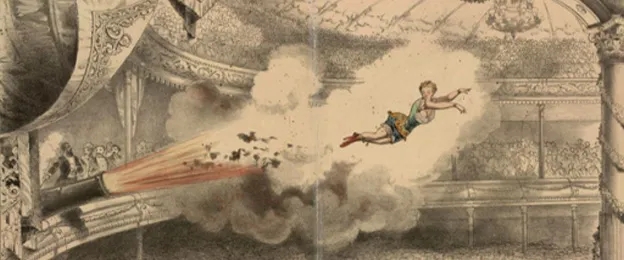
How about Zazel?  Yes, back in 1877, April 2 to be exact ,when those amazing men in their flying machines were still staring at pigeons and wondering how, 14-year-old Rossa Matilda Richter became the first in a storied line of Second Amendment enthusiasts to be shot right out of a cannon and into immortality.  The oohs and aahs of the crowd at the Royal Aquarium in London as Zazel soared overhead to a net some 70 feet away were the nascent sounds of a gun lobby to be.

Zazel was the protégé of The Great Farini, the Canadian rope-walker known for performing above Niagara Falls. He invented the device that would launch Zazel and other human projectiles for years to come.

Zazel’s act was an amazing success. At the peak of her career, she was earning £200 a week, performing before crowds of 20,000 or more every day in England and the USA.  Although many others followed in her footsteps, she was the first and the level of danger she faced was the highest. Eventually it caught up with her: she missed the net, and although she survived, she broke her back.  She retired and faded into obscurity.

The Terrible Terrible Biddle Boys

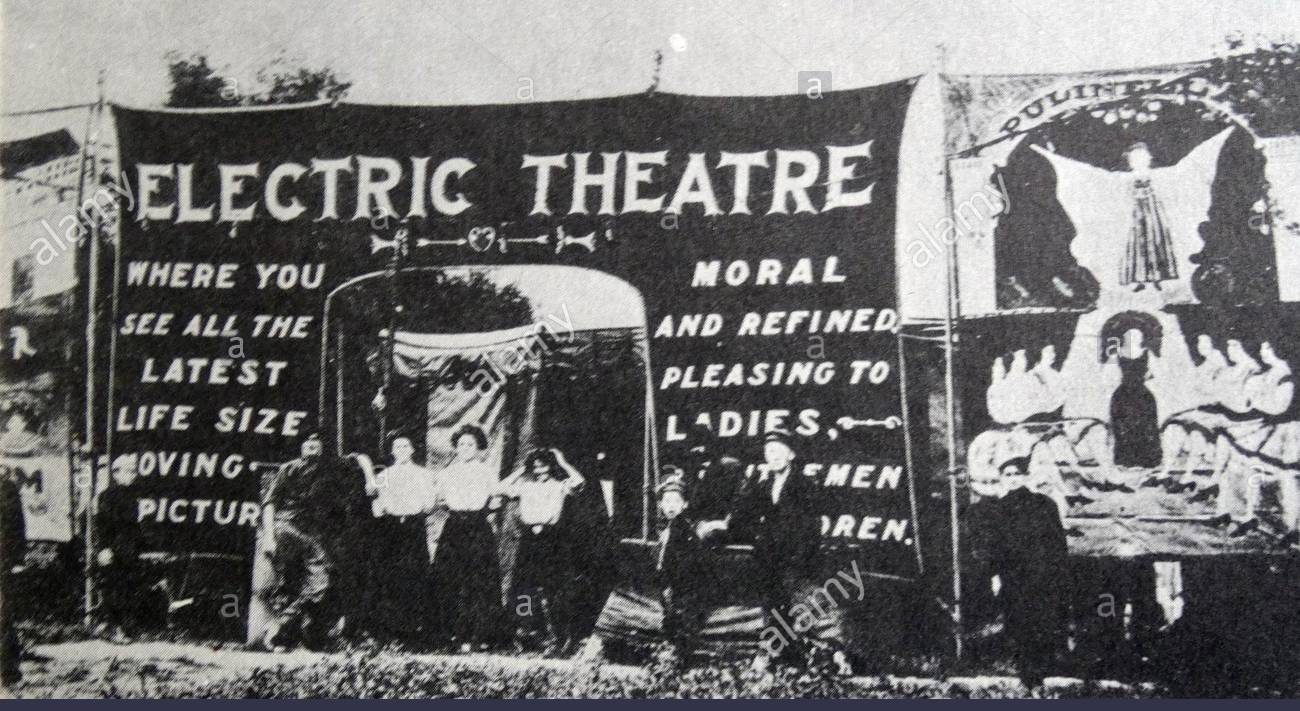
Admission was ten cents. The movie lasted about an hour. There were no cartoons or newsreels. The first theater to show an actual movie was the Electric Theater in Los Angeles on April 2, 1902. The Capture of the Biddle Brothers was an adventure melodrama based on actual events.

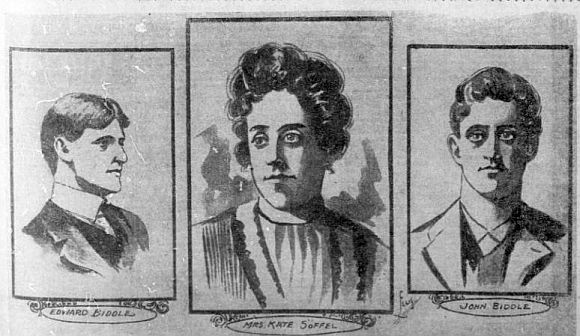
A few months earlier, condemned prisoners Jack and Ed Biddle escaped from a Pennsylvania jail using tools and weapons supplied to them by the warden’s wife, Kate Soffel. “Our picture, which is a perfect reproduction of the capture, is realistic and exciting,” the producer exclaimed — breathlessly one might imagine. Two sheriff-filled sleighs pursue the Biddles and Soffel through the white and drifting snow. The dastardly trio turns to make a stand, shotguns and revolvers blazing. Ed Biddle is shot, falls to the ground in a snow bank. On one elbow, he continues to fire shot after shot until he collapses. The second Biddle continues to fire, and he too is shot. Mrs. Soffel seeing the hopelessness of their situation, if not the error of her ways, attempts to shoot herself. All three are captured. The brothers both die of their wounds. Mrs. Soffel survives, but a reconciliation with her warden husband is probably unlikely.

The movie itself did not survive, and the names of the actors are lost to history. Oddly enough a remake — well maybe not exactly a remake — was released in 1984.  Mrs. Soffel starring Diane Keaton and Mel Gibson once again tells the tale of the terrible, terrible Biddle brothers. But not for a dime.


March 2, 1978: Grave Intrigue in Heidiland

graveSwiss auto mechanics turned thieves,Roman Wardas and Gantscho Ganev, had a great idea for a heist. They executed their bold plan with daring and cunning in the wee hours of March 2, 1978. Their target: a 300-pound oak coffin in the village of Corsier, Switzerland. Inside the coffin, was the body of the Little Tramp, Charlie Chaplin, who had died on Christmas day of the previous year. The graverobbers phoned Chaplin’s widow Oona with their demand for £400,000 a few days later.

Oona was having none of it. “Charlie would have thought it rather ridiculous,” she said, refusing to pay. A cat and mouse game between police and the robbers ensued as the police set up phony payoff meetings. The robbers got cold feet, however, and contact was never made, although police and robbers continued to communicate in an effort to achieve their disparate goals.

So dogged were the Swiss police that they put 200 phone booths under surveillance. The robbers again called Oona, whose phone had been tapped. The call was traced, and the hapless thieves were arrested. The men led police to a cornfield where they had buried the body. Chaplin was buried once again in the same burial plot, surrounded by a thick layer of concrete where he has since rested in peace.

Other robbers have made attempts to steal notable remains, Elvis Presley for a supposed ransom of $10 million and Abraham Lincoln for a mere $200,000. Neither attempt got very far, but as a result the bodies of Presley and his mother were moved from a Memphis cemetery to Graceland and 24-hour security monitoring. The 16th President now rests in a steel cage ten feet below ground, covered by concrete.

Captain Courageous

Captain America was the beefier alter ego of Steve Rogers, a typical captain90-pound weakling who realized every 90-pound weakling’s dream of being enhanced to the peak of human perfection by an experimental magic potion, so that he could employ his super abilities in the American war effort. He wore a rather gaudy American flag costume, a lot like those seen at Republican national conventions today.

In the first issue of Captain America Comics (March 1941), Captain America faced the Red Skull, a bellhop recruited by the Fuhrer himself to become a super villain for the Third Reich (and someone you wouldn’t want to forget to tip).

The incredibly patriotic Captain America fought the Nazis throughout World War II, and was one of the most popular comic characters during the war. After the war ended, his popularity waned and he was whisked off to the superheros’ retirement home in the 1950s, but made a super comeback during the 60s.

MAY 9, 1671: STALKING THE CROWN JEWELS

In the movie The Adventures of Sherlock Holmes, Holmes’ nemesis Professor Moriarty is out to steal the crown jewels. His  battle of wits with Holmes over England’s great treasure lasts about an hour.  Earlier, an Irishman, Colonel Thomas Blood, attempted the same feat with a much more elaborate plan.

Colonel Blood set the plan in motion in April with a visit to the Tower of London. Dressed as a parson and accompanied by a woman pretending to be his wife, Blood made the acquaintance of Talbot Edwards, an aged but trustworthy keeper of the jewels. During this time, the jewels could be viewed by the payment of a fee. After viewing the regalia, Blood’s “wife” pretended to be taken ill, upon which they were conducted to Edward’s lodgings where he gave her a cordial and treated her with great kindness. Blood and his accomplice thanked the Edwardses and left.

Blood returned a few days later with a half dozen gloves as a present to Mrs. Edwards as a gesture of thanks. As Blood became ingratiated with the family, he made an offer for a fictitious nephew of his to marry the Edwardses’ daughter, whom he alleged would be eligible upon their marriage to an income of several hundred pounds. It was agreed that Blood would bring his nephew to meet the young lady on May 9, 1671.  At the appointed time, Blood arrived with his supposed nephew, and two of his friends, and while they waited for the young lady’s appearance, they requested to view the jewels. Edwards accommodated the men but as he was doing so, they threw a cloak over him and struck him with a mallet, knocking him to the floor and rendering him senseless.

Blood and his men went to work. Using the mallet, Blood flattened out the crown so that he could hide it beneath his clerical coat. Another filed the sceptre in two to fit in a bag, while the third stuffed the sovereign’s orb down his trousers.

The three ruffians would probably have succeeded in their theft but for the opportune arrival of Edwards’ son and a companion, Captain Beckman. The elder Edwards regained his senses and raised the alarm shouting, “Treason! Murder! The crown is stolen!” His son and Beckman gave pursuit.

As Blood and his gang fled to their horses waiting at St. Catherine’s Gate, they dropped the sceptre and fired on the guards who attempted to stop them. As they ran along the Tower wharf, they were chased down by Captain Beckman. Although Blood shot at him, he missed and was captured before reaching the Iron Gate.  The crown, having fallen from his cloak, was found while Blood struggled with his captors, declaring, “It was a gallant attempt, however unsuccessful, for it was for a crown!” — a rather eloquent comeuppance speech which today would be something more along the lines of “Oh fuck!”

APRIL 21, 1986: SEEMS LIKE WE STRUCK OUT

Notorious gangster Al Capone moved to Chicago in 1919 where he built a career in gambling, alcohol, and prostitution rackets, eventually becoming Chicago’s go-to guy in the world of crime. He oversaw his various enterprises from a suite at the Lexington Hotel until his arrest in 1931.  He died in 1947.

The Lexington Hotel outlasted Capone by a good many years. In the 1980s, a construction Al-Capone-psd53402company undertook a renovation of the historic hotel. While surveying the building, the company made some unusual discoveries, including a shooting range and an elaborate series of hidden tunnels connecting to taverns and brothels and providing escape routes should the Chicago police get frisky and raid Capone’s headquarters. Most intriguing of all was a secret vault beneath the hotel, where rumor had it, Capone hid vast sums of his ill-gotten gains.

These discoveries were just too tempting for “investigative reporter” Geraldo Rivera to let pass by.  So on April 21, 1986, Geraldo planned to open the vault on live TV in a much ballyhooed special, The Mystery of Al Capone’s Vaults. What would the two-hour media event reveal? Piles of plunder? Bodies of Capone competitors? Jimmy Hoffa? Judge Crater? Among those who stood by Geraldo as the whole world watched were a medical examiner and agents of the Internal Revenue Service, lending the entire undertaking an aura of grim importance.

The vault was opened, and there . . . ? A lot of dirt and a couple of empty bottles. Geraldo did his best to snatch something out of the rubble, suggesting to 30 million disappointed viewers that the bottles were exciting because they had been used for bathtub gin during Prohibition. A nice try, but he summed up the evening by saying: “Seems like we struck out.”

APRIL 2, 1902: THE TERRIBLE, TERRIBLE BIDDLE BOYS

Admission was ten cents. The movie lasted about an hour. There were no cartoons or newsreels. The first theater to show an actual movie was the Electric Theater in Los Angeles on April 2, 1902. The Capture of the Biddle Brothers was an adventure melodrama based on actual events.

A few months earlier, condemned prisoners Jack and Ed Biddle escaped from a Pennsylvania jail using tools and weapons supplied to them by the warden’s wife, Kate Soffel. “Our picture, which is a perfect reproduction of the capture, is realistic and exciting,” the producer exclaimed — breathlessly one might imagine. Two sheriff-filled sleighs pursue the Biddles and Soffel through the white and drifting snow. The dastardly trio turns to make a stand, shotguns and revolvers blazing. Ed Biddle is shot, falls to the ground in a snow bank. On one elbow, he continues to fire shot after shot until he collapses. The second Biddle continues to fire, and he too is shot. Mrs. Soffel seeing the hopelessness of their situation, if not the error of her ways, attempts to shoot herself. All three are captured. The brothers both die of their wounds. Mrs. Soffel survives, but a reconciliation with her warden husband is probably unlikely.

The movie itself did not survive, and the names of the actors are lost to history. Oddly enough a remake — well maybe not exactly a remake — was released in 1984.  Mrs. Soffel starring Diane Keaton and Mel Gibson once again tells the tale of the terrible, terrible Biddle brothers. But not for a dime.

Hear Me Roar

The baseball season was just getting underway as 17-year-old Jackie Mitchell took the mound for the minor-league Chattanooga Lookouts in an exhibition game against the New York Yankees in Chattanooga, Tennessee, and on April 2, 1931, became  one of the first and female pitchers in professional baseball history.

The game had gotten off to a rocky beginning for the Lookouts with their starting pitcher (male) giving up hits to the Yankees’ first two batters. The teenage Mitchell was brought in to face a couple of guys named Babe Ruth and Lou Gehrig. Mitchell’s first pitch to Ruth was a sinker that darted low for ball one. She followed with a sinker on the outside corner, which the Babe swung through and missed. Grinning, the “Sultan of Swat” swung at her next pitch and missed again for strike two. Another sinker on the corner of the plate, and Ruth watched it sail by for a strike three call. “The Babe kicked the dirt and gave his bat a wild heave as he stormed unhappily to the dugout.”

Gehrig came to bat and promptly missed three straight dipping sinkers, swinging early each time. On seven pitches, the Chattanooga teenager had struck out Ruth and Gehrig, two of the game’s greatest hitters. The hometown crowd rewarded her with a standing ovation. The next day, one newspaper cleverly suggested that “maybe her curves were too much for them.”

Unfortunately, Mitchell’s game against the Yankees was also her last.  Just days after her legendary performance, (male) baseball commissioner Kenesaw Mountain Landis voided her contract because the sport of baseball was “too strenuous for women.” Although Jackie went on to tour with other prominent female athletes and play on women’s teams for a short time, Landis had pretty much wrecked her professional career, and she bowed out of sports at age 23.

November 6, 1982: Antifreeze and Old Lace

In Arsenic and Old Lace, a delightfully dark stage play adapted into a movie by Frank Capra, Mortimer Brewster (Cary Grant) has an eccentric family that includes two brothers – one of whom thinks he’s Theodore Roosevelt digging the Panama Canal in the basement, the other a killer who’s had plastic surgery to make him look like Boris Karloff – and two spinster aunts who have taken to murdering lonely old men by poisoning them with home-made elderberry wine laced with arsenic, strychnine, and “just a pinch” of cyanide. Generally, poisoners aren’t as sweet as these two old ladies.

Take the case of Shirley Allen, arrested on November 6, 1982, charged with murdering her sixth husband Lloyd. Shirley certainly wasn’t as sweet as the two old ladies, nor nearly as successful. Her first attempt at poisoning was believed to be an early husband, Joe Sinclair, back in 1968. When his coffee began to taste odd, he didn’t buy the idea that it was the newest flavor of the month, reasoning that Juan Valdez Free Trade Almond Praline Decaf should not give him internal injuries.  Joe went to the police, but no charges were filed. He filed for divorce, however.

Another husband, John Gregg, was not so lucky. He died a year after he married Shirley. He must have sensed that something was amiss because he changed the beneficiary of his insurance policy shortly before he died. Shirley got nothing. As you might guess, she was miffed. A pink-haired, large-bosomed barfly was rather happy, however.

Lloyd Allen was Shirley’s sixth husband. He began to complain of a strange taste in his beer. When Shirley said that it was an iron supplement that would put a tiger in his tank, Lloyd believed her and promptly died. This time she was named as beneficiary of a $25,000 life insurance, but alas her daughter told police about the doctored beers. Toxicology reports confirmed that Lloyd’s body tissue contained a lethal amount of ethyl glycol – antifreeze. Shirley went to prison for life. She was never allowed to work in the prison cafeteria.