The editors of the New York Evening Journal did not think it suitable for the comics section. The public didn’t much care for it. But publisher William Randolph Hearst liked it and gave it a permanent place in the Journal, beginning October 28, 1913.
Krazy Kat was a carefree, simple-minded, gender-confused cat (sometimes a he, sometimes a she), desperately in love with a mouse. It isn’t just unrequited love; Ignatz Mouse, a rather despicable little rodent, positively hates Krazy and endlessly schemes to throw bricks at Krazy’s head. Poor Krazy sees this as a sign of affection.
Add a dog – Officer Bull Pupp, a police officer who dotes on Krazy and makes it his purpose in life to prevent Ignatz from throwing bricks and to haul him off to jail when he’s caught in the act. This peculiar love triangle takes place in a surreal Arizona (or is Arizona naturally surreal?), where the strip’s creator George Herriman had a vacation home.
The premise was simplistic, the humor slapstick, but critics have loved it for 100 years. During it’s thirty-year run, it gained such admirers as H.L. Mencken, Jack Kerouac, E.E. Cummings and Willem de Kooning, and many modern cartoonists have cited the strip as a major influence on their work.
In 1582, the Gregorian Calendar was adopted for the first time with Poland, Portugal and Spain leading the way. The calendar was implemented by and named after Pope Gregory XIII . He didn’t like the Julian Calendar in use at the time because Easter kept creeping back to an earlier time of the year so that eventually it would fall in the middle of winter, even on Christmas Day (which wasn’t creeping) and really confuse Christians.
Jews didn’t care a whole lot because they were already up to year 5303. Muslims were back at 1001. The Chinese were celebrating 4278 (Year of the Horse). Certain scientists were way ahead of everyone else at 11582, having added 10,000 years to the current year to make the starting point the beginning of the human era (like they knew what day that was) instead of the birth of Jesus who they say wasn’t born in 1 BC but in 4 BC (lied about his age) and wasn’t born on his birthday (Christmas).
But back to the Christians for whom it was October 4, 1582, and also for whom tomorrow would be October 15, because Pope Gregory took ten days right out of the calendar to put Easter back where it had been when he was a boy. Well, you can just imagine how upset folks who had birthdays or special anniversaries or doctors’ appointments between October 5 and 14 were.
Some people just refused to use the new calendar. Many European countries fell into line later in the year. But many Protestant countries thought the new calendar was part of a Catholic plot . Britain (and its colonies) didn’t come along until 1752. The Greeks didn’t start using it until 1923. And a few malcontent members of the U.S. Congress are still demanding a recount.
Calling All Crimestoppers
An all-American, tough but smart, police detective arrived on the crime scene on October 4, 1931. Chester Gould’s Dick Tracy comic strip first appeared in the Detroit Mirror. The strip continues to run to this day, although drawn by others since Gould departed for that precinct in the sky back in 1985.
Along with police procedure and gadgets such as the two-way wrist radio, the strip featured a bevy of colorful characters. There’s Tess Trueheart, Tracy’s lady friend and eventual wife, his adopted son Junior and his wife Moon Maid (an alien), their daughter Honey Moon, Junior’s second wife Sparkle Plenty and her parents B. O. and Gravel Gertie. An almost endless list of villains: Abner Kadaver, Art Dekko, Breathless Mahoney, Cueball, Flattop, Gruesome, Junky Doolb (blood backwards), Littleface Finny, the Mole, Mrs. Chin Chillar, Mumbles and Pruneface.
Faraway Places With Strange Sounding Names
The Trojan Horse dates way back to the war between the Trojans and the Greeks in a thousand or so BC. Having been unable to topple Troy, the Greeks pretended to sail away, leaving the large wooden beast as a going away gift. But weren’t there a gaggle of Greeks hiding inside. Laocoon, a Trojan priest warned the others that he feared the Greeks bearing gifts. Perhaps if he had been more precise, counseling the Trojans to beware a gift bearing Greeks or not to look a gift horse in the mouth or you might see a Greek looking back at you, the outcome may have been different. But it wasn’t.
The Trojan Horse became a symbol of Greek might and was revered through the ages, resting at its home in the Trojan Horse National Park. Inexplicably, the Greeks tired of it and it was eventually converted to a condo. The horse which had once been filled with ancient Greek warriors came to house only five Greeks, the Thermopolis brothers — Dmitri, Ergo, Aristotle, Zorba and Smitty.
Starting his career as an anonymous young storyboard artist for Walt Disney Productions on Donald Duck cartoons and other shorts, the cartoonist who would later be compared to everyone from Lewis Carroll and James Joyce to Aesop and Uncle Remus moved to the animation department in 1939. There, during the next five years he contributed to such Disney classics as Pinocchio (Gepetto in the whale), Fantasia (a drunk Bacchus riding a donkey), and Dumbo (the crow sequence). Walt Kelly was doing pretty well at $100 a week.
During the 40s, Kelly devoted himself more and more to comic book art at Dell. The little possum with whom he is now most closely associated came on the scene in 1943 in Dell’s Animal Comics. Pogo would go on to star in 16 issues of his own comic book and 26 years as a syndicated newspaper comic strip. Along with Pogo, there were Albert the Alligator, Churchy LaFemme (a turtle), Howland Owl, Beauregard (Houndog), Porkypine, and Miz Mamzelle Hepzibah (a skunk).
Kelly’s liberal political and social views were rarely disguised as he used the strip to champion the powerless and the oppressed and to satirize political dogmas and figures such as Senator Joseph McCarthy (Simple J. Malarkey, a gun-toting bobcat), Vice President Spiro Agnew, and FBI Director J. Edgar Hoover. Many newspapers dropped Pogo, and others moved it to the editorial page. Walt and Pogo were probably most remembered for their campaign on behalf of the environment and the battle cry: “We have met the enemy, and he is us.”
London’s Bartholomew Fair, a wild celebration on the eponymous saint’s anniversary, died not with a bang but a whimper after enduring for more than seven centuries, Although originally established for legitimate business purposes, the fair had become all eating, drinking and amusement (for shame!) and a bit of a public nuisance with rowdiness and mischief.
Serious pursuits, uplifting exhibits, and dramatic entertainments had given way to shows and exhibits catering to the lowest common denominator of British fair-goers tastes – conjurers, wild beasts, monsters, learned pigs, dwarfs, giants. A prodigious monster with one head and two distinct bodies, a woman with three breasts, a child with three legs. A mermaid with a monkey’s head and the tail of a fish. Puppet shows, pantomimes, and coarse melodramas. A pig-faced lady and a potato that looked like King Henry VIII.
Eventually the fair grew less curiouser and curiouser, and on August 24, 1850, when the mayor went as usual to proclaim the opening of the fair, he found nothing to make it worth the trouble. No mayor went after that, and in 1855 the fair rolled over and expired.
♥
I went to the animal fair,
The Birds and the Beasts were there.
The big baboon, by the light of the moon,
Was combing his auburn hair.
The monkey, he got drunk,
And sat on the elephant’s trunk.
The elephant sneezed and fell on his knees,
And what became of the monk, the monk?
The monk, the monk, the monk.
He is probably the patron saint of inventors everywhere – or at least their idol – for his uncanny ability to devise an incredibly convoluted method to carry out the simplest tasks. In fact the Merriam-Webster dictionary adopted his name as an adjective in 1931 meaning just that, to accomplish something simple through complex means.
Reuben Garrett Lucius (Rube) Goldberg was born on July 4, 1883. He died in 1970, at the age of 87, leaving a legacy for inventors and cartoonists alike. He was a founding member and first president of the National Cartoonists Society and is the namesake of its Reuben Award for Cartoonist of the Year. In 1948, he won his own Pulitzer Prize for his political cartooning. And he is the inspiration for many competitions challenging would-be inventors to create machines using his scientific principles.
Professor Butts and the Self-Operating Napkin offers a typical scenario for a Rube Goldberg invention: A soup spoon (A) is raised to the mouth, pulling string (B) and thereby jerking a ladle (C), which throws cracker (D) past parrot (E). Parrot jumps after cracker and perch (F) tilts, upsetting seeds (G) into pail (H). Extra weight in pail pulls cord (I), which opens and lights automatic lighter (J), setting off skyrocket (K), which causes sickle (L) to cut string (M) and allow the pendulum with the attached napkin to swing back and forth, wiping the user’s chin.
THE DAY WE MOVED OUT
On July 4, 1776, the Continental Congress adopted the Declaration of Independence stating that the thirteen American colonies regarded themselves as a new nation, the United States of America, and were no longer part of the British Empire.
“When in the Course of human events, it becomes necessary for one people to dissolve the political bands which have connected them with another, and to assume among the powers of the earth, the separate and equal station to which the Laws of Nature and of Nature’s God entitle them, a decent respect to the opinions of mankind requires that they should declare the causes which impel them to the separation.
We hold these truths to be self-evident, that all men are created equal, that they are endowed by their Creator with certain unalienable Rights, that among these are Life, Liberty and the pursuit of Happiness. . .”
Harrison Ford cracked a mean bullwhip as the title character in the Indiana Jones series of films. Ford wasn’t born brandishing a bullwhip; he had to learn it for the films. And he was taught by bullwhip master, Lash LaRue born on June 16, 1917.
Like many actors in the 40s and 50s, LaRue spent most of his career making B-Westerns. Originally hired because he looked enough like Humphrey Bogart that producers thought this would draw in more viewers, he used his real last name as the name for most of his film characters. He was given the name Lash because, although he carried a gun, he was noted for preferring to use an 18-foot-long bullwhip to take on bad guys. Lash not only disarmed bad guys, he performed many stunts such as saving people about to fall to their doom by wrapping his whip around them — often while at full gallop on Black Diamond, his trusty horse — and pulling them to safety. Lash, like a guy named Cash, was also known for always wearing black.
After starting out as a sidekick to singing cowboy Eddie Dean, he earned his own series of Western films and his own sidekick, Fuzzy Q. Jones (Al St. John), inherited from Buster Crabbe. He also got his very own villain — an evil, cigar-smoking twin brother, The Frontier Phantom.
His films ran from 1947 to 1951. The comic book series that was named after his screen character lasted even longer, appearing in 1949 and running for 12 years as one of the most popular western comics published.
Walter Lantz, who was born in 1899 to Italian immigrant parents, actually had the surname Lanza until an immigration official anglicized it. Had he not, Walter could have grown up to be an opera singer rather than the creator of Woody Woodpecker and many other cartoon characters.
The first of these characters was Oswald the Lucky Rabbit, star of a 1928 cartoon series for Universal Studios. The character, who bears more than a passing resemblance to Mickey Mouse, had once belonged to Disney. Lantz won it in a game of poker.
Other less memorable characters followed: a trio of chimps, Meany, Miny and Moe; Baby-Face Mouse; Snuffy Skunk; Doxie (a dachshund); and monkeys Jock and Jill. One character stood out from the crowd – Andy Panda became the comic star for 1939.
A year later, Lantz married actress Grace Stafford. While on their honeymoon, Walter and Grace were pestered by an insistent woodpecker pecking on their roof, and Grace suggested that Walter use the bird as a cartoon character. Woody Woodpecker appeared for the first time in an Andy Panda cartoon and soon became a leading character.
Mel Blanc was originally the voice of Woody Woodpecker, but after only three cartoons, he left to join Warner Brothers. Lantz held anonymous auditions for a new Woody. Lantz’s wife Grace made a secret audition tape and was chosen to be the new voice. She continued in the part until production ceased in 1972.
Woody Woodpecker is the only comic character to have his own hit song. Kay Kyser recorded “The Woody Woodpecker Song,” a top hit and Academy Award nominee in 1948.
Ho-ho-ho ho ho! Ho-ho-ho ho ho! Oh, that’s the Woody Woodpecker song. They don’t write lyrics like that anymore.
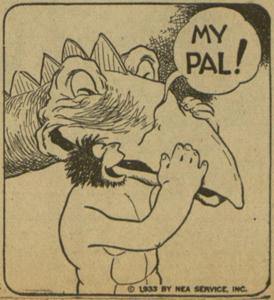
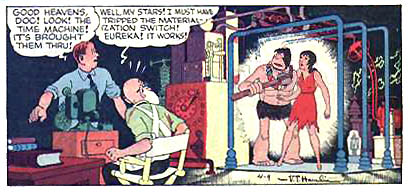
April 4 may have been a banner day for tinkerers, but April 5 was pretty impressive as well. In 1939, another important invention made its debut — Dr. Elbert Wonmug’s time machine. Oh, there had been time machines before this, but this would be the first to transport an honest-to-goodness caveman from way back in the Bone Age right into the 20th century. The caveman was none other than Alley Oop, beamed in from the kingdom of Moo where for the past seven years he had been doing typical caveman things — riding around on his pet dinosaur in a furry loincloth, brandishing his big club at his many enemies, and courting the lovely Ooola.
But once in the 20th century with a time machine to beam him about, Oop was no longer bound by prehistoric limitations. He became a roving ambassador, traveling to such destinations as ancient Egypt, Arthurian England and the American frontier, rubbing elbows with such folks as Robin Hood, Cleopatra, Ulysses, Shakespeare and Napoleon. At one point he even visited the moon. Pretty impressive for a Neanderthal. Let’s see your Australopithecus do that.
The Big Oops
Time travel, if you will, back to this day in 1722, an Easter Sunday. Dutch explorer Jacob Roggeveen, sailing with three ships — the Arend, the Thienhoven, and Afrikaansche Galey (sort of like Columbus and his Nina, Pinta and Santa Marie, but a lot more of a tongue twister) — lands on an island in the South Pacific and names it Easter Island. Along with several thousand inhabitants, he discovers a bunch of stone heads that look rather amazingly like Alley Oop. Could it be that Alley Oop got here earlier in his time machine?
There’s an old tradition among Italian singers: they won’t go on stage unless they see a bent nail. Don’t ask. A certain Italian tenor saw a bent nail on February 17, 1972 (one of many planted surreptitiously by stagehands at New York’s Metropolitan Opera House), and it proved to be quite an omen. Although he had an international reputation, he was the new kid on the block here, making his first appearance in the United States. The production was Donizetti’s La Fille du Régiment, and Luciano Pavarotti sang the role of the peasant Tonio opposite Joan Sutherland. He brought down the house with his mastery of the amazing aria “Ah, mes amis” with its nine successive top Cs. His performance was one for the history books. At the opera’s conclusion, he received a record 17 curtain calls.
He would go on to do much, much more. Pavarotti’s 43-year career included 15 Grammy nominations, five wins and two Guinness world records. He would set another record for curtain calls in a 1988 Berlin production of L’elisir d’amore –165 curtain calls, lasting 67 minutes. His 1990 Three Tenors concert with José Carreras and Plácido Domingo sold 10.5 million albums, the most for a classical recording.
Another Kid, Another Block
Mickey Dugan, a bald, snaggle-toothed kid with a silly grin who always wore an over-sized yellow hand-me-down nightshirt, was right at home in the 19th century New York slum known as Hogan’s Alley, and beginning on February 17, 1895, became right at home in Joseph Pulitzer’s New York World.
In the neighborhood filled with quirky characters that was home to R. F. Outcalt’s comic strip, Mickey, also know as the Yellow Kid was the quirkiest. The Hogan’s Alley comic strip gradually became a full-page Sunday color cartoon with the Kid as its main character. He spoke in a muddled slang that was practically his own language, and everything he said was printed on his nightshirt as though he were a walking billboard.
It may have been a cartoon, but Outcault’s comic strip aimed its humor and social commentary squarely at an adult audience. It has been described as a turn-of-the-century theater of the city, in which a group of mischievous ragamuffins act out the class and racial tensions of the their urban environment.
As the Kid’s popularity grew, the strip’s presence actually increased paper sales for the World, and led to all sorts of merchandising from dolls to playing cards to cigarettes. It also earned Outcault the appellation ‘father of the comic strip.’
When You Wish Upon a Book
The Sears & Roebuck catalog may have become the Magilla Gorilla of mail order, but Aaron Montgomery Ward, born on February 17, 1844, beat Mr. Sears and Mr. Roebuck to the punch by 18 years — and there was only one of him. As a young traveling salesman, Ward saw firsthand how rural folk were being poorly served by small town general merchandisers. Couldn’t they have some of the same opportunities to buy lots of stuff as their big city counterparts? Of course they could, Ward answered, and in 1872, the mail-order catalog was born.
That first catalog was a one-page price list featuring 163 items. By 1874, it had grown to 32 bound pages; by 1895, over 600 pages with thousands of items. Dubbed the Wish Book, it was a magnificent thing, fully illustrated with woodcuts and drawings, hawking anything you could possibly want — tools, jewelry, millinery, musical instruments, furniture, bathtubs and buggies. Cradle to grave.
He’s short with big ears, a big nose and a skinny tail. He’s nattily attired in red shorts with two big buttons, big yellow shoes and white gloves. He hails from Florida these days where he has his own kingdom and is a woke Robin Hood to the state’s evil governor. Back in 1930 when he made his debut he wasn’t quite so colorful, his venue being a black and white comic strip. Mickey Mouse was already well known when his comic strip first appeared, having been a film star since his first appearance in 1928 in the cartoon Plane Crazy. Created by Walt Disney and Ub Iwerks, he has grown in stature through the years to become the face of the Walt Disney organization.
The first comic strip sequence was a reprise of the Plane Crazy cartoon in which Mickey dreams of following in the footsteps of his idol Charles Lindbergh, flying into adventure in his own homemade plane, along with his girlfriend Minnie.
The governor of Florida would probably fare better against a less formidable Disney character. A DeSantis/Donald Duck debate would be priceless.
If Only It Had Wings
On January 13, 1854, musical inventor Anthony Foss received a patent for his accordion, a strange device shaped like a box with a bellows that is compressed or expanded while pressing buttons or keys which cause pallets to open and air to flow across strips of brass or steel, creating something that vaguely resembles music. It is sometimes called a squeezebox. The person playing it is called an accordionist (or squeezeboxer?)
The harmonium and concertina are cousins. And, yes, there is a World Accordion Day.
If Only She’d Had a Squeezebox
Born in Russia on January 13, 1887, “the Last of the Red Hot Mamas,” Sophie Tucker immigrated to the United States as an infant and began her long career shortly afterward, singing for tips in her parents’ restaurant. Between taking orders and serving customers, Sophie would stand in a narrow space by the door and belt out songs with all the drama she could muster. “At the end of the last chorus,” she remembered, “between me and the onions, there wasn’t a dry eye in the place.”
She gained stardom using a combination of comic risque and “fat girl” songs such as “Nobody Loves a Fat Girl, But Oh How a Fat Girl Can Love.” Her signature song, however, was “Some of These Days.” She became one of the most popular entertainers in America, following her vaudeville and burlesque career with movies through the 30’s and 40’s and television in the 50’s and 60’s. She influenced many female performers, including such larger than life performers as Mae West and Bette Midler.
Sophie Tucker continued performing until her death in 1966.






 Wretched Richard's Almanac