December 11, 1969: The Naked Cold War

Relations between the United States and the Soviet Union were generally confrontational through most of the second half of the last century.  In the United States, Communist plots were everywhere, and the Soviet Union blamed American capitalists for most of the ills of the world. On December 11, 1969, a noted Russian author lashed out against western decadence in one of the more unusual cold war recriminations.

On December 11, 1969, Sergei Mikhailkov, secretary of the Moscow writer’s union, known for his books for children, weighed in against the production of “Oh! Calcutta!” that was currently an off-Broadway hit. Performers in their “birthday suits,” he fumed, were proof of the decadence and “bourgeois” thinking in Western culture.  American nudity was an assault on Soviet innocence.

Oddly enough, those Americans throughout the Midwest who didn’t think the play was about India were convinced it was a Communist plot.

More disturbing, Mikhailkov raged on, was the fact that this American abomination was affecting Russian youth. These vulgar exhibitions were “a general striptease that is one of the slogans of modern bourgeois art.” Soviet teens were more familiar with “the theater of the absurd and the novel without a hero and all kinds of modern bourgeois reactionary tendencies in the literature and art of the West” than with “the past and present of the literature of their fatherland.”

Mikhailkov’s outburst came at the end of a conference of Russian intellectuals, who applauded his remarks without visible enthusiasm before returning to their clandestine copies of Fanny Hill.

OCTOBER 6, 1962: YOU CAN COME OUT FROM UNDER YOUR SEAT

When one thinks of offbeat film-making, directors Tim Burton and David Lynch come to mind. You’d be hard pressed, however, to find a more offbeat body of cinematic work than that of Tod Browning. Who?, most people would be asking. Tod Browning’s strange macabre films were a pulp-fiction parade of crooks, carnies, lowlifes, deadbeats, wretches, wastrels, scoundrels and, of course, vampires and freaks. And they helped to define the horror film genre.

Browning came to this career honestly. Born in Louisville, Kentrucky, he gave up his comfortable home life at 16 to immerse himself in the world of carnivals, sideshows and circuses. His resume included stints as a Ringling Brothers clown, a barker for the Wild Man of Borneo and the “Living Corpse” for which he was buried alive. He also worked as a magician, dancer and actor before finding his niche as a director of dozens of silent films, including a 10-film collaboration with Lon Chaney. When sound came to the movies, he made his mark with two of his most notable films: Dracula starring Bela Lugosi and Freaks, his master work and the film that destroyed his career. Freaks was so grotesque and unnerving that it was banned in the United Kingdom for three decades. In the U.S., MGM took the film away from Browning and chopped it by almost a third. It performed miserably.

His career on the skids, Browning made a handful of films during the 1930s before “retiring” at the end of the decade. He died on October 6, 1962.

Freak Show

The Halloween season (not to mention the political season) offers the perfect opportunity to indulge in Freaks.  It’s a love triangle set in a bizarre carnival world, featuring Hans, a wealthy dwarf, Cleopatra, a gold-digging trapeze artist, and Hercules, a strongman. Cleopatra and Hercules plan to trick Hans into marrying Cleopatra and then poison him. All the performers are real sideshow “freaks” — Koo Koo, the bird girl, Daisy and Violet, the Siamese twins, Johnny Eck, the Half Boy, Schlitzie, the Pinhead, to name a few, but the beauty of the film is Browning’s portraying them as the real human beings they are. The film remains frightening and grotesque, even after MGM’s “editing.” The deleted scenes were trashed, so it’s likely that no one still living today has seen the original version.


How I Stopped Worrying and Learned to Love the Bomb

Cold war and nuclear fears had been ramping up for years, when President John F. Kennedy took to the tube on October 6, 1961, to suggest that American families build bomb shelters to protect them from atomic fallout when those pesky Communists of the Soviet Union attacked the Homeland with their nuclear missiles. Just a year later, the Cuban Missile Crisis raised the stakes even higher.

While folks like Nelson Rockefeller and Edward Teller were outlining grandiose plans for an enormous network of concrete lined underground fallout shelters to shelter millions of people, civil defense authorities were talking up concrete block basement shelters that could be constructed by home handifolk for a couple hundred bucks. Exactly how much protection they might actually provide was an open question.

Most people calmed down during the mid-1960s,  and fallout shelters pretty much went the way of duck and cover.  They were converted into wine cellars, recreation rooms or mushroom gardens. For others, the fallout shelter notion has been kept alive by internet sites devoted to nuclear hysteria. You can survive a nuclear or dirty bomb attack, shouts one such site.  It will not be the end of the world. But, you must be prepared!

Being prepared naturally involves purchasing a fallout shelter from one of the many firms that still market them — Acme Survival Shelters, Hardened Structures Inc., Safecastle.  Taking it over the top is a company called Zombie Gear whose motto is Be prepared for anything.

March 27, 1958: They Say Goofy Is a Fellow Traveler

     Nikita Khrushchev was elevated to top commie in the Soviet Union on March 27, 1958. His Cold War relationship with President Eisenhower and the United States was a complex one, certainly more so than the Ego War between the current Russian leader and his previous U.S. bro-hug counterpart.

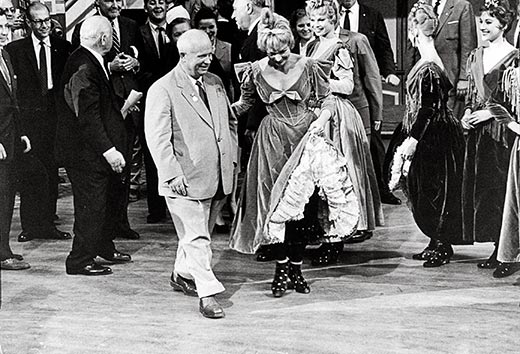
     The following year Khrushchev was in the U.S. for a summit meeting with Eisenhower.   At the Soviet leader’s request, a visit to Hollywood was arranged.  Khrushchev and his wife arrived in Los Angeles, where the day started with a tour of the Twentieth Century Fox Studios in Hollywood and a visit to the sound stage of  Can-Can. Meeting stars Shirley MacLaine and Juliet Prowse pleased the roly-poly dictator even though he had to nyet a chance to dance with MacLaine (probably something to do with the Siberian stare coming from Mrs. K)   A lunch hosted by Frank Sinatra was also a big success even though Sinatra didn’t sing “That Old Bolshevik Magic,” as Nikita requested.

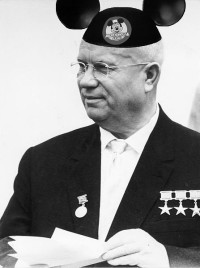
     The day headed downhill when Twentieth Century Fox President Spyros P. Skouras, who wore his anticommunism on his sleeve, got into a bit of a who-will-bury-whom brouhaha with the Russian leader who was known for his temper tantrums.  Shortly afterward, it began to look as though a nuclear exchange were imminent. Meeting Frank Sinatra was nice, but who Nikita really wanted to meet was Mickey Mouse.  His American hosts told him it couldn’t happen.  Security concerns.   Perhaps he’d like to see Cape Canaveral, the White House War Room, the Strategic Air Command. But no Disneyland.  Nicky exploded. “And I say, I would very much like to go and see Disneyland. But then, we cannot guarantee your security, they say. Then what must I do? Commit suicide? What is it? Is there an epidemic of cholera there or something? Or have gangsters taken hold of the place that can destroy me?”

Khrushchev left Los Angeles the next morning, and the Cold War returned to deep freeze.

Put a Cork in It

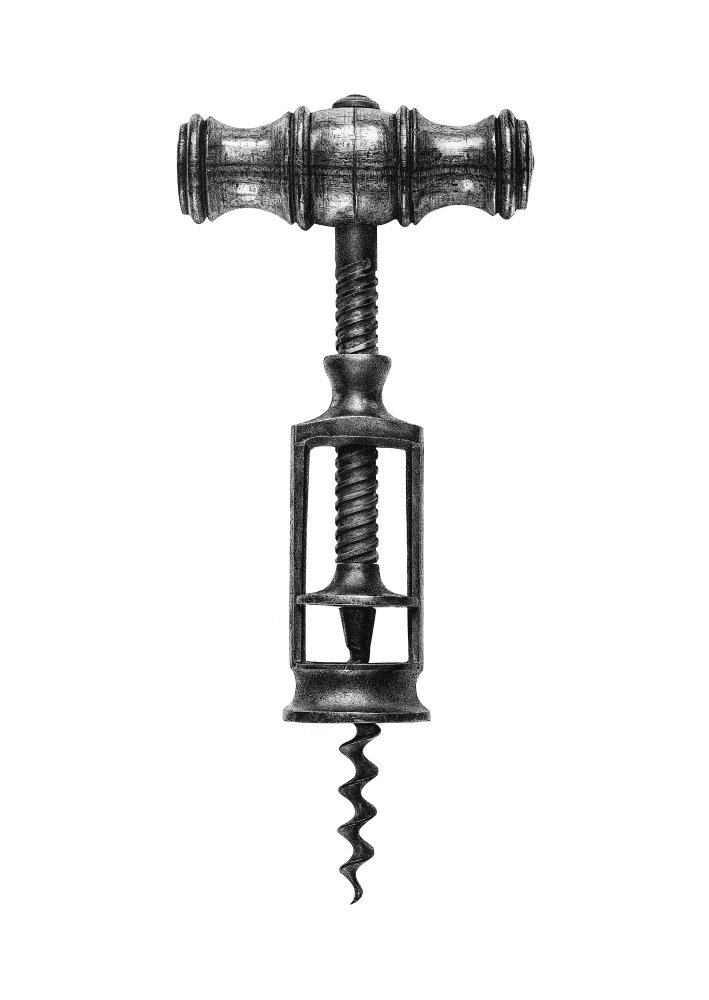
Back through the centuries wine lovers never aged their wines; they consumed it quickly before it went bad.  Then in the 18th century, British glassblowers began to make bottles with narrow necks for wine that made airtight storage possible. Corks were used to seal the bottles. This quickly led to the invention of one of the dandiest little gizmos ever devised — the corkscrew. The design was based on a similar device used to clean muskets. The first corkscrews were T-shaped devices that twisted into the cork and after a certain amount of pulling extracted the cork. Corkscrews were first patented in England and France, then on March 27, 1860, M. L. Byrn of New York City received an American patent.

Since then, hundreds of corkscrews have been designed of every shape, size and mechanics you can imagine — single-lever, double-winged, air pump, electric, mounted. Naturally there are corkscrew books, corkscrew clubs, and corkscrew collectors, helixophiles.

APRIL 19, 1949: SEND IN THE CLOWNS

russian

With the threat of nuclear annihilation hanging over the world, cold war adversaries were nonetheless able to find glimmers of humor. At the opening night of the Moscow Circus, noted Russian clown, Konsantin Berman, demonstrated who had the upper hand in the clown cold war, launching barb after barb in the direction of the United States.

Tossing a boomerang, he likened it to the U.S. Marshall Plan that was pumping economic recovery aid into Western Europe. “American aid to Europe,” he said, “Here is the dollar.” as the boomerang returned to his hand, delighting the audience. Producing a radio that bellowed out the sound of barking dogs, he announced: “That’s the Voice of America.”

Meanwhile American clowns were dumping buckets of water on each other and slipping on banana peels.

Speaking of Banana Peels

The Vagabond King a 1925 operetta by Rudolf Frimi was already an American success when it opened in London on April 19, 1927.  It’s success in England was probably assured given its theme of foibles of the French.  Its hero is a braggart, thief and rabble-rouser who attempts to steal an aristocratic lady from the king himself.  Not only that, he openly mocks the king, boasting about what he would do if he were king.  The angry king gives him royal powers for 24 hours — king for a day — during which he must solve all France’s problems or go to the gallows (the guillotine had not yet been invented).  He succeeds, wins the lady’s hand and lives happily ever after in exile — probably in England.  The operetta was the inspiration for a couple of movies and, of course, the popular radio and television program “Queen for a Day.”


December 11, 1969: The Naked Cold War

Relations between the United States and the Soviet Union were generally confrontational through most of the second half of the last century.  In the United States, Communist plots were everywhere, and the Soviet Union blamed American capitalists for most of the ills of the world. On December 11, 1969, a noted Russian author lashed out against western decadence in one of the more unusual cold war recriminations.

On December 11, 1969, Sergei Mikhailkov, secretary of the Moscow writer’s union, known for his books for children, weighed in against the production of “Oh! Calcutta!” that was currently an off-Broadway hit. Performers in their “birthday suits,” he fumed, were proof of the decadence and “bourgeois” thinking in Western culture.  American nudity was an assault on Soviet innocence.

Oddly enough, those Americans throughout the Midwest who didn’t think the play was about India were convinced it was a Communist plot.

More disturbing, Mikhailkov raged on, was the fact that this American abomination was affecting Russian youth. These vulgar exhibitions were “a general striptease that is one of the slogans of modern bourgeois art.” Soviet teens were more familiar with “the theater of the absurd and the novel without a hero and all kinds of modern bourgeois reactionary tendencies in the literature and art of the West” than with “the past and present of the literature of their fatherland.”

Mikhailkov’s outburst came at the end of a conference of Russian intellectuals, who applauded his remarks without visible enthusiasm before returning to their clandestine copies of Fanny Hill.