AUGUST 12, 1881: READY WHEN YOU ARE, C.B.

Cecil B. DeMille was a larger-than-life filmmaker throughout the first half of the last century as well as God’s public relations director. Born in 1881 in Ashfield, Massachusetts, he went on to enter the world of theater as an actor, director and playwright.  He helped to establish Paramount Pictures and co-directed his first film, The Squaw Man, the first of over 70 films, in 1914. Through the years, he burnished his reputation with lavish biblical epics such as The King of Kings, Samson and Delilah, and The Ten Commandments.

     DeMille created the first movie to have a budget of more than $1 million, paving the way for his future epics “with a cast of thousands.” Although he was adept at directing thousands of extras, he had a bit of a problem with individual actors, becoming a tad tyrannical on the set.  When making redsea1927′s King of Kings, DeMille demanded that in order to preserve the film’s spiritual integrity, the actors all had to enter into contracts promising that they would not do anything “unbiblical” for five years — that included going to baseball games,  frequenting nightclubs and  driving sexy cars.

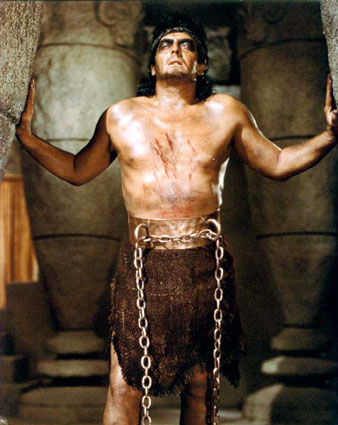
     He saw no reason his actors shouldn’t risk their lives for the good of the film.  Although Victor Mature was a superhero in Samson and Delilah, DeMille said he was “100% yellow” because he refused to wrestle a lion. Paulette Goddard lost future roles with the director by refusing to play with fire in Unconquered.

     And he loved spectacle – the parting of the Red Sea in The Ten Commandments, the toppling of the temple in Samson and Delilah, train wrecks in The Road to Yesterday, Union Pacific and The Greatest Show on Earth, and the destruction of a zeppelin in Madame Satan.

     Gloria Swanson immortalized DeMille in a movie he didn’t direct, Sunset Boulevard, with the frequently repeated line: “All right, Mr. DeMille, I’m ready for my close-up.”

Give me any two pages of the Bible and I’ll give you a picture.  — Cecil B. DeMille

MARCH 26, 47 BC: WITH A LITTLE BIT OF LUCK

Ptolemy XIII was Pharaoh of Egypt from 51 to 47 BC (remember we’re counting backwards here), his reign pretty much demonstrating the bad luck associated with the number thirteen (in fact he could have been nicknamed Ptolemy the Unlucky or Friday the XIII).

Ptolemy XIII succeeded his father Ptolemy XII, becoming co-ruler by marrying Cleopatra who was his older sister at the time. She was Cleopatra VII, but she was the Cleopatra we all know about — the one of Antony and Caesar and the asp and all that. Since XIII was only 11 at the time, he had a regent — and should you be thinking about the regent’s duties vis-à-vis Cleopatra, we’ll point out that the regent’s name was Pothinus the Eunuch.

Still with us?

Cleopatra, it turns out, was a bit of a grandstander, strutting about as Queen, putting her image on coins, and generally hogging the Egyptian spotlight. Thus in 48 BC, XIII and his eunuch tried to depose her, but she ran off to Syria and raised herself an army.

Enter Roman general Pompey, seeking sanctuary from Julius Caesar.  XIII pretended to welcome Pompey but had him murdered instead.  When Caesar arrived, XIII gave him Pompey’s head as a little welcoming gift. Caesar was unimpressed and took Cleopatra as his welcoming gift instead, giving XIII a cold Roman shoulder and killing his eunuch for good measure.

While Caesar and Cleopatra kept busy trysting the night away, XIII in cahoots with another sister (it’s great to be able to toss in another sibling when things are beginning to slow down) tried again to dump Cleopatra.

XIII and his other sister were no match for Caesar and Cleopatra and in the ensuing Battle of the Nile, XIII was forced to flee. Unfortunately, Ptolemy the Unlucky was drowned as he attempted to cross the Nile.


MARCH 26, 47 BC: WITH A LITTLE BIT OF LUCK

Ptolemy XIII was Pharaoh of Egypt from 51 to 47 BC (remember we’re counting backwards here), his reign pretty much demonstrating the bad luck associated with the number thirteen (in fact he could have been nicknamed Ptolemy the Unlucky or Friday the XIII).

Ptolemy XIII succeeded his father Ptolemy XII, becoming co-ruler by marrying Cleopatra who was his older sister at the time. She was Cleopatra VII, but she was the Cleopatra we all know about — the one of Antony and Caesar and the asp and all that. Since XIII was only 11 at the time, he had a regent — and should you be thinking about the regent’s duties vis-à-vis Cleopatra, we’ll point out that the regent’s name was Pothinus the Eunuch.

Still with us?

Cleopatra, it turns out, was a bit of a grandstander, strutting about as Queen, putting her image on coins, and generally hogging the Egyptian spotlight. Thus in 48 BC, XIII and his eunuch tried to depose her, but she ran off to Syria and raised herself an army.

Enter Roman general Pompey, seeking sanctuary from Julius Caesar.  XIII pretended to welcome Pompey but had him murdered instead.  When Caesar arrived, XIII gave him Pompey’s head as a little welcoming gift. Caesar was unimpressed and took Cleopatra as his welcoming gift instead, giving XIII a cold Roman shoulder and killing his eunuch for good measure.

While Caesar and Cleopatra kept busy trysting the night away, XIII in cahoots with another sister (it’s great to be able to toss in another sibling when things are beginning to slow down) tried again to dump Cleopatra.

XIII and his other sister were no match for Caesar and Cleopatra and in the ensuing Battle of the Nile, XIII was forced to flee. Unfortunately, Ptolemy the Unlucky was drowned as he attempted to cross the Nile.


AUGUST 12, 1881: READY WHEN YOU ARE, C.B.

Cecil B. DeMille was a larger-than-life filmmaker throughout the first half of the last century as well as God’s public relations director. Born in 1881 in Ashfield, Massachusetts, he went on to enter the world of theater as an actor, director and playwright.  He helped to establish Paramount Pictures and co-directed his first film, The Squaw Man, the first of over 70 films, in 1914. Through the years, he burnished his reputation with lavish biblical epics such as The King of Kings, Samson and Delilah, and The Ten Commandments.

     DeMille created the first movie to have a budget of more than $1 million, paving the way for his future epics “with a cast of thousands.” Although he was adept at directing thousands of extras, he had a bit of a problem with individual actors, becoming a tad tyrannical on the set.  When making redsea1927′s King of Kings, DeMille demanded that in order to preserve the film’s spiritual integrity, the actors all had to enter into contracts promising that they would not do anything “unbiblical” for five years — that included going to baseball games,  frequenting nightclubs and  driving sexy cars.

     He saw no reason his actors shouldn’t risk their lives for the good of the film.  Although Victor Mature was a superhero in Samson and Delilah, DeMille said he was “100% yellow” because he refused to wrestle a lion. Paulette Goddard lost future roles with the director by refusing to play with fire in Unconquered.

     And he loved spectacle – the parting of the Red Sea in The Ten Commandments, the toppling of the temple in Samson and Delilah, train wrecks in The Road to Yesterday, Union Pacific and The Greatest Show on Earth, and the destruction of a zeppelin in Madame Satan.

     Gloria Swanson immortalized DeMille in a movie he didn’t direct, Sunset Boulevard, with the frequently repeated line: “All right, Mr. DeMille, I’m ready for my close-up.”

Give me any two pages of the Bible and I’ll give you a picture.  — Cecil B. DeMille