APRIL 17, 1610: SOMEWHERE A RIVER BEARS YOUR NAME

Back at the dawn of the 17th century, the holy grail among explorers was the Northwest halfPassage, that elusive sea route that Europeans had been seeking ever since they discovered that North America stood right in the middle of their way to China. (For some reason, they longed to go west to China even though it was a lot closer going east.)

On April 17, 1610, intrepid British explorer Henry Hudson. already famous for having discovered and explored a river that just happened to share his last name, set sail on his latest attempt to find the passage that would at last allow Europeans to take (as the popular song tells us) a slow boat to China.

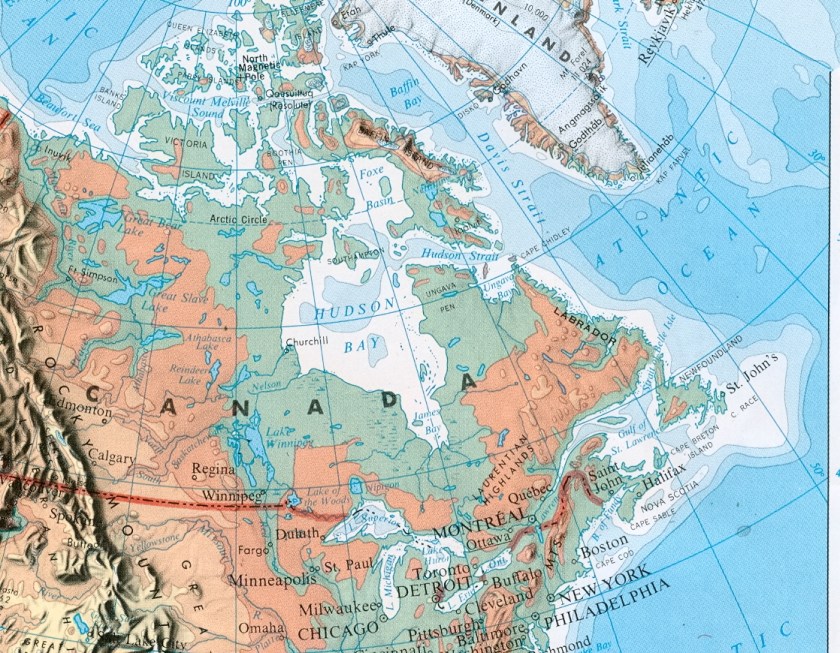
It was his fourth expedition, financed by adventurers from England. Sailing across the Atlantic, slipping between Greenland and Labrador, he entered the Hudson Strait (another remarkable coincidence) and soon reached (you’re not going to believe this) Hudson Bay. Unfortunately after all this seeming good luck, the expedition took a nasty turn.  After three months dawdling around the bay, Hudson was surprised by the onset of winter. Why winter north of Labrador in November would be a surprise is anyone’s guess. Nevertheless, Hudson and his crew were forced to set up a winter camp. The next few months were not pleasant, and many of the crew members were not amused. They grumbled and held their tongues throughout the winter until June. But once they were sailing again, they up and mutinied, setting Hudson, his son and seven friends adrift.  Although Hudson was never seen again, England laid claim to everything that shared his name — river, strait, bay and even a funny looking vehicle that seemed to have no useful purpose.

 

APRIL 17, 1610: SOMEWHERE A RIVER BEARS YOUR NAME

Back at the dawn of the 17th century, the holy grail among explorers was the Northwest halfPassage, that elusive sea route that Europeans had been seeking ever since they discovered that North America stood right in the middle of their way to China. (For some reason, they longed to go west to China even though it was a lot closer going east.)

On April 17, 1610, intrepid British explorer Henry Hudson. already famous for having discovered and explored a river that just happened to share his last name, set sail on his latest attempt to find the passage that would at last allow Europeans to take (as the popular song tells us) a slow boat to China.

It was his fourth expedition, financed by adventurers from England. Sailing across the Atlantic, slipping between Greenland and Labrador, he entered the Hudson Strait (another remarkable coincidence) and soon reached (you’re not going to believe this) Hudson Bay. Unfortunately after all this seeming good luck, the expedition took a nasty turn.  After three months dawdling around the bay, Hudson was surprised by the onset of winter. Why winter north of Labrador in November would be a surprise is anyone’s guess. Nevertheless, Hudson and his crew were forced to set up a winter camp. The next few months were not pleasant, and many of the crew members were not amused. They grumbled and held their tongues throughout the winter until June. But once they were sailing again, they up and mutinied, setting Hudson, his son and seven friends adrift.  Although Hudson was never seen again, England laid claim to everything that shared his name — river, strait, bay and even a funny looking vehicle that seemed to have no useful purpose.
 

March 29, 1974: Can’t Someone Give Us an At Ease

One can imagine the look on the faces of Chinese peasants digging a well on their rural farm when, on March 29, 1974, they discovered not water but a huge subterranean chamber in which an 8,000-man army of fully-armed soldiers with horses and chariots stood ready for battle.  The life-sized figures were all individually crafted from terra cotta and they had stood at attention for more than 2,000 years.

The great chamber was the final resting place of Qin Shi Huang Di (“first emperor of Qin”), who unified various warring states to create a Chinese empire in 221 B.C.

Along with the terra cotta G.I. Joes, were enough bronze and iron farm implements, spears, swords, jade, and silk to keep grins on archaeologists’ faces for years to come.

Dash It All

This day in 1990 marked the beginning of the Hyphen War in Czechoslovakia. Although the USSR had fallen a year earlier, the official name of the country was still the Czechoslovak Socialist Republic. President Václav Havel proposed merely dropping the word Socialist from the name, but Slovak politicians wanted another change – the spelling of the name with a hyphen (i.e., Republic or Federation of Czecho-Slovakia ), as it was spelled from Czechoslovak independence in 1918 until 1920, and again in 1938 and 1939. President Havel agreed to the change, but the Czechoslovak parliament in typical political fashion resolved that the country’s long name was to be spelled without a hyphen in Czech and with a hyphen in Slovak.

This solution was found to be not only dumb but unsatisfactory, and less than a month later, the parliament reversed itself. Problem not solved. Although the Slovaks were demanding a hyphen, the Czechs called it a dash. The Czechs usually use the same term for both; Slovaks use different terms. Thus the Hyphen War began. Oddly enough, the Czechs did not call it the Dash War.

While the Hyphen War was not really a hot war (nor a cold war), it demonstrated differences between Czechs and Slovaks about their identity, that perhaps they really weren’t meant for each other. The slippery slope: the frequent bickering over minor issues, the trial separation, and in 1992, both sides said yes to splitsville. The country was split into two states – the Czech Republic and Slovakia – in what is called the Velvet Divorce (or for some, the Vel-vet Divorce).

APRIL 17, 1610: SOMEWHERE A RIVER BEARS YOUR NAME

Back at the dawn of the 17th century, the holy grail among explorers was the Northwest halfPassage, that elusive sea route that Europeans had been seeking ever since they discovered that North America stood right in the middle of their way to China. (For some reason, they longed to go west to China even though it was a lot closer going east.)

On April 17, 1610, intrepid British explorer Henry Hudson. already famous for having discovered and explored a river that just happened to share his last name, set sail on his latest attempt to find the passage that would at last allow Europeans to take (as the popular song tells us) a slow boat to China.

It was his fourth expedition, financed by adventurers from England. Sailing across the Atlantic, slipping between Greenland and Labrador, he entered the Hudson Strait (another remarkable coincidence) and soon reached (you’re not going to believe this) Hudson Bay. Unfortunately after all this seeming good luck, the expedition took a nasty turn.  After three months dawdling around the bay, Hudson was surprised by the onset of winter. Why winter north of Labrador in November would be a surprise is anyone’s guess. Nevertheless, Hudson and his crew were forced to set up a winter camp. The next few months were not pleasant, and many of the crew members were not amused. They grumbled and held their tongues throughout the winter until June. But once they were sailing again, they up and mutinied, setting Hudson, his son and seven friends adrift.  Although Hudson was never seen again, England laid claim to everything that shared his name — river, strait, bay and even a funny looking vehicle that seemed to have no useful purpose.