June 27, 1893: Pardon Me Boy, Is That the Chadron Choo Choo?

The streets of Chadron, Nebraska, were filled with people on a bright June morning. Spectators climbed atop roofs; they hung out of second-floor windows. Jester’s Freak Band, a cornet group, provided lively music. The prize was $1500 and a fancy saddle; the challenge, a 1,000-mile race from Chadron, Nebraska, to Chicago, Illinois, and Buffalo Bill Cody’s Wild West Show near the site of the 1893 World’s Fair. Ten riders took the challenge.
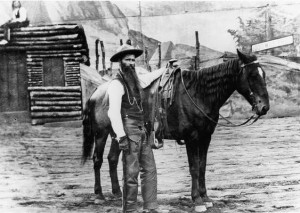
The rules were fairly simple. Each rider was allowed to begin the race with two horses; he was required to stop at various checkpoints along the way; and he must finish the race riding one of the original horses.

The competitors were a questionable lot – various drifters and ne’er-do-wells, such as “Rattlesnake Jim” Stephens and “Doc” Middleton, a “reformed” horse thief. Rules were broken; animals were injured. A newspaper from along the route reported that “ladies are pulling hairs from the manes and tails of the horses as mementos, and if they have a hair left when they reach Chicago it will be surprising.”

Only six of the original ten riders finished the race. The first-place finisher was a railroader named Berry who, riding a horse named Poison, rode triumphantly into Buffalo Bill’s Wild West arena on the morning of June 27 where he was greeted by a crowd of 10,000 people including Buffalo Bill himself.  In a lavish ceremony, Berry was awarded the saddle.

But the winner never received his cash prize. Race promoters discovered that shortly after the beginning of the race, he and his horses had secretly traveled the first 100 miles of the race aboard an eastbound train.

Horse sense is the thing a horse has which keeps it from betting on people. — W C Fields


APRIL 21, 1986: SEEMS LIKE WE STRUCK OUT

Notorious gangster Al Capone moved to Chicago in 1919 where he built a career in gambling, alcohol, and prostitution rackets, eventually becoming Chicago’s go-to guy in the world of crime. He oversaw his various enterprises from a suite at the Lexington Hotel until his arrest in 1931.  He died in 1947.

The Lexington Hotel outlasted Capone by a good many years. In the 1980s, a construction Al-Capone-psd53402company undertook a renovation of the historic hotel. While surveying the building, the company made some unusual discoveries, including a shooting range and an elaborate series of hidden tunnels connecting to taverns and brothels and providing escape routes should the Chicago police get frisky and raid Capone’s headquarters. Most intriguing of all was a secret vault beneath the hotel, where rumor had it, Capone hid vast sums of his ill-gotten gains.

These discoveries were just too tempting for “investigative reporter” Geraldo Rivera to let pass by.  So on April 21, 1986, Geraldo planned to open the vault on live TV in a much ballyhooed special, The Mystery of Al Capone’s Vaults. What would the two-hour media event reveal? Piles of plunder? Bodies of Capone competitors? Jimmy Hoffa? Judge Crater? Among those who stood by Geraldo as the whole world watched were a medical examiner and agents of the Internal Revenue Service, lending the entire undertaking an aura of grim importance.

The vault was opened, and there . . . ? A lot of dirt and a couple of empty bottles. Geraldo did his best to snatch something out of the rubble, suggesting to 30 million disappointed viewers that the bottles were exciting because they had been used for bathtub gin during Prohibition. A nice try, but he summed up the evening by saying: “Seems like we struck out.”

June 27, 1893: Pardon Me Boy, Is That the Chadron Choo Choo?

The streets of Chadron, Nebraska, were filled with people on a bright June morning. Spectators climbed atop roofs; they hung out of second-floor windows. Jester’s Freak Band, a cornet group, provided lively music. The prize was $1500 and a fancy saddle; the challenge, a 1,000-mile race from Chadron, Nebraska, to Chicago, Illinois, and Buffalo Bill Cody’s Wild West Show near the site of the 1893 World’s Fair. Ten riders took the challenge.

The rules were fairly simple. Each rider was allowed to begin the race with two horses; he was required to stop at various checkpoints along the way; and he must finish the race riding one of the original horses.

The competitors were a questionable lot – various drifters and ne’er-do-wells, such as “Rattlesnake Jim” Stephens and “Doc” Middleton, a “reformed” horse thief. Rules were broken; animals were injured. A newspaper from along the route reported that “ladies are pulling hairs from the manes and tails of the horses as mementos, and if they have a hair left when they reach Chicago it will be surprising.”

Only six of the original ten riders finished the race. The first-place finisher was a railroader named Berry who, riding a horse named Poison, rode triumphantly into Buffalo Bill’s Wild West arena on the morning of June 27 where he was greeted by a crowd of 10,000 people including Buffalo Bill himself.  In a lavish ceremony, Berry was awarded the saddle.

But the winner never received his cash prize. Race promoters discovered that shortly after the beginning of the race, he and his horses had secretly traveled the first 100 miles of the race aboard an eastbound train.

Horse sense is the thing a horse has which keeps it from betting on people. — W C Fields