December 18, 1966: You’re a Mean One

grinch-thumb-525x325-23201In 1957, the most infamous Christmas curmudgeon since Ebeneezer Scrooge made his debut in a picture book called How the Grinch Stole Christmas by the amazing Dr. Seuss (Theodor Geisel). It marked the first time an adult had been featured as the main character in a Seuss book and the first time a villain had starred. The book has remained a classic since then. Some conspiracy theorists suggest (and the doctor concurs) that the Grinch is Dr. Seuss himself. In the story, the Grinch complains that he has put up with the Whos’ Christmas celebrations for 53 years. Dr. Seuss was 53 when the book was written and published.

Several years later, on December 18, 1966, the furry misanthrope, now a sickly shade of green, was ready for prime time – television, that is. Chuck Jones of Warner Brothers cartoon fame brought the story to living room screens featuring Boris Karloff as narrator and Grinch. In addition to providing the story, Dr. Seuss created the lyrics for the songs featured in the animated special. (The songs were sung by Thurl Ravenscroft, who some will remember as the bass voice on Rosemary Clooney’s  “This Ole House” or Tony the Tiger – “They’re grrreat!”)

The word grinch has found its way into dictionaries as a person whose lack of enthusiasm or bad temper spoils or dampens the pleasure of others. “Noise, noise, noise, noise.”

shepherd

November 19, 2001: Thomas Crapper Would Be Proud

This is true stuff; the Almanac does not make this stuff up.  November 19 is World Toilet Day. The day was chosen because it is the anniversary of the founding of the World Toilet Organization (WTO), a global non-profit organization committed plunging-toiletto improving toilets worldwide. Founded in 2001 with just 15 visionary members, WTO now boasts 151 member organizations in 53 countries working to eliminate the suppression of toilet talk in polite circles and to bring the toilet out of the shadows of sinks and bathtubs, giving it its own well-deserved recognition.


Sad but true: more money is spent throughout the world on toiletries than is spent on toilets. (Toiletries are not off-trail facilities for hikers.)


In 2005, WTO created the World Toilet College (WTC), the only institution of higher education devoted to toilet design, maintenance, sanitation and use. The WTC is the first and only institution that addresses the needs of both urban and rural toilets (outhouses, presumably) in a holistic manner. The college also seeks to foster a positive image of toilets everywhere, eschewing the use of such mealy-mouthed euphemisms as lavatory, latrine, water closet, rest room, comfort station, powder room and little boys’ and girls’ rooms.

Annual WTO conventions are surely a laugh a minute.

In 2009, a new website was launched dedicated to the celebration of World Toilet Day. Its 2012 slogan was “I give a shit, do you?

November 5, 1975: And Stop Calling Me Dopey

On November 5, 1975, Travis Walton and a half dozen co-workers had finished up their day’s work in the Apache-Sitgreaves National forest near Snowflake, Arizona. As they departed the forest in a pickup truck, they found themselves facing a huge hovering subject blocking the road a hundred feet ahead of them and making an unfriendly buzzing sound. It was of course saucer-shaped.

Travis, evidently the bravest of the bunch, jumped out of the truck and approached the saucer. It is unclear whether he planned to welcome it to Earth, say take me to your leader or tell them to get the hell out of the way before he called in the army with its grenade launchers, bazookas and itchy trigger fingers. It really didn’t matter because before he could say anything that saucer up and zapped him with a nasty beam of light that knocked him unconscious.

Naturally his coworkers ran to his aid. Not really. Actually, they turned that truck around and sped off.

Travis was missing for five days. During those five days, he says, he awoke in what appeared to be a hospital being poked and prodded by three creatures that looked a lot like Dopey of the Seven Dwarfs. They were little, so Travis attempted to beat them up, but was himself subdued by a big guy in a helmet. The big guy and several cohorts forced a plastic mask over Travis’ face and he once again passed out. He awoke on a lonely stretch of highway with the saucer speeding off into the twilight.

Fortunately for Travis, a $5,000 National Enquirer prize for the best true account of an alien abduction took some of the sting out of his unpleasant experience.

Please To Remember, the Fifth of November

As if the juvenile delinquents of the world couldn’t get in enough trouble on Halloween, they get another opportunity to misbehave, at least in England, on Guy Fawkes Day. On this day, November 5, it has long been customary to dress up a scarecrow figure and, sitting it in a chair, parade it through the streets. Those unlucky enough to be passers by are solicited for cash contributions with shouts of “Pray remember Guy” which the passers by hear as “Your money or your life.” Once the revelers have extorted enough money, they built a big bonfire and merrily burn their scarecrow, pretending it is Guy Fawkes or the Pope or the Prime Minister or their history teacher.

Who Is Guy Fawkes, You Ask

Guy Fawkes was a protester some four hundred years ago, a member of a group of English Catholics who were dismayed at having a Protestant as King of England.  Their protests eventually moved beyond the verbal assaults (“Hi de hay, hi de ho, King James the First has got to go”) down the slippery slope to gunpowder, treason and plot.

Guy Fawkes was born in England in 1570 but as a young man went off to Europe to fight in the Eighty Years’ War (not the entire war, of course) on the side of Catholic Spain.  He hoped that in return Spain would back his Occupy the Throne movement in England.  Spain wasn’t interested.

Guy  returned to England and fell in with some fellow travelers.  Realizing that the Occupy the Throne movement required removing the person who was currently sitting on it, the group plotted to assassinate him.  They rented a spacious undercroft beneath Westminster Palace  where they amassed a good supply of gunpowder.  Guy Fawkes was left in charge of the gunpowder.

Unfortunately, someone snitched on them and Fawkes was captured on November 5.  Subjected to waterboarding and other enhanced interrogation methods, Fawkes told all and was condemned to death. (Evidently, James I was not amused.)  Just before his scheduled execution, Fawkes jumped from the scaffold, breaking his neck and cheating the English out of a good hanging.

Since then the English have celebrated the failure of the Gunpowder Plot in 1605 with the November 5 celebration, an integral part of which is burning Guy Fawkes (and sometimes others) in effigy.  Seems like a long time to hold a grudge.

November 1, 1609: I Was Just Drinking a Health and Wound Up Debauched and Drunk

Sir Matthew Hale, born November 1, 1609, was an influential English legal scholar, barrister and judge throughout a good part of the 17thhealth1 century. Perhaps he was a bit of a stick in the mud as well. When he died, he left a rather unusual bit of advice for his grandchildren: “I will not have you begin or pledge any health, for it is become one of the greatest artifices of drinking, and occasions of quarreling in the kingdom. If you pledge one health, you oblige yourself to pledge another, and a third, and so onwards; and if you pledge as many as will be drank, you must be debauched and drunk.”

A fellow Englishman Charles Morton agreed, going so far as to dedicate a book to the subject: The great evil of health-drinking, or, A discourse wherein the original evil, and mischief of drinking of healths are discovered and detected, and the practice opposed with several remedies and antidotes against it, in order to prevent the sad consequences thereof. Catchy title, but most people probably just asked their booksellers for that book by Morton.

The French chimed in with their thoughts as well, the writer/philosopher Voltaire saying that “the custom arose among barbarous nations” (England) and that drinking to the health of one’s guests was “an absurd custom, since we may drink four bottles without doing them the least good.”

And of course they were all right. The slippery slope led to toasting any number of things on any number of occasions in addition to one’s health. The word toast, incidentally, crept into the language as a result of putting pieces of toast in the drinks (to make them healthier?).

One of the earliest known toasts or healths was ancient Saxon. At a banquet hosted by one Hengist, a mercenary in the employ of King Vortigern, the beautiful daughter of Hengist lifted a glass of wine to the king and said: “Lauerd kining, wacht heil” (Lord King your health). The king then drank and replied: “Drine heil” (Here’s looking at you, kid).

OCTOBER 31, LONG AGO: THE DEVIL MADE HIM DO IT

One might assume that the carving of jack-o’-lanterns was a clever promotion by the Association of Pumpkin Growers because there just weren’t enough pumpkin pies being eaten in this world. But as it turns out, folks have been making jack-o’-lanterns at Halloween for centuries. And that there’s a proper legend to explain the practice.

It all started with an Irish fellow called Stingy Jack. In addition to being cheap, Jack was a drunkard and a ne’er-do-well. During one of Jack’s benders, the Devil came calling on him with every intention of claiming his miserable soul. As a last request, Jack asked the Devil to have a  drink with him. (It’s a relief to learn the Devil drinks; Hell might not be so bad after all.)

Naturally, Stingy Jack being Stingy Jack had no intention of paying for the drinks, so he convinced the Devil to turn himself into a coin that Jack could use to buy their drinks, and the Devil agreed. (It would appear that the Devil is not the brightest candle in Hell.) Once the Devil had changed himself into a coin, Jack stuffed him into his pocket next to a crucifix, which prevented the Devil from changing back into his original form. Jack, now having all the chips in this game, agreed to free the Devil, on the condition that he would not bother Jack for ten years and that, should Jack die during this time, he would not claim his soul. (Jack wasn’t all that shrewd either.)

Drunkenness tends to make time fly, and before Jack knew it, ten years had passed.   And the Devil, ever prompt, came calling for Jack’s soul once again. And no last drink this time, the Devil said. Then perhaps just one small apple before I go, Jack begged. The Devil acquiesced. Jack lamented that he was in no condition to climb the apple tree, and would the Devil be so kind as to fetch the apple for him? (The Devil is a lot like Charlie Brown and his football. You’d think, being the Evil One, he wouldn’t be so trusting.) So the Devil climbed the tree, and while he was up in the tree, Jack carved a sign of the cross into the tree’s bark. To earn his release this time, the Devil agreed never to take Jack’s soul.

Wouldn’t you know, little time passed before Jack turned up his toes. Jack’s soul foolishly made it’s way toward Heaven where everyone had a good laugh before telling him to get lost. Then Jack journeyed to the Gates of Hell where the Devil, finally wise to Jack’s tricks,  also sent him packing —  to roam the world between good and evil, with only a burning ember inside a hollowed out turnip to light his way.  Jack of the Lantern. Obviously, the Association of Turnip Growers botched this one. Had they been on their toes, we’d all be celebrating Halloween with carved-out rutabagas.


halloween

MAY 25, 2006: GEEK NIRVANA

2006 marked the very first celebration of Día del orgullo friki in Spain, local at first but now celebrated in such far-ranging places as Halifax, Nova Scotia; Timisoara, Romania; and San Diego, California; making it a truly international, sort of, event. The date commemorates the release of the first Star Wars film on May 25, 1977. (This was the second such commemoration for the movie; the first, Star Wars Day,  held on May 4 so celebrants could say “May the fourth be with you.”). The latest fest was the brainchild of a Spanish blogger known as Senor Buebo.

In 2008, the “holiday”was officially celebrated for the first time in the U.S., sporting its English translation, Geek Pride Day, its goal having become the promotion of geek culture. Today it has a manifesto and everything. Imagine if you will 300 proud geeks coming together to form a human pacman or, better still, a prime-number float in a Fifth Avenue parade.

As if this celebration wasn’t heady enough all by itself, Geek Pride Day shares the same date as two other similar fan “holidays”: Towel Day, for fans of The Hitchhiker’s Guide to the Galaxy on which true believers carry about a favorite towel, and the Glorious 25th of May for fans of Terry Pratchett’s Discworld.

Dinner Leaps This Way

An English gentleman who identified himself only as a friend to the Poor wrote a letter to the Public Advertiser on May 25, 1772, describing a novel idea. The idea had occurred to him after reading a passage in a guidebook about a town in France: “There are three small rivers that run through the town, one of which is much frequented by frogs, though one would imagine that in time they would be destroyed, as they commonly compose a dish or two at each meal at the tables of both rich and poor; the latter mostly living on them.”

Your entree

The letter went on to suggest that the poor of England could avoid the high cost of most kinds of food by procuring frogs as food for themselves, since the ponds and ditches of England were full of them. Although the letter writer had never personally tasted a frog, he had been assured that when fried in butter and parsley one could not distinguish it from fricassee of chicken. To those that worried that the ignorant might mistakenly eat a toad, he pointed out that the frog is light brown whereas the toad is almost black, that frogs leap, toads creep.

The gentlemen closed by saying let those that can afford it have roast beef every day, but to those poor wretches who cannot he offers this hint for their benefit.

AUGUST 24, 1850: MEET ME AT THE FAIR

London’s Bartholomew Fair, a wild celebration on the eponymous saint’s anniversary, died not with bartha bang but a whimper after enduring for more than seven centuries, Although originally established for legitimate business purposes, the fair had become all eating, drinking and amusement (for shame!) and a bit of a public nuisance with rowdiness and mischief.

Serious pursuits, uplifting exhibits, and dramatic entertainments had given way to shows and exhibits catering to the lowest common denominator of British fair-goers tastes – conjurers, wild beasts, monsters, learned pigs, dwarfs, giants. A prodigious monster with one head and two distinct bodies, a woman with three breasts, a child with three legs. A mermaid with a monkey’s head and the tail of a fish. Puppet shows, pantomimes, and coarse melodramas. A pig-faced lady and a potato that looked like King Henry VIII.

Eventually the fair grew less curiouser and curiouser, and on August 24, 1850, when the mayor went as usual to proclaim the opening of the fair, he found nothing to make it worth the trouble. No mayor went after that, and in 1855 the fair rolled over and expired.

I went to the animal fair,

The Birds and the Beasts were there.
The big baboon, by the light of the moon,
Was combing his auburn hair.
The monkey, he got drunk,
And sat on the elephant’s trunk.
The elephant sneezed and fell on his knees,
And what became of the monk, the monk?
The monk, the monk, the monk.

— Minstrel Song

AUGUST 17, 1978: GIVE ‘EM HELIUM

Three Americans from New Mexico completed the first transatlantic balloon flight, landing in a barley field 60 miles from Paris, 138 hours and six minutes after lifting off from Presque Isle, Maine. The helium-filled Double Eagle II covered 3,233 miles in its six-day journey.

Almanac devotees will remember (having most certainly taken notes) that Frenchman Jean-Pierre Blanchard crossed the English Channel to great fanfare some two hundred years earlier.

Balloonists began attempting the Atlantic crossing in the mid-1800s, with 17 unsuccessful flights, resulting in the deaths of at least seven balloonists. Two of our three balloonists gave it their first shot in September 1977, aboard the Double Eagle I, but were blown off course, landing off Iceland after 66 hours.  After recovering from bruises, embarrassment and frostbite, they were ready to foolishly rush in again.  A third pilot was brought in to spread the pain.

The Eagle Junior was a big balloon – 11-stories of helium.  It made good progress after blastoff, but during mid-trip, plunged from 20,000 feet to a hair-raising 4,000 feet, forcing them to jettison ballast material and many of their inflight amenities.  Among the items chucked overboard was evidently all of their finer cuisine, for they were forced to finish the trip dining only on hot dogs and sardines. Toward the end of the trip, one balloonist was heard to remark somewhat testily: “Skip the bun; just grease up my hot dog with mustard real good and I’ll shove it in my ear.”

Panic set in when the balloonists couldn’t find the Eiffel Tower.  Blown off course, they touched down just before dusk on August 17, 1978, near the hamlet of Miserey, missing the wine and ticker-tape parade in Paris. Parisians, not wanting to give up a celebratory occasion, amused themselves in honor of the storming of the Bastille.


JULY 15, 971: JUST LYING IN THE RAIN

‘St. Swithin’s day if thou dost rain
For forty days it will remain
St. Swithin’s day if thou be fair
For forty days ’twill rain nae mair.’

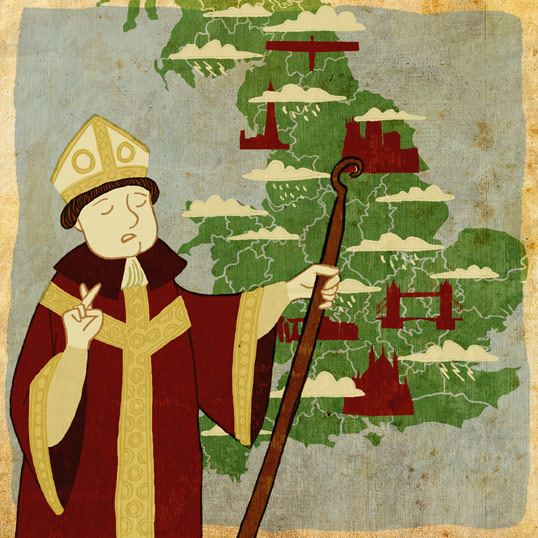
     St. Swithin is the British counterpart to America’s Puxatawney Phil, except that the former is a ninth century bishop and the latter is a ground hog.  And just how did the good St. Swithin get his meterological stripes?  Here’s how:

ST-SWITHIN-DUDLEY-MAXIMS     St. Swithin was noted for his great humility, a quality that some may say he carried to excess. On his deathbed, he asked to be buried, not in the church or in some shrine, but outside where his corpse might be watered by rain from the church eaves and his grave stomped on by passers-by. Folks rolled their eyes a bit but complied with his request.

     And his remains lay wet and walked on for a good hundred years, until a more modern generation of clergy (those 10th century radicals!) took umbrage at one of their own resting in such a lowly spot. They decided at once to relocate Swithin, who could not object, to a great cathedral.  However, on July 15, 971,  just as a ceremony with great pomp and circumstance was about to begin, as if on cue, a heavy rain burst forth and continued with nary a break for 40 days (40 days is a popular duration for great rainfalls).

     The monks interpreted this tempest as a not-so-subtle warning from on high that their nasty little undertaking was a bit of blasphemy.  They immediately abandoned the project. And even without the help of modern social media, word spread throughout the land, and a tradition was born: if it rained on St. Swithin’s Day, it would rain for 40 days.

    St. Swithin also planted apple trees (like Johnny Appleseed, who never predicted weather) leading to the popular description of rain: “St Swithin is christening the apples


Death Visits Aunt Agatha, Part 3: Solomon Grundy et al

Early that evening, after helping herself to a steak she found in the refrigerator, Bridget poured herself a tumblerful of Monty’s gin and returned to the bedroom to console his sick aunt.

“Seen a lot of people die,” said Bridget. “Usually they do it more quickly.”

Aunt Agatha gurgled.

“Simon Walters took the last count back in ’06. He was about the longest, three days. Course, unlike yourself, he was young and healthy. ‘Til the tractor hit him. Now Lucy Beaconsberry was a lot like you, old and frail, withered, look of death all over her. Gurgled just like you been gurgling. Turned her toes up in less than twelve hours. Just figured what good was she doing anybody, just lying there and gurgling. Thoughtful of her, I’d say.”

Aunt Agatha stirred slightly, but didn’t open her eyes.

“Yes, I’ve seen a lot of folks go. Joshua Higgins gave up the ghost just last week. Eighty-seven he was. Nice ripe old age. You’re close to ten years older than that, aren’t you, dear? Pretty old. Good long life you’ve had. When pneumonia took old Frances Cartwright back in October — just a week after her ninetieth birthday, she said ‘ I figure anyone that lives past ninety is stealing space from someone younger.’ Interesting way to look at it, wouldn’t you say? Smart old lady, Frances. Had some pain though. Just feel lucky you don’t have the pain. At least not yet.”

Bridget gave her charge another nasty look, then got up and left the room. When she returned with a refilled tumbler of gin, she thought for a moment that Aunt Agatha had stopped breathing. But several short hacking coughs dashed her hopes. Damn you, old woman, Bridget thought. What good does your hanging on do you or anyone else? “How about a little verse, my dear?” she said.

“Solomon Grundy,

Born on a Monday,

Christened on Tuesday,

Married on Wednesday,

Took ill on Thursday,

Worse on Friday,

Died on Saturday,

Buried on Sunday:

This is the end

Of Solomon Grundy.

“You see, dear, it’s just a matter of pace. Jeremy Lockless held on bedridden for almost two years. Did you know that? Well, let me tell you, his family grew to hate him so much for just lying there so long that, when he did finally bite the dust, they wouldn’t even bury him. They just threw him in the woods out back for whatever wild animals wanted his carcass.”

Sunday evening and two more tumblers of gin made Bridget frantic. Now she was really losing money. Maybe she could just hurry things along with a pillow. Don’t be foolish, Bridget, she told herself. Use your head. And with a third tumbler, now vodka — Aunt Agatha was still here but the gin was gone — Bridget got an idea.

continued


JULY 14, 1789, 1973: BREAKING UP IS HARD TO DO

Every écolier and écolière knows that the breakup of France – Révolution française – began in 1789, its defining moment the storming of the Bastille on the morning of July 14. 1789. This medieval fortress in the center of Paris represented royal authority. That the Bastille housed only seven inmates – all with good reason to be there – was unimportant. It was a symbol of the abuses of the absolute monarchy, and the French had had it with monarchs, aristocrats, and pretty much anyone in power. Bring on liberté, égalité, fraternité.   King Louis XVI, exit stage right


Bye Bye Don

Another momentous breakup took place on the evening of the same day, nearly 200 years later, in 1973, at Knott’s Berry Farm in California (Knott’s Berry Farm was America’s first theme park and probably the only one devoted to grapes and strawberries and such things). Every schoolgirl and schoolboy knows that the Everly Brothers were one of America’s most successful pop duos, lending their sibling harmony to such hits as “Bye Bye Love”, “All I Have To Do is Dream” and “Wake Up Little Susie”, a franchise that would seemingly go on forever. Well, forever is a long time, and brothers Don and Phil had, by the end of the 1960s pretty much had it with liberté, égalité, fraternité and most definitely with each other.

The defining moment of their breakup came in the middle of their set when the stage manager told the audience that the rest of the show had been canceled because brother Don was “too emotional” to play.  In reality, Brother Don was too drunk to play. His skipped guitar notes and bungled lyrics sent brother Phil into a real snit. Phil smashed his guitar and stormed off stage into a solo career, promising he would “never get on stage with that man again.”


Phil and Don reached a sort of detente a decade later.  Louis XVI, on the other hand, was beheaded.

(Phil Everly died in January 2014).

I have no intention of sharing my authority. — King Louis XVI

Death Visits Aunt Agatha, Part 2: A Bargain Is Struck

Monty hated the thought of paying Bridget Berman seventy-five dollars a day to do practically nothing and eat his food in the bargain. What if Aunt Agatha held on for three or four days? No matter how bad she looked, she was a tough old bird. She could rack up a couple hundred dollars while he was in the city.

By the time Monty bit the bullet and finally contacted Bridget Berman, he had already devised a scheme to avoid paying the old hag more than what he considered appropriate remuneration for her services. Emphasizing how sick the old lady was, how she probably wouldn’t make it through the next 24 hours, Monty proposed a flat fee for Bridget’s sitting services. “Ninety dollars,” said Monty, “It’ll be like getting paid time and a half most likely.”

Bridget didn’t trust Monty at all; she assumed right off that he was trying to procure her services on the cheap. But if the old woman were really dying . . . Bridget also hated to pass up something extra for next to nothing. She expressed doubt about the arrangement. “But I will consider it. Mind you, just consider it. First I must see your aunt for myself.” Bridget had watched a good many people check out of this world and felt confident that she could reasonably judge the amount of time a person had left.

Later, as they stood at Aunt Agatha’s bedside, Bridget, after carefully studying the dying woman for several minutes, concluded that here lay one very sick woman and that she had better get an agreement quickly, before Aunt Agatha expired. “I don’t know,” said Bridget, “She doesn’t look all that bad to me. But I understand your situation, and I want to be as agreeable as I possibly can. One hundred and fifty dollars.”

Monty stood silently thinking. Aunt Agatha groaned.

“One twenty-five,” said Bridget.

“You’ll stay until she dies,” said Monty.

“Or until you return,” said Bridget.

“Agreed.”

Ten hours passed. Monty was in the city, Bridget sat bedside, and Aunt Agatha lay there still looking as though the next minute would be her last. Bridget sighed and dozed off. She awoke Saturday morning to find Aunt Agatha just as ill and just as alive as she had been the night before. For eight hours, Bridget stared at the bedridden woman just lying there, continuing to breathe without consideration for others, taking money from Bridget as though she were a common pickpocket.

continued