January 14, 1500: For the Ass Was a Donkey, You See

The Feast of the Ass held on January 14 from around 1100 until 1500 was meant as much as a teach-in as a party-in, a way to present religious doctrine to the illiterati who had no books or Internet access. This festival, held primarily in France as a cousin to the Feast of Fools, celebrated the flight of Joseph, Mary and Jesus into Egypt.

Traditionally, the most beautiful young woman in the village splendidly attired in gold-embroidered cloth, carrying a small child and riding a donkey would be led in a solemn procession through the town to the church. The donkey would stand beside the altar while a mock Mass was performed. Instead of the usual responses to the priest, the congregation would “hee-haw.” At the end of the service, instead of the usual benediction, the priest would bray three times and the congregation would respond with another round of hee-hawing. The choir would then offer up a hymn and everyone would bray along — except for the ass who thought the whole thing rather ridiculous and that these people were all making you know whats of themselves.

Talk to the Donkey

Yes, Doctor Doolittle could talk to the animals, including donkeys. And much more. He ran a post office, a circus and a zoo, took voyages to exotic places around the world, went to the moon. According to the neighborhood mussel-man, he was a nacheralist – “a man who knows all about animals and butterflies and plants and rocks an’ all.” Not only could he talk to and understand animals, he had written history books in monkey-talk, poetry in canary language and songs for magpies to sing. He didn’t just talk to your normal animals like pigs, rats, owls, seals and badgers but to  pushmi-pullyus and wiff-waffs as well.

January 1lofting4 is a red letter day for children who love to read and love animals. Two major authors who spent their lifetimes entertaining the younger set were born on this day 12 years and an ocean apart.

Hugh Lofting, creator of the amazing Doctor Doolittle from Puddleby-on-the-Marsh, was born in 1886 in Maidenhead, England. He wrote a dozen books featuring the doctor , a character he first created in letters to his children during his World War I service in the Irish Guards. The Story of Doctor Doolittle: Being the History of His Peculiar Life at Home and Astonishing Adventures in Foreign Parts Never Before Printed began the series in 1920 and was followed two years later by The Voyages of Doctor Dolittle.

Born on Cape Cod in 1874, Thornton Burgess was a conservationist and prolific writer of burgess1children’s books, producing 170 books between 1910 and 1965.  His books celebrated nature, featuring the many animals that lived in the Green Meadow and Green Forest.

Mother West Wind “How” Stories, an early collection of 16 stories, told how Lightfoot the Deer learned to jump, how the eyes of Old Mr. Owl became fixed, how Drummer the Woodpecker came by his red cap and so on. Other collections told when, where and why various animal things happened – Wild Kingdom without Marlin Perkins or TV commercials The anthropomorphic forest and meadow creatures that had their own adventure books included Peter Rabbit, Jimmy Skunk, Grandfather Frog, Little Joe Otter, Granny Fox, Jerry Muskrat and Digger the Badger to name just a few.




JANUARY 4, 390: COME DOWN, COME DOWN FROM YOUR IVORY TOWER

As we work our way through the twelve days of Christmas, we reach a point where True Love’s gifts are somewhat over the top.  Today is no exception — eleven pipers piping, each armed with a monkey wrench, applying their noble trade to clogged pipes and leaking faucets — at time and a half.  It is Christmastide, you know.  The eleventh ghost of Christmas introduces Scrooge to Tiny Tim.  Scrooge takes an instant dislike to the lad until he learns that Tiny Tim whacks his schoolmates with his crutch and takes their milk money.

In addition to celebrating plumbers, the eleventh day celebrates a saint, as many of the twelve days do. Day eleven is dedicated by those folks who dedicate such things to Saint Simeon Stylites also known as Saint Simeon Stylites the Elder to distinguish him from Simeon Stylites the Younger. He is known primarily for spending 37 years on a platform atop a pillar outside of Aleppo in what is now Syria (one could make a pretty good case that in Syria on top of a pillar might be a good place to be).

Why did Simeon choose to live up there like an Arabian Rapunzel, you ask? Simeon was very likely a wise man or at least people thought he was, because they kept coming to him for advice. Many folks would be honored to be sought out for guidance. Not Simeon. Seekers annoyed him. He wanted to be left alone to pray his private prayers and possibly entertain other thoughts as well.

So he went out and found a pillar. His first pillar was a mere nine feet tall and he soon realized that people could easily shout their entreaties to him. He thus began a series of relocations, each pillar being taller than its predecessor. His final pillar was really up there, some 50 feet above the ground and its many pests.

MAY 5, 1862: VAMOS A CELEBRAR

Today is Cinco de Mayo. It is sometimes mistakenly thought of as a major Mexican holiday; it is, rather, a celebration of Mexican heritage and pride by people of Mexican descent living mostly in the United States – and, of course, non-Mexicans looking for an excuse to drink tequila.

In Mexico, Cinco de Mayo is celebrated primarily in the state of Puebla where it is called El Día de la Batalla de Puebla (The Day of the Battle of Puebla) observed to commemorate the Mexican army’s unlikely victory over French forces at the Battle of Puebla on May 5, 1862. France, under the leadership of Napoleon Number Three, sought to establish a Gallic empire in Mexico (possibly because things had gone so well for Napoleon Number One in Russia back in 1812). In 1861, a large French force landed at Veracruz sending the Mexican government into retreat. Moving toward Mexico City, the French army encountered heavy resistance near Puebla from a poorly equipped Mexican army of 4,500 men. The Mexicans were able to soundly defeat the 8,000-strong French army, considered the best in the world.

APRIL 26, 1970: FLAUNT YOUR INTELLECTUAL PROPERTY

Shine up your sneakers, grab your party hats and noisemakers. It’s a day to cast off your inhibitions and get wild and crazy. Yes, today is World Intellectual Property Day, the day set aside to “raise awareness of how patents, copyright, trademarks and designs impact on daily life” and “to celebrate creativity, and the contribution made by creators and innovators to the development of societies across the globe.” And get pleasantly pickled of course.

It’s not quite as over the top as say Fat Tuesday but it’s close. Celebrating the contributions of creators and innovators with two guys in clown suits and a person of unknown gender wearing nothing but a rubber chicken puts a fair amount of zest into a gray day in late April. And coming as it does on the heels of World Book and Copyright Day – well, it’s not for the faint of heart.

Why April 26 you ask? Because it’s the date on which the Convention Establishing the World Intellectual Property Organization was established in 1970.  Perhaps you missed it.  What is intellectual property you ask? That’s the beautiful part. It’s anything you want it to be. What you are reading here at this moment by very elastic definition could be considered intellectual property – especially after three Harvey Wallbangers. So live it up; National Defense Transportation Day is nearly a month away.

These Aren’t Your Ordinary Old Bottle Rockets

An announcement in a London newspaper on April 26, 1792, described an upcoming special event in breathless anticipation: fireworks to celebrate the birthday of her royal highness the Duchess of York.

The fireworks display would depict the eruption and lava flow of Mount Etna on a scale never before seen. Under the mountain would be shown the cavern of Vulcan with the Cyclops at work forging the armor of Mars as portrayed in Virgil’s Aeneid. Music courtesy of Gluck, Haydn, Giardini and Handel.

As the work progresses, Venus and Cupid arrive to request armor for Aeneas. Mars arrives for his armor and is amorously distracted by Venus, annoying Vulcan. But at this moment the smoke thickens above, the crater on top of Etna vomits forth flames, and lava flows dreadfully down the side of the mountain. This continues with increasing violence until there is a prodigious eruption, punctuated by a tremendous explosion.

Coffee and tea are included.

MARCH 26, 47 BC: WITH A LITTLE BIT OF LUCK

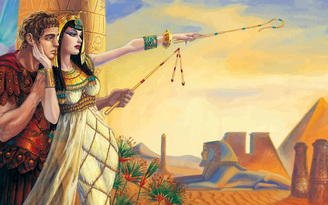
Ptolemy XIII was Pharaoh of Egypt from 51 to 47 BC (remember we’re counting backwards here), his reign pretty much demonstrating the bad luck associated with the number thirteen (in fact he could have been nicknamed Ptolemy the Unlucky or Friday the XIII).

Ptolemy XIII succeeded his father Ptolemy XII, becoming co-ruler by marrying Cleopatra who was his older sister at the time. She was Cleopatra VII, but she was the Cleopatra we all know about — the one of Antony and Caesar and the asp and all that. Since XIII was only 11 at the time, he had a regent — and should you be thinking about the regent’s duties vis-à-vis Cleopatra, we’ll point out that the regent’s name was Pothinus the Eunuch.

Still with us?

Cleopatra, it turns out, was a bit of a grandstander, strutting about as Queen, putting her image on coins, and generally hogging the Egyptian spotlight. Thus in 48 BC, XIII and his eunuch tried to depose her, but she ran off to Syria and raised herself an army.

Enter Roman general Pompey, seeking sanctuary from Julius Caesar.  XIII pretended to welcome Pompey but had him murdered instead.  When Caesar arrived, XIII gave him Pompey’s head as a little welcoming gift. Caesar was unimpressed and took Cleopatra as his welcoming gift instead, giving XIII a cold Roman shoulder and killing his eunuch for good measure.

While Caesar and Cleopatra kept busy trysting the night away, XIII in cahoots with another sister (it’s great to be able to toss in another sibling when things are beginning to slow down) tried again to dump Cleopatra.

XIII and his other sister were no match for Caesar and Cleopatra and in the ensuing Battle of the Nile, XIII was forced to flee. Unfortunately, Ptolemy the Unlucky was drowned as he attempted to cross the Nile.


MARCH 25, 2018: WAITER, THERE’S A LOBSTER ON MY WAFFLE

Today is International Waffle Day, a tradition that is celebrated worldwide but mostly in Sweden. It’s a day to enjoy – guess what? – eating waffles. The day may have arisen out of confusion. Waffle Day in Swedish, Våffeldagen, sounds a lot like Our Lady’s Day,Vårfrudagen, (you really have to be on a street in Stockholm to get the full effect), a Christian holiday also known as Annunciation (the third Thursday after Pronunciation), when the Archangel Gabriel told the Virgin Mary she was pregnant. Mary was understandably upset and did what any virgin would do upon being told she was pregnant – stuffed herself with waffles. Waffle Day also coincides with the beginning of Spring, another traditional day for eating waffles in Sweden. Therefore, if you see a Swede eating waffles today, you don’t know if it’s religious or secular or just hunger.

More interesting facts:

Waffles were made with cheese and herbs in ancient Greece.

The familiar grid pattern of today’s waffles originated in the Middle Ages. Some waffles had fancier designs such as coats of arms,  landscapes and portraits of Middle Age people.

Waffles were so popular that they were even sold from street carts (by strange looking men who eventually switched to selling chestnuts and large pretzels).

In the late 1800’s, Thomas Jefferson returned from France with a waffle iron.  It’s unclear how he got it through security.

Many folks in Britain celebrate International Waffle Day by eating rutabagas which are known there as Swedes.  There is no International Rutabaga Day.

There is, however, a Lobster Newburg Day – and it’s today!

Lobster Newburg, lobster with a sherry and cognac infused, egg-thickened cream sauce, was first served at New York’s Delmonico’s in the 1870s. Delmonico’s was not only the first formal dining restaurant in the United States, it was the first to serve hamburger, the creator of Baked Alaska, the creator of Eggs Benedict, and of course the creator of Lobster Newburg.  A waffle topped with Lobster Newburg, anyone?

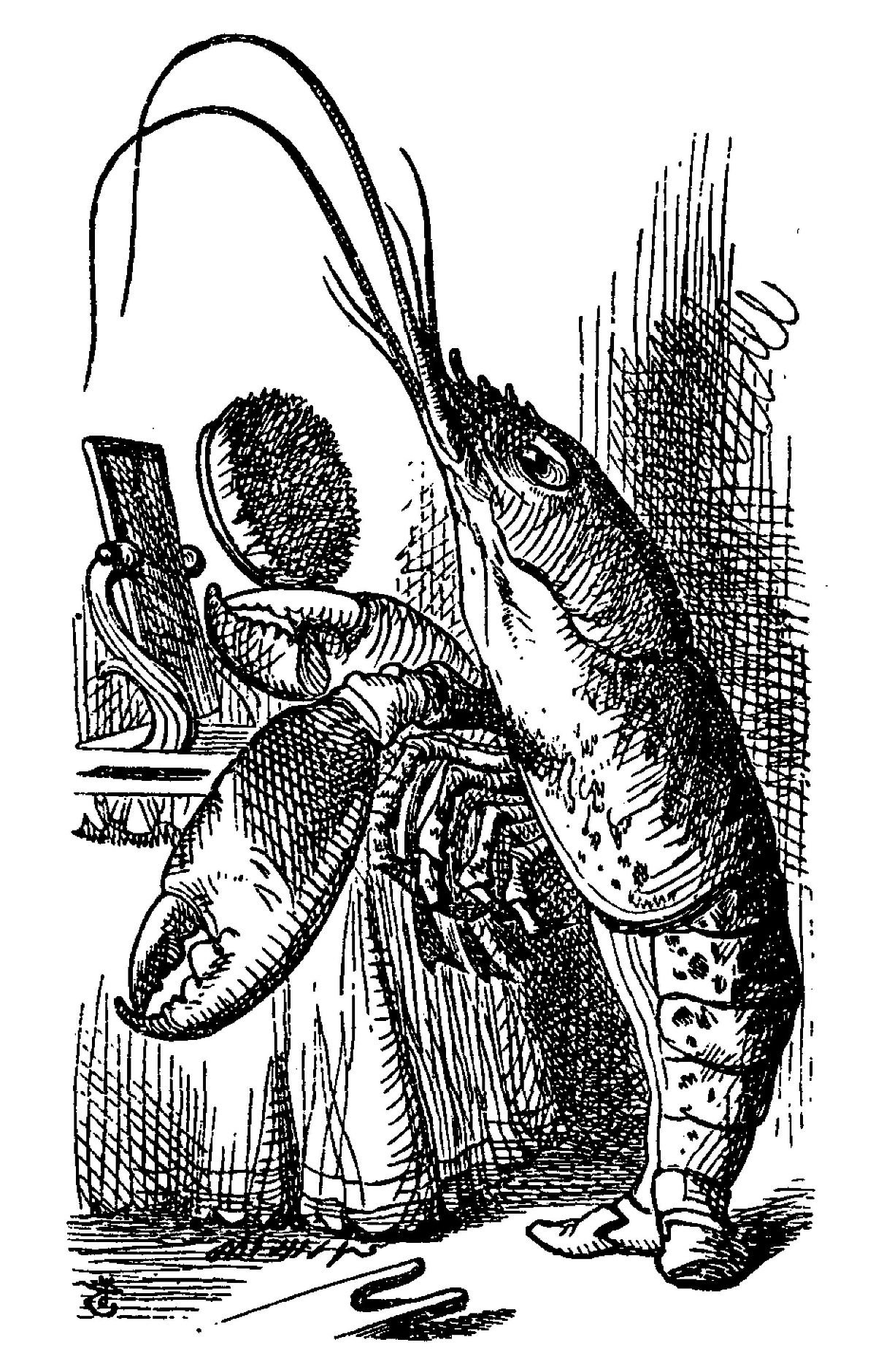
The Lobster Quadrille (from Alice in Wonderland)

“Will you walk a little faster?”
Said a whiting to a snail,
“There’s a porpoise close behind us,
Treading on my tail. ”
See how eagerly the lobsters
And the turtles all advance!
They are waiting on the shingle –
Will you come and join the dance?
So, will you, won’t you, won’t you,
Will you, won’t you join the dance?
Will you, won’t you, will you,
Won’t you, won’t you join the dance?

“You can really have no notion
How delightful it will be
When they take us up and throw us,
With the lobsters, out to sea! ”
But the snail replied, “Too far, too far!”
And gave a look askance –
Said he thanked the whiting kindly,
But he would not join the dance.
So, would not, could not, would not,
Could not, would not join the dance.
Would not, could not, would not,
Could not, could not join the dance.

“What matters it how far we go?”
His scaly friend replied,
“There is another shore, you know,
Upon the other side.
The further off from England
The nearer is to France –
Then turn not pale, beloved snail,
But come and join the dance.

Will you, won’t you, will you,
Won’t you, will you join the dance?
Will you, won’t you, won’t you,
Will you, won’t you join the dance?

Will you, won’t you, will you,
Won’t you, won’t you join the dance?
Will you, won’t you, will you,
Won’t you, won’t you join the dance?

MARCH 17, 461: IS THAT A SHILLELAGH IN YOUR POCKET?

Today is St. Patrick’s Day, a major holiday for the Irish and for non-Irish hangers on who just want to drink green beer. There is precious little celebration of jolly old St. Patrick himself who died on March 17, 461, which is a pity for he was an interesting guy, turning Druids into Christians with a wave of his shillelagh, hurling blarney stones and sham rocks at unrepentant heathens, and playing his pipe to drive all the snakes out of Ireland.

He was, however, a bit of an enigma. Some believe there were actually two Patricks. That might explain some of the contradictions – a good Patrick and a bad Patrick. The good Patrick worked among the poor, feeding them corned beef and cabbage, encouraging them to be chaste and follow a righteous path. The bad Patrick worked among young women, pinching them if they weren’t wearing green, encouraging them to be unchaste and look at his shillelagh. It was the good Patrick who drove the snakes out of Ireland; the bad Patrick, who when he didn’t get enough recompense, stole all the Irish children to feed to the English.

How high’s the water, mama?

Some medieval calendars suggest that St. Patrick shares his day with a Biblical superstar name of Noah.  They have him boarding his ark on March 17 and disembarking on April 29.  And in religious plays of the time, they give Noah and his wife rather more down-to-earth personalities than depicted in the original source book — particularly the wife who is painted as somewhat of a shrew (which would make three shrews aboard the ark).

In one such play, when Noah brings her the news that God has recruited him as a sailor, she sneers at him, calls him a gullible fool, and complains that he never takes her anywhere, let alone on a cruise with a bunch of animals.  Noah tells her to hold her tongue, she refuses, and they come to blows.  He sulks away to build his ark.  She changes her tune when the waters start to rise, jumping aboard at the last minute, only to start complaining about the ambiance.  They continue their fighting ways — frequently beating each other around their heads with their shillelaghs — for forty days and forty nights.


Shaking His Shillelagh at Prairie Dogs

Legendary mountain man Jim Bridger was born on this day in 1804. He was not Irish. Bridger explored and trapped throughout the West during the mid-1800s which is what mountain men do. Were they on beaches instead of in mountains they would be beachcombers or, worse still, ho-dads. Bridger was one of the first white men to see the geysers of the Yellowstone region and the first European American to see the Great Salt Lake which he misnamed the Pacific Ocean. Most everything else he discovered he named after himself. He was a bit irascible, shaking his shillelagh at prairie dogs and playing his pipe to drive the Mormons out of Utah.


December 24, 1843: What a Delightful Boy

Published in 1843, it’s the figgy pudding of Christmas stories.  Don’t go until you get some.  Just one tasty scene for your merriness:

(Scrooge has been visited by the three ghosts on Christmas Eve, and he awakens the following morning.)

“I don’t know what day of the month it is!” said Scrooge. “I don’t know how long I’ve been alastair-sim-as-scrooge-at-windowamong the Spirits. I don’t know anything. I’m quite a baby. Never mind. I don’t care. I’d rather be a baby. Hallo! Whoop! Hallo here!”

He was checked in his transports by the churches ringing out the lustiest peals he had ever heard. Clash, clang, hammer, ding, dong, bell. Bell, dong, ding, hammer, clang, clash! Oh, glorious, glorious!

Running to the window, he opened it, and put out his head. No fog, no mist; clear, bright, jovial, stirring, cold; cold, piping for the blood to dance to; golden sunlight; heavenly sky; sweet fresh air; merry bells. Oh glorious, glorious!

“What’s today?” cried Scrooge, calling downward to a boy in Sunday clothes, who perhaps had loitered in to look about him.

“Eh?” returned the boy, with all his might of wonder.

“What’s today, my fine fellow?” said Scrooge.

“Today!” replied the boy. “Why, Christmas Day.”

“It’s Christmas Day!” said Scrooge to himself. “I haven’t missed it. The Spirits have done it all in one night. They can do anything they like. Of course they can. Of course they can. Hallo, my fine fellow?”

“Hallo!” returned the boy.

“Do you know the Poulterer’s, in the next street but one, at the corner?” Scrooge inquired.

“I should hope I did,” replied the lad.

“An intelligent boy!” said Scrooge. “A remarkable boy! Do you know whether they’ve sold the prize Turkey that was hanging up there? Not the little prize Turkey, the big one?”

“What, the one as big as me?” returned the boy.

“What a delightful boy!” said Scrooge. “It’s a pleasure to talk to him. Yes, my buck!”

“It’s hanging there now,” replied the boy.

“Is it?” said Scrooge. “Go and buy it.”

“Walk-er!” exclaimed the boy.

“No, no,” said Scrooge, “I am in earnest. Go and buy it, and tell ’em to bring it here, that I may give them the direction where to take it. Come back with the man, and I’ll give you a shilling. Come back with him in less than five minutes, and I’ll give you half-a-crown!”

The boy was off like a shot. He must have had a steady hand at a trigger who could have got a shot off half so fast.

“I’ll send it to Bob Cratchit’s!” whispered Scrooge, rubbing his hand, and splitting with a laugh. “He shan’t know who sends it. It’s twice the size of Tiny Tim. Joe Miller never made such a joke as sending it to Bob’s will be!”

scrooge1

scrooged-1988-3

December 21, 1946: Don’t You Know Me, Bert? Ernie?

Frank Capra said that it was his favorite of the many movies he made throughout a phenomenal career. He screened it for his family every Christmas season. Yet it’s initial 1946 release at the Globe Theater in New York did not bring about yuletide euphoria and visions of sugar plums. It’s a Wonderful Life premiered to mixed and sometimes dismissive reviews, but it went on to become one of the most critically acclaimed films ever made, garnering a permanent spot in every list of the top films of the last century.

From its very beginning, it did not inspire great expectations. It was based on an original story “The Greatest Gift”written by Philip Van Doren Stern in 1939. After being unsuccessful in getting the story published, Stern made it into a Christmas card, and mailed 200 copies to family and friends in 1943.  In 1944, RKO Pictures ran across the story and bought the rights to it for $10,000, hoping to turn the story into a vehicle for Cary Grant. Grant made another Christmas movie, The Bishop’s Wife, instead, and the story languished on a shelf until RKO, anxious to unload the project, sold the rights to Capra in 1945.

Capra, along with several other writers, including Dorothy Parker, created the screenplay that Capra would rename It’s a Wonderful Life.

The town of Seneca Falls, New York claims that Capra modeled Bedford Falls after it. The town has an annual “It’s a Wonderful Life” Festival in December, a Hotel Clarence, and the “It’s a Wonderful Life” Museum. The town of Bedford Falls itself, however, was built in Culver City, California, on a 4-acre set originally designed for the western Cimarron. Capra added a working bank and a tree-lined center parkway, planted with 20 full grown oak trees. Pigeons, cats, and dogs roamed at will.

The dance scene where George and Mary end up in the swimming pool was filmed at the Beverly Hills High School. The pool still exists.


itsa-wonderfulll


December 20, 1880: Remember Me to Herald Square

On December 20, 1880, the stretch of Broadway between Union Square and Madison Square in New York City was illuminated by electric lights for the first time, becoming one of the first streets in the country to be lit up.  It had been exactly one year since over in New Jersey, in Menlo Park, Thomas Edison had demonstrated his incandescent light.  By the 1890s, the section of Broadway from 23rd Street to 34th Street had become so brightly illuminated by electrical advertising signs, that it was dubbed “The Great White Way.”  Later, when the theater district moved uptown to the Times Square area, the name moved with it.

Broadway is the oldest north-south thoroughfare in New York City, dating back to the first New Amsterdam settlement.  The name Broadway is an English translation of the Dutch breede weg, which means something like “street of hot pretzel vendors.”  Although best known for the boulevard portion that runs through Manhattan, Broadway also runs through the Bronx and north for another 18 miles through Westchester County to Sleepy Hollow.  There are countless landmarks along the route, but the one that first springs to mind this time of year is Macy’s Herald Square department store, between 34th and 35th Streets, where Christmas begins with Macy’s annual parade,  and its windows spectacularly celebrate the season.

Talk About Holiday Spirit

On December 20, 1989, Vice President Dan Quayle mailed out 30,000 Christmas cards with the inscription “May our nation continue to be the beakon of hope.”

miracle