JULY 15, 971: JUST LYING IN THE RAIN

‘St. Swithin’s day if thou dost rain
For forty days it will remain
St. Swithin’s day if thou be fair
For forty days ’twill rain nae mair.’

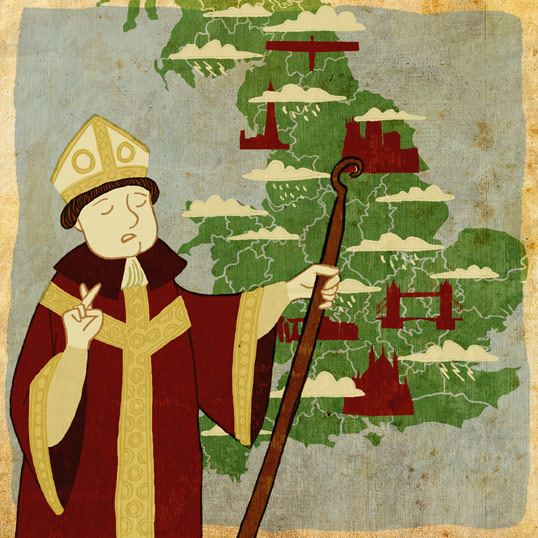
     St. Swithin is the British counterpart to America’s Puxatawney Phil, except that the former is a ninth century bishop and the latter is a ground hog.  And just how did the good St. Swithin get his meterological stripes?  Here’s how:

ST-SWITHIN-DUDLEY-MAXIMS     St. Swithin was noted for his great humility, a quality that some may say he carried to excess. On his deathbed, he asked to be buried, not in the church or in some shrine, but outside where his corpse might be watered by rain from the church eaves and his grave stomped on by passers-by. Folks rolled their eyes a bit but complied with his request.

     And his remains lay wet and walked on for a good hundred years, until a more modern generation of clergy (those 10th century radicals!) took umbrage at one of their own resting in such a lowly spot. They decided at once to relocate Swithin, who could not object, to a great cathedral.  However, on July 15, 971,  just as a ceremony with great pomp and circumstance was about to begin, as if on cue, a heavy rain burst forth and continued with nary a break for 40 days (40 days is a popular duration for great rainfalls).

     The monks interpreted this tempest as a not-so-subtle warning from on high that their nasty little undertaking was a bit of blasphemy.  They immediately abandoned the project. And even without the help of modern social media, word spread throughout the land, and a tradition was born: if it rained on St. Swithin’s Day, it would rain for 40 days.

    St. Swithin also planted apple trees (like Johnny Appleseed, who never predicted weather) leading to the popular description of rain: “St Swithin is christening the apples

JULY 14, 1789, 1973: BREAKING UP IS HARD TO DO

Every écolier and écolière knows that the breakup of France – Révolution française – began in 1789, its defining moment the storming of the Bastille on the morning of July 14. 1789. This medieval fortress in the center of Paris represented royal authority. That the Bastille housed only seven inmates – all with good reason to be there – was unimportant. It was a symbol of the abuses of the absolute monarchy, and the French had had it with monarchs, aristocrats, and pretty much anyone in power. Bring on liberté, égalité, fraternité.   King Louis XVI, exit stage right.

Bye Bye Don

Another momentous breakup took place on the evening of the same day, nearly 200 years later, in 1973, at Knott’s Berry Farm in California. (Knott’s Berry Farm was America’s first theme park and probably the only one devoted to grapes and strawberries and such things.) Every schoolgirl and schoolboy knows that the Everly Brothers were one of America’s most successful pop duos, lending their sibling harmony to such hits as “Bye Bye Love”, “All I Have To Do is Dream” and “Wake Up Little Susie”, a franchise that would seemingly go on forever. Well, forever is a long time, and brothers Don and Phil had, by the end of the 1960s, pretty much had it with liberté, égalité, fraternité and most definitely with each other.

The defining moment of their breakup came in the middle of their set when the stage manager told the audience that the rest of the show had been canceled because brother Don was “too emotional” to play.  In reality, Brother Don was too drunk to play. His skipped guitar notes and bungled lyrics sent brother Phil into a real snit. Phil smashed his guitar and stormed off stage into a solo career, promising he would “never get on stage with that man again.”

Phil and Don reached a sort of detente a decade later.  Louis XVI, on the other hand, was beheaded.

(Phil Everly died in January 2014).

I have no intention of sharing my authority. — King Louis XVI

MAY 25, 2006: GEEK NIRVANA

2006 marked the very first celebration of Día del orgullo friki in Spain, local at first but now celebrated in such far-ranging places as Halifax, Nova Scotia; Timisoara, Romania; and San Diego, California; making it a truly international, sort of, event. The date commemorates the release of the first Star Wars film on May 25, 1977. (This was the second such commemoration for the movie; the first, Star Wars Day,  held on May 4 so celebrants could say “May the fourth be with you.”). The latest fest was the brainchild of a Spanish blogger known as Senor Buebo.


In 2008, the “holiday”was officially celebrated for the first time in the U.S., sporting its English translation, Geek Pride Day, its goal having become the promotion of geek culture. Today it has a manifesto and everything. Imagine if you will 300 proud geeks coming together to form a human pacman or, better still, a prime-number float in a Fifth Avenue parade.


As if this celebration wasn’t heady enough all by itself, Geek Pride Day shares the same date as two other similar fan “holidays”: Towel Day, for fans of The Hitchhiker’s Guide to the Galaxy on which true believers carry about a favorite towel, and the Glorious 25th of May for fans of Terry Pratchett’s Discworld.

Dinner Leaps This Way

An English gentleman who identified himself only as a friend to the Poor wrote a letter to the Public Advertiser on May 25, 1772, describing a novel idea. The idea had occurred to him after reading a passage in a guidebook about a town in France: “There are three small rivers that run through the town, one of which is much frequented by frogs, though one would imagine that in time they would be destroyed, as they commonly compose a dish or two at each meal at the tables of both rich and poor; the latter mostly living on them.”

Your entree

The letter went on to suggest that the poor of England could avoid the high cost of most kinds of food by procuring frogs as food for themselves, since the ponds and ditches of England were full of them. Although the letter writer had never personally tasted a frog, he had been assured that when fried in butter and parsley one could not distinguish it from fricassee of chicken. To those that worried that the ignorant might mistakenly eat a toad, he pointed out that the frog is light brown whereas the toad is almost black, that frogs leap, toads creep.
The gentlemen closed by saying let those that can afford it have roast beef every day, but to those poor wretches who cannot he offers this hint for their benefit.

MAY 5, 1795: Keep Your (Hair) Powder Dry

Unlike today, a nice head of hair made an important fashion statement in the 17th century.  Hair loss and baldness were accompanied by a loss of status and style and, even worse, might indicate the heartbreak of syphilis.  Wigs were often used to cover up such shameful appearance.  Their use became widespread after two monarchs, Louis XIV of France and Charles II of England, victims of premature hair loss, donned wigs.  Courtiers, always quick to jump on a convenient bandwagon, started wearing wigs as well, and a fashion was born.

The first wigs were fashioned from horse and goat hair and, even though they identified the wearer as an elite member of society, they smelled bad and attracted lice and other unwanted critters.  To combat this inconvenience, wig wearers would powder their faux tresses.  Hair powder usually consisted of wheat starch and perfume.  Cheaper powders might be made of flour, ground rice or chalk.

The more popular wigs became, the more elaborate and  bigger they got, hence the term bigwig.  Then in the 18th century, wigs fell out of fashion just as quickly as they had risen.  Late in the century, the clever British, needing revenue to finance another of their endless wars with France, hit upon the idea of taxing hair powder. On May 5, 1795, the government introduced the Hair Powder Act, requiring citizens to purchase a certificate to purchase hair powder.  Well didn’t that put a dent in the use of wigs.  All  of a sudden, in England folks began to wonder what else those wigs might be hiding.  In France, they saw how often wig-wearing dandies ended up with their wigged heads at the wrong end of a guillotine.

Longhair became a word of derision.  Short hair or be square.  But nothing is forever.  Long hair made a comeback in the 20th century.  And you can buy hair powder on Amazon.  Tax-free.

Vamos A Celebrar

In Mexico, Cinco de Mayo is celebrated primarily in the state of Puebla where it is called El Día de la Batalla de Puebla (The Day of the Battle of Puebla) observed to commemorate the Mexican army’s unlikely victory over French forces at the Battle of Puebla on May 5, 1862. France, under the leadership of Napoleon Number Three, sought to establish a Gallic empire in Mexico (possibly because things had gone so well for Napoleon Number One in Russia back in 1812). In 1861, a large French force landed at Veracruz sending the Mexican government into retreat. Moving toward Mexico City, the French army encountered heavy resistance near Puebla from a poorly equipped Mexican army of 4,500 men. The Mexicans were able to soundly defeat the 8,000-strong French army, considered the best in the world.


APRIL 26, 1970: FLAUNT YOUR INTELLECTUAL PROPERTY

Shine up your sneakers, grab your party hats and noisemakers. It’s a day to cast off your inhibitions and get wild and crazy. Yes, today is World Intellectual Property Day, the day set aside to “raise awareness of how patents, copyright, trademarks and designs impact on daily life” and “to celebrate creativity, and the contribution made by creators and innovators to the development of societies across the globe.” And get pleasantly pickled of course.

It’s not quite as over the top as say Fat Tuesday but it’s close. Celebrating the contributions of creators and innovators with two guys in clown suits and a person of unknown gender wearing nothing but a rubber chicken puts a fair amount of zest into a gray day in late April. And coming as it does on the heels of World Book and Copyright Day – well, it’s not for the faint of heart.

Why April 26 you ask? Because it’s the date on which the Convention Establishing the World Intellectual Property Organization was established in 1970.  Perhaps you missed it.  What is intellectual property you ask? That’s the beautiful part. It’s anything you want it to be. What you are reading here at this moment by very elastic definition could be considered intellectual property – especially after three Harvey Wallbangers. So live it up; National Defense Transportation Day is nearly a month away.

These Aren’t Your Ordinary Old Bottle Rockets

An announcement in a London newspaper on April 26, 1792, described an upcoming special event in breathless anticipation: fireworks to celebrate the birthday of her royal highness the Duchess of York.

The fireworks display would depict the eruption and lava flow of Mount Etna on a scale never before seen. Under the mountain would be shown the cavern of Vulcan with the Cyclops at work forging the armor of Mars as portrayed in Virgil’s Aeneid. Music courtesy of Gluck, Haydn, Giardini and Handel.

As the work progresses, Venus and Cupid arrive to request armor for Aeneas. Mars arrives for his armor and is amorously distracted by Venus, annoying Vulcan. But at this moment the smoke thickens above, the crater on top of Etna vomits forth flames, and lava flows dreadfully down the side of the mountain. This continues with increasing violence until there is a prodigious eruption, punctuated by a tremendous explosion.

Coffee and tea are included.

MARCH 26, 47 BC: WITH A LITTLE BIT OF LUCK

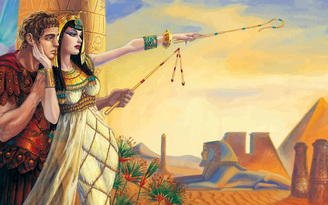
Ptolemy XIII was Pharaoh of Egypt from 51 to 47 BC (remember we’re counting backwards here), his reign pretty much demonstrating the bad luck associated with the number thirteen (in fact he could have been nicknamed Ptolemy the Unlucky or Friday the XIII).

Ptolemy XIII succeeded his father Ptolemy XII, becoming co-ruler by marrying Cleopatra who was his older sister at the time. She was Cleopatra VII, but she was the Cleopatra we all know about — the one of Antony and Caesar and the asp and all that. Since XIII was only 11 at the time, he had a regent — and should you be thinking about the regent’s duties vis-à-vis Cleopatra, we’ll point out that the regent’s name was Pothinus the Eunuch.

Still with us?

Cleopatra, it turns out, was a bit of a grandstander, strutting about as Queen, putting her image on coins, and generally hogging the Egyptian spotlight. Thus in 48 BC, XIII and his eunuch tried to depose her, but she ran off to Syria and raised herself an army.

Enter Roman general Pompey, seeking sanctuary from Julius Caesar.  XIII pretended to welcome Pompey but had him murdered instead.  When Caesar arrived, XIII gave him Pompey’s head as a little welcoming gift. Caesar was unimpressed and took Cleopatra as his welcoming gift instead, giving XIII a cold Roman shoulder and killing his eunuch for good measure.

While Caesar and Cleopatra kept busy trysting the night away, XIII in cahoots with another sister (it’s great to be able to toss in another sibling when things are beginning to slow down) tried again to dump Cleopatra.

XIII and his other sister were no match for Caesar and Cleopatra and in the ensuing Battle of the Nile, XIII was forced to flee. Unfortunately, Ptolemy the Unlucky was drowned as he attempted to cross the Nile.


MARCH 25, 2024: WAITER, THERE’S A LOBSTER ON MY WAFFLE

Today is International Waffle Day, a tradition that is celebrated worldwide but mostly in Sweden. It’s a day to enjoy – guess what? – eating waffles. The day may have arisen out of confusion. Waffle Day in Swedish, Våffeldagen, sounds a lot like Our Lady’s Day,Vårfrudagen, (you really have to be on a street in Stockholm to get the full effect), a Christian holiday also known as Annunciation (the third Thursday after Pronunciation), when the Archangel Gabriel told the Virgin Mary she was pregnant. Mary was understandably upset and did what any virgin would do upon being told she was pregnant – stuffed herself with waffles. Waffle Day also coincides with the beginning of Spring, another traditional day for eating waffles in Sweden. Therefore, if you see a Swede eating waffles today, you don’t know if it’s religious or secular or just hunger.

More interesting facts:

Waffles were made with cheese and herbs in ancient Greece.

The familiar grid pattern of today’s waffles originated in the Middle Ages. Some waffles had fancier designs such as coats of arms,  landscapes and portraits of Middle Age people.

Waffles were so popular that they were even sold from street carts (by strange looking men who eventually switched to selling chestnuts and large pretzels).

In the late 1800’s, Thomas Jefferson returned from France with a waffle iron.  It’s unclear how he got it through security.

Many folks in Britain celebrate International Waffle Day by eating rutabagas which are known there as Swedes.  There is no International Rutabaga Day.

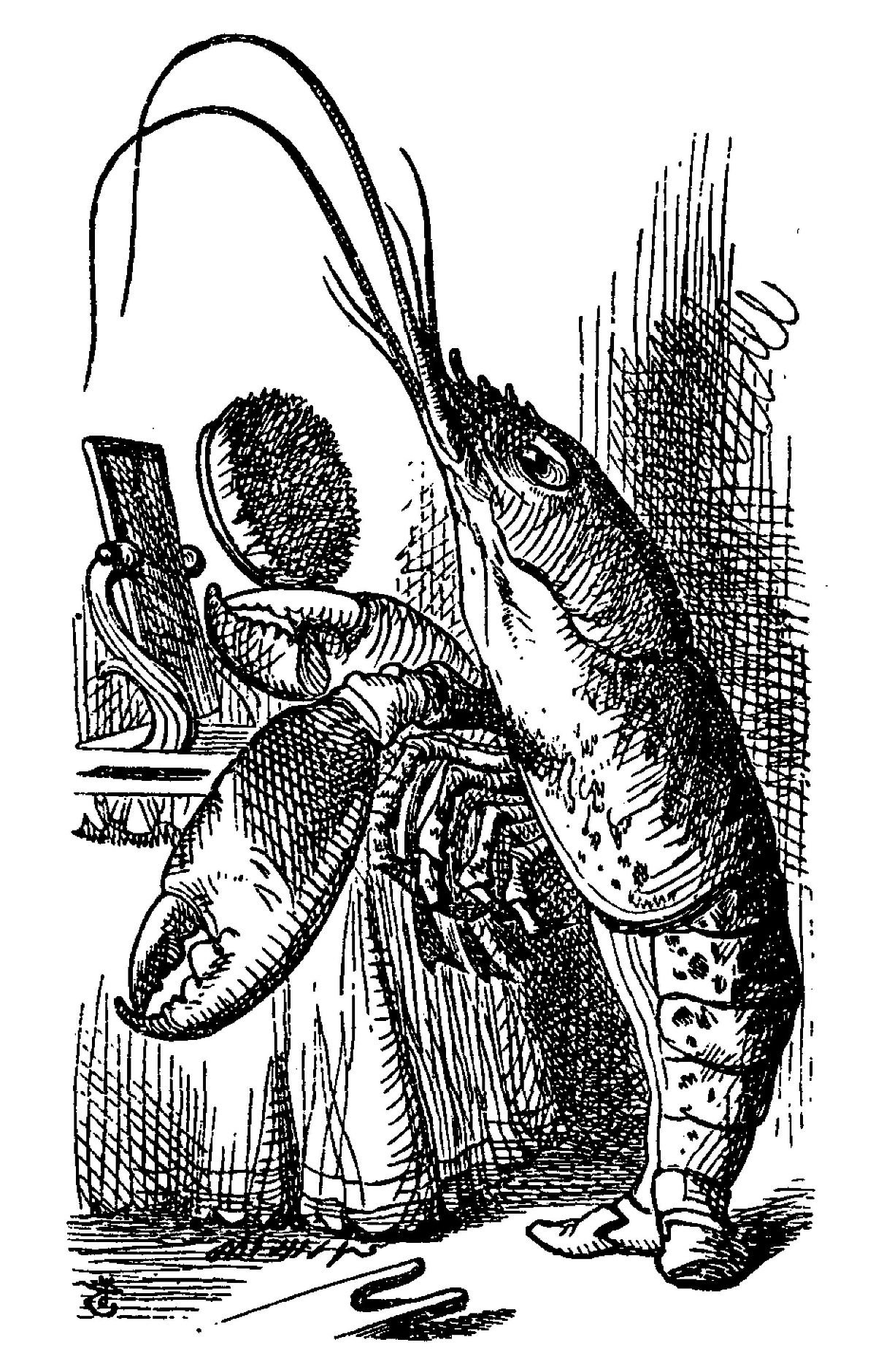
There is, however, a Lobster Newburg Day – and it’s today!

Lobster Newburg, lobster with a sherry and cognac infused, egg-thickened cream sauce, was first served at New York’s Delmonico’s in the 1870s. Delmonico’s was not only the first formal dining restaurant in the United States, it was the first to serve hamburger, the creator of Baked Alaska, the creator of Eggs Benedict, and of course the creator of Lobster Newburg.  A waffle topped with Lobster Newburg, anyone?

The Lobster Quadrille (from Alice in Wonderland)

“Will you walk a little faster?”
Said a whiting to a snail,
“There’s a porpoise close behind us,
Treading on my tail. ”
See how eagerly the lobsters
And the turtles all advance!
They are waiting on the shingle –
Will you come and join the dance?
So, will you, won’t you, won’t you,
Will you, won’t you join the dance?
Will you, won’t you, will you,
Won’t you, won’t you join the dance?

“You can really have no notion
How delightful it will be
When they take us up and throw us,
With the lobsters, out to sea! ”
But the snail replied, “Too far, too far!”
And gave a look askance –
Said he thanked the whiting kindly,
But he would not join the dance.
So, would not, could not, would not,
Could not, would not join the dance.
Would not, could not, would not,
Could not, could not join the dance.

“What matters it how far we go?”
His scaly friend replied,
“There is another shore, you know,
Upon the other side.
The further off from England
The nearer is to France –
Then turn not pale, beloved snail,
But come and join the dance.

Will you, won’t you, will you,
Won’t you, will you join the dance?
Will you, won’t you, won’t you,
Will you, won’t you join the dance?

Will you, won’t you, will you,
Won’t you, won’t you join the dance?
Will you, won’t you, will you,
Won’t you, won’t you join the dance?

MARCH 17, 461: IS THAT A SHILLELAGH IN YOUR POCKET?

Today is St. Patrick’s Day, a major holiday for the Irish and for non-Irish hangers on who just want to drink green beer. There is precious little celebration of jolly old St. Patrick himself who died on March 17, 461, which is a pity for he was an interesting guy, turning Druids into Christians with a wave of his shillelagh, hurling blarney stones and sham rocks at unrepentant heathens, and playing his pipe to drive all the snakes out of Ireland.

He was, however, a bit of an enigma. Some believe there were actually two Patricks. That might explain some of the contradictions – a good Patrick and a bad Patrick. The good Patrick worked among the poor, feeding them corned beef and cabbage, encouraging them to be chaste and follow a righteous path. The bad Patrick worked among young women, pinching them if they weren’t wearing green, encouraging them to be unchaste and look at his shillelagh. It was the good Patrick who drove the snakes out of Ireland; the bad Patrick, who when he didn’t get enough recompense, stole all the Irish children to feed to the English.

How high’s the water, mama?

Some medieval calendars suggest that St. Patrick shares his day with a Biblical superstar name of Noah.  They have him boarding his ark on March 17 and disembarking on April 29.  And in religious plays of the time, they give Noah and his wife rather more down-to-earth personalities than depicted in the original source book — particularly the wife who is painted as somewhat of a shrew (which would make three shrews aboard the ark).

In one such play, when Noah brings her the news that God has recruited him as a sailor, she sneers at him, calls him a gullible fool, and complains that he never takes her anywhere, let alone on a cruise with a bunch of animals.  Noah tells her to hold her tongue, she refuses, and they come to blows.  He sulks away to build his ark.  She changes her tune when the waters start to rise, jumping aboard at the last minute, only to start complaining about the ambiance.  They continue their fighting ways — frequently beating each other around their heads with their shillelaghs — for forty days and forty nights.

Shaking His Shillelagh at Prairie Dogs

Legendary mountain man Jim Bridger was born on this day in 1804. He was not Irish. Bridger explored and trapped throughout the West during the mid-1800s which is what mountain men do. Were they on beaches instead of in mountains they would be beachcombers or, worse still, ho-dads. Bridger was one of the first white men to see the geysers of the Yellowstone region and the first European American to see the Great Salt Lake which he misnamed the Pacific Ocean. Most everything else he discovered he named after himself. He was a bit irascible, shaking his shillelagh at prairie dogs and playing his pipe to drive the Mormons out of Utah.

February 14, 278: Roses Are Red, Etc., Etc.

How did St. Valentine’s Day become a day associated with hearts and flowers and all things romantic? One account puts a definitely sinister spin on the origin of this holiday. It begins back in the third century with a fellow named Claudius the Cruel. As you might guess, Claudius is not going to be the hero of this tale.

Claudius (II, if you’re counting) was the Emperor of Rome, a barbarian who proved that any young boy can grow up to be emperor if he believes. Valentinus, or Valentine, was not a saint at the time, but he was a holy priest.

Claudius, in addition to his barbarianism and cruelty, was a bit of a warmonger. Continually involved in bloody campaigns to destroy upstart nations throughout the region, Claudius needed to maintain a strong army.  But it was a constant battle to keep his military at full strength what with Christianity gaining a toehold and everyone  into family values. The men for their part were unwilling to be all they could be in the army because of their annoying attachment to wives and families.

Claudius had a fairly simple solution; he banned all marriages and engagements in Rome. Valentine, part of whose livelihood was the performing of marriages, thought this decree unjust and defied the emperor by continuing to marry young lovers on the sly.  Claudius, as emperors will, got wind of Valentine’s doings and, true to his name, ordered that Valentine be put to death. Valentine was arrested and condemned to be beaten about the head, and then have said head cut off. The sentence was carried out on February 14, 278.

Legend has it that while in jail, Valentine left a farewell note for the jailer’s daughter, with whom he had had a brief relationship (that will not be explored here), and signed it “From Your Valentine.”  There may have been other cute little Valentine poems as well,  but they have been lost to history.

For this, Valentine was named a saint and had a holiday created after him, though not a legal one with school closings and such. Conspiracy theorists will naturally jump up and down, saying there were several St. Valentines and the holiday could have been named after any one of them. Or it could have come from the pagan festival Lupercalia, a day of wanton carrying on. They should mind their own business.

February 13, 1862: Thaw Out the Holly

With the giving and getting of gifts growing to a crescendo in late December, it is to many a glass of cold water in the face when the merriment suddenly gives way to a bleak long winter with scarcely a box or a bow in sight. The people of Norwich, a city on England’s east coast, a couple of centuries ago found a way to keep on giving by elevating February 13, St. Valentine’s Eve to a Christmas-like celebration.

According to an 1862 account, this Victorian tradition was evidently peculiar to Norwich: visitors to the city were often puzzled to find the shop windows crammed with gifts in early February and newspapers full of advertisements for ‘Useful and Ornamental Articles Suitable for the Season’ available from local retailers.

As soon as it got dark on St. Valentine’s Eve, the streets were swarming with folks carrying baskets of treasures to be anonymously dropped on doorsteps throughout the city. They’d deposit a gift, bang on the door, and rush away before anyone inside could reach the door. Indoors there were excited shrieks and shouts, flushed faces, sparkling eyes and laughter, a rush to the door, examination of the parcels.

Practical jokers  were everywhere as well, ringing doorbells and running off, leaving mock parcels that were pulled away by string when someone attempted to pick them up. Large parcels that dwindled to nothing as the recipient fought through layer after layer of wrapping, and even larger parcels containing live boys who would jump out, steal a kiss, and run away.

As with most holidays that involve children out after dark and mischief, the celebration of St. Valentine’s Eve fell out of favor, to be replaced by the Hallmark-inspired and saintless Valentine’s Day.

No Valentine, This One

Hal Foster had been drawing the Tarzan comic strip based on the books by Edgar Rice Burroughs for several years, but itched to create his own original strip. He began work on a feature called Derek, Son of Thane, set in Arthurian England. Before the strip had its coming out party on February 13, 1937, it had gone through a couple of name changes, first to Prince Arn and eventually to Prince Valiant.

Prince Valiant was five years old when his story began, a continuous story that has been told through 4,000 Sunday episodes. Without a whole lot of deference to historical accuracy, Val’s adventure’s take him throughout Europe, Africa, the Far East and even the Americas in a time frame covering hundreds of years. He does battle with Huns, Vikings, Sorcerers, witches and a slew of monsters from prehistoric to modern, but always big.

Foster drew the strip until 1971 and wrote the continuity until 1980. Since then, other artists have kept it alive. Foster died in 1982, at age 89.

Fore, I mean duck

Golf is thought of as relatively safe sport.  But for the safety of others, there are just some people who should not be allowed on a golf course.  Vice President Spiro Agnew had the dubious distinction of beaning not just one but three spectators on this day in 1971 during the Bob Hope Desert Classic.  On his very first drive, he sliced into the crowd for a two-bagger, bouncing off a man to nail his wife as well.  On his next shot, he hit a woman, sending her to the hospital.  The previous year, Agnew had managed to hit his partner in the back of the head.