
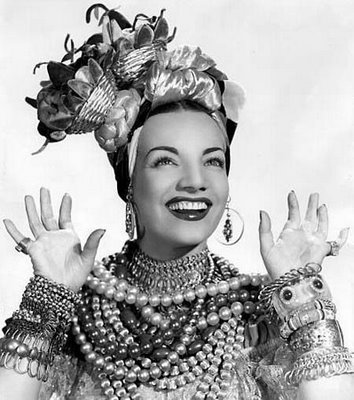
Maria do Carmo Miranda da Cunha was born February 9, 1909, in Marco de Canavazes, Portugal, not in Brazil, as is often assumed. A year later, though, she did arrive in Rio de Janeiro, where her father opened a lucrative wholesale fruit business, selling bananas of course.
One wouldn’t think a young girl could soak up much rhythm and culture from the good sisters of the convent of Santa Teresinha, but by 17 she was singing in the cafes of Rio. In 1929, using her mother’s surname to keep her career hidden from her disapproving father, Maria do Carmo made her first appearance as Carmen Miranda. She was tiny in stature, standing only 5’1.”. Nevertheless, she filled a stage with her Latin energy and machine gun delivery, melodic Brazilian bullets ricocheting everywhere.
 She worked her way into singing on Brazilian radio and in movies. She made her first recording, a romantic choro on one side, but oh on the other side — a lively samba.
The samba was a lusty part of the social life of the people who lived in the hills beyond the urban refinement of Rio and its European influences. Its rhythms were African, at once rustic and cosmopolitan, erotic and refined, measured and languorous. And during the following years, she became the Queen of Samba (or Smiling Dictator of Samba according to one radio announcer). Her crown an imposing tower of fruit.
She and her samba stormed the United States in 1939 – nightclubs, radio, and throughout the 40s and eary 50s, a string of movies – Down Argentine Way, That Night in Rio, Weekend in Havana, and the over-the-top Busby Berkeley musical The Gang’s All Here in which she sang “The Girl in the Tutti-Frutti Hat.” At age 36, with a salary of over $200,000, she was the highest paid woman in the nation, ninth on the Treasury Department’s salary list, ahead of  Betty Grable, Bing Crosby, Bob Hope and Humphrey Bogart.
In 1955, it all ended. After filming an appearance on the Jimmy Durante television show, at 46 years of age, she died of a heart attack.
Mama Eu Quero
An excerpt from the short story, one of 15 in Calypso, Stories of the Caribbean
The Tropicana was a frenzied, pulsating place, as animated as the tourists and Havana socialites who crowded the casino, bar, dance floor and every table, there to be entertained by a half dozen celebrities, three full orchestras and the Tropicana’s own ballet troupe. It had not been easy for Jorge to secure a table, and when he did, it was some distance from where Carmen Miranda would shortly perform. He liked the table just fine, not wanting to be conspicuous in such a place. Delia wished they were closer but couldn’t say anything, and just being here was the high point in her sixteen years plus four months. She looked as mature as any seventeen-year-old in the place, sipping the wine Jorge had bought her and wearing another bright outfit that Carmen herself might have worn, but without the tutti frutti hat, of course, for that would be presumptuous.
Miranda’s Boys broke into a spirited overture, and suddenly there was Carmen Miranda herself, bouncing to the beat of “South American Way.” Jorge turned to see the look on Delia’s face, but there was no look on Delia’s face because there was no Delia. He scanned the floor, fearing she had fainted in her excitement. Nothing. Then he spotted her, crawling on hands and knees between the tables, toward the stage. He closed his eyes afraid to watch but finally had to look again. He spotted her as she squeezed unnoticed between the chairs occupied by the sleek black-haired man and his sleek black-haired companion, disappearing under the table next to where Carmen Miranda sang and danced.
 Wretched Richard's Almanac