MAY 2, 1843: THE TOWN THAT CRIED WOLF

     Chances are you’ve never heard of Champoeg — unless maybe you’re from Oregon which is where it is, or was. Champoeg had the historical significance of being the first American government on the West Coast, having been established by representatives of Willamette Valley settlers on May 2, 1843, by a vote of 52-50. These representatives had held a series of meetings starting back in February to entertain measures to deal with the threat of wolves. During these so-called “Wolf Meetings,” the conferees established a series of civil codes (although its doubtful the wolves paid much attention to them).

     When the Oregon Territory was created in 1848, Champoeg was cold-shouldered as upstart Oregon City became its capital. This despite the fact that Champoeg had become rather a bustling little metropolis with a steamboat landing, a ferry across the Willamette River, a stagecoach office, a granary and a warehouse. Ten streets ran north to south, crossed by six east-west thoroughfares.

     Champoeg chugged along through the years as Oregon grew and gained statehood. Then in 1861, the Willamette River reared its ugly head, rising 55 feet above its normal stage, flooding the town and destroying every structure in it with the exception of two saloons (there’s a lesson here somewhere). Champoeg was never rebuilt after the flood; all that remains is a small monument describing its place in history and a stake marking a street corner (probably the one where a saloon stood).

“Well!”

     Although he was first heard on radio as a guest of Ed Sullivan, Jack Benny debuted his own radio show for NBC on May 2, 1932. After six months he moved to CBS and then in 1933 back to NBC. Although he continued to jump back and forth on networks, his radio program lasted until 1955, some five years after his television program appeared.

     Benny was a fixture on radio and TV for three decades, and is still considered one of the best. He was a master of comic timing, creating laughter with pregnant pauses or a single expression, such as his signature “Well!

     Appearing with him over the years were Eddie “Rochester” Anderson, Don Wilson, Dennis Day, Mary Livingston, Phil Harris, Mel Blanc and Sheldon Leonard. Leonard helped Benny produce what was said to be the longest laugh in radio history. Leonard as a holdup man approached Benny and demanded “your money or your life.” Benny remained silent. Finally, Leonard said “Well!?” and Benny answered “I’m thinking it over!”

MAY 1, 1931: TALL BUILDING WITH APE

US President Herbert Hoover pushed a button in Washingtonempire D .C. turning on the lights of a building in New York City. On May 1, 1931, the world’s tallest building (102 stories with a total height of 1,454 feet), one of the seven wonders of the modern world, and soon to become an American icon, the Empire State Building, was open for business.

Commanding the intersection of Fifth Avenue and West 34th Street, the Art Deco masterpiece had taken just over a year to complete. It remained the tallest building in the world for 40 years, and is still a celebrated symbol of American culture. It has been a featured star in over 250 movies and many other forms of entertainment for its entire existence – An Affair to Remember, Sleepless in Seattle, Elf and, probably the most famous, the one with that giant ape clinging to its spire, battling modern technology.

Although jumping (or attempting to) from the Empire State Building is a much depicted form of suicide, just 30 people have pulled it off. The most noted is the 1947 death of a young woman who landed on a United Nations limousine parked at the curb. A photo taken minutes after her death was featured in Life magazine as “The Most Beautiful Suicide” and was later used by Andy Warhol in his print Suicide (Fallen Body).

Notable failures included a woman who jumped from the 86th floor observation deck, only to be blown back onto the 85th floor by a gust of wind and left with a broken hip, and a man who jumped or fell from the 86th floor but landed alive on an 85th floor ledge from which he was rescued suffering only minor injuries.


March 15, 44 BC: I Only Have Ides for You

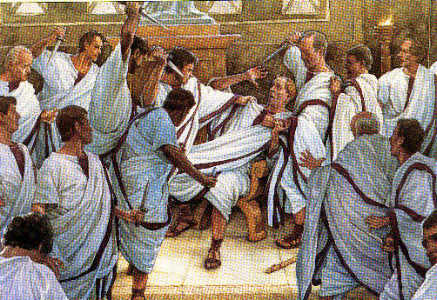
Beware. Today is the ides of March, a day once enthusiastically celebrated among the common people with picnics, drinking, and revelry. In the ancient Roman calendar, each of the 12 months had an ides (from the Latin to divide). In March, May, July and October, the ides fell on the 15th day. In all other months, the ides fell on the 13th.  There is a reason for this, but the logic declined and fell with Rome, and the ides lost their original intent and purpose and eventually came to mean the day that a bunch of guys are going to stick knives into you.

This was thanks to Shakespeare,  Julius Caesar, and Caesar’s pals Brutus et al.  In Act I, Scene 2, of Shakespeare’s history, the old soothsayer utters these words, dripping with foreboding: “Beware the Ides of March.” Pretty straightforward, but does Caesar pay attention? Of course not. And on March 15, 44 BC, aided by his friends, he buys the forum, so to speak, exiting stage left halfway through the play even though it bears his name.

Despite an occasional pretentious allusion to the Ides of March and the popular song, today’s calendar is pretty much ideless (as ideless as a painted ship upon a painted ocean, to slip in a quick pretentious allusion).


Wretched Richard’s Little Literary Lessons – No. 2

al·lu·sion

əˈlo͞oZHən/

noun

As a literary device, an allusion is an expression designed to call something to mind without mentioning it explicitly; an indirect or passing reference to another person, event, work etc.

For example:

“That’s a rather abrupt and indifferent exit. Feel guilty?”

“I’m not sure. You don’t approve?”

“Well, I suppose it’s better than ‘I’m running off to hook up with Lolita for a few days. I’ll be back when I’m tuckered out. I hope you don’t mind.”

“Lolita? You’re hardly a nymphet.”

“I beg your pardon,” Huey huffed. “Would you care to elaborate on that point?”

“A nymphet is fourteen or fifteen years old, tops.”

“Maybe I’m only fifteen.”

“You also pointed out that you weren’t trying to seduce me.”

“Maybe I was lying. And maybe I’m no Lolita – as hot as I am – but you most definitely fit the part of Humbert Humbert, you old fart. Just remember you’re here of your own free will. You can’t claim I forced you to come along.”

“I won’t if you won’t,” said Paul.

Not forcing anyone to come along, just inviting: Voodoo Love Song