In 1937, Congress passed the Marihuana Tax Act which levied a tax of one dollar on anyone who dealt commercially in marijuana. The bill had been written using the slang term “marihuana” throughout, obscuring the fact that it covered the plant’s legitimate uses in medicine, where it was broadly known as cannabis and in the fiber industry as hemp. The Act did not itself criminalize their possession, but regulations and restrictions on the sale of cannabis as a drug had been around since the previous century. In effect, the bill made it impossible for anyone to deal with call it what you will in any form.
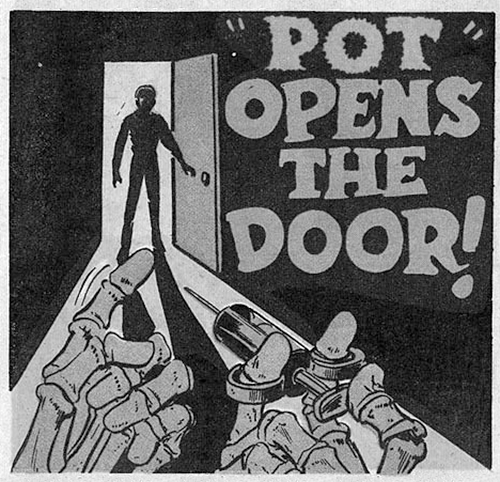
Conspiracy theorists maintained that business tycoons Andrew Mellon, Randolph Hearst, and the Du Pont family were behind passage of the Act as a way to reduce the size of the hemp industry. Hemp had became a very cheap substitute for the paper  pulp that was used in the newspaper industry and as such was a threat to Hearst’s extensive timber holdings. Mellon had invested heavily in the Du Pont family’s new synthetic fiber nylon that was competing with hemp. The campaign that Hearst’s newspapers had been staging against the dangers of the recreational use of the”powerful narcotic in which lurks MURDER! INSANITY! DEATH!” was therefore disingenuous. (‘Beware the evils of hemp’ didn’t quite cut it. “Reading newspapers printed on hemp will lead to degradation and reading the New York Post.”)
The legislation effectively killed the hemp industry and the medical use of cannabis, and the ensuing years of “reefer madness” completed its evolution to the abominable recreational drug it became through the rest of the century.
face down in a cranberry bog, part 4: the corpse returns
“Yoo hoo.” I turned and saw her standing in front of a thicket of heath, twenty yards beyond the bogs.
 “Where is he?” I demanded when I reached her, even though it sounded as if I were getting a little possessive with this body. She was quite disheveled, as though – as though she’d dragged a body out of a cranberry bog.
“Back there, in the bushes.”
“Why?”
“After you left, I started thinking more clearly and realized that he can’t be found here. That would be terrible. I hope you’re not angry.”
“Angry? The Nantucket police chief thinks I’m a lunatic. And if anyone dies mysteriously on this island in the next ten years, I’m his number one suspect. Angry? Of course not.”
“Oooh, I’m sorry,” she wailed and unleashed her puppy dog eyes.
“Why can’t he be found here?”
“Because he’s supposed to be in Boston. It’s very complicated.”
“You had sex with a man who’s supposed to be in Boston on the edge of a Nantucket cranberry bog and he died and fell in so now he’s back there in the bushes. What’s complicated?”
She looked at me as though she still wasn’t sure I could be trusted even though I had aided and abetted every inch of her little crime other than the actual killing – and the sex, of course. Finally she spoke. “You didn’t recognize him, did you?” I was about to reply that we hadn’t met under ideal conditions. “He’s Alexander Farnsworth.”
“Alexander Farnsworth. The name’s not familiar, nor his face. Why would I recog – ?” I guess my mouth dropped open because she began to shake her head excitedly.
“No,” I said, as if my denial would make it not so, but now the face was familiar, too. “Not Secretary of State Alexander Farnsworth?”
“Yes. Everyone thinks he’s in Boston. But he’s been here for the past week having secret meetings with a Prince Somebody from somewhere important.”
“I thought he was here to fool around with someone in a cranberry bog.”
“That’s not very nice,” she snapped.
“Okay. How did the two of you happen to end up…?”
“I came to Nantucket with him. I work for him. This morning, he wanted to relax for a while so we took a walk and – well, you know the rest. Now you know why he can’t be here. It’s not just me. It’s national security stuff.”
“He’s no better off in those bushes than in the bog.”
“I know,” she said. “I’m going to take him back to Boston.”
“Oh boy.”
“I’ve made up my mind. I’ve got to do it. But I need your help again. Do you have a car?”
“I hope you’re not going to ask me to drive a dead man to Boston.”
“No, I wouldn’t do that.” Then she breathlessly explained to me how she herself was going to drive the dead Secretary of State first onto the ferry then to Boston in an official government vehicle which she would leave with him behind the wheel in the underground parking lot of an exclusive Boston hotel. My mind went a little numb as I listened to her plan and gazed into her conspiring eyes. When she stopped talking, I leaned forward and kissed her. She let me, but then pulled away. “Please,” she said. “Not now. Later, before I go to Boston.”
continued

 pulp that was used in the newspaper industry and as such was a threat to Hearst’s extensive timber holdings. Mellon had invested heavily in the Du Pont family’s new synthetic fiber nylon that was competing with hemp. The campaign that Hearst’s newspapers had been staging against the dangers of the recreational use of the”powerful narcotic in which lurks MURDER! INSANITY! DEATH!” was therefore disingenuous. (‘Beware the evils of hemp’ didn’t quite cut it. “Reading newspapers printed on hemp will lead to degradation and reading the New York Post.”)
 Wretched Richard's Almanac