February 9, 1909: I Make My Money with Bananas

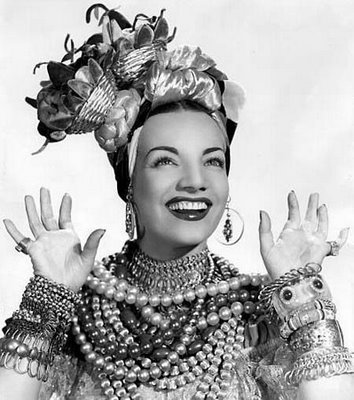
Maria do Carmo Miranda da Cunha was born February 9, 1909, in Marco de Canavazes, Portugal, not in Brazil, as is often assumed.  A year later, though, she did arrive in Rio de Janeiro, where her father opened a lucrative wholesale fruit  business, selling bananas of course.

One wouldn’t think a young girl could soak up much rhythm and culture from the good sisters of the  convent of Santa Teresinha, but by 17 she was singing in the cafes of Rio.  In 1929, using her mother’s surname to keep her career hidden from her disapproving father, Maria do Carmo made her first appearance as Carmen Miranda.  She was tiny in stature, standing only 5’1.”.  Nevertheless, she filled a stage with her Latin energy and machine gun delivery, melodic Brazilian bullets ricocheting everywhere.

She worked her way into singing on Brazilian radio and in movies.  She made her first recording, a romantic choro on one side, but oh on the other side —  a lively samba.

The samba was a lusty part of the social life of the people who lived in the hills beyond the urban refinement of Rio and its European influences.  Its rhythms were African, at once rustic and cosmopolitan, erotic and refined, measured and languorous.  And during the following years, she became the Queen of Samba (or Smiling Dictator of Samba according to one radio announcer).  Her crown an imposing tower of fruit.

She and her samba stormed the United States in 1939 – nightclubs, radio, and throughout the 40s and eary 50s, a string of movies – Down Argentine Way, That Night in Rio, Weekend in Havana, and the over-the-top Busby Berkeley musical The Gang’s All Here in which she sang “The Girl in the Tutti-Frutti Hat.” At age 36, with a salary of over $200,000, she was the highest paid woman in the nation, ninth on the Treasury Department’s salary list, ahead of Betty Grable, Bing Crosby, Bob Hope and Humphrey Bogart.

In 1955, it all ended.  After filming an appearance on the Jimmy Durante television show, at 46 years of age, she died of a heart attack.

Mama Eu Quero

An excerpt from the short story, one of 15 in Calypso, Stories of the Caribbean

The Tropicana was a frenzied, pulsating place, as animated as the tourists and Havana socialites who crowded the casino, bar, dance floor and every table, there to be entertained by a half dozen celebrities, three full orchestras and the Tropicana’s own ballet troupe. It had not been easy for Jorge to secure a table, and when he did, it was some distance from where Carmen Miranda would shortly perform. He liked the table just fine, not wanting to be conspicuous in such a place. Delia wished they were closer but couldn’t say anything, and just being here was the high point in her sixteen years plus four months. She looked as mature as any seventeen-year-old in the place, sipping the wine Jorge had bought her and wearing another bright outfit that Carmen herself might have worn, but without the tutti frutti hat, of course, for that would be presumptuous.
Miranda’s Boys broke into a spirited overture, and suddenly there was Carmen Miranda herself, bouncing to the beat of “South American Way.” Jorge turned to see the look on Delia’s face, but there was no look on Delia’s face because there was no Delia. He scanned the floor, fearing she had fainted in her excitement. Nothing. Then he spotted her, crawling on hands and knees between the tables, toward the stage. He closed his eyes afraid to watch but finally had to look again. He spotted her as she squeezed unnoticed between the chairs occupied by the sleek black-haired man and his sleek black-haired companion, disappearing under the table next to where Carmen Miranda sang and danced.


MAY 2, 1843: THE TOWN THAT CRIED WOLF

     Chances are you’ve never heard of Champoeg — unless maybe you’re from Oregon which is where it is, or was. Champoeg had the historical significance of being the first American government on the West Coast, having been established by representatives of Willamette Valley settlers on May 2, 1843, by a vote of 52-50. These representatives had held a series of meetings starting back in February to entertain measures to deal with the threat of wolves. During these so-called “Wolf Meetings,” the conferees established a series of civil codes (although its doubtful the wolves paid much attention to them).

     When the Oregon Territory was created in 1848, Champoeg was cold-shouldered as upstart Oregon City became its capital. This despite the fact that Champoeg had become rather a bustling little metropolis with a steamboat landing, a ferry across the Willamette River, a stagecoach office, a granary and a warehouse. Ten streets ran north to south, crossed by six east-west thoroughfares.

     Champoeg chugged along through the years as Oregon grew and gained statehood. Then in 1861, the Willamette River reared its ugly head, rising 55 feet above its normal stage, flooding the town and destroying every structure in it with the exception of two saloons (there’s a lesson here somewhere). Champoeg was never rebuilt after the flood; all that remains is a small monument describing its place in history and a stake marking a street corner (probably the one where a saloon stood).

“Well!”

     Although he was first heard on radio as a guest of Ed Sullivan, Jack Benny debuted his own radio show for NBC on May 2, 1932. After six months he moved to CBS and then in 1933 back to NBC. Although he continued to jump back and forth on networks, his radio program lasted until 1955, some five years after his television program appeared.

     Benny was a fixture on radio and TV for three decades, and is still considered one of the best. He was a master of comic timing, creating laughter with pregnant pauses or a single expression, such as his signature “Well!

     Appearing with him over the years were Eddie “Rochester” Anderson, Don Wilson, Dennis Day, Mary Livingston, Phil Harris, Mel Blanc and Sheldon Leonard. Leonard helped Benny produce what was said to be the longest laugh in radio history. Leonard as a holdup man approached Benny and demanded “your money or your life.” Benny remained silent. Finally, Leonard said “Well!?” and Benny answered “I’m thinking it over!”

MAY 1, 1931: TALL BUILDING WITH APE

US President Herbert Hoover pushed a button in Washingtonempire D .C. turning on the lights of a building in New York City. On May 1, 1931, the world’s tallest building (102 stories with a total height of 1,454 feet), one of the seven wonders of the modern world, and soon to become an American icon, the Empire State Building, was open for business.

Commanding the intersection of Fifth Avenue and West 34th Street, the Art Deco masterpiece had taken just over a year to complete. It remained the tallest building in the world for 40 years, and is still a celebrated symbol of American culture. It has been a featured star in over 250 movies and many other forms of entertainment for its entire existence – An Affair to Remember, Sleepless in Seattle, Elf and, probably the most famous, the one with that giant ape clinging to its spire, battling modern technology.

Although jumping (or attempting to) from the Empire State Building is a much depicted form of suicide, just 30 people have pulled it off. The most noted is the 1947 death of a young woman who landed on a United Nations limousine parked at the curb. A photo taken minutes after her death was featured in Life magazine as “The Most Beautiful Suicide” and was later used by Andy Warhol in his print Suicide (Fallen Body).

Notable failures included a woman who jumped from the 86th floor observation deck, only to be blown back onto the 85th floor by a gust of wind and left with a broken hip, and a man who jumped or fell from the 86th floor but landed alive on an 85th floor ledge from which he was rescued suffering only minor injuries.


SEPTEMBER 8, 1892: PLEDGE, SALUTE, SING OUT THE CHORUS

Daniel Sharp Ford was a bit of a flag-waver. He thought the country needed a little more patriotism, and so launched a crusade to get flags into every school in the country. As the owner of the magazine Youth’s Companion he had a ready-made platform for the promotion of his ideas. As part of his patriotism package, he asked a socialist minister, Francis Bellamy, to create a pledge to the flag of one’s country, a pledge that could be used throughout the world.

Bellamy came up with a pledge that was simplicity itself, and Ford published it in the September 8, 1892, issue of his magazine. The Pledge of Allegiance, as it was called, read:

“I pledge allegiance to my Flag and the Republic for which it stands, one nation, indivisible, with liberty and justice for all.”

The pledge was incredibly popular, repeated in schools, public gatherings, government meetings, in Congress. However, Ford and Bellamy found it awkward that folks just stood there while pledging, so they came up with a nifty salute. Pledgers would face the flag, extend their right arm forward and slightly upward — the Bellamy Salute.

Years passed and folks were happily pledging, but then the tinkering began. In 1923, the words, “the Flag of the United States” were added, thanks to the efforts of the American Legion and the Daughters of the American Revolution who fretted that immigrant children might be confused about just which flag they were pledging allegiance to. A year later, the worriers added “of America.”

Then the Bellamy Salute came under fire; it looked a little too much like the German Nazi salute.

Come 1954, Congress got into the act, adding the words “under God” as a way of thumbing their noses at those godless communists, and giving the pledge its current form.

SING OUT THE CHORUS

BelafontecalypsoHarry Belafonte is an American singer, songwriter, actor, activist, and of course the King of Calypso. His third album, Calypso, hit the top of the charts on September 8, 1956, and had everyone singing out the chorus “Day-o.” It became the first album by a single artist to sell a million copies. In addition to “Day-o (Banana Boat Song),” the album included such calypso standards as “Jamaica Farewell,” “Man Smart,” and “Will His Love Be Like His Rum?” Discerning readers will note that some of those calypso standards serve as titles for short stories included in Calypso: Stories of the Caribbean.