AUGUST 16, 1896: THERE’S BACON IN THEM THAR HILLS

Tagish-Tlingit Packer Keish (Lone Wolf), commonly known as Jim, carried equipment and supplies for early prospectors over the mountain passes from the Alaskan seacoast to the headwaters of the klondike.previewYukon River. He earned the nickname “Skookum” (Chinook for big and strong) for his feat of carrying 156 pounds of bacon over Chilkoot Pass in a single trip. (You don’t pull the mask off the old Lone Ranger, And you don’t mess around with Jim.)

Eventually, tired of slogging other folk’s bacon, Skookum Jim formed a partnership with his sister Shaaw Tlaa (Kate), his cousin Dawson Charlie (Tagish Charlie), and Kate’s husband George Carmack (no nickname) to go look for the Big G.

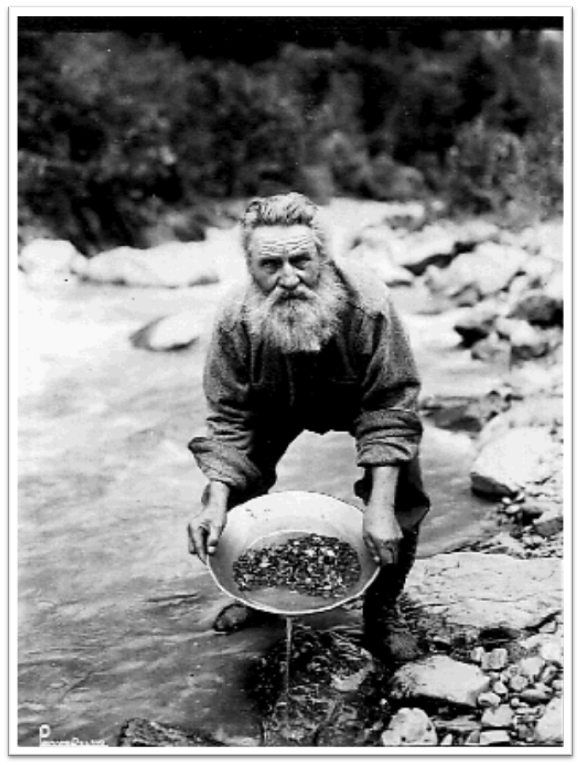
On August 16, 1896, the Skookum party discovered rich gold deposits in Bonanza (Rabbit) Creek, Yukon.  Although Skookum Jim is believed to have made the actual discovery, George Carmack was officially credited for the gold discovery because the actual claim was staked in his name. The group agreed to this because they felt that an Indian’s claim would not be recognized because of the rampant racism of the time.

Well, you can just imagine what happened when word of their discovery got out. The Klondike was suddenly a “destination” for every would-be prospector who ever dreamed of the Big G. The exodus known as the Klondike Gold Rush (Yukon Gold Rush) (Alaskan Gold Rush) (The Gold Rush to End All Gold Rushes) was on.

Together our heroes worked what would become known as Discovery Claim (Look What We Found) and collectively earned nearly a million dollars. Skookum Jim built a home for his wife (the little woman) and daughter (junior) in the Yukon Territory (Tagish First Nation) where he spent the winters trapping, hunting and eating lots of bacon hauled in by others. George and Kate moved to California where he deserted her for another woman. You can’t trust anyone without a nickname.

JULY 8, 1898: SQUEAKY CLEAN IN SKAGWAY

Soapy Smith, “king of the frontier con men” died in a gunfight celebrated as the Shootout on Juneau Wharf on the evening of July 8, 1898. His last words, while not particularly memorable and certainly not effective, were nevertheless appropriate to the situation: “My God, don’t shoot!”

Soapy’s career began soon after the death of his mother in Fort Worth, Texas. He formed a highly disciplined cadre of ne’er-do-wells to work for him, and rose rapidly to criminal super stardom. He built three major evil empires: in Denver, Colorado, from 1886 to 1895; Creede, Colorado in 1892; and Skagway, Alaska, from 1897 to 1898. It was in Skagway that he finally made his dramatic exit.

Starting off with small-time cons such as three-card monte and shell games, he eventually employed the big con that gave him his nickname. On a busy street corner, Smith would go into an ordinary sales pitch extolling the wonders of his soap cakes. But he proceeded to wrap money around the cakes of soap – ones, tens, a hundred dollar bill.   He then wrapped plain paper around them to hide the money.

He mixed the money-wrapped packages with bars containing no money and began selling the soap for a dollar a cake. Immediately, one of his shills would buy a bar, tear it open, and begin waving around the money he had supposedly won.  People began buying soap, usually several bars. Every few minutes, someone would shout that he had won, always a confederate. Eventually, Smith would announce that the hundred-dollar bill remained unpurchased and began auctioning off the remaining soap bars to the highest bidders. Naturally, the only money was “won” by members of the gang.

Smith used this swindle successfully for twenty years. The proceeds from this scam and others gave him the money to pay graft to police, judges, and politicians, and live as a somewhat shady swell until his comeuppance on the Juneau Wharf at the hand of a man he had cheated.


AUGUST 16, 1896: THERE’S BACON IN THEM THAR HILLS

Tagish-Tlingit Packer Keish (Lone Wolf), commonly known as Jim, carried equipment and supplies for early prospectors over the mountain passes from the Alaskan seacoast to the headwaters of the klondike.previewYukon river. He earned the nickname “Skookum” (Chinook for big and strong) for his feat of carrying 156 pounds of bacon over Chilkoot Pass in a single trip. (You don’t pull the mask off the old Lone Ranger, And you don’t mess around with Jim.)

Eventually, tired of of slogging other folk’s bacon, Skookum Jim formed a partnership with his sister Shaaw Tlaa (Kate), his cousin Dawson Charlie (Tagish Charlie), and Kate’s husband George Carmack (no nickname) to go look for the Big G.

On August 16, 1896, the Skookum party discovered rich gold deposits in Bonanza (Rabbit) Creek, Yukon.  Although Skookum Jim is believed to have made the actual discovery, George Carmack was officially credited for the gold discovery because the actual claim was staked in his name. The group agreed to this because they felt that an Indian’s claim would not be recognized because of the rampant racism of the time.

Well, you can just imagine what happened when word of their discovery got out. The Klondike was suddenly a “destination” for every would-be prospector who ever dreamed of the Big G. The exodus known as the Klondike Gold Rush (Yukon Gold Rush) (Alaskan Gold Rush) (The Gold Rush to End All Gold Rushes) was on.

Together our heroes worked what would become known as Discovery Claim (Look What We Found) and collectively earned nearly a million dollars. Skookum Jim built a home for his wife (the little woman) and daughter (junior) in the Yukon Territory (Tagish First Nation) where he spent the winters trapping, hunting and eating lots of bacon hauled in by others. George and Kate moved to California where he deserted her for another woman. You can’t trust anyone without a nickname.


JULY 8, 1898: SQUEAKY CLEAN IN SKAGWAY

Soapy Smith, “king of the frontier con men” died in a gunfight celebrated as the Shootout on Juneau Wharf on the evening of July 8, 1898. His last words, while not particularly memorable and certainly not effective, were nevertheless appropriate to the situation: “My God, don’t shoot!”

Soapy’s career began soon after the death of his mother in Fort Worth, Texas. He formed a highly disciplined cadre of ne’er-do-wells to work for him, and rose rapidly to criminal super stardom. He built three major evil empires: in Denver, Colorado, from 1886 to 1895); Creede, Colorado in 1892; and Skagway, Alaska, from 1897 to 1898. It was in Skagway that he finally made his dramatic exit.

Starting off with small-time cons such as three-card monte and shell games, he eventually employed the big con that gave him his nickname. On a busy street corner, Smith would go into an ordinary sales pitch extolling the wonders of his soap cakes. But he proceeded to wrap money around the cakes of soap – ones, tens, a hundred dollar bill.   He then wrapped plain paper around them to hide the money.

He mixed the money-wrapped packages with bars containing no money and began selling the soap for a dollar a cake. Immediately, one of his shills would buy a bar, tear it open, and begin waving around the money he had supposedly won.  People began buying soap, usually several bars. Every few minutes, someone would shout that he had won, always a confederate. Eventually, Smith would announce that the hundred-dollar bill remained unpurchased and began auctioning off the remaining soap bars to the highest bidders. Naturally, the only money was “won” by members of the gang.

Smith used this swindle successfully for twenty years. The proceeds from this scam and others gave him the money to pay graft to police, judges, and politicians, and live as a somewhat shady swell until his comeuppance on the Juneau Wharf at the hand of a man he had cheated.