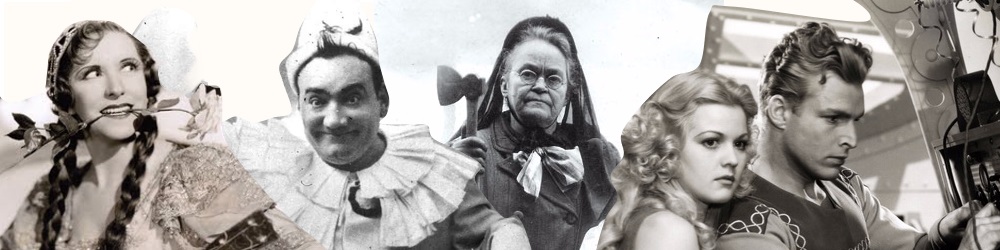
October 13, 1947: Before There Were Muppets

The name Frances Allison probably doesn’t ring a bell with most people. In the days of live programming and test patterns, the radio comedienne and singer became well known to those who huddled around the TV set early evenings to watch the misadventures of the Kuklapolitan Players.  She was better known simply as Fran, and she was one-third of the trio Kukla, Fran and Ollie.

Created by puppeteer Burr Tillstrom, the show got its start as Junior Jamboree locally in Chicago, on October 13, 1947. Renamed Kukla, Fran and Ollie, it began airing nationally on NBC in early 1949.  Although the show, all puppets except for Fran, was originally targeted to children, it was soon watched by more adults than children. It was entirely ad-libbed.

Fran assumed the role of big sister and cheery voice of reason as the puppets engaged each other in life’s little ups and downs. It was a Punch and Judy kind of show but with less slapstick and more character development. Kukla was the nerdy leader of the amateur acting troupe, plucky and earnest, and Ollie (short for Oliver J. Dragon) was his complete opposite, a devilish one-toothed dragon who would roll on his back when sucking up or slam his chin on the stage when annoyed. Joining them were Madame Oglepuss, a retired opera diva; Beulah, a liberated witch; Fletcher Rabbit, a fussy mailman, and several others.

KFOs fan base included Orson Welles, John Steinbeck, Tallulah Bankhead, and Adlai Stevenson among many others.  James Thurber wrote that Tillstrom and the program were “helping to save the sanity of the nation and to improve, if not even to invent, the quality of television.”

Kukla, Fran and Ollie ran for ten years until 1957.  Mister, we could use a Kukla, Fran and Ollie today.

To Swazzle or Not To Swazzle

Kukla and Ollie didn’t come on the scene until the mid-20th century; but puppets has already been around for some 4,000 years. And they come in many different flavors: marionettes, finger puppets, rod puppets. The Tillstrom characters are glove puppets, controlled by a hand inside the puppet.

Punch and Judy are the most famous of this type of puppet. Their first recorded appearance in England was during the Restoration when King Charles II replaced wet blanket Oliver Cromwell and the arts began to thrive. Punch and Judy shows generally feature the fine art of slapstick with characters hitting each other as frequently as possible.

Punch speaks with a distinctive squawk, created by means of a swazzle, an instrument held in the mouth while speaking. Punch’s cackle is deemed so important in Punch and Judy circles (yes, there are Punch and Judy circles) that a non-swazzled Punch is considered no Punch at all.

“I knew Punch. Punch was a friend of mine. Senator, you’re no Punch.”


October 12, 1940: The Suitcase of Death

According to his press agent, Tom Mix, the star of 291 full-length westerns was the real thing – a genuine, actual cowboy hero of the American Wild West; born under a sagebrush in Texas, veteran of Tom Mix BBBnot one but three wars (Spanish-American War, Boxer Rebellion and Boer War); a sheriff in Kansas, a marshal in Oklahoma, a Teddy Roosevelt Rough Rider and a Texas Ranger, to boot.

Seems, however, he was really born in Driftwood, Pennsylvania, deserted the Army in 1902; marched in a Rough Rider parade, and was not quite a lawman but a so-so drum major in the Oklahoma Territorial Cavalry before heading off to Hollywood in 1909. Nevertheless, Mix became one of the top silent-film stars, at one time the highest-paid actor in Hollywood. Unfortunately, like many silent film stars, Mix had a difficult transition to talkies. His squeaky voice didn’t match his beefy cowboy image.

On October 12, 1940, having traded in his faithful horse Tony for a bright yellow Cord Phaeton sports car, Mix was speeding north from Tucson at 80 mph when he failed to notice a sign warning that a bridge was out on the road ahead. The Phaeton swung into a dry wash, and Mix was smacked in the back of the head by one of the heavy aluminum suitcases he was carrying in the convertible’s backseat. The impact killed him instantly.

Today, visitors to the site of the accident (now called the Tom Mix Wash) can see a rather diminutive (2-foot–tall) iron statue of a riderless horse with a rather wordy plaque that reads: “In memory of Tom Mix whose spirit left his body on this spot and whose characterization and portrayals in life served to better fix memories of the Old West in the minds of living men.” And if you visit the Tom Mix Museum in Dewey, Oklahoma, you can view the featured attraction – the dented “Suitcase of Death.”

OCTOBER 11, 1944: All the Presidents’ Dogs

Republicans were on the political attack and the President was angry. At a campaign dinner with the Teamsters union, on this day in 1944, President Franklin D. Roosevelt struck back. It was one thing for the Republicans to spread “malicious falsehoods” about him and Eleanor, but they had stepped over the line, making libelous statements about Fala, his small, black Scottish terrier.

After addressing weighty labor and war issues, Roosevelt blasted Republican critics for circulating a claim that he had accidentally left Fala behind while visiting the Aleutian Islands earlier that year and had, at a taxpayer cost of $20 million, sent a Navy destroyer to pick up the dog. Although Fala slept at the foot of President’s bed and received a bone every morning with Roosevelt’s breakfast tray, Roosevelt accused his critics of attempting to tarnish a defenseless dog’s reputation just to distract Americans from more pressing issues facing the country.

Did Richard Nixon, eight years later to the day, take a page out of the Roosevelt playbook to defend his own honor when critics accused him of accepting improper gifts and making funny with campaign funds? The story broke two months after Nixon’s selection as Dwight D. Eisenhower’s running mate, threatening Nixon’s place on the ticket. Nixon interrupted a whistle-stop tour of the West Coast to fly to Los Angeles for a television and radio broadcast to the nation in which he vowed he would not return one gift: a black-and-white dog who had been named Checkers by his children. But unlike Roosevelt, who took Fala to meetings with heads of state such as Winston Churchill, there is no evidence that Nixon even touched Checkers, let alone fed him.

Just Put Your Lips Together

Harry “Steve” Morgan and his alcoholic sidekick, Eddie, are a couple of ne’er-do-wells crewing a boat for hire on the island of Martinique. to_have_and_have_not_1944_film_posterLife is okay, but World War II is happening all around them, doing a number on the tourist trade and thus their livelihood. Howard Hawks’ film To Have and Have Not which premiered in New York on October 11, 1944, was notable for bringing together what would become one of Hollywood’s hottest couples, Humphrey Bogart and Lauren Bacall.

The film takes the title from the book by Ernest Hemingway but not much else. Hawks was a Hemingway fan but thought this particular book was a “bunch of junk.” Even so, Hemingway worked with Hawks on the screenplay, in which Bogart once again gives up his professed neutrality in the war to thwart the Nazis. The plot is well thickened by the stormy relationship between Bogart and Bacall who plays Slim, a saucy singer in the club where Morgan drinks away his days.

Another notable member of the cast is Hoagy Charmichael who appears as the club piano player, Cricket. He and Bacall perform several Charmichael songs: “How Little We Know,” “Hong Kong Blues,” and “The Rhumba Jumps.” Bacall does her own singing, even though persistent rumors would have a 14-year-old Andy Williams singing for her.

The most memorable take away from the film is one line of dialogue delivered seductively by Bacall: “You know how to whistle, don’t you, Steve? You just put your lips together and . . . blow . . .”

October 10, 1953: Drop Those Crayons and Step Away from the TV

In television, it’s always good to have a gimmick — you know, three doors with prizes behind them, a “Jeanie” in a magic bottle, a talking horse. Saturday mornings and children’s programming were no exceptions. Back in 1953, a couple of producers came up with a dandy gimmick, one that was called the first interactive TV show by Microsoft’s Bill Gates. The program was called Winky Dink and You, with emphasis on the “you.”

Winky Dink was a tousle-haired, saucer-eyed cartoon boy in plaid pants. Each week would feature an adventure with Winky Dink, his dog Woofer, and of course “you.” You would help Winky overcome obstacles using the special Winky Dink kit your parents plunked down fifty cents for. The kit consisted of a magic drawing screen which attached to your TV screen by means of static electricity and a handful of Winky Dink crayons. You would draw a bridge on your TV so Winky could get across a river or a cage to trap a hungry lion. You could also decode secret messages from Winky.

The show ran for four years and Winky was one of the most popular characters of the 50s. Popularity , however, couldn’t save Winky from the fears that x-rays from the TV’s picture tube might fry little kids who were sitting too close.

And then there were the complaints from parents who hadn’t purchased the magic drawing screen and whose kids were drawing on the TV screen with ordinary crayons.

OLD DEVIL MOON

The Treaty on Principles Governing the Activities of States in the Exploration and Use of Outer Space, including the Moon and Other Celestial Bodies (commonly  known as TPGASEUOSMOCB?) is an agreement among nations that forms the basis of international space law. It entered into force on October 10, 1967, and remains in force today (although a recent President tried to pull out of it – “worst treaty ever negotiated, the Moon is taking advantage of us.”).

The treaty expresses the Pollyanna notion that space  is the common

Nations are responsible for any damage done by their own space objects.

heritage of mankind and that the exploration of it shall be done for the benefit of the entire world and the nations therein.  Extra-terrestrial spokesbeings have not as yet weighed in on this declaration; it could prove amusing.

All parties to the treaty have agreed not to place nuclear weapons or any other weapons of mass destruction  in Earth orbit. Nor will they place such forbidden items on the Moon or any other celestial body or otherwise station them in outer space.  In a nod to that merry band of second amendment groupies, the NRA, AK47s, Saturday Night Specials and other weapons of not-quite-mass destruction are not forbidden.

The treaty exclusively limits the use of the Moon and other celestial bodies to peaceful purposes such as church socials,  group sing-alongs, and the jumping of cows.


October 9, 1900: Soda Sipping Ingenuity

Joseph Friedman born on this day in 1900 was one of those inventors who might more correctly be called dabblers, thinking up ideas here and there that usually don’t amount to much (a lighted pencil, for example) although his nephew, a British MP, referred to one particular invention as “arguably the most significant technological achievement of the twentieth century.”

It came about one day in 1937 while Friedman was sitting in his younger brother Albert’s fountain parlor, the Varsity Sweet Shop in San Francisco. Friedman watched his young daughter sitting at the counter as she struggled to drink her soda through a straw that seemed to stay just beyond her reach. He took another paper straw and pushed a screw into it. Then, using dental floss, he wrapped the paper into the screw threads, creating corrugations in the straw. After he removed the screw, the straw would bend easily over the edge of the glass, allowing his daughter to conveniently sip her soda – a  eureka! moment by any standard, the creation of the bendy straw. Friedman hastened to the Patent Office and secured patent #2,094,268 for his invention under the title Drinking Tube. He later filed for two additional U.S. patents and three foreign patents.

His attempts to interest straw manufacturers in his invention were unsuccessful so he eventually produced the straw himself. The Flexible Straw Corporation was incorporated in 1939 in California. However, war intervened and he didn’t make his first sale until 1947 – to a hospital rather than kids sipping sodas.

Columbus Was No Viking

October 9 has been designated as the day to celebrate the true discoverer of America Leif Erikson, son of Erik the Red, son of Thorvald the Blue, son of Knut the Orange, son of Sven the Green and so on.  It is a day to reflect on Scandinavian heritage and, of course, Viking humor.

October 8, 1911: Do You Smile to Tempt a Poet, Mona Lisa

Guillaume Apollinaire was an important poet and critic in early 2oth century France. He was a fan of modern art and is credited with coining the word surrealism. To the French police he was important for another reason. In September 1911, they arrested and jailed him on suspicion of aiding and abetting the theft of the Mona Lisa and a number of Egyptian statuettes from the Louvre. It didn’t help his case that he had once called for the Louvre to be burnt down.

The strange case began early on a Monday morning. Before the Louvre was opened for visitors,the Mona Lisa was stolen by a thief who acted quickly when no guards were around. The theft wasn’t reported until Tuesday; guards who noticed that the painting was missing assumed it had been removed to be photographed. Once museum officials realized the truth, however, all hell broke loose. The Louvre went into lock-down. Police arrived to question the staff, re-enact the crime and dust for fingerprints, a newfangled detection technique. The French border was sealed, departing ships and trains thoroughly searched.

By the time the museum re-opened two weeks later, the theft was on the front page of newspapers around the world. Tips poured in from amateur sleuths, clairvoyants and your everyday would-be experts. Thousands of people lined up at the Louvre just to see the empty spot where the painting had once hung. More it seems than had ever viewed the painting itself which was not widely known outside the art world until it was stolen (Nat King Cole had not yet sung about it). Giving the whole situation a Kafkaesque touch, Franz Kafka was among those who came to view the empty space.

The plot thickened (as plots will) when a mystery man called the Paris-Journal, which was offering a reward for information about the crime. The man showed up at the newspaper’s offices with a small statue, one of several that he claimed to have stolen from the Louvre. The anonymous thief turned out to be a con man named Honoré Joseph Géry Pieret who had a questionable relationship with Apollinaire. Pieret implicated Apollinaire and he was arrested.

Under pressure, Apollinaire, admitted that Pieret had sold the pilfered works to his friend Pablo Picasso. Thinking they might have discovered a dandy crime ring, police arrested Picasso as well. Although Picasso admitted buying the objects, prosecutors couldn’t build a case that either he or Apollinaire had stolen them, much less the Mona Lisa, and both of them went free.

And what happened to the Mona Lisa? Conspiracy theorists tell us it was never found, that museum officials had to hire a noted art forger (Leonard DaVinsky) to paint a replacement. “How about a real smile this time,” they suggested.

Madame Would-Be President

In 1872, Victoria Woodhull, newspaper publisher, stock broker, lobbyist, traveling clairvoyant, became the first woman to run for president in the United States as the candidate of the Equal Rights Party. She had a few things going against her: women couldn’t vote, so she couldn’t even vote for herself; she was not old enough to serve as president; and just a few days before the election, she was arrested on obscenity charges for publishing an account of an adulterous affair.

She didn’t receive any electoral votes, and no one knew her popular vote total since her votes weren’t counted. One gentleman in Texas did publicly admit voting for her.


OCTOBER 7, 1219: I’M-A GONNA GIVE YOU APPLE AND A PLUM AND AN APRICOT OR TWO

Every history buff is familiar with the great Khwarezmian Empire. No? The Khwarezmian Empire under the stewardship of Shah Ala ad-Din Muhammad reached the height of its glory during the early 13th century. It also reached its nadir during the early 13th century. The story of the Khwarezmian Empire is a cautionary tale about the  genghisimportance of peace, friendship and good manners and as such would be uplifting in its own special way were it not for all the bloodshed and gore.

Khwarezmia was a neighbor to Mongolia whose benevolent commander-in-chief was none other than Genghis Khan, who had a bit of a bad reputation throughout the East. Nevertheless Genghis offered an olive branch to the shah by sending him a rather lavish fruit basket with the Hallmark words of friendship: ‘You are the ruler of the land of the rising sun and I of the setting sun.’

Comes a watershed moment in the history of Khwarezmia and possibly the reason it doesn’t trip off our tongues today. Genghis sent a delegation of several hundred men to deliver the fruit basket, but the shah, in an admittedly bad start to a relationship, had them tossed into a dungeon. He kept the fruit basket.

Genghis was irked, but thought maybe the shah misunderstood his intentions (his being a foreigner and all). So he sent three royal ambassadors — two Mongols and a Muslim interpreter –to make inquiries. The shah, in what we can all agree was a doozie of a tactical blunder, had everyone in the first delegation killed, shaved the heads of the two Mongol ambassadors, and sent them back with the head of the interpreter as his answer to Genghis.

Genghis Khan sent no further pleasantries. Instead, he personally visited Khwarezmia, along with thousands of his best cutthroats. Khwarezmian cities fell like dominoes. The shah’s army was decimated and four million Khwarezmians were killed. Genghis even diverted rivers to erase the shah’s birthplace. The empire ceased to exist.

Violence never settles anything. — Genghis Khan

What It Was Was Football

Back in the days when football was still known as that game with the pointy ball, the son of German immigrants became the coach at the Georgia Institute of Technology (known to its friends as Georgia Tech). John Heisman became the first coach in college football to be paid for his services. They got their money’s worth. He led the school to its first national championship and had a career winning percentage of .779 which remains the best in Tech history.

The most memorable — or perhaps infamous — game in Heisman’s Georgia Tech career was played on October 7, 1916, with Tech playing host to Tennessee’s Cumberland University. Talk about a nail biter! The plucky Cumberland Bulldogs got off to a bad start, losing the coin toss.  Georgia Tech returned the Bulldogs’ first punt for a touchdown. Score 7-0 in less than a minute played. Cumberland fumbled on its first play after the following kickoff. 14-0, with just seconds off the clock.   On their next possession, the Bulldogs fumbled once again on their first play.  21-0. It went pretty much the same until the game mercifully ended with a score of 222-0.  A record, of course, that still stands.

In Cumberland’s defense, it should be pointed out that the college, on the verge of bankruptcy, had eliminated its football program at the beginning of the season. The school was forced to field a team (fraternity brothers of the team’s student manager) to avoid a $3,000 forfeit fee.

Heisman, who went on to be elected to the Football Hall of Fame and give his name to the trophy for the outstanding college football player of the year, up by 18 touchdowns at the half, told his players not to relent. “We’re ahead, but you just can’t tell what those Cumberland players have up their sleeves.”

OCTOBER 6, 1962: YOU CAN COME OUT FROM UNDER YOUR SEAT

When one thinks of offbeat film-making, directors Tim Burton and David Lynch come to mind. You’d be hard pressed, however, to find a more offbeat body of cinematic work than that of Tod Browning. Who?, most people would be asking. Tod Browning’s strange macabre films were a pulp-fiction parade of crooks, carnies, lowlifes, deadbeats, wretches, wastrels, scoundrels and, of course, vampires and freaks. And they helped to define the horror film genre.

Browning came to this career honestly. Born in Louisville, Kentrucky, he gave up his comfortable home life at 16 to immerse himself in the world of carnivals, sideshows and circuses. His resume included stints as a Ringling Brothers clown, a barker for the Wild Man of Borneo and the “Living Corpse” for which he was buried alive. He also worked as a magician, dancer and actor before finding his niche as a director of dozens of silent films, including a 10-film collaboration with Lon Chaney. When sound came to the movies, he made his mark with two of his most notable films: Dracula starring Bela Lugosi and Freaks, his master work and the film that destroyed his career. Freaks was so grotesque and unnerving that it was banned in the United Kingdom for three decades. In the U.S., MGM took the film away from Browning and chopped it by almost a third. It performed miserably.

His career on the skids, Browning made a handful of films during the 1930s before “retiring” at the end of the decade. He died on October 6, 1962.

Freak Show

The Halloween season (not to mention the political season) offers the perfect opportunity to indulge in Freaks.  It’s a love triangle set in a bizarre carnival world, featuring Hans, a wealthy dwarf, Cleopatra, a gold-digging trapeze artist, and Hercules, a strongman. Cleopatra and Hercules plan to trick Hans into marrying Cleopatra and then poison him. All the performers are real sideshow “freaks” — Koo Koo, the bird girl, Daisy and Violet, the Siamese twins, Johnny Eck, the Half Boy, Schlitzie, the Pinhead, to name a few, but the beauty of the film is Browning’s portraying them as the real human beings they are. The film remains frightening and grotesque, even after MGM’s “editing.” The deleted scenes were trashed, so it’s likely that no one still living today has seen the original version.


How I Stopped Worrying and Learned to Love the Bomb

Cold war and nuclear fears had been ramping up for years, when President John F. Kennedy took to the tube on October 6, 1961, to suggest that American families build bomb shelters to protect them from atomic fallout when those pesky Communists of the Soviet Union attacked the Homeland with their nuclear missiles. Just a year later, the Cuban Missile Crisis raised the stakes even higher.

While folks like Nelson Rockefeller and Edward Teller were outlining grandiose plans for an enormous network of concrete lined underground fallout shelters to shelter millions of people, civil defense authorities were talking up concrete block basement shelters that could be constructed by home handifolk for a couple hundred bucks. Exactly how much protection they might actually provide was an open question.

Most people calmed down during the mid-1960s,  and fallout shelters pretty much went the way of duck and cover.  They were converted into wine cellars, recreation rooms or mushroom gardens. For others, the fallout shelter notion has been kept alive by internet sites devoted to nuclear hysteria. You can survive a nuclear or dirty bomb attack, shouts one such site.  It will not be the end of the world. But, you must be prepared!

Being prepared naturally involves purchasing a fallout shelter from one of the many firms that still market them — Acme Survival Shelters, Hardened Structures Inc., Safecastle.  Taking it over the top is a company called Zombie Gear whose motto is Be prepared for anything.

OCTOBER 5, 1983: BURPING IN POLITE COMPANY

Noted American businessman and inventor, Earl Silas Tupper died on October 5, 1983. He was buried in a 100-gallon Tupperware container whose lid was “burped”to get an airtight seal before being lowered into the ground. Thousands paid their respect at a memorial Tupperware Party held earlier.

For indeed this was the man who invented and gave his name to Tupperware, a line of plastic containers in an almost infinite array of shapes and sizes that changed the way Americans stored their food. Tupper invented the plasticware back in the late 30s, but it didn’t really start worming its way into every household until the 50s when Tupper introduced his ingenious and infamous marketing strategy, the Tupperware Party. This clever gambit gave the so-called little woman the opportunity to earn an income without leaving home and to simultaneously annoy friends and relatives.

tupper1

The Art of the Robbery

The Dalton Gang terrorized the Old West from 1890 to 1892, robbing banks and trains, and generally making a nuisance of themselves. They were sometimes called the Dalton Brothers but only three of the five were actually brothers. So to be technically correct you’d have to call them the Dalton Brothers and Others. Gang is easier.

Their abrupt demise on October 5, 1892, suggests they were not the brightest brother act on the outlaw circuit. On that day, someone came up with the clever idea that since there were five of them and two banks in the town of Coffeyville, Kansas,, they could rob both of them at the same time. At one of the banks, an employee convinced them that the safe was on a time lock and couldn’t be opened by anybody for another 45 minutes. The boys bought that story and waited patiently.

When the safe was finally opened, the boys scooped up their ill-gotten gains and exited the bank, only to find themselves facing the entire Coffeyville population, armed to the teeth. In the ensuing shootout, four of the gang were killed. One, a Dalton brother, was shot 23 times, but survived. He was sentenced to life in prison. He wrote a book, When the Daltons Rode, which was pretty much an over the top fabrication. It could have been called The Art of the Robbery.

He Should have Written the Book

A hundred years later, Jim Bakker was far more successful than the Dalton Boys.  He stole $158 million from townspeople all over the country without so much as brandishing a gun.  But the televangelist got his comeuppance too.  He was convicted of fraud and conspiracy on October 5, 1989, and spent the next 4 1/2 years in prison.

OCTOBER 4, 1582: TEMPUS FUGIT, REALLY FUGIT

In 1582, the Gregorian Calendar was adopted for the first time with Poland, Portugal and Spain leading the way. The calendar was implemented by and named after Pope Gregory XIII . He didn’t like the Julian Calendar in use at the time because Easter kept creeping back to an earlier time of the year so that eventually it would fall in the middle of winter, even on Christmas Day (which wasn’t creeping) and really confuse Christians.

Jews didn’t care a whole lot because they were already up to year 5303. Muslims were back at 1001. The Chinese were celebrating 4278 (Year of the Horse). Certain scientists were way ahead of everyone else at 11582, having added 10,000 years to the current year to make the starting point the beginning of the human era (like they knew what day that was) instead of the birth of Jesus who they say wasn’t born in 1 BC but in 4 BC (lied about his age) and wasn’t born on his birthday (Christmas).

But back to the Christians for whom it was October 4, 1582, and also for whom tomorrow would be October 15, because Pope Gregory took ten days right out of the calendar to put Easter back where it had been when he was a boy.  calendarWell, you can just imagine how upset folks who had birthdays or special anniversaries or doctors’ appointments between October 5 and 14 were.

Some people just refused to use the new calendar. Many European countries fell into line later in the year. But many Protestant countries thought the new calendar was part of a Catholic plot . Britain (and its colonies) didn’t come along until 1752. The Greeks didn’t start using it until 1923. And a few malcontent members of the U.S. Congress are still demanding a recount.

Calling All Crimestoppers

An all-American, tough but smart, police detective arrived on the crime scene on October 4, 1931. Chester Gould’s Dick Tracy comic strip first appeared in the Detroit Mirror. The strip continues to run to this day, although drawn by others since Gould departed for that precinct in the sky back in 1985.

Along with police procedure and gadgets such as the two-way wrist radio, the strip featured a bevy of colorful characters. There’s Tess Trueheart, Tracy’s lady friend and eventual wife, his adopted son Junior and his wife Moon Maid (an alien), their daughter Honey Moon, Junior’s second wife Sparkle Plenty and her parents B. O. and Gravel Gertie. An almost endless list of villains: Abner Kadaver, Art Dekko, Breathless Mahoney, Cueball, Flattop, Gruesome, Junky Doolb (blood backwards), Littleface Finny, the Mole, Mrs. Chin Chillar, Mumbles and Pruneface.

Faraway Places With Strange Sounding Names

The Trojan Horse dates way back to the war between the Trojans and the Greeks in a thousand or so BC. Having been unable to topple Troy, the Greeks pretended to sail away, leaving the large wooden beast as a going away gift. But weren’t there a gaggle of Greeks hiding inside. Laocoon, a Trojan priest warned the others that he feared the Greeks bearing gifts. Perhaps if he had been more precise, counseling the Trojans to beware a gift bearing Greeks or not to look a gift horse in the mouth or you might see a Greek looking back at you, the outcome may have been different. But it wasn’t.

The Trojan Horse became a symbol of Greek might and was revered through the ages, resting at its home in the Trojan Horse National Park. Inexplicably, the Greeks tired of it and it was eventually converted to a condo. The horse which had once been filled with ancient Greek warriors came to house only five Greeks, the Thermopolis brothers — Dmitri, Ergo, Aristotle, Zorba and Smitty.