OCTOBER 23, 4004 BC: AND ON THE 29TH HE RESTED

Those who predict the imminent end of the world display a certain amount of chutzpah if not foolhardiness (such as Micheal Stifel, October 19 and William Miller, October 22).  It probably takes even more of those qualities to identify the exact date of the beginning of the world, but didn’t James Ussher (1581-1656) do just that.

As Archbishop of Armagh, Primate of All Ireland, and Vice-Chancellor of Trinity College in Dublin, Ussher was rather highly regarded in his day as both churchman and scholar. He was not your average man on the street (“Tell me sir, when did the world begin?”) making bold proclamations. And evidently he didn’t just pull important dates out of a hat. His declarations were based on an intricate correlation of Middle Eastern and Mediterranean histories and Holy writ, incorporated into an authorized 1701 version of the Bible, or so he explained. And they were accepted, regarded without question as if they were the Bible itself.

Through the aforementioned methods, Ussher established that the first day of creation was Sunday, October 23, 4004 BC. He didn’t give a time. On a roll, Ussher calculated the dates of other biblical events, concluding, for example, that Adam and Eve were driven from Paradise on Monday, November 10 of that same year BC. (It took them less than three weeks to get in trouble with God.) And Noah docked his ark on Mt Ararat on May 5, 2348 BC. That was a Wednesday if you were wondering.


Late-breaking news: Dr. John Lightfoot, of Cambridge, an Ussher contemporary, declared in a bold bid for oneupsmanship, that his most profound and exhaustive study of the Scriptures, showed that “heaven and earth, centre and circumference, were created all together, in the same instant, and clouds full of water,” and that “this work took place and man was created by the Trinity on October 23, 4004 B.C., at nine o’clock in the morning.”


Okay Lightfoot, Take This

Wretched Richard will jump out onto the proverbial limb and give you a few more dates you might be wondering about.

January 29, 3995 BC, 8 a.m. — God creates children.

March 12, 3906 BC, 5:00 p.m.  — Shouting something about his damn sheep, Cain slays Abel.

September 3, 3522 BC, 6:00 p.m. — God creates Facebook, then decides the world isn’t ready for it.

October 2, 2901 BC, 4:00 p.m.  God, having been in a bad mood all day, turns Lot’s wife into a pillar of salt.

June 7, 2549 BC 11:15 a.m.  God once again in a creative mood creates marijuana.

1:30 p.m. –Later that day, God, thoroughly annoyed with all his creations except his latest, instructs Noah to build an ark because he, God, is going to destroy the world.

August 14, 2371 BC,  5:30 a.m. — Methuselah finally turns his toes up after 969 years on this good earth.

July 7, 1425 BC, 8:30 p.m. — God gives Moses the Ten Commandments.

March 1, 2 AD, 10:15 a.m. — God creates an amusing diversion featuring Christians and lions.

July 2, 1854 AD, 11:45 p.m. — After a few too many martinis, God creates Republicans.

November 9, 2016, 2:45 a.m. — Feeling rather wicked, God makes Donald Trump president.

November 5, 2024, 10 a.m.  — A big grin spreads across God’s face . . .


October 22, 1844: The Great Disappointment

One would think they’d learn a lesson from the many prognosticators who predicted the end of the world only to end up with egg on their faces. But no, there seems to be an endless queue of folks wanting to give it a go. William Miller might well be the most famous (or infamous) of these Jeremiahs. He reached the front of the line in the 1840s.

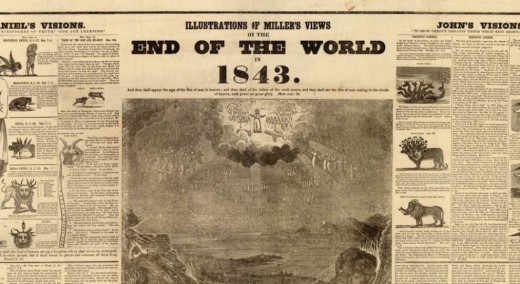
Miller preached his doomsday story to a large group of followers known, strangely enough, as Millerites. At least Miller didn’t get as specific as many others who predicted the exact date and time of the finale. Miller hedged his bets a bit, calling for the long-awaited Second Coming and the great big beautiful bonfire to take place sometime between March of 1843 and March of 1844. He publicized the event with posters, speeches, pamphlets and tweets (no, strike that last one). As a result, he convinced 100,000 true believers to unload all their stuff and head up to the mountains to usher in the Apocalypse.

Well, they waited. And waited. 1843 became 1844. March came in like a lion and went out like a lamb. Miller recalculated and set a new date for the final comeuppance: April 18. April showers brought May flowers, but not much else. Did our plucky prophet of doom fold up his tent? No way. Another recalculation, another date. October 22, and you can take that to the bank. The Millerites, who by this time should have been used to having their expectations dashed, went once more to the mountains.

October 22, 1844: Oh somewhere in this favored land, the sun is shining bright, the band is playing somewhere, and somewhere hearts are light, and somewhere men are laughing, and somewhere children shout; but there is no joy on the mountain — William Miller has struck out.

In some religious circles, October 22, 1844, is known as the Great Disappointment.

October 21, 2011: Was It Big and Slimy?

They lurk in the watery depths — fearsome creatures beyond imagination created by radioactivity from atomic bomb tests, scientific experimentation, or man’s inhumanity to man. Like the Creature from the Black Lagoon, Orca, or IT Came from beneath the Sea, most of us have only seen them in movies, but we know they’re down there and we know they wish us harm. Now after an October 21, 2011, discovery we can add to the list of terrors keeping us awake at night, Attack of the Giant Xenophyphores.

These guys are way down there — more than 6 miles in the depths of the Mariana Trench.  And they weren’t discovered by a couple of drunk fishermen or something. They were discovered by a crack team of scientists from the Scripps Institute of Oceanography in La Jolla, California.

They may not be gigantic in absolute terms, but for single-celled animals — think amoebas — these guys are mammoth at 20 cm. in diameter. There are thousands of them, lying about on the ocean floor, sucking in food from the mud around them, secreting slimy (and most likely deadly) goo all over the place and attaching bits of dead things to themselves (in fact their scientific name means “bearer of foreign bodies”).

Don’t go near the water.

Beware the Frubious Sea-Bishop

The Elizabethan era was a time of fertile travel, abounding in discoveries that required very little exaggeration to carry them into the realm of the marvelous. And, unlike today, folks would clamor to see anything that was strange, fantastic, beyond belief. This taste for the wonderful was catered to by adventurers returning from voyages with tales of bizarre creatures, monsters even.

sea-monkSure, many of the “monsters” would not seem at all unusual today – a shark or an octopus in the possession of a fast-talking charlatan could easily separate country folk from their money. In fact inland people who had never experienced the sea were thought capable of believing just about anything.

Narrations by sixteenth century authors each attempted to outdo each other describing the oddities taken from the sea. One account from 1632, described a creature that, although a fish, bore a striking resemblance to a bishop. And there were drawings to prove its existence. The author pointed out that this was meant to assure us that bishops were not confined to land alone, but that the sea also has the advantage of their blessed presence. This particular sea-bishop was taken before the king and after a conversation expressed his wish to be returned to his own element. The king so ordered and the sea-bishop was cast back into the sea.

No sooner had the creature disappeared than another author in the best tradition of oneupsmanship (and perhaps a bow to evolution) showed us that any sea that possessed a sea-bishop must certainly have a sea-monk!


October 20, 1928: And a Pot for Every Chicken

The political silly season is at its height, full of promises and a few threats.  A burning question: will some wag pull out the proverbial chicken in every pot to ridicule another candidate’s over-the-top tax cut (my tax cut’s bigger than yours). The chicken in the pot is, of course, an allusion to a much earlier presidential campaign in which Republicans running Herbert Hoover promised a chicken for every pot and a car in every garage. Although the statement has been hung like an albatross around poor Hoover’s neck, he never actually said it himself; it appeared in a Republican party flyer on October 20, 1928.

chickenpouleThe Republicans did not coin the phrase, however. That honor goes to King Henry the IV of France (Republicans quoting a Frenchman, my, my) who some 400 years earlier said: “Je veux qu’il ait si pauvere paysan en mon royaume qu’il n’ait tous les diamaches sa poule au pot.” Translation: “I wish that there would not be a peasant so poor in all my realm who would not have a chicken in his pot every Sunday.” A little wordy, but he was the king. Le bon roi Henri came to be known as le Roi de la poule au pot or King of the Chicken in the Pot. Much as the 1928 presidential candidate came to be known as the Hoover of the Chicken in the Pot. This was probably the result of his opponent Al Smith continually ridiculing the statement while holding up a rubber chicken (Okay, he actually held up a copy of the flyer, but a rubber chicken would have been better.)

As so often happens in campaigns, the statement got inflated to a chicken, a bunch of vegetables, two cars in every garage, a gasoline card and silk stockings.

Hoover’s actual campaign slogans were the rather uninspiring “Who but Hoover” and “Hoover and Happiness Or Smith And Soup Houses,” in spite of which he won the election. During his single term in office, the Great Depression got underway, an irony Hoover probably did not appreciate.

Hoover died on October 20, 1964, and was buried with a rubber chicken (actually that’s an unsubstantiated rumor).


lbj3

OCTOBER 19, 1533: I’M ALWAYS CALCULATING STIFELS

Michael Stifel (or Steifel or Styfel) was a German mathematician, priest and monk. He was also a big fan of Martin Luther, publishing a poem called On the Christian, righteous doctrine of Doctor Martin Luther (not really in the same neighborhood as Keats or Shelley). But what he came to be most villagersfamous for was a verse of a different color.

The German saying “to talk a Stiefel” or “to calculate a Stiefel” meaning to say or calculate nonsense can be traced right back to  Michael Stifel – all because of one particular calculation our mathematician/monk made back in 1532. A few years earlier, Stifel had become minister in quiet Lochau, where the tranquil life allowed him to dabble in mathematical studies. His particular interest was in one that he called “Wortrechnung” (word calculation), studying the statistical properties of letters and words in the bible.

As a result of these studies he published a book (publishing seems to be the downfall of many a good person), A Book of Arithmetic about the AntiChrist. A Revelation in the Revelation. Well, this had best seller written all over it. It had the sort of great hook a book needs to grab audiences – the rapidly approaching Judgment Day. To be specific – which Michael was – the world would end on October 19, 1533, at 8 a.m., German Standard Time.

One would think that a would-be Nostradamus – especially one with a statistical bent – would calculate the risk/reward of predicting the end of the world. If you’re wrong, there’s a pretty large helping of egg on your face, and if you’re right, there’s no one around to congratulate you. As you might guess, Stifel fell into first category.

The townsfolk who, believing his prediction, did not plant crops or store foods and even burned their homes and possessions on the appointed day, were not amused. Stifel had to be taken into protective custody with the villagers chanting death threats outside his cell (visualize the final scenes of Frankenstein). He made no further predictions.

Bad Bad John

England’s King John, who has no number because he was the only royal John, reigned from 1199 until his death on October 19, 1216. Most historian’s agree he was a so-so monarch who had his share of disagreeable traits — belligerence, pettiness, narcissism, cruelty and strange orange hair.

Perhaps John suffered by comparison to his brother Richard I (although he was not I until Richard II came along a century or two later). Mom (Eleanor of Aquitane) always liked Richard best. Richard was tall and lionhearted; John was short and weasely.

Historians began picking on John almost immediately. And then the writers chimed in. Shakespeare gave him a bad rep, Sir Walter Scott goosed it along in Ivanhoe, and Howard Pyle really skewered him in The Merry Adventures of Robin Hood, portraying him as the unmerriest of villains who, along with his loathsome pal the Sheriff of Nottingham, doubled down on atrocity. Even A. A. Milne mostly known for warmth and fuzziness got his licks in with the poem King John’s Christmas:

King John was not a good man—
He had his little ways.
And sometimes no one spoke to him
For days and days and days.
And men who came across him,
When walking in the town,
Gave him a supercilious stare,
Or passed with noses in the air—
And bad King John stood dumbly there,
Blushing beneath his crown.

OCTOBER 18, 1963: SPACE, THE FELINE FRONTIER

The story of cats in space is a dramatic tale indeed. It begins in an unlikely place with the 1957 Soviet launch of Sputnik 2, carrying of all felicettethings a dog named Laika. Laika was a stray found on the streets of Moscow who could have been the star of a dandy rags-to-riches shaggy dog story, except that things didn’t go all that well and the pooch perished under mysterious circumstances.

This was viewed as an early skirmish in the superpower space race to which NASA responded by sending a chimp into space and successfully returning him.

The French meanwhile had been plotting their own animal space probe. Fifteen cats had been chosen to undergo extensive training involving centrifuges, compression chambers and other medieval torture devices for a space mission in which the French would prove that they belonged at the table with the big guys and a cat would demonstrate to its fanciers everywhere that cats were superior to dogs in yet another way.

A pretty black and white Parisian chatte was eventually selected for the mission, because she was the only one who hadn’t become overweight during training, something to do with croissants most likely. On October 18, 1963, at 8:09 am, Chatte Félicette boarded a Véronique AGI 47 rocket at a base in the Algerian Sahara Desert and was blasted 97 miles into space. Fifteen minutes later, she parachuted safely to earth and pussycat immortality. Voilà!

ANOTHER CAT CAME BACK

In 1813, Londoners were amazed to see, floating down the Thames River toward London Bridge, a large bowl with a passenger on board — a tortoiseshell cat, quite relaxed and seemingly enjoying the journey. As she approached the fall, onlookers were certain she would be overturned and thrown into the water. But she stayed seated and, to loud cheers, deftly shot the center arch with as much dexterity as a white water kayaker.

A young boy in a boat having observed this feat rowed toward her and lifted her into his boat. He discovered a parchment scroll hanging from a collar around her neck. The note stated that if she should reach London safely she should be taken to a Mrs. Clarke in Highstreet who would reward the person delivering the cat. The boy conveyed the cat to Mrs. Clarke who gave him half a crown. Mrs. Clarke was well aware of the circumstances of the cat’s arrival, the voyage having been the result of a wager between two Richmond gentlemen. With precious little to do, it would seem.

OCTOBER 17, 1814: THIS ROUND’S ON ME

An unfortunate incident involving beer – aged porter to be precise – occurred in London back in 1814.

The central London parish of St Giles was, as slums go, one of the slummiest.  Although it has since been rather gentrified with theaters, Covent Garden and the British Museum nearby, it was then mostly squalid housing where immigrants crowded into its ramshackle buildings, often more than one family to a room. Near one end of the parish stood the massive Meux and Company Horse Shoe Brewery, its giant vats filled with thousands of gallons of aging porter.

One particular vat which held over 135,000 gallons had seen better days. Like the shanties surrounding the brewery, it suffered from age, and on October 17 it succumbed, bursting and letting loose enough precious liquid to give all of St. Giles and then some a pretty good buzz, although the fury with which it was released made tippling difficult. Like giant shaken cans of beer, nearby vats ruptured and joined the game of dominoes.

Within minutes the brick structure that was the Meux and Company Horse Shoe Brewery was breached, and the deluge roared down Tottenham Court Road, flinging aside or burying in debris anyone or anything in its path.

Homes caved in. A busy pub crumbled, burying a buxom barmaid and her ogling patrons for several hours.  All in all, nine people were killed by drink that day. Those who didn’t lose their lives lost everything they owned to evil alcohol. Soon after the suds subsided, survivors rushed in to save what they could of the precious brew, collecting one or more for the road in pots and cans.

St. Giles smelled like the morning after a particular robust party for weeks. The brewery was later taken to court over the accident, but they pleaded an “Act of God,” and the judge and jury bought it, leaving them blameless. The brewery even received reparations from the government.  God, it would seem, has a soft spot for brewers.

I am a firm believer in the people. If given the truth, they can be depended upon to meet any national crisis. The great point is to bring them the real facts, and beer. ~ Abraham Lincoln


OCTOBER 16, 1869: ONE MORE GIANT FOR MANKIND

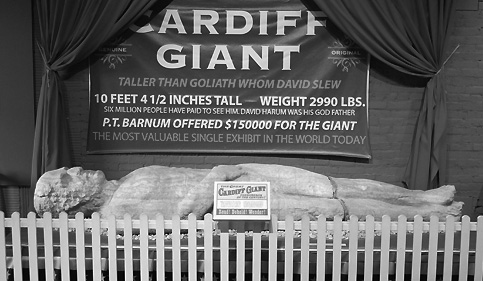
In 1869, George Hull, a New York tobacconist, and his cousin, William Newell, a farmer, hired two men to dig a well on Newell’s farm. As theycardiff_ were digging, one of the men suddenly shouted: “I declare, some old Indian has been buried here!” ‘I declare’ is a tad short of ‘Eureka!’ but it got the point across; what the two men had discovered was, according to Hull, a perfectly preserved ten-foot-plus petrified giant.

Noting the incredible scientific implications of this discovery, Hull and Newell immediately did the scientific thing. They set up a tent over the giant and charged 25 cents for people who wanted to see it. Two days later, thanks to public demand, the price doubled to 50 cents. And the crowds doubled along with the price. Everyone wanted to see the amazing, colossal Cardiff Giant, as the stony corpse had come to be called.

Archaeological scholars stood at the back of the throngs shouting “fake, fake” but folks ignored them (folks generally ignore archaeologists). And they ignored the geologists who said there was no earthly reason to dig a well in the exact spot the giant had been found. A Yale palaeontologist, getting really worked up, called it “a most decided humbug.” Some Christian fundamentalists and preachers, came to the giant’s defense, however, citing some positive reviews in Genesis.  And we all know there were some mighty big people in the Bible.

Eventually, Hull sold his part-interest for $23,000 (close to half a million today) to a syndicate in Syracuse, New York, for exhibition. The giant continued to draw amazing crowds, so much so that P. T. Barnum offered $50,000 for the giant. When the syndicate turned him down, he hired an unscrupulous sculptor to create a plaster replica. Barnum put his giant on display in New York, claiming that his was the true giant, and that the Cardiff Giant was an impostor.

Then in December, Hull confessed to the press that he had faked the Cardiff Giant (he already had his $23,000). It had been carved out of a block of gypsum then treated with stains and acids to make the giant appear to be old and weathered.  (It had been whacked with steel knitting needles embedded in a board to simulate pores.) And the following February, both giants were declared fakes in court.

Epilogue: An Iowa publisher later bought the Cardiff Giant to use as a conversation piece in his basement rumpus room. In 1947 he sold it to the Farmers’ Museum in Cooperstown, New York, where it is still on display.


OCTOBER 15, 1954: I HAVE PEOPLE TO FETCH MY STICKS

Long before he debuted in his own television show on October 15, 1954, Rin Tin Tin had become an international celebrity. It was as good a rags-to-riches story as Hollywood could churn out. He was rescued rin-tin-tin_from a World War I battlefield by an American soldier who trained him to be an actor upon returning home. He starred in several silent films, becoming an overnight sensation and going on to appear in another two dozen films before his death in 1932.

Rinty (as he was known to his friends) was responsible for a great surge in German Shepherds as pets. The popularity of his films helped make Warner Brothers a major studio and pushed a guy named Darryl F. Zanuck to success as a producer.

During the following years Rin Tin Tin Jr. and Rin Tin Tin III kept the Rin Tin Tin legacy alive in film and on the radio. Rin Tin Tin IV was slated to take the franchise to television in The Adventures of Rin Tin Tin, but he flunked his screen test and was shamefully replaced by an upstart poseur named Flame.

The TV series featured an orphan named Rusty who was being raised by soldiers at a cavalry post known as Fort Apache.  Rin Tin Tin was the kid’s dog. It was a low budget affair, filmed on sets used for other productions with actors frequently called upon to play several soldiers, Apaches, and desperadoes in a single episode. Although it was children’s programming, you might not guess that by the lofty literary titles of many episodes: Rin Tin Tin Meets Shakespeare, Rin Tin Tin and the Barber of Seville, Rin Tin Tin and the Ancient Mariner, Rin Tin Tin and the Connecticut Yankee.

Meanwhile, IV stayed at home on his ranch, fooling visitors into believing he was actually a TV star (and perhaps contemplating a run for President).

Rated P. G.

“Freddie experienced the sort of abysmal soul-sadness which afflicts one of Tolstoy’s Russian peasants when, after putting in a heavy day’s work strangling his father, beating his wife, and dropping the baby into the city’s reservoir, he turns to the cupboards, only to find the vodka bottle wodehouseempty.” One line from someone who had a great knack for them, which he displayed in over 300 stories, 90 books, 30 plays and musicals, and 20 film scripts. Comic novelist P.G. Wodehouse, creator of Jeeves the butler, was born on this day in 1881 in Surrey, England.

He had the look of one who had drunk the cup of life and found a dead beetle at the bottom.

Mike nodded. A sombre nod. The nod Napoleon might have given if somebody had met him in 1812 and said, “So, you’re back from Moscow, eh?”

I could see that, if not actually disgruntled, he was far from being gruntled.

She looked as if she had been poured into her clothes and had forgotten to say ‘when.’

The fascination of shooting as a sport depends almost wholly on whether you are at the right or wrong end of the gun.

Every author really wants to have letters printed in the papers. Unable to make the grade, he drops down a rung of the ladder and writes novels.

It was my Uncle George who discovered that alcohol was a food well in advance of modern medical thought.

And she’s got brains enough for two, which is the exact quantity the girl who marries you will need.

At the age of eleven or thereabouts women acquire a poise and an ability to handle difficult situations which a man, if he is lucky, manages to achieve somewhere in the later seventies.

October 14, 1790: If It’s Thursday, This Must Be Pitcairn

When British ships arrived at Pitcairn Island in 1814, two men paddled out in canoes to meet them. Both spoke English well, impressing the officers and men of the ships with their refinement as they met on deck. Their civilized demeanor persuaded the ships’ captains that  the mutineers from the Bounty, had created a proper society (after alcoholism, murder and disease had killed most of them off), and did not merit prosecution for the takeover.

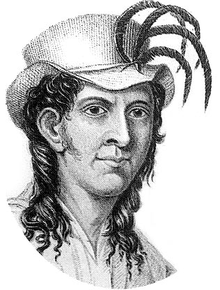
One of the two men was Thursday October Christian, son of Fletcher Christian and his Tahitian wife Mauatua. Fletcher, you will remember, was the ringleader of the mutiny that took place on the Bounty‘s voyage to Tahiti for breadfruit. Captain Philip Pipon, commander of one of the British ships, described Fletcher’s son Thursday as being “about twenty five years of age, a tall fine young man about six feet high, with dark black hair, and a countenance extremely open and interesting. He wore no clothes except a piece of cloth round his loins, a straw hat ornamented with black cock’s feathers, and occasionally a peacock’s, nearly similar to that worn by the Spaniards in South America, though smaller.”

Thursday October Christian, born on October 14, 1790, was the first child born on the Pitcairn Islands after the mutineers took refuge there. Born on a Thursday in October, he was given his name because his father wanted him to have “no name that will remind me of England,” forgetting perhaps that there are both Thursdays and Octobers in England. Captain Pipon referred to young Thursday as Friday October Christian,” because the Bounty had crossed the international date line going eastward, but the mutineers had somehow failed to adjust their calendars for this. The mutineers were living on a tropical island where everyone was running around naked. Is it any surprise that they didn’t know what day it was – or care?

As soon as Captain Pipon left, Thursday went back to his original name, not wanting to be confused with that other character from a story set on a tropical island.