JUNE 23, 1626: ANOTHER FISH STORY

A codfish was brought to market in Cambridge, England, on this day in 1626. Codfish were probably brought to market every day in 1626 – and in 1627 and throughout the centuries, but this was a rather unusual fish. Upon being opened, it was found to have a book in its stomach.  There are plenty of  fish in books, but how many books in fish are there?

The book had seen better days, but it remained readable. It had been written by one John Frith and included several essays on religious subjects evidently written by Frith when in prison. Oddly enough, he had been confined in a fish cellar where many of his fellow prisoners died from smelling too much salt cod. Frith got past the salt cod but was eventually taken to the Tower, and in 1533 was burned at the stake for unacceptable religious beliefs.  How he got his essays – which were no doubt inflammatory – into that cod is still a mystery.

The folks at Cambridge reprinted the work, which had been totally forgotten for a hundred years until it turned up inside the fish.  The reprint was called Vox Piscis, which would translate to “voice of the fish.”  There’s definitely a morale booster for writers here:  When Random House says no, go find yourself a big fish.

JUNE 22, 1774: RUN SILENT, RUN DEEP

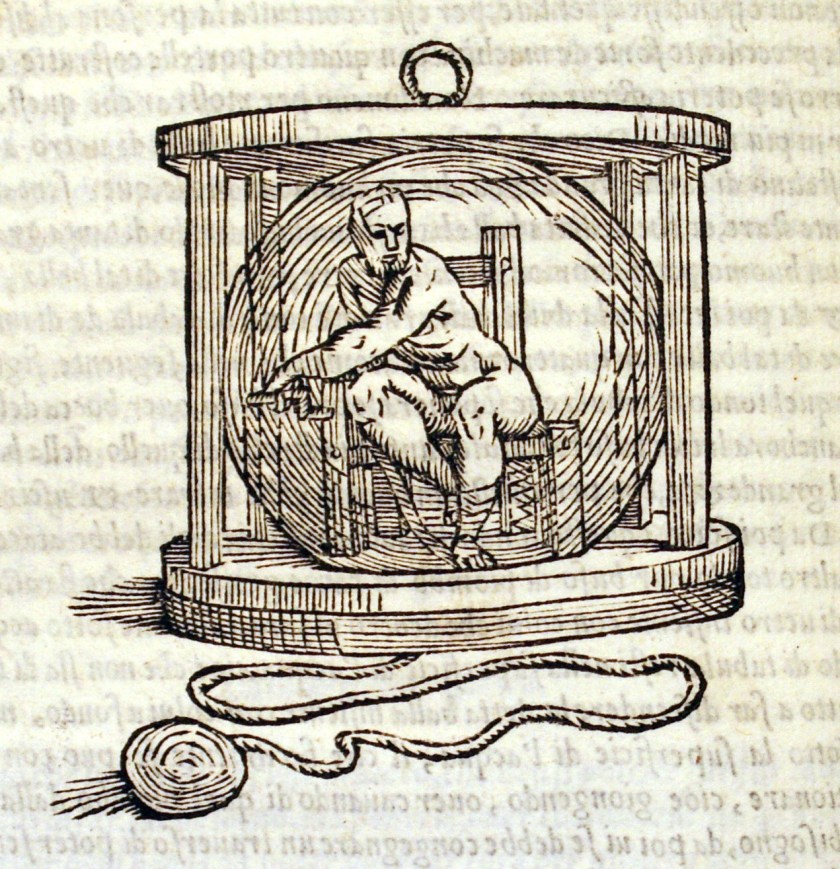
In 1774, John Day, an ignorant but ingenious English millwright, fancied that he had devised a plan by which he could remain completely underwater at any depth for at least 24 hours. The contraption he had devised for this feat would afford him a degree of comfort until, at his leisure, he returned to the surface.  Day could think of no useful purpose for his invention other than making money by wagering on his feat. He therefore contacted a local gambler who agreed to furnish funds for the construction of Day’s diving machine for a lion’s share of all the bets gained by it.

If nothing else, Day’s plan had the virtue of simplicity. His machine was merely a watertight box attached to a weight by means of screws. After entering the box and sealing the entrance, the vessel would be sunk and would remain underwater until, at the designated time, Day would remove the screws and he and the box would rise to the surface.

The machine was finished, bets were taken, and everyone convened at a designated spot on Plymouth Sound where the water was 132 feet deep. Day entered the compartment with a comfortable chair, a watch, some biscuits, a bottle of water and a candle.  Perhaps had he taken a basic science book with him — it may have enlightened him (if he read fast enough) but at that point it wouldn’t have helped.   The box was tightly closed and sunk 132 feet to the bottom from where neither it nor the unfortunate John Day ever arose.


JUNE 21, 1947: PLAN 10 FROM OUTER SPACE

In 1947, shortly after noon, Harold A. Dahl, who had spent the day scavenging for drifting logs in Puget Sound, near Tacoma, Washington, saw something. It wasn’t a drifting log.  Actually it was four or five somethings. They were shaped like doughnuts (he had already eaten, so it wasn’t his stomach’s imagination, and none of the objects were glazed or chocolate-covered).  They were overhead.  And they were flying in formation.

Dahl described these curiosities in detail. He said he could see blue sky through the holes in the center of the discs, and that there were portholes lining the inside of the ring. One of the craft appeared to be having engine trouble (if indeed it had an engine). A second doughnut came alongside, then retreated. At this point, things began being tossed out through the inner portholes of the troubled doughnut. Stuff began raining on and hitting the little boat, damaging its windshield, the wheel house and a light fixture, wounding Dahl’s son and killing his dog Shep.

The next morning, even though Dahl had not publicly described the incident, a mysterious man in black visited Dahl. He was driving a new black 1947 Buick and had the air of a government official. “I know a great deal more about this experience of yours than you will want to believe,” the man said cryptically (and rather dramatically). He also made not-so-subtle threats that Dahl’s family might be in danger. As a result, Dahl later claimed the UFO sighting was a hoax, but even later suggested he had claimed it was a hoax to avoid bringing harm to his family. His son, however, claimed not to have been on the boat.  And Dahl’s dog wasn’t really named Shep.

None of this is fooling conspiracy theorists who have suggested one great big cover-up which they follow directly to the executive boardroom of none other than Dunkin’ Donuts.


JUNE 20, 1890: PAINTING OUTSIDE THE LINES

Oscar Wilde’s only published novel, The Picture of Dorian Gray, appeared as the lead story in Lippincott’s Monthly Magazine in the July 1890 issue, released on June 20.

In the novel, the title character is the subject of a painting by artist Basil Hallward. Basil is impressed by Dorian’s beauty and becomes infatuated with him. Dorian is also infatuated by Dorian’s beauty, especially the beauty in the painting, and more than annoyed that the man in the painting will remain the same, while Dorian himself will get old and wrinkled and forget people’s names and so forth. Obviously the only answer is to put his soul on the market, which he does, with the purchaser (you know who) promising that the painting will age while Dorian himself stays the same.

In an apparent effort to make the painting age as quickly as possible, Dorian embarks on a life of debauchery, and each sin takes its toll on the portrait.

The book had about the same effect on British critics as Dorian’s naughtiness had on the painting. “Vulgar”, “unclean”, “poisonous” and “discreditable” were a few of their nicer comments. “A tale spawned from the leprous literature of the French Decadents – a poisonous book, the atmosphere of which is heavy with the mephitic odours of moral and spiritual putrefaction,” said the Daily Chronicle.   And this was after Wilde’s editor had already deleted a lot of “objectionable” text before it made its first appearance in Lippincott’s, eliminating titillating bits of debauchery and elements of homosexuality.

Deciding that the novel contained things that might upset an innocent woman, the editor cut further, removing many more decadent passages before the book was published in 1891.

MAN THE TOMATOES, FULL SPEED AHEAD

It’s a battlefield out there. Each morning I prepare my weaponry and fortify myself to better face the enemy.  Then it’s out into the morning mist, bellying my way through the trenches, my trusty trowel at my right, my insecticidal soap at my left. Half a league, half a league, half a league onward, into the valley of Death – mine not to reason why, mine but to do or die.  “Huzzah, huzzah,” I shout,  “Be valiant, stout and bold.”

With scant warning, they attack!  Tufts of crabgrass pop up behind every rock, aphids to the right of me, weevils to the left of me. A slug squadron advances relentlessly head on.   Japanese beetles at four o’clock.  The battle is joined.  Almost at once, I’m ambushed by an elite corps of exotic man-eating weeds, snapping at my ankles and calves, while trash-talking thistles peek out from between tomatoes, taunting me with Donald Trump slogans.

But I’ll not be intimidated.

“Forward,” I shout and storm into the mouth of Hell. I manage to free a tiny pepper plant being held prisoner by a half dozen stinging nettle goons.  Moments after I make a clearing to let the cucumbers once again see sunlight, the neighbor’s cat claims it for his own and begins his morning toilette.  He glowers at me, unflinching, as I try to encourage him to move on, his eyes saying I may not be big but I can bring down a gazelle and I can bring down you.  Enjoying the moment, knotweeds laugh merrily and loudly insult my gardenerhood.

I jump in with both feet, hacking and pulling and spraying.  When I’m done, a pile of green debris lies all around me shattered and sundered.  The day is mine.  The tomatoes, cucumbers and beans all nod in appreciation as I holster my trowel and spray bottle and ride off into cocktail time.

Later, exhausted, I’ll sleep, perchance to dream – of late potato blight.


JUNE 19, 1885: BEWARE THE FRENCH BEARING GIFTS

In 1885, the French ship Isere sailed into New York Harbor carrying 214 crates filled with 350 libertypieces of a 305-foot high jigsaw that had been crafted in France and would, over the next four months, be re-assembled on an awaiting pedestal on Bedloe Island (now called Liberty Island) – there to stand for the next 134 years (so far).

Once constructed, this would, of course, be the Statue of Liberty or “Liberty Enlightening the World,” to those not on a first-name basis. It was a gift from France to the United States back during the two countries’ honeymoon days.   Actually it was something of a joint enterprise, the French providing the statue and the U.S. the pedestal on which it would stand.

French sculptor Frederic Auguste Bartholdi began designing the statue in 1876, working with Alexandre Gustave Eiffel, the designer of the Eiffel Tower. Richard Morris Hunt, designer of New York City’s first apartment building, designed the pedestal. Given his background, one might have expected his pedestal to house several luxury apartments, a missed funding opportunity: “Give me your tired, your poor, your huddled masses yearning to rent 3BR LUX APT, LWR FLR, UNF, HRBR VIEW.”

As it was, funding of the statue was a bit of an issue. Both countries faced challenges in getting money for the project. The French charged public fees, held fundraising events, and used money from a lottery to finance the statue. One notable fundraising method in the U.S. was a traveling arm. The statue’s torch-bearing arm was displayed at the Centennial Exposition in 1876.  After the exhibition closed, it was transported to New York, where it remained on display in Madison Square Park for several years before being returned to France to be reunited with its torso. The French, in a bit of Gallic oneupsmanship, exhibited the head at the 1878 Paris World’s Fair.

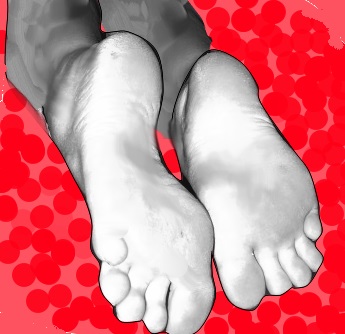
The plan to display Lady Liberty’s breasts in Boston was banned before it got off the drawing board, and a nationwide tour of her feet failed to muster sufficient enthusiasm.

The Statue of Liberty is no longer saying, ‘Give me your poor, your tired, your huddled masses.’ She’s got a baseball bat and yelling, ‘You want a piece of me?’ Robin Williams

When Mexico sends its people, they’re not sending the best. They’re sending people that have lots of problems and they’re bringing those problems. They’re bringing drugs, they’re bringing crime. They’re rapists and some, I assume, are good people. –Donald Trump

JUNE 18, 1913: THEY CALL IT SAM’S SONG

Violinist, meat-packer, usher, tinsmith, elevator operator, and lyricist, Sammy Cahn (no relation to Kublai or Genghis) penned his first lyrics at the age of 16 – “Like Niagara Falls, I’m cahnFalling for You,” not one of his most notable successes. But he kept writing them, giving up those other professions, until he got it right, and got it right again, and again.

     Over the course of his career, Cahn was nominated for 23 Academy Awards, five Golden Globe Awards, an Emmy and a Grammy. In 1988, the Sammy Awards, for movie songs and scores, were created in his honor.

With Jimmy Van Heusen, Cahn wrote so many songs for Frank Sinatra that the two were almost considered to be his personal songwriters. Oscar winners “Three Coins in the Fountain,” “All the Way,” and “High Hopes” were all introduced in films by Sinatra.  Add “Love and Marriage,”  “The Tender Trap,” “My Kind of Town,” “Come Fly with Me” and a host of others.

     The pair also won an Oscar for “Call Me Irresponsible” and received nominations for “Pocketful of Miracles,” “The Second Time Around,” and “Thoroughly Modern Millie.” Cahn and Jule Styne added nominations for “I’ll Walk Alone,” “I’ve Heard That Song Before,” and “It’s Magic.”

Cahn was born on June 18, 1913, and died in 1993.

JUNE 17, 1972: CREEPS THAT GO BUMP IN THE NIGHT

It was the middle of the night in June 1972, and while much of the nation slept, something was afoot at a large apartment complex in the Foggy Bottom area of Washington DC. A security guard noticed pieces of tape covering the latch on the locks on several doors, leaving the doors unlocked. He removed the tape, naively thinking nothing of it – the wind maybe?  (He evidently had never read a suspense novel.)  An hour later, he discovered that the locks had been retaped and realized that this was something more than just the wind. He called the police who discovered not just one but five intruders in the offices belonging to the Democratic National Committee.

     The five men were charged with attempted burglary and attempted interception of telephone and other communications. In September, a grand jury indicted them and two other men (E. Howard Hunt, Jr. and G. Gordon Liddy) for conspiracy, burglary, and violation of federal wiretapping laws.

     The men who broke into the office were tried and convicted in early 1973.  An investigation, tied all five men to CREEP. CREEP is the loving acronym applied to the 1972 Committee to Re-elect the President, the President being Richard Milhouse Nixon. Trial judge, John J. Sirica, (who evidently did read suspense novels) suspected a conspiracy involving people at the pinnacles of government.

     In March 1973, James McCord, one of the original gang of five claimed that he was told to plead guilty. He implicated Attorney General John Mitchell and other top Nixon aides, who began to topple like so many Republican dominoes, and the June 17 Watergate robbery quickly escalated into one of the juiciest political scandals of the century — wherein the aforementioned President Nixon resigned to avoid — dare we use the word?


JUNE 16, 1917: WHIPPING BOY

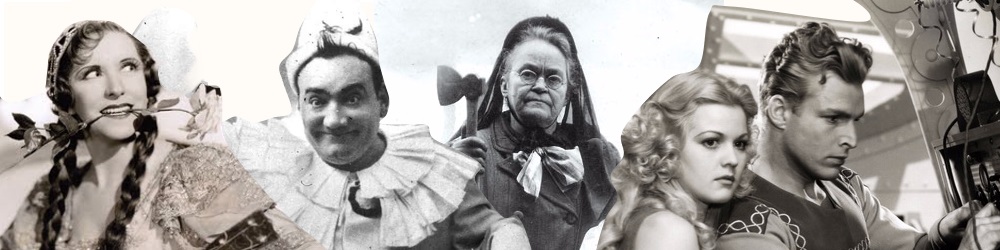
Harrison Ford cracked a mean bullwhip as the title character in the Indiana Jones series of films. Ford wasn’t born brandishing a bullwhip; he had to learn it for the films. And he was taught by bullwhip master, Lash LaRue born on June 16, 1917.

Like many actors in the 40s and 50s, LaRue spent most of his career making B-Westerns. Originally hired because he looked enough like Humphrey Bogart that producers thought this would draw in more viewers, he used his real last name as the name for most of his film characters. He was given the name Lash because, although he carried a gun, he was noted for preferring to use an 18-foot-long bullwhip to take on bad guys. Lash not only disarmed bad guys, he performed many stunts such as saving people about to fall to their doom by wrapping his whip around them — often while at full gallop on Black Diamond, his trusty horse — and pulling them to safety. Lash, like a guy named Cash, was also known for always wearing black.

After starting out as a sidekick to singing cowboy Eddie Dean, he earned his own series of Western films and his own sidekick, Fuzzy Q. Jones (Al St. John), inherited from Buster Crabbe. He also got his very own villain — an evil, cigar-smoking twin brother, The Frontier Phantom.

His films ran from 1947 to 1951. The comic book series that was named after his screen character lasted even longer, appearing in 1949 and running for 12 years as one of the most popular western comics published.


face down in a cranberry bog, part 5: driving mr. corpse

We needed my car because she had asked me, and I had agreed, to mind the body for a few hours while she got a government car and fussed with the paperwork so that the vehicle would never have been on the island. I had agreed to this cloak-and-dagger enterprise only because I couldn’t come up with a better one and, face it, I was seduced. When I returned I found her standing at the scene of the accident, looking down into the bog. For a moment, I was afraid she’d moved him again. She smiled and took my hand as I reached her, then led me off toward the bushes, our arms swinging between us – a most romantic portrait, except for the corpse. He was still lying face down and I was happy for that. The red boxer shorts had been cloaked by a distinguished dark gray governmental suit.

“You dressed him,” I said.

“It was the least I could do,” she said, with a little laugh. “After all, I undressed him.”

We lugged the body out of the bushes and slipped it into the trunk of my car, keeping a wary watch for prying policemen until the deed was done.

We agreed to meet at my place – foolish, perhaps, but my garage is more private than most places. I slept for two hours – fitfully, even though the morning had exhausted me – and, once up, puttered impatiently, waiting for her arrival. Finally I turned on the TV and watched two senators calling each other names over an appropriations bill. The political repartee immediately brought to mind the politician in my trunk and I felt the need to check up on him – possibly afraid he’d disappear again. I went to the garage and, with just a little foreboding, carefully opened the trunk. Unwarranted foreboding, for he was still there. I never thought I’d be relieved to find a body in the trunk of my car. Unfortunately, he had shifted, and his ghostly face now looked up chidingly, suggesting that I was somehow unAmerican. I tried to push him back over and felt something hard in the jacket pocket. I reached in and pulled the object out – a knife, an ugly knife. Working almost mechanically now in the grip of this new fear, I unbuttoned the crisp white shirt and – to no great surprise – found a wound in his chest. Looking back to the knife, I was certain it was the father of the wound.

I returned to the house. On TV the smiling anchor paused to glare at me as though I had been holding up his news program and only now could he continue . . . “And boarding a private jet at Logan Airport, here is Prince Leopold, chief of state of this tiny but strategically important nation. No one has indicated why the Prince made this secretive trip to the United States, but rumors suggested that he was seeking financial backing to save his crumbling empire. Those rumors, and his own angry statements, suggest also that he is going home empty-handed. His companion, thought by many to actually be his mistress….”

And there she was, my bicyclist, my co-conspirator, my would-be lover, once again gazing at me. Even though she was getting on that plane and even though the smile wasn’t there, I could see it in her eyes – she probably still loved me.

The knife is sitting on the table in front of me. I’m sure mine will be the only prints on it. Did she seduce him for the cause, hoping to blackmail him, or did she kill him because he turned them down? Did she actually make love to him? Probably not. Probably just the promise of it, like the promise to me. I probably should feel sorry for myself. A lot of people bicycle to ‘Sconset, but I’m pushing sixty and had to stop halfway. And now there’s a knife on my table, a dead Secretary of State in the trunk of my car, and the chief of police doesn’t like me much.

The snarl at the other end of the line tells me I’ve reached him. “Hello there. I don’t know if you remember me. I’m the one who found the body this morning – you know, the body that disappeared. Well, you’re not going to believe this. No, let me put that another way. This is quite extraordinary, but I’m sure if you look at it logically and carefully, you will believe it. Anyway . . .”


This story is included in the collection Naughty Marietta and Other Stories.

JUNE 15, 1937: REEFER MADNESS

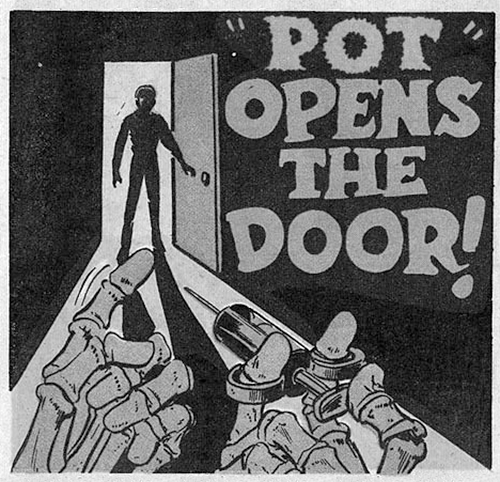
In 1937, Congress passed the Marihuana Tax Act which levied a tax of one dollar on anyone who dealt commercially in marijuana. The bill had been written using the slang term “marihuana” throughout, obscuring the fact that it covered the plant’s legitimate uses in medicine, where it was broadly known as cannabis and in the fiber industry as hemp. The Act did not itself criminalize their possession, but regulations and restrictions on the sale of cannabis as a drug had been around since the previous century.  In effect, the bill made it impossible for anyone to deal with call it what you will in any form.

     Conspiracy theorists maintained that business tycoons Andrew Mellon, Randolph Hearst, and the Du Pont family were behind passage of the Act as a way to reduce the size of the hemp industry. Hemp had became a very cheap substitute for the paper marijuana-propagandapulp that was used in the newspaper industry and as such was a threat to Hearst’s extensive timber holdings. Mellon had invested heavily in the Du Pont family’s new synthetic fiber nylon that was competing with hemp.  The campaign that Hearst’s newspapers had been staging against the dangers of the recreational use of the”powerful narcotic in which lurks MURDER! INSANITY! DEATH!” was therefore disingenuous. (‘Beware the evils of hemp’ didn’t quite cut it.   “Reading newspapers printed on hemp will lead to degradation and reading the New York Post.”)

     The legislation effectively killed the hemp industry and the medical use of cannabis, and the ensuing years of “reefer madness” completed its evolution to the abominable recreational drug it became through the rest of the century.


face down in a cranberry bog, part 4:  the corpse returns

“Yoo hoo.” I turned and saw her standing in front of a thicket of heath, twenty yards beyond the bogs.

“Where is he?” I demanded when I reached her, even though it sounded as if I were getting a little possessive with this body. She was quite disheveled, as though – as though she’d dragged a body out of a cranberry bog.

“Back there, in the bushes.”

“Why?”

“After you left, I started thinking more clearly and realized that he can’t be found here. That would be terrible. I hope you’re not angry.”

“Angry? The Nantucket police chief thinks I’m a lunatic. And if anyone dies mysteriously on this island in the next ten years, I’m his number one suspect. Angry? Of course not.”

“Oooh, I’m sorry,” she wailed and unleashed her puppy dog eyes.

“Why can’t he be found here?”

“Because he’s supposed to be in Boston. It’s very complicated.”

“You had sex with a man who’s supposed to be in Boston on the edge of a Nantucket cranberry bog and he died and fell in so now he’s back there in the bushes. What’s complicated?”

She looked at me as though she still wasn’t sure I could be trusted even though I had aided and abetted every inch of her little crime other than the actual killing – and the sex, of course. Finally she spoke. “You didn’t recognize him, did you?” I was about to reply that we hadn’t met under ideal conditions. “He’s Alexander Farnsworth.”

“Alexander Farnsworth. The name’s not familiar, nor his face. Why would I recog – ?” I guess my mouth dropped open because she began to shake her head excitedly.

“No,” I said, as if my denial would make it not so, but now the face was familiar, too. “Not Secretary of State Alexander Farnsworth?”

“Yes. Everyone thinks he’s in Boston. But he’s been here for the past week having secret meetings with a Prince Somebody from somewhere important.”

“I thought he was here to fool around with someone in a cranberry bog.”

“That’s not very nice,” she snapped.

“Okay. How did the two of you happen to end up…?”

“I came to Nantucket with him. I work for him. This morning, he wanted to relax for a while so we took a walk and – well, you know the rest. Now you know why he can’t be here. It’s not just me. It’s national security stuff.”

“He’s no better off in those bushes than in the bog.”

“I know,” she said. “I’m going to take him back to Boston.”

“Oh boy.”

“I’ve made up my mind. I’ve got to do it. But I need your help again. Do you have a car?”

“I hope you’re not going to ask me to drive a dead man to Boston.”

“No, I wouldn’t do that.” Then she breathlessly explained to me how she herself was going to drive the dead Secretary of State first onto the ferry then to Boston in an official government vehicle which she would leave with him behind the wheel in the underground parking lot of an exclusive Boston hotel. My mind went a little numb as I listened to her plan and gazed into her conspiring eyes. When she stopped talking, I leaned forward and kissed her. She let me, but then pulled away. “Please,” she said. “Not now. Later, before I go to Boston.”

continued


JUNE 14, 1287: PROSE AND KHANS

In 1287, Kublai Khan, on a bit of a tear through Asia, defeated the forces led by princes of Mongolia and Manchuria. Kublai was a grandson of Genghis, another Khan known for being rather hard to get along with. Like his grandfather, Kublai was a holy terror right from infancy when he frequently seized power from fellow toddlers. Eventually, Kublai pushed the Mongol Empire to new heights, creating a unified, militarily powerful China and gaining international attention in the process.

Marco Polo, in the accounts of his travels, made Kublai well-known to western audiences, and Samuel Taylor Coleridge added a romantic aura in the early 19th century with his description of Kublai (Kubla to Coleridge) Khan’s summer cottage at Xanadu:

     In Xanadu did Kubla Khan

     A stately pleasure-dome decree:

     Where Alph, the sacred river, ran

     Through caverns measureless to man

     Down to a sunless sea.

     When the sacred river Alph plunged into that sunless sea it naturally created a great waterfall. In the rush of this waterfall, the voices of Kubla’s ancestors could be heard — that strident, discordant one being Genghis.


Face down in a cranberry bog, part 3: somebody stole my corpse

“A person ought to remain at the scene of the crime,” said the chief of police, taking me to task when he should have been commending my citizenship, as we drove back toward the bog.
“What crime?” I complained. “I’m sure it’s just an accident. And even if I had stayed at the scene of the accident, how could I report it? I don’t have a cell phone. It might be weeks before anyone came by. I’d eventually starve. I couldn’t even eat cranberries because the sign said not to. And I’m too law-abiding to disobey a sign let alone do something criminal to a person, if someone did indeed do something criminal, which I don’t think anyone did, but I have no way of knowing.”

“You’re acting mighty guilty.” I thought I was behaving quite calmly. Upon hearing the word guilty, however, any veneer of calm was violently stripped away. And then I remembered with a jolt of nausea that the recently departed wore only red boxer shorts.

“I always act guilty,” I said, squirming to confirm my words. “Even as a kid. If someone put a baseball through a window, the owner of the house would look at me and figure I did it – just because I looked guilty. People who act guilty are almost always innocent; did you know that?”

“No, I didn’t,” said the chief, looking skeptical. “Here we are.” He stopped the car and we got out. “Now exactly where is this body?”

“Over there. On the other side of that bog.”

We approached and began to circle the bog. We circled it once, and we circled it again. We saw nothing but cranberries. “Are you sure you got the right bog?” the chief asked, giving me that look.

“Yes, I’m sure,” I said. We circled three more bogs, and a deputy who joined us began to circle the rest.

The chief of police leaned back against his car, reached into his pocket and pulled out a pen and a small tablet. “This wouldn’t be a joke, would it? If it was, it wouldn’t be very funny; I can tell you that.”

“Of course not. Do I look like a joker?” I wished I hadn’t said that.

“Had anything to drink today?” He scratched at the tablet as he spoke.

“It’s ten a.m.”

“Had anything to drink this morning?”

“Tomato juice and coffee, that’s it.”

“Do you take medication or any other kinds of drugs?”

“No, I don’t, and I resent that implication.”

“I resent spending my time searching cranberry bogs for bodies that don’t exist.” He looked at me as though he wanted nothing more out of life than to throw me into a jail cell. “You say you’re not joking, you’re not drunk or spaced out. Tell me what you think.”

“It’s obvious,” I said. “Somebody stole the corpse. Otherwise, it would be there.”

“Not that obvious to me. What’s obvious to me is that I’m going to be watching you. Now describe this alleged body to me.”

“It looked dead.”

“Nice start. Would you care to elaborate?”

“Male Caucasian.”

“Now you’re getting it. Go on.”

“Hair gray. Face sort of blue. Mustache.”

“You think this whole thing is some kind of big joke, don’t you?”

“Not at all,” I answered. “I take dead bodies quite seriously. I’m doing my best to help.”

“Okay, mustache. Gray like his hair?”

“Hmmm.” I tried to visualize the mustache but couldn’t. “I don’t know. I think it was dark. But maybe it just looked darker because it was wet. I’m just not sure. In real life, people don’t really remember all the little details. Anyone who knows all the details probably memorizes them. And maybe because that person is guilty – even though he doesn’t look it.”

“Or she.”

“What?”

“Never assume the guilty party is a man. Women kill too. Now can we dispense with the criminology and get on with it?” He continued to write in his little tablet. I wished I could have seen what he was writing; I’ll bet it wasn’t flattering.

“Okay,” I said. “The mustache was three shades darker than the hair. His forehead had six, no seven, wrinkles.”

“Okay, I’ve got enough,” he said, flipping the notebook shut and giving me a nasty look. “If we come up with a body, we’ll get back to you.”

“Don’t call us, we’ll call you?”

“Something like that.”

I watched as he and his trusty deputy returned to their respective police vehicles and pulled away, leaving me alone, angry and confused. Someone had stolen my corpse.

continued