November 12, 1933: It Came from Beneath the Sea

Hugh Gray was walking along a loch after church when he spotted a brouhaha in the nearby water. As he looked on, a massive creature rose up from the lake. The quick-thinking Scotsman took several pictures of it (why he had a camera when he had been to church is anyone’s guess). Only one of the pictures he took on November 12, 1933, turned out; it looked a lot like a plesiosaur frolicking in the water. Some naysayers suggest it looked more like a dog carrying a stick swimming towards the camera, but the legend of the Loch Ness Monster was born nevertheless, as was the science of cryptozoology, the study of animals that don’t exist (such as Bigfoot and Rudy Giuliani).

While Nessie, as those on a first-name basis call it, is a bona fide cryptid, the monster that showed up on a beach just south of Florence, Oregon, on November 12, 1970, was not. It was the real thing – an 8-ton, 45-foot-long sperm whale. For a while the creature, which had been dead for some time, was a curiosity for locals and visitors alike, something more dramatic than the typical flotsam and seashells they usually found on the beach. But then it began to smell.

The task of dealing with the carcass fell to the state Highway Division, and it presented a monster problem. If the carcass were buried, it would simply be uncovered by the ocean tides. Oregon officials consulted U.S. Navy officials (division of cetacean disposal) and hatched the ingenious plan to blast the behemoth into a billion bits of blubber using a bunch of dynamite – little morsels that would then be devoured by seagulls.

The engineer in charge of the operation said that he wasn’t exactly sure how much dynamite would be needed, but a half ton of dynamite was finally applied to the carcass. Walter Umenhofer, a military veteran with explosives training, happened to be beachcombing at the scene. He warned the engineer that the amount of dynamite he was using was a tad excessive – 20 sticks was about right, not the 20 cases that were being used. Umenhofer said the engineer was not interested in his advice.

Needless to say, the explosion didn’t go as planned. The blast pulverized only part of the whale, sending pieces soaring — not toward the ocean, as hoped, but toward people watching from the dunes. No onlookers were seriously hurt, but they were pelted by bits of smelly blubber. And as an added thanks for butting in, Walter Umenhofer’s brand-new Oldsmobile was flattened by a chunk of falling blubber after the blast. He had just bought the Ninety-Eight in Eugene, during a “Get a Whale of a Deal” promotion.

After onlookers scurried away, the Highway Division crew buried the remaining whale. The seagulls who were supposed to dine on whale tidbits were found wandering in a daze in Utah and Wyoming.

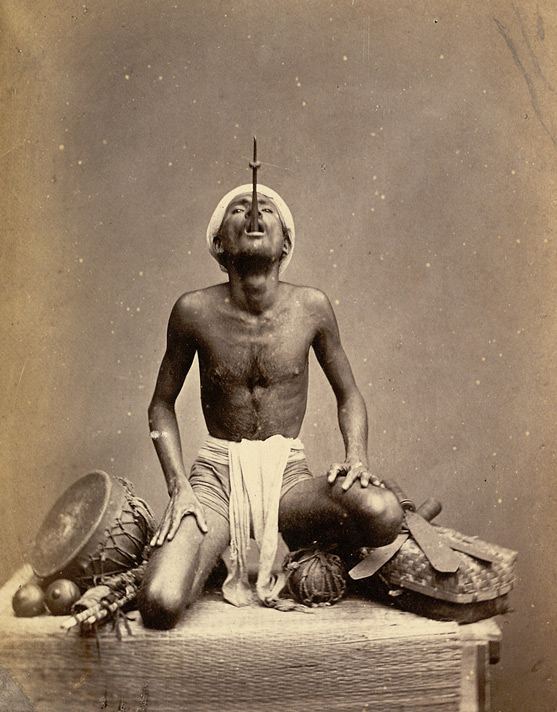
November 11, 1817: If You Believe This You’ll Swallow Anything

When New Yorkers paid their $1 admission price to enter St. John’s Hall swordon November 11, 1817, they were prepared to be amazed. And amazed they were, by an Indian juggler Ramo Sammee (also known as Senna Samma or Samaa because to Americans all Indian names sound alike).

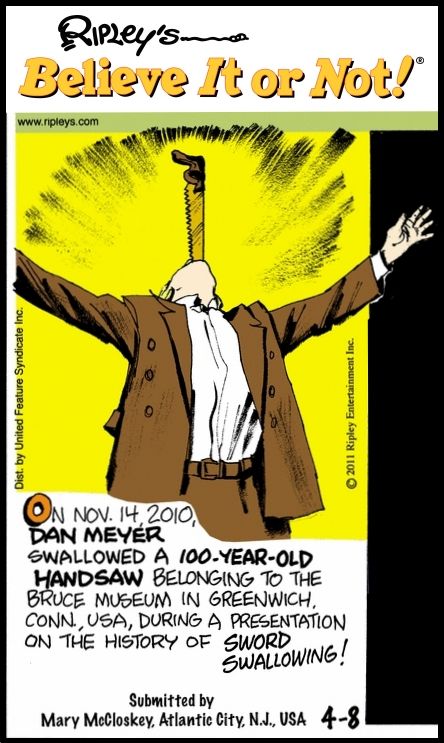
What New Yorkers witnessed that day was not just another juggling act; no, Ramo stupefied the spectators by swallowing a sword. Now Indian street performers had been swallowing swords for centuries — along with climbing ropes into mid-air and staring down cobras –but this was a first for this continent. Sword swallowing in this country presented its own kind of danger as demonstrated later that month by the announcement that Ramo would be swallowing a new sword of American manufacture as “a substitute for the one lately stolen from him by some villain.”

Ramo continued to swallow that sword and others, gaining a certain fame, until his death in 1850. Live by the sword . . .

Those who followed Ramo, particularly in this country, sought to distinguish themselves with longer swords, multiple swords, hot swords, cutlasses, bayonets and even glowing neon Star-Wars swords.

The Sword Swallowers Association International (yes, there is one) reports that there are fewer than a dozen professional sword swallowers actively performing today. That led the association to create World Sword Swallowers Day (yes, there is one) “to honor and celebrate these courageous and daring performers” and to bring together dozens of amateurs and professionals for a sword swallowing extravaganza. The celebrations help raise funds for the Injured Sword Swallowers Relief Fund (yes, there are injuries).

And occasional deaths. But — mea culpa for misleading you — Ramo Sammee did not die by the sword.

November 10, 1903: Cold, Cold, Cold Was the Trolley

It was a typically nasty winter day — wet and cold — in New York City at the dawn of the 20th century, when Mary Anderson, an out-of-towner took a typical tourist trolley ride. There wasn’t a whole lot to see with sleet clinging to the windows. In fact, Mary observed that the driver of the streetcar himself could barely see through the front windshield. The trolley’s front window had supposedly been designed for bad-weather visibility: it was made up of individual panes that could be opened when covered by rain or snow, allowing the driver to peer out through the opening. Hardly high tech. Not only did it do little to improve the driver’s ability to see where he was going, it left him with an ice-encrusted face, and chilled the passengers as well.

Right there, while sitting in the cold trolley, Mary began to sketch a mechanical device that would wipe the trolley’s windshield. Her invention had arms made of wood and rubber that were attached to a lever near the steering wheel of the drivers’ side. By pulling the lever, the driver could drag the spring-loaded arm across the window and back again, wiping away raindrops, snowflakes, sleet, dead birds, what-have-you. The wipers could easily be removed when meteorologists prophesied sunny skies.

Mary returned home to Birmingham, Alabama, and applied for a patent. On November 10, 1903, she received U.S. Patent No. 743,801 for her “window cleaning device for electric cars and other vehicles to remove snow, ice or sleet from the window.” Alas, she was an inventor ahead of her time. She made not a penny for her cleverness. And yet within ten years windshield wipers were standard issue in passenger cars everywhere.

In 1917, another woman, Charlotte Bridgewood, patented the “Electric Storm Windshield Cleaner,” an automatic wiper system that used rollers instead of blades. (Her daughter had already invented the turn signal.) But like Mary Anderson, Charlotte Bridgewood never made any money from her invention. Another type of automatic windshield wiper came onto the scene in 1921. Called “Folberths,” after their inventors, these wipers were powered by a device connected by a tube to the inlet pipe of the car’s motor.

The male Folberths profited from their invention, which may lead some to believe that wiping devices were at work on glass ceilings as well as windshields.


November 9, 1918: And Mona Lisa Isn’t Talking

Guillaume Apollinaire, who died on this date in 1918, was a French poet and critic of the early 20th century. He was a fan of modern art and is credited with coining the word surrealism. To the French police, however he was just another voleur, but certainly not a petty one. Seven years earlier, they had arrested and jailed him on suspicion of aiding and abetting the theft of the Mona Lisa and a number of Egyptian statuettes from the Louvre.

The strange case began early on a Monday morning. Before the Louvre was opened for visitors,the Mona Lisa was stolen by a thief who acted quickly when no guards were around. The theft wasn’t reported until Tuesday; guards who noticed that the painting was missing assumed it had been removed to be photographed. Once museum officials realized the truth, however, all hell broke loose. The Louvre went into lock-down. Police arrived to question the staff, re-enact the crime and dust for fingerprints, a newfangled detection technique. The French border was sealed, departing ships and trains thoroughly searched.

By the time the museum re-opened nine days later, the theft was on the front page of newspapers around the world. Tips poured in from amateur sleuths, clairvoyants and your everyday would-be experts. Thousands of people lined up at the Louvre just to see the empty spot where the painting once hung. More it seems than ever viewed the painting itself, which was not widely known outside the art world until it was stolen (Nat King Cole had not yet sung about it). Giving the whole situation a Kafkaesque touch, Franz Kafka was among those who came to view the empty space.

The plot thickened (as plots will) when a mystery man called the Paris-Journal, which was offering a reward for information about the crime. The man showed up at the newspaper’s offices with a small statue, one of several that he claimed to have stolen from the Louvre. The anonymous thief turned out to be a con man named Honoré Joseph Géry Pieret who had a questionable relationship with Apollinaire. Pieret implicated Apollinaire and he was arrested.

Under pressure, Apollinaire, admitted that Pieret had sold the pilfered works to his friend Pablo Picasso. Thinking they might have discovered a dandy crime ring, police arrested Picasso as well. Although Picasso admitted buying the objects, prosecutors couldn’t build a case that either he or Apollinaire had stolen them, much less the Mona Lisa, and both of them went free.

And what happened to the Mona Lisa? Conspiracy theorists tell us it was never found, that museum officials had to hire a copy artist named Lenny DaVinci to paint a replacement. “How about a real smile this time,” they suggested.

But She’s Showing It All

This just in:  French experts have determined that a nude portrait that has been hiding at the Conde Museum at the Palace of Chantilly, north of the French capital is actually Mona Lisa herself.  She has been going under the alias Monna Vanna.  Curators have determined that Leonardo himself had a hand in the charcoal work.  Shocking!

November 8, 1957: Flying Too High

Pan Am’s Flight 7 was known as the Clipper Romance of the Skies, an around-the-world flight that originated in San Francisco and flew west, eventually arriving in Philadelphia. The plane itself was a Boeing B-377 Stratocruiser. Introduced in 1947, the aircraft was the biggest, the fastest, and the fanciest, called “the ocean liner of the air.”

Pullman-style sleeping berths, separate men’s and women’s dressing rooms, a cocktail lounge in the belly of the airplane, reclining seats that offered 60 inches of something they used to have called legroom. Seven-course dinners, with champagne and caviar, catered by Maxim’s of Paris. This you could happily go through searched luggage and patdowns for, but there weren’t any.

Of course it was expensive – a $1,600 round-the-world fare (equivalent to $10,500 today).

When the November 8, 1957, flight left the gate shortly before noon for its first leg, the nine-and-a-half-hour flight to Honolulu, 38 passengers were aboard. They included the vice president of Renault Auto, a French flying ace, the general manager of Dow Chemical in Tokyo, a well-known Phoenix dress designer, a Louisville surgeon, a spice company honcho, and a U.S. Air Force major on a mysterious mission to southeast Asia with a briefcase full of classified documents.

At 4:04 p.m., the flight captain radioed a routine position report from an altitude of 10,000 feet to the Pontchartrain, a Coast Guard weather ship stationed in the Pacific. Romance of the Skies had just passed the point of no return, on course and on schedule, 1,160 miles from Honolulu and about 10 miles east of the Pontchartrain. The skies were clear and the seas calm, the sun low in the western sky. The plane was never heard from again.

The biggest air-sea search since the disappearance of Amelia Earhart ended just days later with the discovery of 19 bodies and floating wreckage about 1,000 miles northeast of Honolulu. And the little that was recovered from the flight only deepened the mystery. There had been no distress call; the location of the debris showed that the Clipper was well off course; and, finally, elevated levels of carbon monoxide were found in several of the recovered bodies.

The definitive cause of the accident has never been determined. Speculation includes a malfunctioning engine, a disgruntled flight crew member, and insurance related fraud that involving an explosive device. And then there’s that mysterious major.

Way Bigger Than a Breadbox

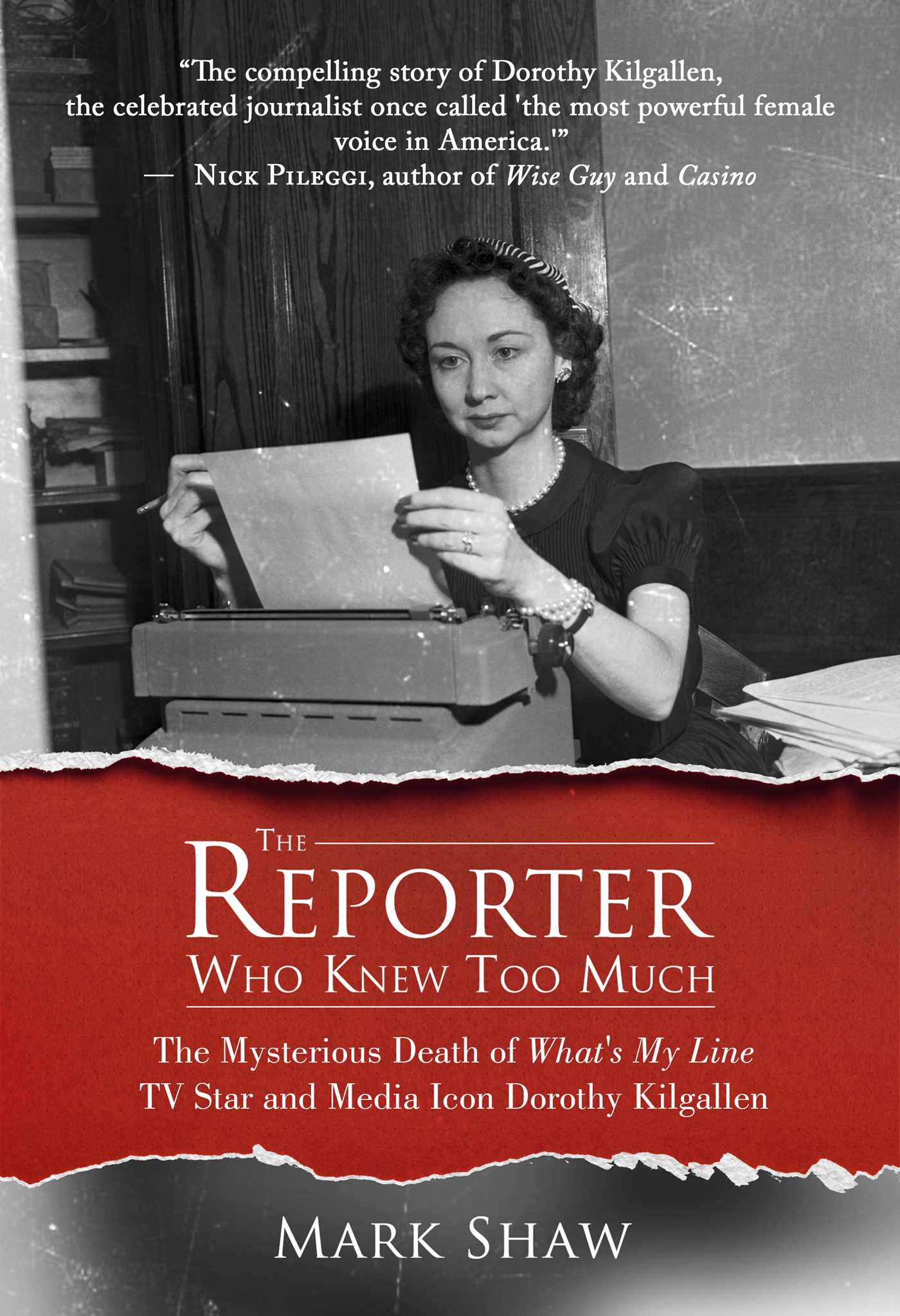
To most people, Dorothy Kilgallen was known as a long-time panelist on the television game show What’s My Line? (Does ‘Is it bigger than a breadbox?’ ring a bell?) or as a high society New York newspaper columnist. She was also throughout her career a rather enterprising reporter. Her journalism coming out party was a 1936 race around the world against two male colleagues. Her cabled columns and a book Girl Around the World made her a celebrity.

In 1963, she once again took up the role of daring reporter. According to a biographer, Kilgallen was devastated when President Kennedy was shot by Lee Harvey Oswald. She was among those who refused to believe that Oswald acted alone. She spent the next two years in her own investigation of the assassination, gathering evidence and conducting interviews. She was the only reporter to interview Jack Ruby, and she somehow got hold of an advance copy of the Warren Commission report even before President Lyndon Johnson had seen it. He was miffed.

So was J. Edgar Hoover. The FBI and CIA both began to follow her and her friends. She was interrogated, and her phone was tapped. In 1965, she told her lawyer that she was going to break the real story and that it would be the scoop of the century. She planned to meet a secret informant in New Orleans.

On November 7, she appeared on What’s My Line? as usual, and afterward wound down with a few drinks along with other members of the show before returning to her apartment. The next day — November 8, 1965 — she was found dead, sitting up in bed in a blue bathrobe and still wearing in her hair a floral accessory from the previous evening. On her nightstand, an empty sleeping pill bottle and a drinking glass. The police playing the bumblers they traditionally play in detective fiction found nothing suspicious. Her death was attributed to an accidental overdose.

Loose ends included the fact that her accumulated evidence had gone missing, that she was found in a bed she never slept in wearing clothes she never wore to bed, that she had recently bought a gun telling her hairdresser she was ‘scared for her life.’ Lawyer and author Mark Shaw suggested in a 2016 book The Reporter Who Knew Too Much that Kilgallen’s death was orchestrated by a mobster who feared her book would name him as the mastermind behind Kennedy’s assassination.


November 7, 1811: Tippecanoe and So Do You

Long before the confederacy of southern states, United States forces faced the uprising of a confederacy under the Shawnee leader and Native American folk hero Tecumseh who had visions of a Midwestern Indian nation allied with the British. Confederacy forces led by Tecumseh’s brother Tenskawatawa (One with Open Mouth) met government forces under the direction of William Henry Harrison, Governor of the Indian Territory, on November 7, 1811, in the Battle of Tippecanoe (and Tyler too).

The battle took place in Indiana, at the confluence of the Tippecanoe and Wabash too Rivers. The day gave government forces an important political and symbolic victory and dealt a devastating blow to Tecumseh’s confederacy. Public opinion in the United States blamed the entire brouhaha on buttinsky Brits. The War of 1812 broke out only six months later.

The Battle of Tippecanoe (and Tyler too) also served as an important springboard for Harrison’s political ambitions which culminated in his becoming president in 1841. At the age of 68 years and 23 days when inaugurated, Harrison was the oldest president to take office until Ronald Reagan in 1981. During the campaign, Democrats characterized Harrison as an out-of-touch old fart (One Who Sits in Log Cabin Drinking Hard Cider). Harrison and running mate John Tyler (and Tippecanoe too) turned the tables on the Dems, adopting the log cabin and hard cider as campaign symbols along with one of the most famous campaign slogans ever (Tippecanoe and you know who).

Harrison caught cold shortly after his inauguration and went quickly from bad to worse. Harrison’s doctors tried applications of opium, castor oil, leeches, and Virginia snakeweed too. But to show his disdain for modern medicine, Harrison became delirious and died. He served only 32 days in office – some would say the perfect tenure for any politician.


November 6, 1982: Antifreeze and Old Lace

In Arsenic and Old Lace, a delightfully dark stage play adapted into a movie by Frank Capra, Mortimer Brewster (Cary Grant) has an eccentric family that includes two brothers – one of whom thinks he’s Theodore Roosevelt digging the Panama Canal in the basement, the other a killer who’s had plastic surgery to make him look like Boris Karloff – and two spinster aunts who have taken to murdering lonely old men by poisoning them with home-made elderberry wine laced with arsenic, strychnine, and “just a pinch” of cyanide. Generally, poisoners aren’t as sweet as these two old ladies.

Take the case of Shirley Allen, arrested on November 6, 1982, charged with murdering her sixth husband Lloyd. Shirley certainly wasn’t as sweet as the two old ladies, nor nearly as successful. Her first attempt at poisoning was believed to be an early husband, Joe Sinclair, back in 1968. When his coffee began to taste odd, he didn’t buy the idea that it was the newest flavor of the month, reasoning that Juan Valdez Free Trade Almond Praline Decaf should not give him internal injuries.  Joe went to the police, but no charges were filed. He filed for divorce, however.

Another husband, John Gregg, was not so lucky. He died a year after he married Shirley. He must have sensed that something was amiss because he changed the beneficiary of his insurance policy shortly before he died. Shirley got nothing. As you might guess, she was miffed. A pink-haired, large-bosomed barfly was rather happy, however.

Lloyd Allen was Shirley’s sixth husband. He began to complain of a strange taste in his beer. When Shirley said that it was an iron supplement that would put a tiger in his tank, Lloyd believed her and promptly died. This time she was named as beneficiary of a $25,000 life insurance, but alas her daughter told police about the doctored beers. Toxicology reports confirmed that Lloyd’s body tissue contained a lethal amount of ethyl glycol – antifreeze. Shirley went to prison for life. She was never allowed to work in the prison cafeteria.


November 5, 1605: And Brer Fawkes He Lay Low

Please to remember the fifth of November,

Gunpowder, treason and plot.

As if the juvenile delinquents of the world couldn’t get in enough trouble on Halloween, they get another opportunity to misbehave, at least in England, on Guy Fawkes Day. On this day, November 5, it has long been customary to dress up a scarecrow figure and, sitting it in a chair, parade it through the streets. Those unlucky enough to be passers by are solicited for cash contributions with shouts of “Pray remember Guy” which the passers by hear as “Your money or your life.” Once the revelers have extorted enough money, they build a big bonfire and merrily burn their scarecrow, pretending it is Guy Fawkes or the Pope or the Prime Minister or their history teacher.

Who Is Guy Fawkes, You Ask.  Guy Fawkes was a protester some four hundred years ago, a member of a group of English Catholics who were dismayed at having a Protestant as King of England.  Their protests eventually moved beyond the verbal assaults (“Hi de hay, hi de ho, King James the First has got to go”) down the slippery slope to gunpowder, treason and plot.

Guy Fawkes was born in England in 1570 but as a young man went off to Europe to fight in the Eighty Years’ War (not the entire war, of course) on the side of Catholic Spain.  He hoped that in return Spain would back his Occupy the Throne movement in England.  Spain wasn’t interested.

Guy  returned to England and fell in with some fellow travelers.  Realizing that the Occupy the Throne movement required removing the person who was currently sitting on it, the group plotted to assassinate him.  They rented a spacious undercroft beneath Westminster Palace  where they amassed a good supply of gunpowder.  Guy Fawkes was left in charge of the gunpowder.

Unfortunately, someone snitched on them and Fawkes was captured on November 5.  Subjected to waterboarding and other enhanced interrogation methods, Fawkes told all and was condemned to death. (Evidently, James I was not amused.)  Just before his scheduled execution, Fawkes jumped from the scaffold, breaking his neck and cheating the English out of a good hanging.

Since then the English have celebrated the failure of the Gunpowder Plot in 1605 with the November 5 celebration, an integral part of which is burning Guy Fawkes (and sometimes others) in effigy.  Seems like a long time to hold a grudge.

In the U.S., we can only hope that November 5, 2024, will not be remembered for hundreds of  years as a day of infamy.  We face it with trepidation as we recall the aftermath of the last election culminating in that January day of, if not gunpowder, treason and plot, at least insurrection or riot.  Or as candidate
Trump would have it, a day of love with happy patriots playing ring around the capital and chanting “hug Mike Pence, hug Mike Pence.”

November 4, 1879: The Incorruptible Cashier

James Ritty was by his own description a dealer in pure whiskies, fine wines and cigars. Common folk would probably just refer to him as a saloonkeeper. He opened his first saloon in Dayton, Ohio, in 1871. His life as the owner of a saloon was not without its angst; Ritty was certain his bartenders – a disreputable lot – were pocketing a portion of his profits. In those days, beer was but a nickel a stein or fifteen cents a bucket and came with a free lunch of boiled eggs, sardines, blind robins (little nuggets made from salt and herring), cold meats, pigs’ feet, pickles, pretzels, crackers, and bread. Every penny counted.

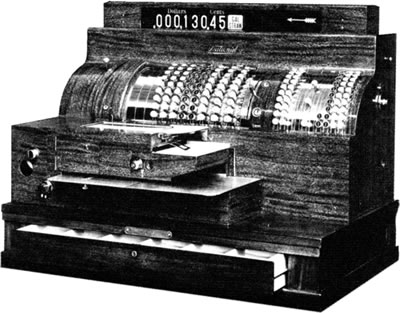
In 1878, on a steamboat trip to Europe but worrying about the saloon back home, Ritty became fascinated by a mechanism that counted how many times the ship’s propeller went around. Could something like this record the cash transactions made at his saloon? As soon as he returned home to Dayton, Ritty and his brother, a mechanic, began working on a design for such a device. Eventually, they devised a machine operated by pressing a key that represented a certain amount of money. The Rittys patented the design on November 4, 1879, calling it “Ritty’s Incorruptible Cashier.”

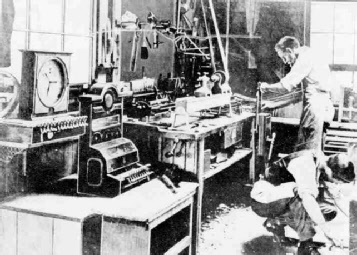
They opened a small factory in Dayton to manufacture the devices while still operating the saloon. The company didn’t do all that well, and Ritty was overwhelmed by the running of two businesses, so in 1881, he sold the cash register business. The buyers were a group of investors who formed the National Manufacturing Company which was renamed the National Cash Register Company a few years later.

Free of the cash register business and able to keep those pesky bartenders honest, Ritty opened another saloon, the Pony House, in 1882, in a historic Dayton building that had been a school of French and English for young ladies. For the Pony House, Ritty had wood carvers create a 32-foot bar that looked like the interior of a passenger railcar with Honduras mahogany, hand-tooled leather, and giant mirrors . Dining, drinking and gaming were the specialties of the Pony House – along with occasional fruitless searches for young French-speaking ladies. The saloon had it’s share of notable customers: Buffalo Bill Cody once rode his horse right up to the bar; John Dillinger (who never robbed a saloon) was a regular; and Jack Dempsey frequently took his spirits, never taking part in a barroom brawl.

The Pony House building was torn down in 1967, but the bar was saved and today resides at Jay’s Seafood in Dayton.


NOVEMBER 3, 1883: STAGECOACH POETICA

STAGECOACH POETICA

The California Gold Rush was in full swing by the latter half of the 19th century. Stagecoaches and Wells Fargo wagons were hauling gold out of California by the, well by the wagonload.  All this gold was just too much of a temptation for some folks, transplanted New Yorker Charles Boles being one such tempted soul.

In the summer of 1875, Boles donned a white linen duster, put a flour sack over his head and a black derby on top of that and set about robbing the gold from a stagecoach leaving the mining city of Copperopolis. Boles stepped out in front of the stage, aimed a shotgun at the driver, forcing him to stop and demanding him to “Throw down the box.” The driver was reluctant to comply until he saw several gun barrels aimed at them from nearby bushes. He calculated the odds, and turned over the strongbox. Boles whacked the strongbox with an ax until it disgorged its treasure, which Boles hauled off while the stagecoach driver remained a captive of Boles’ fellow conspirators. After this standoff had lasted a bit too long, he moved to retrieve the empty strongbox and found that the rifles pointing at him were nothing but sticks tied to branches of the bushes.

Boles was rather amazed at how easy this robbery business was and so, adopting the moniker Black Bart, he embarked on a life of crime. He became a bit of a legend due to his daring, the fact that he never rode a horse and leaving bits of verse “po8try” behind at each robbery:

I’ve labored long and hard for bread —

For honor and for riches —

But on my corns too long you’ve tred,

You fine-haired sons of bitches.

His victims also called him a gentleman. Once after ordering a stage drive to throw down the box, a frightened passenger tossed him her purse. Bart returned it to her, saying that he wanted only the strongbox and the mailbag.

Black Bart the Po8 robbed his last stagecoach on November 3, 1883 — that is, attempted to rob his last stage. Wells Fargo, not amused at having lost close to half a million to bandits, had secreted an extra guard on the stage. Bart escaped the trap but dropped his derby and left several other incriminating items behind a nearby rock. Within days, Black Bart had been apprehended.

During his eight years as a highwayman, Black Bart never shot anyone, nor did he ever rob an individual passenger. He stole a grand total of $18,000. Sentenced to six years in prison, he served four before receiving a pardon and disappearing into retirement.