SEPTEMBER 1, 1422: WHO’S GOING TO BURP THE KING?

On September 1, 1422, young Henry VI crawled (or perhaps toddled) onto the throne of England, succeeding his father Henry V. Little Henry was nine months old, a rather tender age to be an English monarch and, a few months later, King of France as well. A regency council ran the kingdoms until Henry hit 16 and was considered old enough to rule.

Kinging two countries isn’t a piece of cake. First off, its a killer commute, usually undertaken only by one country to invade the other. The French were not overjoyed at being ruled by an Englishman.  And one of them, Joan of Arc, was making a real nuisance of herself. Eventually Henry lost France and fell into a deep funk followed by an “inertia.” To use a more scientific description, he went wacko. (Observant readers will notice the inescapable connection between this incident and the Pat Boone hit song: When I lost France, I almost lost my mind.)

When Henry recovered 18 months later, he was surprised to discover he had a toddler of his own and that the toddler was named Edward, not Henry. Oh, and the War of the Roses was getting underway, during which Henry would lose the throne, regain it, lose it again, and end up murdered.

Henry VI remains the youngest king to ascend to the British throne and the only monarch to be both King of England and King of France.

TARZAN WOULDN’T LOSE FRANCE

Tarzan_of_the_Apes_1918Born on September 1, 1875, Edgar Rice Burroughs enjoyed a successful career as a pencil sharpener salesman. An honest occupation, but what do you do when you’re on the road, stuck in some cheesy motel with a bunch of sharp pencils? You either see how many you can fit into your ears or you write. Burroughs wrote. Prodigiously. In 1912, his most famous creation swung through a jungle near you in Tarzan of the Apes. And he kept on swinging through the decades, in two dozen books, including a few released after Burroughs’ death in 1953.

Tarzan was born with the rather ho-hum name, John Clayton. It was the apes who gave him the name we know him by. In their language (yes, they speak) tar means white, and zan means skin: Tarzan, clever, what? And Tarzan didn’t just swing around the jungle, as a short list of Tarzan adventures will demonstrate: Tarzan at the Earth’s Core, Tarzan and the Huns, Tarzan and the Foreign Legion, Back to the Stone Age, and Tarzan Rescues the Moon.

Tarzan became the star of radio, television, comics, stage, video and computer games, action figures and over 200 movies. Elmo Lincoln was the first of a whole gaggle of Tarzans which included Johnny Weissmuller, Buster Crabbe, and Lex Barker.  Burroughs didn’t like any of them.  And he didn’t like Enid Markey, the original Jane.  In fact, he disliked her performance so much that he killed Jane off in his next story.

tar4

Me Tarzan, you Jane.

This famous quote did not appear in either the original books or any of the movies.  Johnny Weissmuller uttered the words as a joke in an interview.

Me Paul, you Huey

If only I’d known it was available

Pencil it in to your copy wherever it seems appropriate.  Don’t have a copy?  Fix that here.

AUGUST 31, 1928: LOOK OUT FOR LOTTE LENYA

With music by Kurt Weill and words by Bertolt Brecht, Die Dreigoschenoper premiered in Berlin in 1928. By 1933, when Brecht and Weill were forced to leave Germany, the musical comedy which offers a socialist view of a capitalist world had been translated into 18 languages and performed more than 10,000 times. We of course are more familiar with the English title, The Threepenny Opera.  And we’re mostly familiar with the opening song which has been sung by practically everyone, most notably, Frank Sinatra, Louis Armstrong, Ella Fitzgerald in a grammy-winning performance, and Bobby Darin who made it the top song of 1959 – “Die Moritat von Mackie Messer” (“The Ballad of Mack the Knife”). The song was added just before the premiere, when the actor playing Macheath threatened to quit if his character did not receive an introduction.


At the beginning of the play, we meet Jonathan Jeremiah Peachum, a London entrepreneur who runs the city’s begging operation, training the beggars and taking a nice chunk of their earnings. He is the perfect capitalist, a man who today would work for Goldman Sachs.

But Peachum has problems: his grown daughter Polly did not return home the previous night, and Peachum fears she has been misbehaving, and worse still, misbehaving with the ne’er-do-well Macheath.  Peachum does what any worried father would do – he determines to thwart this budding relationship by taking away her cell phone and having her paramour hanged.

Fade to Macheath who is preparing to marry Polly once his gang has stolen her trousseau. After the gang has stolen some food and a table, they all enjoy a wedding banquet. Polly entertains with a charming little song about a maid who becomes a pirate queen and executes her former bosses and customers. The Chief of Police, Tiger Brown, joins the party. It seems he had served with Macheath during the wars and had, over the years, exerted his influence to keep Macheath out of jail. He and Macheath sing. Polly returns home and lays the fact that she has married Macheath on her parents who are not amused. She sings a charming little song advising them to go fuck themselves, bringing the first act to a conclusion.

In Act Two, Polly warns Macheath that her father is gunning for British bear and that he must leave London. He agrees and leaves his gang in Polly’s hands. On his way out of town, Macheath stops at his favorite brothel, where he sees his ex-lover, Jenny. They sing a charming little song (“Pimp’s Ballad”) about their days together, but (the plot having thickened) Jenny has been bribed by Mrs Peachum to turn him in. Despite Brown’s apologies, he’s powerless and must drag Macheath away to jail. Macheath sings a charming little song about his life being over.   Another girlfriend, Lucy (Brown’s daughter) and Polly arrive at the same time from stage right and stage left, respectively.  A nasty argument ensues and together they sing a charming little duet about scratching each other’s eyes out. After Polly leaves, Lucy engineers Macheath’s escape, bringing the act to a tidy conclusion.

In Act Three, Jenny selfishly demands her money for the betrayal of Macheath, which Mrs Peachum refuses to pay.  Jenny nevertheless reveals that Macheath is at Suky Tawdry’s house, and he is once again arrested. Back in jail and scheduled to be executed, Macheath desperately tries to raise the bribe money to get out again, even as the gallows are being erected.  But no one comes to his aid, and Macheath prepares to die.  He laments his fate in a charming little song.  But what’s this? A deus ex machina enters stage left. Peachum announces that in this opera mercy will prevail over justice, and in a parody of a happy ending, a messenger from the Queen arrives to pardon Macheath and grant him a title, a castle and a pension. The play then ends with a plea that wrongdoing not be punished too harshly as life is harsh enough.

AUGUST 30, 1794: PENNY WISE, POUND FOOLISH

In the late 1800s, many of the unfortunates who found themselves in English prisons were there as a result of debts they could not pay. Benjamin Pope had a different story; he found his way to prison for a debt he could easily have paid. Pope was a tanner and quite successful in his trade, enough so that he gave up tanning and became a money-lender and mortgagee. He proved successful at this endeavor as well, earning the nickname “Plum Pope.”

     Alas, his good fortune began to desert him, in no small part because of his greed. His grasping ways in the lending of money led him afoul of the usury laws, and he was frequently brought before the court. In one particularly blatant case, he was fined £10,000.

Instead of paying the fine, he stole away to France with all his property. There, he complained bitterly to anyone who would listen about the unfairness of the English laws. The French naturally commiserated. Nevertheless, he eventually returned to England, but still refused to pay the fine. He went to prison instead. At one point, he could have secured his release by paying just £1000 of the £10,000 fine. Not Plum Pope.

     While in prison, he carried on his avocation as a money lender, albeit on a more limited and cautious scale. While always a penny-pincher, he became more so and more eccentric about it. He would drink beer with anyone who would give it to him, but would never buy it. He would not eat meat unless it was given to him. He chewed his gum twice. When he died on August 30, 1794, after 12 years in prison, he still owed the debt that had sent him there, even though he left behind more than enough to pay it.

Any man who would walk five miles through the snow, barefoot, just to return a library book so he could save three cents — that’s my kind of guy. — Jack Benny

AUGUST 29, 1769: WICKED WITCH OF THE WHIST

In 1769 London, a gentleman died at the ripe old age of 97. Although little is known about the gentleman himself, his name has traveled down through the years and is more familiar to us today than to those who might have rubbed elbows with the man back in the eighteenth century. His name was Edmond Hoyle, and although he was a barrister by trade, he is now known for law only as it applies to games of chance. And he is much more recognized by his nickname ‘According to.”

     Hoyle laid down the law for the game of Whist in a widely circulated treatise on the subject. He also had a great deal to say about backgammon, quadrille, piquet, and chess. He was, we might surmise, one of those wet blankets who must rain on card-game parades (to jumble metaphors, about which Hoyle had nothing to say) with their whining “but the rules say” or “according to Hoyle.”

     But Whist was his long suit. This venerable game provides ample material on which to pontificate, and pontificate Hoyle did. A forerunner of Bridge, Whist is all about taking tricks. Who takes them, and when and how and why gives the game a wide variety of flavors from which to choose. There’s Knockout Whist, a game in which a player who wins no trick is eliminated, sent to stand in a corner; Solo Whist, a game where individuals can bid to win 5, 9 or 13 tricks or to lose every trick; Kleurenwiezen, an elaborate Belgian version of the game, filled with Gallic mischief; Minnesota Whist, played to win tricks or to lose tricks (talk about flexibility); Romanian Whist, a game in which players try to predict the exact number of tricks they will take; German Whist for two very aggressive players who take tricks from Poland without prior warning; Bid Whist in which players bid to determine trump and one player is a dummy who sits out the hand; and Danish Whist, in which the dummy brings pastries to the other players.  But England lays claim to most of the true Whist players. It is easy to imagine a group of eighteenth century British aristocrats at their club. “Shall we have a go at a spot of Whist?” “Capital idea.” “Jolly.” “According to Hoyle . . .”


AUGUST 28, 1963: I HAVE A DREAM

In Washington DC, on  August 28, 1963, Martin Luther King, Jr. spoke to a crowd stretching from the Lincoln Memorial to the Washington Monument.

“Go back to Mississippi, go back to Alabama, go back to South Carolina, go back to Georgia, go back King_Jr_Martin_Luther_093.jpgto Louisiana, go back to the slums and ghettos of our northern cities, knowing that somehow this situation can and will be changed. Let us not wallow in the valley of despair.”

I have a dream that one day this nation will rise up and live out the true meaning of its creed: ‘We hold these truths to be self-evident: that all men are created equal.’ I have a dream that one day on the red hills of Georgia the sons of former slaves and the sons of former slave-owners will be able to sit down together at the table of brotherhood. I have a dream that one day even the state of Mississippi, a state sweltering with the heat of injustice, sweltering with the heat of oppression, will be transformed into an oasis of freedom and justice. I have a dream that my four little children will one day live in a nation where they will not be judged by the color of their skin but by the content of their character. I have a dream today.”

“When we allow freedom to ring, when we let it ring from every village and every hamlet, from every state and every city, we will be able to speed up that day when all of God’s children, black men and white men, Jews and Gentiles, Protestants and Catholics, will be able to join hands and sing in the words of the old Negro spiritual, ‘Free at last! Free at last! Thank God Almighty, we are free at last!'”


Part of that is when they try and demean me unfairly, because we had a massive crowd of people. We had a crowd… I looked over that sea of people, and I said to myself, ‘wow’, and I’ve seen crowds before. Big, big crowds. That was some crowd. — Donald Trump

AUGUST 27, 1938: POETS GONE WILD

Some say the world will end in fire, / Some say in ice. / From what I’ve tasted of desire / I hold with those who favor fire.

     It is pretty well agreed that Robert Frost was among the best American poets of the twentieth century. Both popularly and critically acclaimed, he received four Pulitzer Prizes for Poetry. It’s also pretty much agreed that Frost was not a warm and fuzzy individual, that he leaned more toward nasty and tyrannical behavior. It was also said “that he tolerated rivals badly, that he was a prima donna who was never content to share the center of the stage.”

     Perhaps the incident of August 27, 1938, was just an accident or Frost’s mind was wrapped up in his poem, “Fire and Ice.” Nevertheless, his behavior – or misbehavior – looked a bit suspicious.  On this night, writer Archibald MacLeish visited the Breadloaf Writers Conference to read his poems and radio plays at a gathering in the hills above Middlebury, Vermont. Frost was among the attendees, sitting in the back. As MacLeish read from his poetry, Frost began heckling him. “Archie’s poems all have the same tune,” he said in a stage whisper. Then just as MacLeish read the single-sentence poem, “You, Andrew Marvell,” smoke filled the room. Frost had somehow set fire to some papers and was busily beating them out and waving away the smoke.

     Most people accepted Frost’s explanation that it was an accident, and the reading continued. MacLeish, still the center of attention, was asked to read from one of his plays. Frost was not finished. His wisecracks from the back of the room became steadily harsher and more barbed. He interrupted, he commented, he took exception. What may have been innocent literary give and take turned into a clear effort to frustrate and humiliate MacLeish, and the situation became increasingly painful to those in the room.  Finally, Bernard DeVoto, a scholar and friend of Frost, had had enough. He shouted: “For God’s sake, Robert, let him read!” Frost ignored him, but a few minutes later snarled savagely and stomped out of the room and down the road not taken.

Pausing for a moment to wish Linda a happy birthday.


AUGUST 26, 1851: DOO-DA, DOO-DA

Picture a young man sitting on an elaborate veranda on a warm afternoon. Off to his right a beautiful river languidly flows on its journey from the swamps of Georgia to the Gulf Mexico; on the left, fields of cotton stretch into the distance. He is sipping a mint julep perhaps, and listening to the lilting voices of the slaves as they sing a happy song while picking cotton for their beloved “massa.” Life is good, everyone thinks, and hopes it will stay just like this forever.

The young man is inspired to pen a song: “Way down upon de Swanee Ribber, Far, far away. Dere’s wha my heart is turning ebber, Dere’s wha de old folks stay.”

The young man is, of course, Stephen C. Foster, one of America’s best-loved musical storytellers, who wrote “Old Folks at Home” (or Swanee River) in 1851, one of about 200 songs he authored during his prolific career.

While working as a bookkeeper in Cincinnati, Foster wrote his first successful songs — among them “Oh! Susanna,” and “Nelly Was a Lady”, made famous by the blackface Christy Minstrels. During the following years, Foster wrote most of his best-known songs for the Christy Minstrels: “Camptown Races,” “Nelly Bly,” “Old Folks at Home”, “My Old Kentucky Home,” and “Jeanie With the Light Brown Hair.”

Many of Foster’s songs were not original; he was a “Songcatcher,” writing down songs that had been passed down for generations. And about him sitting on that southern veranda – erase that. Foster chose the Suwannee River that flows through Florida because it fit the meter of the song; he never set foot in the state. Nor the south. He visited only once, on a riverboat voyage down the Mississippi – after he had written the songs.

Swanee River became the Florida state song in 1935. In an episode of Jackie Gleason’s “Honeymooners” called The $99,000 Answer, Ed Norton warms up on the piano by playing the opening to “Swanee River.” Later, on the game show of the title, the first question asked is, “Who is the composer of “Swanee River?” Ralph nervously responds with “Ed Norton,” and loses the game.

Chances are, those slaves picking cotton were not all that happy either.

Slaves are generally expected to sing as well as to work. ― Frederick Douglass

AUGUST 25, 1913: WE HAVE MET THE ENEMY

Starting his career as an anonymous young storyboard artist for Walt Disney Productions on Donald Duck cartoons and other shorts, the cartoonist who would later be compared to everyone from Lewis Carroll and James Joyce to Aesop and Uncle Remus moved to the animation department in 1939. There, during the next five years he contributed to such Disney classics as Pinocchio (Gepetto in the whale), Fantasia (a drunk Bacchus riding a donkey), and Dumbo (the crow sequence).  Walt Kelly was doing pretty well at $100 a week.

During the 40s, Kelly devoted himself more and more to comic book art at Dell. The little possum with whom he is now most closely associated came on the scene in 1943 in Dell’s Animal Comics. Pogo would go on to star in 16 issues of his own comic book and 26 years as a syndicated newspaper comic strip.  Along with Pogo, there were  Albert the Alligator, Churchy LaFemme (a turtle), Howland Owl, Beauregard (Houndog), Porkypine, and Miz Mamzelle Hepzibah (a skunk).

Kelly’s liberal political and social views were rarely disguised as he used the strip to champion the powerless and the oppressed and to satirize political dogmas and figures such as Senator Joseph McCarthy (Simple J. Malarkey, a gun-toting bobcat), Vice President Spiro Agnew, and FBI Director J. Edgar Hoover. Many newspapers dropped Pogo, and others moved it to the editorial page. Walt and Pogo were probably most remembered for their campaign on behalf of the environment and the battle cry: “We have met the enemy, and he is us.”

Walt Kelly died in 1973.

kelly

AUGUST 24, 1850: MEET ME AT THE FAIR

London’s Bartholomew Fair, a wild celebration on the eponymous saint’s anniversary, died not with bartha bang but a whimper after enduring for more than seven centuries, Although originally established for legitimate business purposes, the fair had become all eating, drinking and amusement (for shame!) and a bit of a public nuisance with rowdiness and mischief.

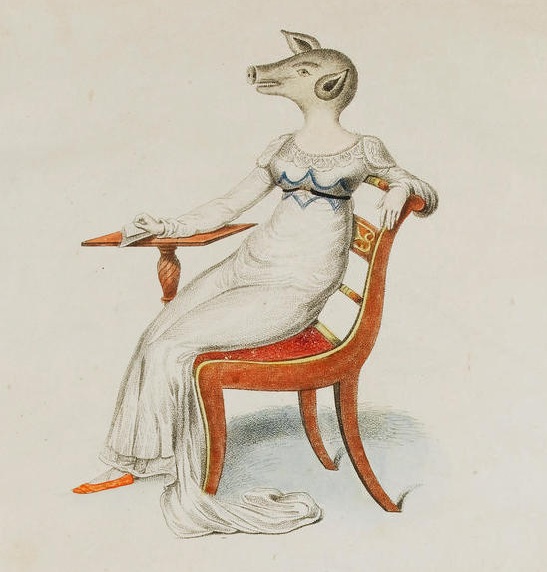
Serious pursuits, uplifting exhibits, and dramatic entertainments had given way to shows and exhibits catering to the lowest common denominator of British fair-goers tastes – conjurers, wild beasts, monsters, learned pigs, dwarfs, giants. A prodigious monster with one head and two distinct bodies, a woman with three breasts, a child with three legs. A mermaid with a monkey’s head and the tail of a fish. Puppet shows, pantomimes, and coarse melodramas. A pig-faced lady and a potato that looked like King Henry VIII.

Eventually the fair grew less curiouser and curiouser, and on August 24, 1850, when the mayor went as usual to proclaim the opening of the fair, he found nothing to make it worth the trouble. No mayor went after that, and in 1855 the fair rolled over and expired.

I went to the animal fair,

The Birds and the Beasts were there.
The big baboon, by the light of the moon,
Was combing his auburn hair.
The monkey, he got drunk,
And sat on the elephant’s trunk.
The elephant sneezed and fell on his knees,
And what became of the monk, the monk?
The monk, the monk, the monk.

— Minstrel Song

AUGUST 23, 1618: THIS LITTLE PIG HAD ROAST BEEF

There is no dearth of stories in the realm of pig-faced lady literature; a 17th century Dutch account typifies the genre. This particular pig-faced lady was born at Wirkham on the Rhine in 1618. Her name was Tanakin Skinker. Miss Skinker was a near perfectly formed little girl – one might say beautifully constructed – except that her face (some say her entire head) was that of a swine. She was a dead ringer for a pig.

     The child grew to be a woman and a source of great discomfort to her parents, for although her disposition and carriage were in general unoffending, her table manners fell a bit short of those desirous in a lady. Her voracious and indelicate appetite was appeased by placing large amounts of food in a silver trough to which she would vigorously apply her entire face, accompanied by grunts, snorts and squeals. The maid who served her had to be paid handsomely for enduring this and risking her limbs to the wildly snapping jaws.

     A fortune awaited the man who would consent to marry Miss Skinker, and many suitors came calling, gallants from Italy, France, Scotland, and England – fortune hunters all, naturally – but ultimately they all refused to marry her. Were there no pig-faced men in the world?  Or even a dog-faced boy?  Apparently not, at least not one who saw himself as such.

     In this particular account, our pig-faced lady was sadly left to die an old maid (or sow, if you prefer). Other accounts have happier, if less likely, conclusions. The woman’s pig-like appearance was the result of witchcraft.  A husband was found, and he was granted the choice of having her appear beautiful to him but pig-like to others, or pig-like to him and beautiful to others. When the husband told her that the choice was hers, the enchantment was broken and her pig-like appearance vanished. And in some modern accounts, the pig-faced lady is abducted by aliens.