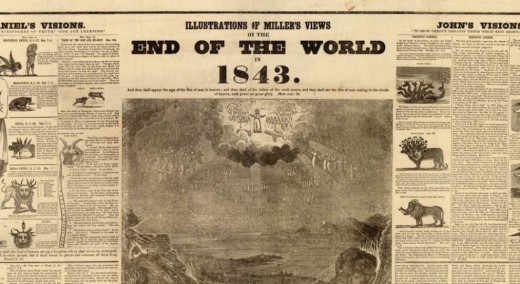
October 22, 1844: The Great Disappointment

One would think one would learn a lesson from the misfortunes of Michael Stifel and not be so quick to go predicting the end of the world. But no, there seems to be an endless queue of folks wanting to give it a go (these same people go to the track and bet only daily doubles or trifectas). William Miller might well be the most famous (or infamous) of these Jeremiahs. He reached the front of the line in the 1840s, some 500 years after the Stifel debacle.

Miller preached his doomsday story to a large group of followers known, strangely enough, as Millerites. At least Miller didn’t get as specific as Stifel, predicting the exact date and time of the finale. Miller hedged his bets a bit, calling for the long-awaited Second Coming and the great big beautiful bonfire to take place sometime between March of 1843 and March of 1844. He publicized the event with posters, speeches, pamphlets and tweets (no, strike that last one). As a result, he convinced 100,000 true believers to unload all their stuff and head up to the mountains to usher in the Apocalypse.

Well, they waited. And waited. 1843 became 1844. March came in like a lion and went out like a lamb. Miller recalculated and set a new date for the final comeuppance: April 18. April showers brought May flowers, but not much else. Did our plucky prophet of doom fold up his tent? No way. Another recalculation, another date. October 22, and you can take that to the bank. The Millerites, who by this time should have been used to having their expectations dashed, went once more to the mountains.

October 22, 1844: Oh somewhere in this favored land, the sun is shining bright, the band is playing somewhere, and somewhere hearts are light, and somewhere men are laughing, and somewhere children shout; but there is no joy on the mountain — William Miller has struck out.

In some religious circles, October 22, 1844, is known as the Great Disappointment.

SEPTEMBER 17, 1908: FLYING TOO HIGH WITH SOME GUY IN THE SKY

It had been about five years since Wilbur and Orville Wright made history with their airplane flight at Kitty Hawk, North Carolina. During the following years, the brothers developed their flying machine into the first practical fixed-wing aircraft, the Wright Flyer. And in 1908, Orville took the Flyer flyerto Fort Myer, Virginia, to demonstrate it for the US Army Signal Corps division.

     Lieutenant Thomas Selfridge arranged to be a passenger on the demonstration flight while Orville piloted the craft.  Selfridge might be considered one of the first frequent flyers. Selfridge took his first flight in 1907, a flight that took him 168 feet in the air above Bras d’Or Lake in Nova Scotia, Canada. He also piloted a Canadian craft that flew three feet off the ground for about 100 feet.  He next took to the air in Hammondsport, New York, traveling 100 feet on his first attempt and 200 feet on his second. The next day he added another 800 yards to his mileage credit. A successful flight with Orville would no doubt have given him an upgrade if not a free flight.

     On September 17, 1908, Selfridge and Orville circled Fort Myer in the Wright Flyer 4½ times at 150 feet. Halfway through the fifth go-round, the right propeller broke, losing thrust. A nasty vibration ensued, causing the split propeller to hit a guy wire bracing the rear vertical rudder. Luggage flew out of the overhead storage compartments; the wire tore out of its fastening and shattered the propeller; the rudder swiveled and sent the Flyer into a nose-dive. Orville ordered Selfridge to return to his seat and fasten his seat belt. Then he shut off the engine and managed to glide to about 75 feet, but the Flyer hit the ground nose first — not a smooth landing.

     Orville was bruised and quite embarrassed.  His passenger was unfortunately dead, the first ever airplane fatality.  If Selfridge had been wearing a helmet of some sort, he most likely would have survived the crash. The fatality also saddled the fledgling flying industry with a pretty poor safety track record – one death per 2,500 passenger-feet,  just slightly better than traveling on the back of a hungry lion.


September 16, 1732: How Hot Is It?

Some people find their true calling early on in life, some take a good part of their lives to find it and fahrothers never find it.  A young man named Gabriel who lived in Danzig around the turn of the 18th century took some time to find his calling. Starting out as a merchant, Gabriel found himself ill-suited as an entrepreneur; every business he touched failed.

     Stand-up comedy didn’t work so well either. If anyone were foolish enough to rise to the bait of Gabriel’s opening remarks about how hot it had been with the question “How hot is it?” they didn’t even get the mediocre chuckle of “It’s so hot that my chickens are laying hard-boiled eggs” or “It’s so hot that even Mitt Romney seems cool.” Gabriel might answer, “On a scale of 32 to 212, I’d give it a 92.” Yawn.

     But hidden in his failure as a comedian was success of a sort – he had actually constructed the device that measured the temperature of which he joked. Up until that time all measurements of temperature were as vague as “hot as a basted turkey” or “cold as a Republican’s heart.” Many a scientist – including Isaac Newton – had tried to develop a means of measuring the temperature. Gabriel had done it – and had found his calling.

     At first, he made his temperature measuring devices using wine-filled tubes, but he couldn’t achieve any degree of accuracy and someone was always drinking the contents of his thermometer. Switching to mercury solved both problems. He marked the tube at the point where the mercury stood when the tube was placed in freezing water and again at the point it reached in boiling water. The freezing point became 32 degrees (his lucky number, perhaps). He then divided the space between that and the boiling point into 180 parts (something to do with half a circle). It was just mysterious enough that it caught on, and it became oh so trendy to measure the temperature of things.

     His thermometer took his name, and would from then on be known as the Gabriel. Well it might have been, but his agent insisted that his last name, Fahrenheit, was much more scientific sounding. Even after Gabriel Fahrenheit’s death on September 16, 1736, the Fahrenheit Thermometer remained the standard by which temperature was measured, used by everyone except some guy from Stockholm named Celsius.

A Harvard Medical School study has determined that rectal thermometers are still the best way to tell a baby’s temperature. Plus, it really teaches the baby who’s boss. — Tina Fey

SEPTEMBER 15, 1907: IT WAS BEAUTY KILLED THE BEAST

W.C. Fields cautioned against working with children or animals because they’re sure to steal the scene. You might say the same about a 50-foot gorilla. But scream queen Fay Wray had the big guy eating out of the palm of her hand (actually she spent quite a few scenes in the palm of faywrayhis hand). Born Vina Fay Wray on September 15, 1907, she became well-known for her roles in a series of horror movies, spanning the evolution from silent to talkie. But it was her role as the love of King Kong’s life that remained her primary claim to fame throughout a 57-year career in both movies and television.

In 2004, Peter Jackson approached her for a cameo in his remake of King Kong. She turned down the role, saying that the first Kong was the true King (Long live the King). Fay Wray died in her sleep that same year, before filming of the remake had begun.

Two days later, the Empire State Building went dark for 15 minutes in her memory.

King Kong had more than its share of “you’re going to regret saying that” lines, such as:

“Yeah, but what’s on the other side of that wall; that’s what I wanna find out.”

“He’s always been king of his world, but we’ll teach him fear.”

“Suppose it doesn’t like having its picture taken?”

Working the Little Gray Cells

In 1920, a new detective appeared upon the literary scene.– a former Belgian police officer with twirly “magnificent moustaches” and an egg-shaped head. Hercule Poirot debuted in The Mysterious Affair at Styles, the first novel by Dame Agatha Christie, “the Queen of Crime,”agatha born on September 15, 1890. It is one of 66 detective novels and 14 short story collections featuring the Belgian detective and several other characters, most notably Miss Marple.

Christie’s career was full of superlatives. She is the best-selling novelist of all time, over 2 billion copies of her books having been sold. Her books are the third most widely-published in the world, trailing only Shakespeare and the Bible. And Then There Were None is the best-selling mystery ever — 100albert_finney_plays_poirot million copies thus far. The Mousetrap is the longest running stage play with more than 25,000 performances and still running. The Murder of Roger Ackroyd was named the best crime novel ever by the 600-member Crime Writers’ Association.

Hercule Poirot appeared in half of Christie’s novel and in 54 short stories. By midway through her career, she was finding him “insufferable.” And by the 1960s she described him as an “egocentric creep.” Finally in the 1975 novel Curtain, she disposed of him (although the book was written many years earlier and stored in a bank vault for publication at the end of her life). Most of her books and stories have been adapted for television, radio and movies.

Agatha Christie died in 1976.


It is the brain, the little gray cells on which one must rely. One must seek the truth within–not without. ~ Hercule Poirot

SEPTEMBER 12, 1970: TURN ON, TUNE IN, DROP OUT

Richard Nixon called him the most dangerous man in America, an honor usually reserved by Republicans for figures such as Charles Darwin and Barack Obama. Timothy Leary wasn’t always so “dangerous.” He had a distinguished military service and academic psychology career timothy-leary-until he started thinking way outside the box, promoting the therapeutic use of psychedelic substances. It was your basic slippery slope, as he quickly evolved during the wild and woolly 60’s to a self-described performing philosopher and hippie guru. He used LSD himself and developed a philosophy of mind expansion and personal truth through LSD with such heady concepts as space migration and intelligence increase. Eventually, it was all about turning on, tuning in, and dropping out.

As a result, Leary also came to spend more time in jail than out of it, becoming intimate with 36 prisons throughout the world. In January 1970, he received a 20-year prison sentence for a pair of earlier transgressions. Upon his reporting for prison duty, Leary was given a series of psychological tests meant to help determine what work duties he was suited to. Having himself designed such tests, he found it quite easy to manipulate the results so that they would show him to be a model citizen with an interest in forestry and gardening, pursuits that would conveniently keep him out of doors.

Leary was assigned to work as a gardener in a minimum security prison. On September 12, 1970, leaving a farewell note, he climbed over the prison wall along a telephone wire to a waiting pickup truck supplied by the Weather Underground. For $25,000 (paid by the Brotherhood of Eternal Love), the weathermen smuggled Leary and his wife out of the United States and into Algeria. From there, they traveled to Switzerland, Vienna and Beirut. In 1972, they headed for Afghanistan which had no extradition policy with the U.S. Unfortunately, they traveled aboard an American airline, and were arrested before they could deplane.

Leary was returned to prison where he remained until his release in 1976. He died in 1996.

Come Together

“Come Together,” written by John Lennon, became a big hit for the Beatles and an anti-war anthem. It was originally written as a campaign song for Timothy Leary’s aborted run for governor against Ronald Reagan.

Said Lennon: “The thing was created in the studio. It’s gobbledygook; “Come Together” was an expression that Leary had come up with for his attempt at being president or whatever he wanted to be, and he asked me to write a campaign song. I tried and tried, but I couldn’t come up with one. But I came up with this, “Come Together,” which would’ve been no good to him—you couldn’t have a campaign song like that, right?”

Murray Middlebury Has an Affair, Part 1: Healthy, Wealthy and Wise

Murray Middlebury downed the last of his daily bran flakes as his wife Lenora looked on approvingly. “Good fiber,” she would frequently intone, giving blessing to their morning ritual of oat bread, bran flakes, and decaffeinated coffee. “To our health,” Murray would often quip in reply as they clinked together their glasses of V-8.

Bacon never found itself on the Middlebury table, for the Middleburys, a classic 21st century health-conscious couple, had forsaken all things animal in their quest for immortality or whatever it is that is the holy grail of 21st century health consciousness. Beef was banished, pork proscribed; even chicken was cast off.

Murray sometimes jokingly referred to Lenora as the bean queen for the innovative ways she could feature the lowly legume. To their credit, their diet and program of daily exercise did leave them fit and trim. Murray’s position as an actuary and Lenora’s as a CPA gave them a good household income. And the Middleburys exercised their minds as well as their bodies, reading the right books and associating with the likes of Bach, Brahms, and Mahler.

In short, the Middleburys were healthy, wealthy, and wise – sure candidates for living happily ever after. But Murray had a dirty little secret. He was about to have an affair.

“You’re remembering, dear,” said the imperfect half of the perfect pair, “that my men’s discussion group is having its first meeting tonight.”

“And you won’t be home for dinner,” said Lenora, showing obvious concern for his well-being.

“No, but I’ll take a couple of extra apples with me,” said Murray. “We’re discussing Pilgrim’s Progress.”

“How lucky for you that you read it just last year.”

“Yes,” Murray agreed, with a smile.

continued


This story originally appeared in Hemispheres, the United Airlines magazine. It is included in Naughty Marietta and Other Stories.


SEPTEMBER 6, 1899: Is Your Cow Really Happy?

Elbridge Amos Stuart was a man who knew his cows. He learned cows on his father’s farm in North Carolina and carried that knowledge into his own adult enterprises. Eventually he went west, young man, finding his way to the state of Washington where on September 6, 1899, he founded a company that was all about cows and a new process that evaporated the milk from those cows and canning it, thus creating a sanitary milk product that required no refrigeration.

The business grew, and he gave it a new identity, the Carnation Evaporated Milk Company (the name taken from a box of cigars he had seen in a tobacco shop window).  Then in 1907 he introduced the promotional slogan that would from then on be the company’s mantra: “Carnation, the milk from contented cows.”

And were those cows contented. Stuart’s conviction that the best milk came from cows that were healthy, wealthy and wise was the company’s guiding principle. And Stuart didn’t just fall off the turnip truck. Those happy cows were also the most productive. Carnation cows led world milk production for over 30 years. One really contented cow, Segis Pietertje Prospect (Possum Sweetheart to friends), delivered a record 37,381 pints during one year. A statue in Tolt, Washington (now Carnation, Washington) commemorated this achievement.

That’s Some Cow

Possum Sweetheart, a Holstein, achieved her record output in 1920. She was born in 1913 at the Carnation Milk Farms, sired by a bull known as Old Buckshot. The first time her milker (contented cows evidently have personal milkers) milked her, she produced twice as much milk as any of the other less contented cows. And she did it again and again, producing her own weight in milk every three weeks.

Her fame spread. Officials from agricultural colleges throughout the world came to see her. Reporters and photographers reported and photographed. Celebrities and politicians dropped by.

Possum Sweetheart died at the age of 12, five years after her record output. Her offspring were sold to breeders throughout the world, and many of her heifers’ offspring became productive Carnation cows themselves.

Then There’s Elsie

What Contented Cows Listen To

Known throughout his career as the Texas Troubadour, Ernest Tubb was a pioneer of country music who helped to popularize the honky tonk style with his major 1941 hit “Walking the Floor Over You.” His career went on to span another four decades. He died on September 6, 1984.


Sept 5, 1786: Watch it with that Thing, You’ll Poke Someone’s Eye Out

Jonas Hanway who died on September 5, 1786, was well-know in several British spheres — a vice president of the Foundling Hospital, founder of Magdalen Hospital, revolutionizing London birth registration and in charge of “victuallizing” the Navy. On the other hand, he was also known for tirades against tipping and tea-drinking and his support for the concept of solitary confinement.

But what he is most remembered for is bringing the umbrella to Britain. Now the umbrella had been around for a long time. It was invented in China back in the 11th century B.C. It was popular in Greece and Egypt as a sunshade. It was also used in Rome, but when the empire declined and fell, so did use of the umbrella. It was finally reintroduced in the 15th century, and by the 17th century had become quite popular among sophisticated women in France and even some British women. But a man?

Hanway is credited with being the first male Londoner to carry an umbrella, much to the chagrin of hackney coachmen who thought it their proprietary right to protect Londoners from rainfall. For years, they jeered at him with vigor as being a feminine sissy and even worse, a French sissy. But by the time of his death, umbrellas were commonplace throughout London.

Brolliology is of course the study of umbrellas. Of course. Does anyone actually know a brolliologist? What inspires someone to become one? What are their conventions like? We will study the umbrella a little further on September 7, the date of another noted umbrella in history.

Taxi Dancers and Tango Pirates

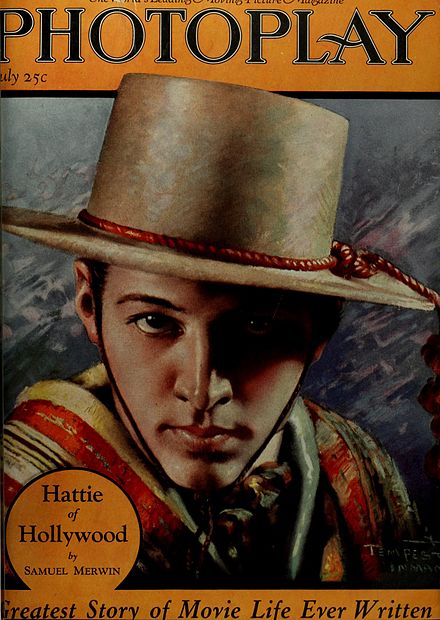
As America roared through the 20s, Hollywood’s fledgling film industry was itself roaring, the screen filled with stars such as Charlie Chaplin, Rudolph_ValentinoDouglas Fairbanks, Greta Garbo, and the roaring MGM lion. Come 1926, a new star would jump to the top of the heap, blazing a trail of sex and seduction. It almost didn’t happen.

Italian born Rodolfo Alfonso Rafaello Pierre Filibert Guglielmi di Valentina D’Antonguolla arrived at Ellis Island in 1913, at the age of 18. The young man who would eventually be known as the Latin Lover Rudolph Valentino took up residence in Central Park and on the streets of New York City. He found work as a taxi dancer (think “ten cents a dance”)at Maxim’s and became a”tango pirate,” a gigolo who sought out wealthy women at dances who were willing to pay for the company of handsome young men.

Valentino developed a relationship with a Chilean heiress who was unhappily married to a wealthy businessman. When she sued for divorce in 1915, Valentino testified that he had evidence of the husband’s having had multiple affairs. The ex-husband didn’t let bygones be bygones and on September 5, 1916, at his instigation, Valentino was arrested and charged with luring a young man into a whorehouse for white slavery. Valentino was jailed for several days before being cleared and released. A short time later the heiress shot her husband, and Valentino thought it wise to exit the scene. He headed to the opposite coast and began his meteoric rise to stardom.


Speaking of Tangoing Pirates

Another devilishly clever segue.

And it only takes one to tango here.

September 4, 1992: They’ll Never Replace Fart Jokes

You’ve got this great idea. Take all those funny home videos people sent you that were too risqué for the TV program Funniest Home Videos and use them to create a brand new TV program called Naughtiest Home Videos. Better still call it Australia’s naughtiestNaughtiest Home Videos because that’s where the racy adult program aired on September 4, 1992.

How racy? Well, there were shots of various animals’ private parts, both animals and humans humorously having sex (which not only begs the question how do you have sex humorously but also blurs the line between human and animal), people losing their clothing in unusual ways, an elderly woman removing an envelope from a male stripper’s skivvies using her dentures, two men lifting a barbell without using their hands . . . well, one could continue listing these hilarious bits but one would be in danger of laughing so hard one would pee one’s pants.

“I’d like to sincerely say that if we’ve offended just one of you, we’ve failed,” said the show’s host returning from the first commercial break. “We were hoping for half a million offended viewers by now.”

It took an agonizing 34 minutes for the network owner, who was enjoying a quiet dinner out with friends, to hear about the program and call the studio to cancel the program or, in his words, “get that shit off the air.” Almost immediately, a network announcer said: “We apologize for this interruption. Unfortunately, a technical problem prevents us continuing our scheduled program for the moment ” and the show made history, being the shortest running television series ever.

The following morning was not a pleasant one for anyone who had had anything to do with airing the program. They were berated loudly and had their careers cut just as short as Australia’s Naughtiest Home Videos.

Rabbits Behaving Badly?

As far as we know, there were no racy bits featuring anthropomorphic rabbits scheduled for the unseen portion of Naughtiest Videos. A much tamer depiction of the same had it’s beginnings a century earlier in a letter written on September 4, 1893, peterrabthat included an illustrated story about a rabbit named Peter. The letter was written by Beatrix Potter to the five-year-old son of her former governess, Annie Moore. Moore suggested that the story be made into a book.

Potter further developed the storyline, added additional illustrations, and in 1901, self-published 250 copies of The Tale of Peter Rabbit. Today with 45 million copies sold it remains one of the most popular children’s books of all time.

You Are So Rare

Howie Morris, born September 4, 1919, ( died 2005) was best known for his portrayal of Ernest T. Bass on the Andy Griffith Show and numerous characters on Sid Caesar’s Your Show of Shows.


SEPTEMBER 3, 1967: Swedish Switcheroo

The countdown to Dagen H (shorthand for Högertrafikomläggningen) had begun some four years earlier when the Swedish parliament passed the enabling legislation that would impact every Swede down in Swedenville. A commission (Statens Högertrafikkommission) would implement a major re-education program under the guidance of a team of psychologists.

On H Day, Sunday, September 3, 1967, at 1 a.m, all nonessential traffic was banned from roads throughout the country and at exactly 4:50, all remaining vehicles would come to a complete stop then carefully move from the traditional left side of the road to the right and stop again, taking care to avoid vehicles on this side moving to their right. At 5, traffic movement would resume with all drivers now (and forevermore) driving on the right side of the road.

The people of Sweden didn’t really want to switch to the right side of the road. They were perfectly happy of the left (being the liberals they are, perhaps) even though many of them drove vehicles with steering wheels on the left, a contributor to many accidents. And their nearest neighbors, Norway and Finland drove on the right. Five million vehicles crossed those borders every year and had to switch sides in the process.

Perhaps that explains the psychologists and all the commemorative items and the Dagen H logos on everything from milk cartons to underwear. There was even a popular song to celebrate the switch –“Håll dig till höger, Svensson” (‘Keep to the right, Svensson’).

And Svensson and all his or her fellow Swedes kept to the right and still do.

Heading South (Driving on the Right, Of Course)

It’s fortunate that the people of San Marino drive on the right, what with it being the only country with more automobiles than people. Not that there are all that many of either. Nestled high in the Apennine Mountains, the Most Serene Republic of San Marino is the world’s fifth smallest country and one of only three surrounded entirely by another country (Italy).

San Marino was founded as a monastic community by Saint Marinus, a Roman stonemason, on September 3, 301, making it the oldest sovereign state still in existence. It is one of the wealthiest countries in the world, with a stable economy, low unemployment, no national debt and a budget surplus. And all those cars.

Infinite Monkeys

Back to Sweden: In Stockholm, the newspaper Expressen gave five stock analysts and a chimpanzee the equivalent of $1,250 each to make as much money as they could on the stock market in one month.

Mats Jonnerhag, publisher of the newsletter Bourse Insight, turned in a nice performance. His stock portfolio gained $130. Not good enough. The stock-picking chimp (who went by the name Ola) saw the value of his portfolio climb by $190 for an easy victory.

While the stock experts carefully assembled their portfolios using a variety of analytical tools, Ola put aside such things as price/earnings ratios, volatility measures and technical factors in favor of darts, which he tossed at the Stockholm Stock Exchange listings.

Naysayers will no doubt bring up the infinite monkey theorem: that an infinite number of monkeys with an infinite number of typewriters and an infinite amount of time could eventually write the works of Shakespeare. Or the lesser quoted corollary that seven monkeys with seven typewriters in seven weeks could write the Republican Party Platform.

In a reported real-life attempt to prove either of these theories, two chimpanzees and an orangutan were put in a room with three typewriters. By the end of just 24 hours, they had written “jid;lwer fivcjfdoske flfjwlsjfpos p3mzds[sk,43l;cv kdid,ewodkdjss;djelldsd kdjhdps ddodlsps psvvspap39djk3^jh& jfioermcjd,ud3$m kidelqqwerty” Even more amazing: They had used exactly 140 characters which they tweeted (using the orangutan’s twitter account). It went viral.


You wouldn’t believe how many monkeys on how many beaches it took to create the stories in Calypso: Stories of the Caribbean.  Why not procure a copy and figure it out.

SEPTEMBER 2, 44 BC: O Tempora, O Mores

Some 2,000 years give or take before our current leader (?) kicked up his first tweetstorm another statesman/orator/philosopher launched the Roman equivalent of a tweetstorm. On September 2, 44 BC, Marcus Tullius Cicero delivered the first of a series of speeches known as the Philippics (or Philippicae in Latin) hectoring his favorite enemy Mark Antony.

As every schoolchild knows, a group of unhappy Roman senators had removed Julius Caesar from office a year earlier. Cicero had not taken part in the affair, but he heartily approved of it. In a letter written afterward, he said: “How I wish that you had invited me to that most glorious banquet on the Ides of March!”
Cicero was not a fan of Caesar’s protege, Mark Antony, either. He was convinced that Antony was planning revenge upon the Ides gang. Cicero’s attacks on Antony rallied the Senate in his favor and established him as the leading politician of his age.

Antony did not take these insults lightly (Cicero had called him a sheep and said he had small hands). He and his supporters prepared to march on Rome and “lock him up, lock him up,” forcing Cicero to hit the road.  But to no avail; Cicero was intercepted and executed.

“O tempora! O mores!” (Oh what times. Oh what standards.)

O Tempora, O Swine

Another Cicero might be more familiar to a lot of us. That would be Cicero Pig, a diminutive version of his famous Uncle Porky. He first appeared in the cartoon “Porky’s Naughty Nephew” as a bit of a brat. He was called Pinky at the time, then Algernon, and finally Cicero. He never went by the name Marcus Tullius, and no one ever called Marcus Tullius Pinky — although Mark Antony probably would have had he thought of it.

Never try to teach a pig to sing; it wastes your time and it annoys the pig.  — Robert Heinlein

Carry a Big Shtick

Vice President Theodore Roosevelt was somewhat of an orator himself.  He delivered a speech at the Minnesota State Fair On September 2, 1901 in which he publicly used the phrase with which he would always be associated:  Speak softly and carry a big stick; you will go far.  Four days later, President William McKinley was shot by an assassin and following his death eight days later, Roosevelt became President.

My father always wanted to be the center of attention.  When he went to a wedding, he wanted to be the bridegroom.  When he went to a funeral, he wanted to be the corpse. — Alice Roosevelt Longworth