November 25, 287: Some of My Best Friends Were Martyrs

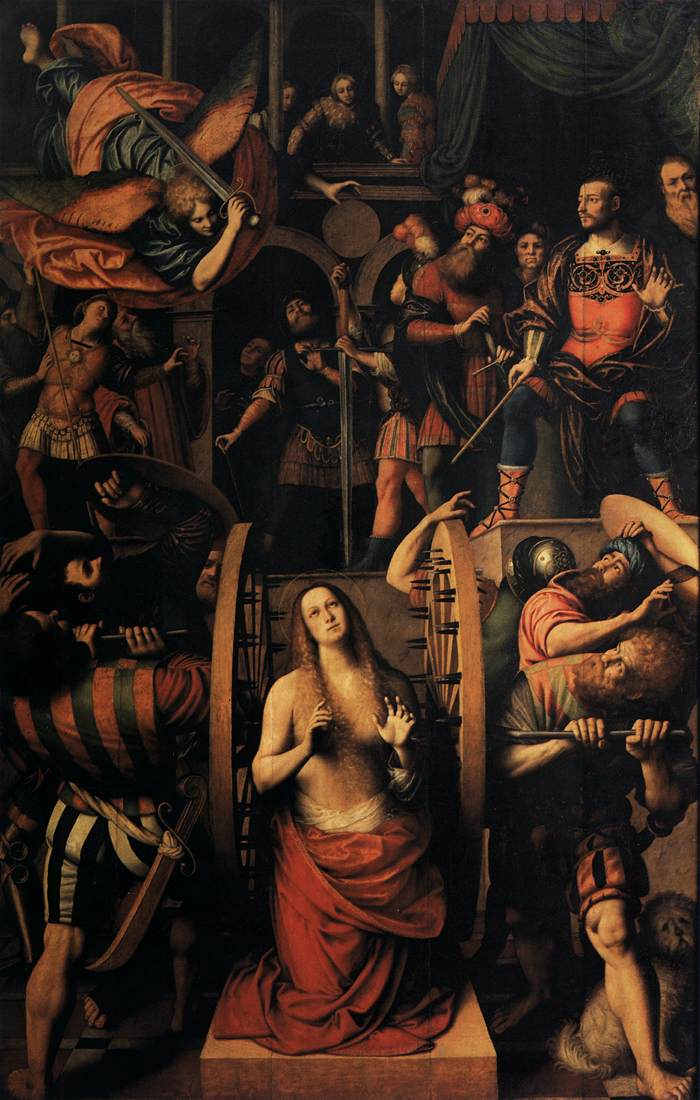
November 25 marks the feast of St. Catherine of Alexandria who was born in 287.  As a young teenager, Catherine was evidently pretty, witty and wise. Devoting herself to an uncharacteristic amount of study for a teenager, she found herself lured into the ways of Christianity, which was not a particularly popular pursuit at the turn of the 4th century. In fact, the evil emperor Maxentius was quite put out by her piety, particularly when she called him on his cruelty, right to his face.

Not only that, he was obsessed enough with her religiosity that he summoned fifty noted pagan philosophers to convince her that her religion was a passing fad.  But didn’t she whup them good in all their debates. In fact, she argued her case so eloquently that many of them converted. They were of course immediately put to death.

Maxentius then had Catherine thrown into prison, where she continued to convert those who came to visit her. He had her tortured, and when that yielded no results, he took the next logical step and asked her to marry him. She refused, giving him the excuse that she wanted to remain a virgin and telling him they could remain friends (if he’d give up the cruelty). This really annoyed him so he condemned her to death on a spiked breaking wheel. When she touched the wheel, however, it shattered, a bit of a miracle for which she would always be remembered by the nickname St. Catherine of the Wheel. Unfortunately, she was beheaded shortly thereafter (at least never being given the sobriquet St. Catherine the Headless).

As a dead virgin, a martyr, and then a saint, her popularity grew steadily, and she was eventually named one of the fourteen most helpful saints in heaven.  As such, she is the patron saint to all sorts of people — potters and spinners (think wheel), unmarried girls and/or virgins, mechanics, knife sharpeners, librarians, milliners and philosophers to name just a few. The latter sought her help to sharpen their minds, guide their pens, and bring eloquence to their words.

Obviously, Wretched Richard’s Almanac got no such help.
November 24, 1859: Insulting Monkeys

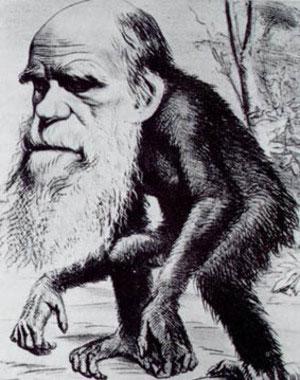
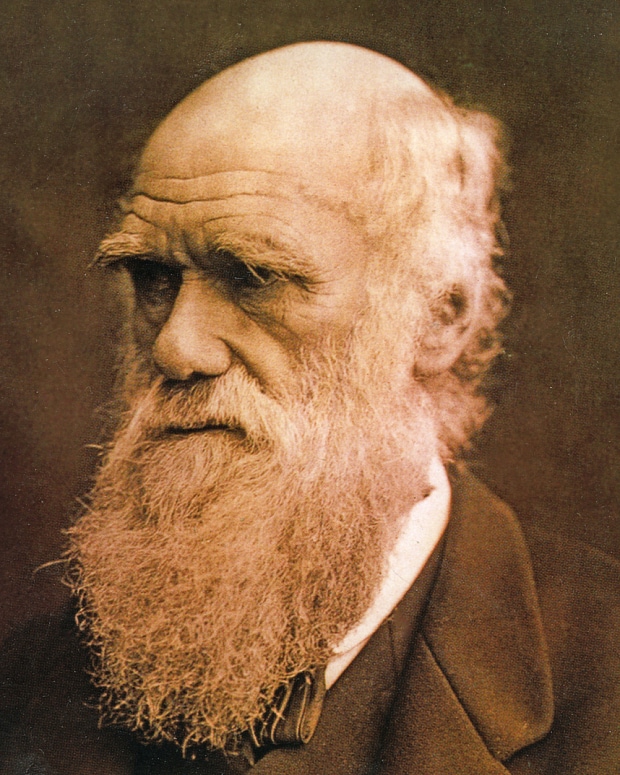
Charles Darwin was not expecting a seismic event when on November 24, 1859, he introduced a little volume with the catchy title On the Origin of Species. Although it didn’t go viral at the time, the printing run of 1,250 copies did sell out.  A few more have sold since then.

In his book, Darwin suggested that all species of life have descended over time from common ancestors.  That sounds a lot like a plug for family values, but weren’t people upset anyway.  Although Darwin’s only allusion to human evolution was a cryptic “light will be thrown on the origin of man and his history,” the title of his book might just as well have been Men from Monkeys because that’s what detractors brought away from it.  And any attempt on the part of scientists to explain that it’s not about that pretty much put people to sleep.  Even though enlightenment eventually crept into the scientific community, to many others Darwin became forever the symbol of runaway science.  Were he alive today, he’d probably be conspiring with the 99 percent of scientists involved in the vast climate change hoax.

What is Man? Man is a noisome bacillus whom Our Heavenly Father created because he was disappointed in the monkey. ― Mark Twain

New Rule: Stop asking Miss USA contestants if they believe in evolution. It’s not their field. It’s like asking Stephen Hawking if he believes in hair scrunchies. Here’s what they know about: spray tans, fake boobs and baton twirling. Here’s what they don’t know about: everything else. If I cared about the uninformed opinions of some ditsy beauty queen, I’d join the Tea Party. ― Bill Maher

It is even harder for the average ape to believe that he has descended from man. ― H.L. Mencken

Organic life, we are told, has developed gradually from the protozoan to the philosopher, and this development, we are assured, is indubitably an advance. Unfortunately it is the philosopher, not the protozoan, who gives us this assurance. ― Bertrand Russell

November 23, 534 BC: Another Opening, Another Show

Back in the 6th century BC, Greek theatrical performances were generally dithyrambs, choral offerings featuring stories from mythology sung by a chorus of anywhere from a dozen to fifty singers. They usually wore masks and might even dance a little. Whatever they did, they did in lockstep.

Then on November 23, 534 BC, a member of one of these choruses, Thespis of Icaria, stepped out of the anonymity of the chorus and spoke several lines not as himself, but portraying the character of the Greek God Dionysus. Well, this had never been done before. No one had ever assumed the character of another person for storytelling. Thespis thus became the world’s first actor.

This new idea quickly caught on, and individual actors began to portray different characters in their stories which they now called tragedies. Pretty soon scores of Greeks were saying to each other “Gee, we could put on a play in Farmer Brown’s barn.” And taking their tragedies on the road.

Thespis was the most popular actor of the day, winning the first wooden horse for best actor in a tragedy. And he took his shows on the road, carrying with him costumes, masks and props from town to town. This made him not only the father of theater but also the father of theatrical touring. And actors throughout history have called themselves Thespians in his honor.

Let’s Get a Recording of That Greek Chorus

The scene is the Palais Royale Saloon in San Francisco, November 23, 1889. Entrepreneur Louis Glass has installed a machine destined to become an overnight sensation, and find a permanent spot in the psyche of the nation, even the world. He called his device the “nickel-in-the-slot player” a name that would certainly need a bit of massaging in the future.

What it played was music. Inside a handsome oak cabinet was an electric phonograph.  Four stethoscope-like tubes were attached to it, each operating individually after being activated by the insertion of a coin. Four different listeners could be plugged into the same song at the same time! In a nod to sanitation, towels were supplied to patrons so they could wipe off the end of the tube after each listening.

The success of the “nickel-in-the-slot player” eventually spelled the demise of the player piano, then the most common way of providing popular music to saloon patrons, notorious for their love of music.

Most machines were capable of holding only one musical selection, the automation coming from the ability to play that one selection at will. Obviously, after each patron had listened to that one song several times, the novelty wore off and the player went idle. In 1918, another entrepreneur solved that problem with an apparatus that automatically changed records. Ten years later, enter Justus P. Seeburg, who combined an electrostatic loudspeaker with a coin-operated record player that gave the listener a choice of eight records.

This machine was pretty cumbersome: it had eight separate turntables mounted on a rotating Ferris wheel-like device, allowing patrons to select from eight different records. Later versions included Seeburg’s Selectophone, with 10 turntables mounted vertically on a spindle. By maneuvering the tone arm up and down, the customer could select from 10 different records.

There was still no decent name for these devices. That came in the 1940s, when person or persons unknown dubbed it a jukebox, a reference to juke house, slang for a bawdy house, a favorite location for the devices. All that remained necessary in the evolution of the jukebox was the addition of a healthy helping of rock and roll.

November 22, 1928: Au Fou, Au Fou

Russian dancer and actress Ida Rubenstein convinced her friend Maurice Ravel to write her a Spanish flavored ballet in 1928. The composer had long considered the idea of structuring an entire composition around a single theme. The theme came to him on a vacation a few month’s later. He sat at a piano playing a melody with one finger. As he played, he said to a friend: ‘Don’t you think that has an insistent quality? I’m going to try to repeat it a number of times without any development, gradually increasing the orchestra as best I can.”

Bolero was born. It was performed on November 22, 1928, at the Paris Opera. The 15-minute work was received with thunderous acclaim — cheering, shouting, foot stomping. One woman was heard screaming “Au fou, au fou!” (the madman, the madman). Ravel’s reaction, when told of it: “That lady, she understood.”

Rarely staged as a ballet in later years, Bolero became Ravel’s most popular work, although he considered it one of his least important. “Once the idea of using only one theme was discovered,” he said, “any conservatory student could have done as well.”

Time Flies Like an Arrow

Robin Hood has been celebrated through story, song and film as that charming rogue who, along with his merry men, robbed from the 1 percent and gave to the 99 percent, a nobleman cheated out of his birthright by the nasty Sheriff of Nottingham, a patriot in service to Richardrobin hood the Lionhearted, fighting the villainy of that usurper Prince John.

To the consternation of the authorities, Robin Hood and his merry gang carried out their trade for a number of years.  But as Robin Hood ushered in his 87th year, his arrows began to get a little wobbly and off-target. He increasingly felt the infirmities of his age, and was eventually convinced to seek medical attention at the local nunnery. The prioress evidently took an instant dislike to the merry old man, which she vented by opening up an artery and allowing him to bleed to death. The date of his demise is reckoned to be November 22, 1247.

But before he turned his toes completely up, Robin realized that he was the victim of treachery (flowing blood will do that), and he blew a blast on his bugle (kept handily at his bedside for just such a situation). This summoned his compatriot Little John who forced his way into the chamber in time to hear his chief’s last request. “Give me my bent bow in my hand,” he said. “And an arrow I’ll let free, and where that arrow is taken up, there let my grave digged be.” Rhyming right to the end. Which came just after he shot the arrow through an open window, selecting the spot where he should be buried. Which he was.

November 21, 1931: It’s Alive, It’s Alive

On the screen, a man steps from behind a curtain to tell us we are about to see “one of the strangest tales ever told. It deals with the two great mysteries of creation; life and death. I think it will thrill you. It may shock you. It might even horrify you. So, if any of you feel that you do not care to subject your nerves to such a strain, now’s your chance to uh, well,––we warned you!!”

It’s November 21, 1931, and the warning is all about Frankenstein, the gothic horror film based on the novel by Mary Shelley. There have been countless films over the years featuring the famed monster but this one is the daddy of them all. Audiences and critics all loved it, and it, along with Dracula released earlier in the year, saved Universal Pictures.

The story is well known. Young Henry Frankenstein has this notion. He wants to create a living being from dead spare parts, mostly stolen. Perhaps he played Mr. Potatohead too often as a child. Things move along swimmingly until the time comes to give the creation a brain. Frankenstein’s assistant, Fritz the Hunchback, botches the brain acquisition, dropping the good brain and substituting a bad brain for it. The assembled creature is brought to life amid an amazing display of electrical pyrotechnics and shouts of “It’s alive!”

Karloff (without the Boris) is both frightening and sympathetic as the monster.  He kills a lot of people. It’s not that he’s really bad, he’s just misunderstood. Nevertheless, the villagers form a mob and hunt him down, trapping him in a windmill and setting it ablaze.

One of the most famous and controversial scenes was cut from the original and not restored until the 1980s:

Humor He Wrote

American humorist Robert Benchley died on November 21, 1945, (born 1889) after a writing career that took him from the Harvard Lampoon to Vanity Fair and The New Yorker. Although he described himself as not quite a writer and not quite an actor, he enjoyed success as both. His topical and absurdist essays, particularly at The New Yorker gained him both recognition and influence. He was also one of the members of the group that made up the fabled Algonquin Round Table.  As a character actor, he appeared in such films as You’ll Never Get Rich, Bedtime Story, the Crosby/Hope Road to Utopia, and Alfred Hitchcock’s Foreign Correspondent.

benchley

It took me fifteen years to discover that I had no talent for writing, but I couldn’t give it up because by that time I was too famous.

A dog teaches a boy fidelity, perseverance, and to turn around three times before lying down.

I have tried to know absolutely nothing about a great many things, and I have succeeded fairly well.

After an author has been dead for some time, it becomes increasingly difficult for his publishers to get a new book out of him each year.

Dachshunds are ideal dogs for small children, as they are already stretched and pulled to such a length that the child cannot do much harm one way or the other.

November 20, 1952: Hi, I’m a Stranger in These Parts

George Adamski had his first close encounter of the weird kind in November 1952 when he and a few friends were out in California’s Colorado Desert. There they saw what appeared to be a George_Adamski_ship_1large submarine hovering in the sky. Adamski for some reason believed the ship was looking for him (or maybe for an ocean) and, leaving his friends, went off to greet it.

A bit later, Adamski returned to report that the ship had landed, and its pilot had disembarked and greeted him. The visitor was an outgoing alien who introduced himself as a Venusian named Orthon. He did not ask to be taken to Adamski’s leader. Orthon was a humanoid of medium height with long blond hair and sported a great tan for the time of year. He wore reddish-brown Thom McAns and rather unfashionable trousers.

Adamski said Orthon chatted using telepathy and hand signals while talking very loudly, each assuming the other was deaf. Then the engaging Orthon took Adamski on a quick sightseeing trip of the Solar System, including his home planet Venus, where the late Mrs. Adamski just happened to have been reincarnated. Ever the tourist, Adamski tried to take pictures, but Orthon turned all camera shy and refused to allow himself to be photographed. But he agreed to take a blank photographic plate and promised to return with an autographed picture.  True to his word, Orthon returned the plate a few weeks later, but it only contained a bunch of strange symbols. Piqued, Adamski surreptitiously took a picture of Orthon’s space ship, a photo that afterward became famous in ufology circles.

Although Adamski’s tale seemed a bit much for some naysayers, Adamski had a letter he received in 1957 from the Cultural Exchange Committee of the U.S. State Department corroborating that Adamski had spoken to extraterrestrials in a California desert in 1952. Adamski frequently waved this letter around to support his claims.

Unfortunately, in 2002 some spoil-sport ufologist revealed that the letter was a hoax, that it had probably been written by those Communists who were everywhere in the State Department during the 50s.

November 19, 2001: Thomas Crapper Would Be Proud

This is true stuff; the Almanac does not make this stuff up.  November 19 is World Toilet Day. The day was chosen because it is the anniversary of the founding of the World Toilet Organization (WTO), a global non-profit organization committed plunging-toiletto improving toilets worldwide. Founded in 2001 with just 15 visionary members, WTO now boasts 151 member organizations in 53 countries working to eliminate the suppression of toilet talk in polite circles and to bring the toilet out of the shadows of sinks and bathtubs, giving it its own well-deserved recognition.


Sad but true: more money is spent throughout the world on toiletries than is spent on toilets. (Toiletries are not off-trail facilities for hikers.)


In 2005, WTO created the World Toilet College (WTC), the only institution of higher education devoted to toilet design, maintenance, sanitation and use. The WTC is the first and only institution that addresses the needs of both urban and rural toilets (outhouses, presumably) in a holistic manner. The college also seeks to foster a positive image of toilets everywhere, eschewing the use of such mealy-mouthed euphemisms as lavatory, latrine, water closet, rest room, comfort station, powder room and little boys’ and girls’ rooms.

Annual WTO conventions are surely a laugh a minute.

In 2009, a new website was launched dedicated to the celebration of World Toilet Day. Its 2012 slogan was “I give a shit, do you?

November 18, 1307: Fun with Apples

It is the dawn of the 14th century and the hundredth anniversary of Austrian rule over Switzerland. Every little Heidi up in Heidiville and william tellevery one of her goats are under the cruel dominion of the Habsburgs. It is November 18, 1307, and a legend is about to be born.

It’s a day of grand celebration for the Austrians (the Swiss, not so much). Soldiers sing of the glories of the Emperor and his appointed local despot Gesler. The evil Gesler has had his hat placed on top of a pole, forcing the Swiss to bow and scrape and generally pay homage to the hat – one of those silly felt things with a feather in it. Gesler also commands that there should be dancing and singing to mark the century during which the Austrian empire has dominated the 98-pound weaklings of Switzerland. Gioachino Rossini and his Italian Racals are on hand to provide appropriate music.

Among the Swiss that day is one William Tell, known among his compatriots as a strong man, a mountain climber, and a whiz with the crossbow. Well, doesn’t Tell pass right by that hat, refusing to bow to it. And doesn’t his son (like father. . .) do just the same. Gesler is really put out and has the pair arrested.  Aware of Tell’s amazing marksmanship, Gesler devises an ingenious punishment: Tell must shoot an apple off the head of his son. If he refuses, they both will be immediately executed. At this point, you can cut the tension with a Swiss Army knife. Rossini strikes up the band.  As every schoolboy knows (if you don’t know, go find a schoolboy), Tell splits the apple with a single bolt (that’s an arrow) from his crossbow. Rossini’s Rascals break into a rollicking version of the William Tell Overture. (In the Lone Ranger, this same music was used to introduce the scene where Tonto shoots an apple from kemo sabe’s head.)

Ah, but sharp-eyed Gesler notices that Tell has taken not one but two crossbow bolts from his quiver. Gesler quizzes Tell, who answers that if he had killed his son, he would have used the second bolt on Gesler himself. Well, Gesler is now pretty pissed and has Tell carted off to prison.

Crossing Lake Lucerne, prison-bound, the soldiers, afraid their boat will founder, release strongman Tell to steer. Tell escapes, tracks down Gesler, places an apple on his head, and misses it by just that much. He shouts out, “Hi yo Switzerland,” Heidis and goats frolic on hillsides, Swiss watches begin keeping perfect time, and the Swiss Confederation is born.

November 17, 1968: A Girl, a Goat and a Football

The New York Jets were leading the home team Oakland Raiders by a skinny three points, 32-29, on the afternoon of November 17, 1968. NBC was airing the game for sports fans throughout the country.heidi1 It was a game between two formidable adversaries, and a hard fought one. The intensity of the play had led to injuries, penalties, extra timeouts and lots of scoring, with the lead changing eight times. As a result, the game ran longer than usual, longer than the three hours NBC had allotted for it. That meant that on the East Coast the game ran right into the 7 p.m. time slot when the evening’s prime time schedule was set to begin.

With just minutes left in the game, eastern viewers were switched to Switzerland for the television movie Heidi, the heartwarming story of a sweet little girl and her kindly grandfather, filled with Alps and yodeling and stuff, but no football. Worse, still, as Heidi cavorted with her goats, the Raiders scored two touchdowns in nine seconds to win the game. Football fans were not pleased.

As it turns out, NBC executives had decided to postpone the start of the film, but they couldn’t get through to the studio because the switchboard was jammed with irate football fans.

The Heidi Game, as it came to be called, led to a change in the television broadcasting of football; the NFL inserted a clause into its TV contracts that guaranteed all games would be broadcast completely. Television networks had separate telephone exchanges installed (known lovingly as Heidiphones) to prevent such incidents from happening in the future.

In 1997, the Heidi Game was voted the most memorable regular season game in U.S. professional football history. Heidi remains the most memorable film about little girls and mountain goats.


And a Memorable Dog

A noted canine was born on this day in 1933. Terry, a female cairn terrier, appeared in 16 motion pictures during her career. If you don’t recognize her name, it’s probably because fame went to her head after a star turn in the 1939 blockbuster The Wizard of Oz, and she changed her name to Toto.

November 16, 1620: Kansas in August

After having lived for months on board ship in cramped, dirty, smelly quarters, the Pilgrims finally sailed into Provincetown Harbor in November of 1620. On November 16, a group of 16, led by Myles Standish (also known as Captain Shrimp behind his back, being a tad short of stature) set off to explore the nearby environs.

They found fresh water at a place called Pilgrim Springs. (It wasn’t called that at the time they arrived.) Then at the top of a hill, hidden in a teepee, they found a cache of a funny sort of food — long ears with tidy little rows of yellow kernels. They called it corn and promptly stole it. The hill itself they called Hill Where We Stole the Corn from the Natives. That being quite a mouthful, it quickly got shortened to Corn Hill.

From this point the long historical march began to “I’m as corny as Kansas in August” and high fructose corn syrup.

What, you’re shouting — they just up and called it corn?

Yes kids, they did, but it’s really not that a-maize-ing (sorry). The word corn to Europeans at the time simply referred to grain, any grain. In England, wheat was “corn,” in Ireland oats were “corn” and in Indonesia rice was “corn.”

Today, Americans, Canadians and Australians are the only ones that call the yellow ears corn, To most people, it’s maize as in “I’m as maizy as Kansas in August.”