December 5, 1933: Let the Good Times Roll

At 3:32 p.m., Mountain Standard Time, on December 5, 1933, Utah ratified the 21st Amendment to the Constitution, the 36th state to do so (close on the heels of Pennsylvania and Ohio). It was the magic number required to repeal the 18th Amendment. Booze was back. The so-called noble experiment, 13 years worth of national prohibition of alcohol in America, had ended, having been pretty much a dismal failure.

Prohibition was supposed to reduce crime and corruption, solve social problems, reduce the tax burden created by prisons and poorhouses, and improve health, hygiene and good manners throughout the country. Instead it ushered in the likes of Al Capone and made a lot of ordinarily law-abiding citizens petty criminals. We got bootlegging and speakeasies, moonshine and bathtub gin.

By the early 1930s the electorate had pretty much demonstrated a profound distaste for abstinence. When Franklin Roosevelt ran for President in 1932 pledging repeal, it was bye-bye tee-totaling Herbert Hoover. The new President celebrated with his own dirty martini.

Alas, it wasn’t freedom from sobriety for everyone. Several states continued Prohibition with state temperance laws. Mississippi didn’t join Tipplers Unanimous until 1966.

A few observations overheard on the occasion:

“I think the warning labels on alcoholic beverages are too bland. They should be more vivid. Here is one I would suggest: “Alcohol will turn you into the same asshole your father was.” ― George Carlin

“We were not a hugging people. In terms of emotional comfort it was our belief that no amount of physical contact could match the healing powers of a well made cocktail.”― David Sedaris

“I like to have a martini,
Two at the very most.
After three I’m under the table,
after four I’m under my host.”
― Dorothy Parker

“When a man who is drinking neat gin starts talking about his mother he is past all argument.” ― C.S. Forester

“In wine there is wisdom, in beer there is Freedom, in water there is bacteria.” ― Benjamin Franklin

“It’s 4:58 on Friday afternoon. Do you know where your margarita is?” ― Amy Neftzger

December 4, 1872: Took a Trip on a Sailing Ship

Was the Mary Celeste a cursed ship? Three owners of the brigantine built in Nova Scotia in 1861 didn’t fare so well; they all died during voyages. The ship also suffered a damaging fire and a collision in the English Channel. But it was the voyage from New York harbor headed for Genoa, Italy in November 1872 that is the stuff of legends.

On December 4, 1872, the Dei Gratia, a small British brig spotted the Mary Celeste, sailing marycerratically but at full sail near the Azores Islands in the Atlantic Ocean. The captain and crew of the Dei Gratia boarded the ship. The ship was seaworthy although its sails were slightly damaged and there was some water in the hold. Its cargo of 1,700 barrels of crude alcohol was mostly untouched.  Six months’ worth of food and water remained on board, and the crew’s personal belongings were still in place, including valuables. But the ten persons who had been aboard the Mary Celeste had vanished.

The Mary Celeste had sailed into nautical history as one of its most tantalizing mysteries, a classic ghost ship.

Through the years, a dearth of hard facts has created endless speculation and a host of theories as to what might have taken place. Mutiny? Piracy? Killer waterspouts? Just a few of the least bizarre explanations. In an 1884 short story, Arthur Conan Doyle suggested a capture by a vengeful ex-slave. A 1935 movie featured the irrepressible Bela Lugosi as a homicidal sailor killing off the other passengers.


The more logical speculators agree that for unknown reasons, the ten passengers (the captain, his wife and daughter, and seven crew members) abandoned the ship in the ship’s lifeboat (which was missing) and disappeared at sea. Hardcore conspiracy theorists are having none of that; they’re sticking with the Bermuda Triangle, sea monsters, and the ever-popular alien abductions.

The Mary Celeste, lived to sail another day, but presumably the curse remained. Her last owner intentionally wrecked her off the coast of Haiti in 1885 in an unsuccessful attempt at insurance fraud.


December 3, 1926: Lords of the Rings

German -born Heinrich Friedrich August Ringling and Marie Salome Juliar of France tied the knot back in the mid-19th century. Theirs was a rather productive union in the offspring department, bringing the world seven sons and a daughter.

Five of the brothers – August, Otto, Alfred, John, and Charles, who died on December 3, 1926 – were entertainers of sorts, performing skits and juggling routines in town halls and other local venues around the state of Wisconsin. They called themselves the “Ringling Brothers’ Classic and Comic Concert Company.” In 1884, they teamed up with a well-known showman, Yankee Robinson to create a one-ring circus that toured the Midwest. It was a good season for the Ringling Brothers; not so much for Yankee Robinson who died halfway through it.

The Ringlings did another circus in 1887, bigger and better, if you accepted its name: “Ringling Brothers United Monster Shows, Great Double Circus, Royal European Menagerie, Museum, Caravan, and Congress of Trained Animals.”

In 1889, they purchased railroad cars and parade equipment, allowing them to move around farther and faster, playing larger towns every day, substantially increasing their profits. On a real roll, they purchased the Barnum & Bailey Circus, running both circuses until they merged them into the Ringling Brothers Barnum and Bailey Circus – skipping right over two rings to become a three-ringer, modestly known as the Greatest Show on Earth.

December 2, 1941: Here’s Looking at You, Kid *

World War II had engulfed most of Europe and refugees everywhere were searching for the exits. The most popular way out was through Lisbon, Portugal, but getting there was a bit of a do. A long, roundabout refugee trail led desperate refugees from Paris to Marseilles, across the Mediterranean to Algeria, then by train or auto or even by foot across northern Africa to Casablanca in French Morocco.

Once in Casablanca, those with enough cash or influence could scare up exit visas and scurry off to Lisbon, then the Americas. Ah, but those unlucky ones, those without means, would wait in Casablanca “and wait and wait and wait.”

casablanca2

Picture yourself in an open-air city market, dripping with intrigue, teeming with black marketeers, smugglers, spies, thieves, double agents, and assorted ne’er-do-wells, all loudly engaged in their business activities. And of course there’s the aforementioned refugees attempting to deal and double-deal their way out. It’s December 2, 1941. The news spreads quickly through the market that two German couriers on their way to Casablanca have been murdered. They were carrying “letters of transit” allowing the bearers to travel freely around German-controlled Europe and to neutral Portugal. You better believe these papers are to kill for.

Now walk into a cafe owned by an American expatriate named Rick. It’s the place in Casablanca where everybody and everything eventually show up. And right on cue, the letters of transit do, in the possession of Ugarte, the town weasel. And so does everyone else who is anyone else: There’s Czech resistance leader, Victor Lazlo, Norwegian Ilsa Lund (Rick’s former lover), nasty German Major Strasser, Vichy syncophant Louis Renault, rival club owner and black marketeer Senor Ferrari, Sam the piano player, and a cast of, if not thousands, dozens. Of course, all of this is taking place not in Casablanca but on the lot of Warner Brothers studio in Hollywood, California.

The story line is well-known by most movie-goers, and the cast is like one large dysfunctional family. If you haven’t seen Casablanca during its first seven decades, chances are you never will. But if you have, you’ll probably see it again and again. And you probably have your favorite scene. Maybe it was this one:

* No.5 on the AFI list of top movie quotes

December 1, 1929: Gimme a B, Gimme an I . . .

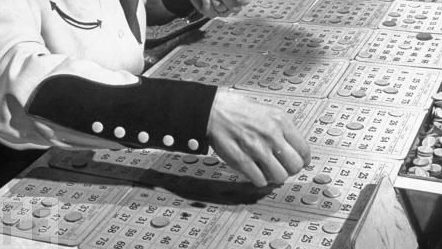
Edwin Lowe is credited as being the Father of the game Bingo but it’s abingo murky paternity. Lowe was a toy merchandiser in the late 1920s. At a traveling carnival near Atlanta, on December 1, 1929, he noticed players involved tooth and nail in a game called Beano in which they placed beans on numbers on a card as the numbers were called by an official number caller. Lowe took the idea back to New York with him where he amazed his friends with it. It’s popularity grew, and Lowe’s finances grew with it. The name Bingo was said to have originated when an excited player yelled “Bingo” instead of “Beano,” although some conspiracy theorists say the word had been used in England for some 150 years.

Further clouding the picture are the French (as the French will do). They created a similar game called Le Lotto back in in 1778. And they probably plagiarized the Italian Il Giuoco del Lotto d’Italia from the 1500s.

For those who may be in the Bingo dark, today’s typical game uses the numbers 1 through 75 arranged on a card in five columns headed by the letters B – I -N- G – O. Each column has five numbers arranged vertically The B’ column contains only numbers between 1 and 15, the ‘I’ column contains 16 through 30 and so on. When a player covers five numbers, horizontally, vertically or diagonally, the lucky devil shouts “Bingo!” to the great dismay of everyone else.

The game is now pretty much the province of little old ladies who command dozens of Bingo cards and whom you’d better not mess with if you know what’s good for you. Last year an 18-year-old Kentucky lad was barred by a judge from uttering the word “bingo” for six months after he falsely did that while working security at a Bingo hall. A police officer arrested him for his disorderly conduct which delayed the game by several minutes, causing alarm and real consternation to patrons. Chances are, he was taken into protective custody when the patrons, primarily elderly women, began yelling, cussing and threatening him. The officer explained that you can’t shout “out” in a ballpark or “fire” in a crowded theater.

And in England, two grandmothers were permanently banned from a local Bingo club after an argument over a ‘lucky’ seat led to a broken nose and two black eyes.

November 30, 1954: Stars Fell on Alabama

It was a pleasant afternoon on November 30, 1954, in Sylacauga, Alabama, a small town a few hours away from Tuscaloosa and Birmingham. Quiet — until folks saw something streaking across the sky — a bright red fireball like a Roman candle with a long tail of smoke. Some thought it was a visitor from outer space; others were sure it was a Russian invasion.

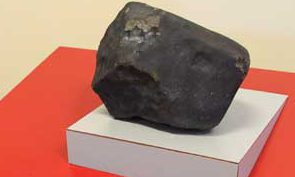
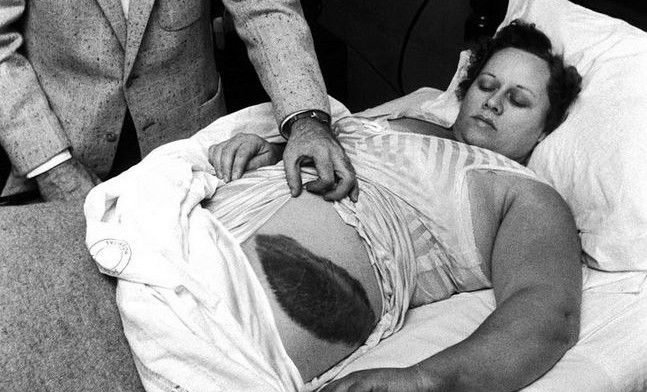
Ann Elizabeth Hodges thought neither. Under the weather, under a ann-hodges-meteoritequilt, napping, she didn’t see the thing — not until it crashed through her ceiling, bounced off her big console radio and onto the couch where she reclined, striking her in the hip. The eight-pound thing, which was indeed from outer space, left a bruise the size of a football. And to make matters worse, her house was soon overrun by curious Alabamans from miles around. A government geologist called to the scene identified the thing as a meteorite, many of which fall to earth but usually end up in an ocean or some remote wilderness.

A legal battle followed over who now owned the meteorite. “I feel like the meteorite is mine,” Elizabeth said. “I think God intended it for me. After all, it hit me!” Unfortunately, the law was not on her side. She and her husband rented their house, and their landlady claimed ownership. The case was settled out of court, with the landlady relinquishing control for a settlement of $500. After all, there was a hole in her roof.

Elizabeth’s husband thought they would be able to earn some big bucks by showing off the meteorite, but he was disappointed, and the Hodges eventually donated it to the Smithsonian.

Elizabeth did earn a spot in the record books, being the only person ever struck by a meteorite. Evidently, the odds of being struck by a meteorite are about the same as tripping over the body of a dead clown, falling into an open elevator shaft and being struck by lightning on the way down.

November 29, 1924: Don’t Shoot the Soprano

Giacomo Puccini, who died on November 29, 1924, was a giant in Italian opera, unrivaled in orchestration and a sense of theater. Passion, sensuality, tenderness, pathos and despair infused such operas as Manon Lescaut, La Bohème, Madama Butterfly, and Turandot.

Tosca was one of Puccini’s greatest operas, but it seems to have taken on a bit of a curse, like that Scottish play whose title shall not be uttered in the theater. More things have evidently gone awry in Tosca than in any other opera.  A few vivid examples:

Exit Stage Left . . . Exit Damnit: In Act II of a performance of Tosca featuring Maria Callas in the title role, Tosca stabs her tormentor Scarpia, and then leaves the stage. After doing the deed, Callas who suffered from myopia but couldn’t wear contact lenses wandered the stage, unable to find her way out. Baritone Tito Gobbi, our Scarpia, while lying dead, tried to discreetly point out the exit, but started laughing so much that both his laughing and his pointing were obvious to the audience. The next morning, newspapers raved about his memorable portrayal of Scarpia’s death.

They Shoot Divas, Don’t They?: In another performance, a firing squad is called upon to execute Tosca’s lover Mario in the final act. The players were instructed to enter and shoot the person they found onstage, and then to exit with the principals. But when the players got onstage, they discovered two people and didn’t know which one to shoot. They aimed at one then the other as both principals said not to shoot them. They finally chose Tosca, but when they shot her, Mario keeled over dead. They stood there, further bewildered; they had been told to exit with the principals but neither of the principals were exiting. Mario remained lifeless while Tosca tried to shoo them away. Finally, when Tosca jumped to her death from the castle parapet, they seized the opportunity to exit with at least one principal, and they jumped after her, adding immeasurably to the tragedy.

Follow the Bouncing Diva: Tosca’s leap to her death  from the parapet of the Castel Sant’Angelo is the dramatic conclusion to the opera. Various methods have been employed to keep the jumping soprano safe; usually a mattress does the trick. In a Lyric Opera of Chicago performance,  stage hands replaced the usual mattress with a trampoline to provide added safety for a British soprano. They also added some unintended encores as Tosca bounced back into view several times.


November 28, 1922: Ghost Writers in the Sky

It didn’t take long after the advent of flying for crafty marketing types to come up with a way to use it for advertising.   Skywriting was the way showing the most promise: a small airplane spits out magic smoke during a flight, creating text able to be read by someone on the ground.sky Messages naturally run the gamut from the inane to the weighty. Advertisers had a field day.

The first use of skywriting for advertising came on November 28, 1922, when Captain Cyril Turner of the Royal Air Force flew over New York City, spelling out, “Hello USA. Call Vanderbilt 7200.” Within just a few hours, 47,000 people had done just that. And of course operators were standing by at Vanderbilt 7200 to take their orders although no one had any idea what was being sold.

Pepsi-Cola became the first major brand to use skywriting as a medium to reach a mass market with thousands of flights through the 1930s into the mid-1940s. During the following years, skywriting became more sophisticated with the use of coordinated flights by fleets of planes that could deliver longer and more clearly written text messages.

At one point, rumor has it, an ambitious skywriter produced Pride and Prejudice in its entirety, but most observers fell asleep during the first three paragraphs.

November 27, 1703: What Do We Do with a Drunken Sailor?

The Eddystone Lighthouse sits atop the treacherous Eddystone Rocks off the coast of the United Kingdom. The current lighthouse is actually the fourth to hold sway there.

eddystoneThe original Eddystone Lighthouse was an octagonal wooden structure whose light first shone in November of 1698. It was destroyed just five years later on November 27 during the Great Storm of 1703. The unfortunate builder Henry Winstanley was on the lighthouse, completing additions to the structure at the time. No trace was found of him, or of the other five men in the lighthouse.

The fame of the lighthouse spread well beyond those using it for guidance in the English Channel. It became the subject of a sea shanty sung by drunken sailors around the world. Shanties are those songs sung on board ship to relieve the boredom of shipboard tasks, but during the 20th century and particularly during the mid-century folk craze, sea shanties were adopted by landlubbers everywhere. The Eddystone Light became a particular favorite of many a drunken sailor, armed with a guitar or banjo and a good supply of beer, no matter how far away the nearest navigable waters.

Oh, me father was the keeper of the eddystone light
And he slept with a mermaid one fine night
From this union there came three
A porpoise and a porgy and the other was me

Yo ho ho
The wind blows free
Oh for the life on the rolling sea

One day as I was a-trimmin’ the glim
Humming a tune from the evening hymn
A voice from the starboard shouted, “Ahoy”
And there was me mother a-sittin’ on the buoy

Yo ho ho
The wind blows free
Oh for the life on the rolling sea

Oh what has become of me children three?
Me mother then she asked of me
One was exhibited as a talking fish
The other was served in a chafing dish

Yo ho ho
The wind blows free
Oh for the life on the rolling sea

Then the phosphorus flashed in her seaweed hair
I looked again, but me mother wasn’t there
But I heard her voice echoing back through the night
The devil take the keeper of the eddystone light

Yo ho ho
The wind blows free
Oh for the life on the rolling sea

November 26, 1865: O Frabjous Day

On a summer afternoon boat trip in the early 1860s the Reverend Charles Lutwidge Dodgson told the three Liddell sisters – Lorina, Alice and Edith – a story that featured a bored little girl named Alice who goes looking for an adventure. The girls loved the story, and ten-year-old Alice asked Dodgson to write it down for her. In November of 1864, Dodgson gave Alice the handwritten manuscript of the story called Alice’s Adventures Under Ground, with his own illustrations, dedicated as “A Christmas Gift to a Dear Child in Memory of a Summer’s Day”.

A year later on November 26, 1865, he gave the book to the world with a new title, Alice’s Adventures in Wonderland, published under the pseudonym Lewis Carroll.  The book in which Alice falls down a rabbit hole into a world filled with outlandish anthropomorphic characters was not a big success at the time; it has since become a giant of “children’s” literature and Lewis Carroll’s language and logic have become fixtures in modern culture and literature.

Alice as depicted by Rev. Dodgson

“I can’t explain myself, I’m afraid, sir,” said Alice, “because I’m not myself, you see.”

From the original by Tenniel
From the original by John Tenniel

“Begin at the beginning,” the King said, very gravely, “and go on till you come to the end: then stop.”

Alice by Arthur Rackham

“Would you tell me, please, which way I ought to go from here?”
“That depends a good deal on where you want to get to,” said the Cat.
“I don’t much care where –” said Alice.
“Then it doesn’t matter which way you go.”

alice charles pears
Alice by Charles Pears

They drew all manner of things — everything that begins with an M . . . such as mousetraps, and the moon, and memory, and muchness — you know you say things are much of a muchness.

Alice by Charles Robinson

The hurrier I go, the behinder I get.

Alice by George Soper

The rule is, jam tomorrow and jam yesterday-but never jam today

Alice by Harry Rountree
alice disney
By Disney Studios

Speak roughly to your little boy
and beat him when he sneezes!
he only does it to annoy,
because he knows it teases!

By Mervyn Peake
By Mervyn Peake