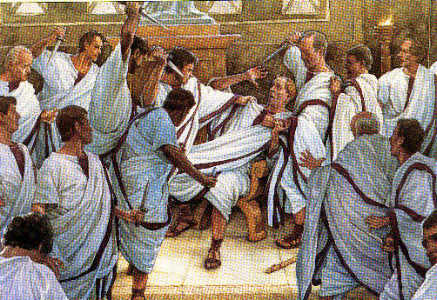
March 15, 44 BC: I Only Have Ides for You

Beware. Today is the ides of March, a day once enthusiastically celebrated among the common people with picnics, drinking, and revelry. In the ancient Roman calendar, each of the 12 months had an ides (from the Latin to divide). In March, May, July and October, the ides fell on the 15th day. In all other months, the ides fell on the 13th.  There is a reason for this, but the logic declined and fell with Rome, and the ides lost their original intent and purpose and eventually came to mean the day that a bunch of guys are going to stick knives into you.

This was thanks to Shakespeare,  Julius Caesar, and Caesar’s pals Brutus et al.  In Act I, Scene 2, of Shakespeare’s history, the old soothsayer utters these words, dripping with foreboding: “Beware the Ides of March.” Pretty straightforward, but does Caesar pay attention? Of course not. And on March 15, 44 BC, aided by his friends, he buys the forum, so to speak, exiting stage left halfway through the play even though it bears his name.

Despite an occasional pretentious allusion to the Ides of March and the popular song, today’s calendar is pretty much ideless (as ideless as a painted ship upon a painted ocean, to slip in a quick pretentious allusion).


Wretched Richard’s Little Literary Lessons – No. 2

al·lu·sion

əˈlo͞oZHən/

noun

As a literary device, an allusion is an expression designed to call something to mind without mentioning it explicitly; an indirect or passing reference to another person, event, work etc.

For example:

“That’s a rather abrupt and indifferent exit. Feel guilty?”

“I’m not sure. You don’t approve?”

“Well, I suppose it’s better than ‘I’m running off to hook up with Lolita for a few days. I’ll be back when I’m tuckered out. I hope you don’t mind.”

“Lolita? You’re hardly a nymphet.”

“I beg your pardon,” Huey huffed. “Would you care to elaborate on that point?”

“A nymphet is fourteen or fifteen years old, tops.”

“Maybe I’m only fifteen.”

“You also pointed out that you weren’t trying to seduce me.”

“Maybe I was lying. And maybe I’m no Lolita – as hot as I am – but you most definitely fit the part of Humbert Humbert, you old fart. Just remember you’re here of your own free will. You can’t claim I forced you to come along.”

“I won’t if you won’t,” said Paul.

Not forcing anyone to come along, just inviting: Voodoo Love Song

March 14, 1885: Nanki-Poo and the Nattering Nabob

Gilbert and Sullivan’s most famous work The Mikado premiered in London in 1885. It almost didn’t happen. A year earlier, Arthur Sullivan, whining about his precarious health and a Mikadodesire to devote himself to more serious music, told W.S. Gilbert that he couldn’t bring himself to do another piece of the kind the two had previously written. Gilbert was surprised to hear of Sullivan’s qualms, having started work on a new opera in which people fell in love against their wills after taking a magic lozenge. Gilbert wrote Sullivan asking him to reconsider, but the composer replied that he was through with such operas. Gilbert, after much whining of his own, persuaded Sullivan by promising a plot in which no supernatural element occurs “. . . a consistent plot, free from anachronisms, constructed in perfect good faith and to the best of my ability.”

The Mikado was born. With a setting in Japan, an exotic locale far away from Britain, Gilbert was able to poke fun at British politics and institutions by disguising them as Japanese and, with Sullivan’s music, create one of the greatest comic operas, featuring such characters as Nanki-Poo, the wandering minstrel; Yum-Yum, Nanki-Poo’s love; Ko-Ko, the Lord High Executioner; and Pooh-Bah, the Lord High Everything Else.  This is the origin of the word poo-bah — a pretty important person, a high muckety-muck, nabob, honcho, Donald Trump.


March 13, 1923: Rock-a-bye, Baby On the Treetop

In 1906, Eleanor Roosevelt, then a young mother living in New York City, bought a cage made of chicken wire and hung it outside the window of her townhouse. The cage was for her daughter Anna to nap in and enjoy the fresh outside air. Her neighbors threatened to call in the authorities. Young Eleanor wasn’t really a wicked mother; she was just a few years ahead of her time. Fast forward to the 1930s; baby cages are a booming business, particularly in London.

In between, Emma Read of Spokane, Washington, had the foresight to apply for a patent for “an article of manufacture for babies and young children, to be suspended upon the exterior of a building adjacent to an open window, wherein the baby or young child may be placed.” She envisioned a cage with removable curtains and an overlapping slanted roof to protect the suspended tyke from rain and snow — And from rattles and other toys maliciously thrown by the rotten little kid in the cage on the floor above.  Her patent was granted on March 13, 1923.

Interest peaked and petered out in the 1950s, and the baby cage disappeared into history despite the fascinating concept of children being caged.


Gonna Find Me a Planet

An advanced civilization inhabited Mars, but the times were desperate. The planet was becoming arid, and the Martians had constructed a series of canals and oases in an attempt to tap the polar ice caps. This was the theory espoused by Percival Lowell based on studies from his observatory in Flagstaff, Arizona, during the early 20th century. Lowell was born on March 13, 1855, and after many years traveling in and studying the Far East, he turned his attention to the far reaches of space. He was all over Mars, writing three books on the red planet that captured the public imagination and helped give rise to the notion of men from Mars.

The existence of canals was later disproved by more powerful telescopes and space flights, but Lowell would make a more important contribution to planetary studies during the last years of his life. Turning from Mars to Neptune and Uranus, Lowell became convinced that their positions were affected by a hypothetical Planet X. Lowell began searching for the mystery planet in 1906. Dying in 1916, Lowell himself did not witness the discovery, but the Lowell Observatory announced on what would have been his 75th birthday — March 13, 1930 — that they had discovered the planet Pluto.

Sadly, after nearly a century as our ninth planet, Pluto was cruelly downgraded to the status of dwarf planet in 2006.  And the name Pluto will become more associated with the Disney hound dog of that name.

Of Which You Ain’t Nothing But a

Mike Stoller (right), born March 13, 1933, working with his partner Jerry Leiber, helped shape rock leiberand roll with an amazing list of hit songs beginning with Hound Dog in 1952. Elvis Presley , the Beatles, the Rolling Stones, the Beach Boys, John Lennon, Otis Redding, Jimi Hendrix, and Frank Sinatra top the list of the many artists who have recorded their songs. More than three dozen of their hits were featured in the Broadway production Smokey Joe’s Cafe including the title tune, Young Blood, Dance With Me, Searchin’, Kansas City, Poison Ivy, On Broadway, Yakety Yak, Charlie Brown, Loving You, Jailhouse Rock, Spanish Harlem and Stand by Me.

In an interview, Stoller was asked to compare Elvis Presley’s 1956 version of Hound Dog with the original recorded by Big Mama Thornton. “It sounded kind of stiff and a bit too fast, a little nervous,” he answered. “It didn’t have that insinuating groove like on Big Mama’s record.”

Eventually, he grew to like the Presley version.   After it sold seven million copies it began to sound better.”


March 12, 1609: Wanna Get to Heaven, Let Me Tell You What To Do

Prophet, evangelist, guardian of the gates of heaven and hell, and notorious pain in the butt Lodowicke Muggleton was born in 1609. Uneducated, he worked as a tailor until his forties when he began to have revelations, announcing to the world that he and his cousin were the last two witnesses of God that would ever be appointed on earth and the exclusive deciders of who got into heaven and who didn’t. When his cousin died, Muggleton took this great burden upon himself.

Blessing those who listened to him and cursing those who didn’t, he eventually attracted a few followers who became known as Muggletonians. His cursing and raving made him enough of a public nuisance that he was twice jailed, fined and sentenced to stand in the pillory for several days. He had a particular dislike of Quakers which he spelled out in his book with the catchy title The Neck of the Quakers Broken or Cut in Sunder by the Two-Edged Sword of the Spirit Which Is Put Into My Mouth (1663).

Among some of the more interesting Muggletonian beliefs: Heaven is six miles above Earth; God is between five and six feet tall and has absolutely no interest in the affairs of mankind. Man’s greatest enemy is not the Devil, who doesn’t exist, but Reason, which, for humans, is unclean and filthy. They had no organized worship; they would sometimes meet in taverns to talk and sing rancorous Muggletonian songs.

Muggleton died at the age of 88, and his religion more or less continued for centuries after him. One Philip Noakes who bequeathed to the British Library an archive of Muggletonian documents in 1979 is thought to have been the last surviving Muggletonian, although this entry is bound to bring a few more out of hiding.

Wretched Richard’s Little Literary Lessons – No. 1

nov·el

nävəl

A fictional prose narrative of book length, usually involving multiple major characters sub-plots, conflicts and twists. Its length, at 40,000 words or more, allows it to be read at several sittings. A novella is 17,000 to 39,999 words, a novelette is 7,500 to 16,999 words. Under 7,500 words, its either a short story, flash fiction, a memo or a shopping list.

For example:

“Rain.”

It was the first word uttered during the past hour, and even it was unnecessary – not to mention understated – since the dark sky had ruptured, and a heavy downpour pummeled both the beach and the choppy sea that stretched away from it. The sun had been playing hide-and-go-seek for a week now, its occasional appearances bracketed by rains such as this one. Rain is, of course, a word of four letters, and it was spoken in this case in the tone of voice reserved for four-letter words. Albert Lafitte, the speaker who had so eloquently described the spectacle they now witnessed, sat between two other men. The three of them sat in distressed director’s chairs and remained for the most part dry, thanks to a large thatched canopy held above them by four wooden corner posts. From this vantage point, they settled in for what would likely be an afternoon of silent observation of nature’s life giving, but occasionally irritating, miracle.

For when the rain was this plentiful, the visitor’s weren’t, and Albert’s Booby Bay Cafe was lifeless; they might just as well shut the doors, if it had any. Actually the Booby Bay Cafe was pretty much lifeless rain or shine. The tiny island of Soleil, whose windward beach it graced, was a long ten miles from its nearest neighbor, an island whose seaport, Bluebeard’s Reef, had at one time been small but bustling. Back then, Albert’s cafe had been a popular watering hole for a steady parade of seafarers, from vacationing sailors to fishermen to the pilots of odd junk crafts whose reason for being at sea remained a mystery. That was until Hurricane Glenda, which had been following a ladylike northward course through the islands, not threatening anyone, turned fickle and suddenly westward, nearly eliminating Bluebeard’s Reef. And with Bluebeard’s Reef all but gone, the journey from civilization to Booby Bay became more trouble than it was worth.

Quick quiz: The preceding was the beginning of:

a. novelette

b. novella

c. novel

d. whichever one it is, it’s just a cheap ploy to get you to buy it. For proof, go here.


March 11, 1958: And Then We’ll Nuke North Carolina

In 1958, the U.S. Air Force bombed South Carolina. Surprisingly, the bombing of Mars Bluff, a rural area near Florence, was not intentional. The bomb was a nuclear weapon carried by a B-47 Stratojet en route from Savannah, Georgia, to the United Kingdom. (The Air Force was not planning to bomb the Brits; the plane was on its way to military exercises and was required to carry nuclear weapons in the event of a sudden Dr. Strangelovian incident with the Soviet Union.)  A fault light in the cockpit indicated that the bomb harness locking pin for the transatlantic flight did not engage, and the navigator was summoned to the bomb bay to investigate. As he reached around the bomb to pull himself up, he mistakenly grabbed Printthe emergency release pin. The bomb dropped to the floor of the B-47, its weight forcing the bomb bay doors open and sending the bomb 15,000 feet down to unsuspecting Mars Bluff. Oops.

Because the removable core of fissionable uranium and plutonium was stored separately on board the plane, the bomb was not actually atomic, but it did contain 7,600 pounds of explosives. And it created a pretty good mushroom cloud over Mars Bluff, leaving a 75-foot wide and 35-foot deep crater where Walter Gregg’s home and vegetable garden had been. The only real casualties were several chickens who bought the farm so to speak.

The crater is still preserved but grown over, pretty much just a big hole. Steven Smith, who chaired a 50th anniversary event a few years ago, couldn’t understand why it never became a real tourist attraction. “It sure could be,” he said. “This is a national treasure!”

Take This Verb and Parse It

Diagramming sentences – what fond memories that brings back.  Shuffling nouns and verbs and predicate adjectives around until they find their proper position on the diagram.  Those were the days, my friend.  However, it’s with some sorrow that I contemplate our dear parts of speech.  One of their number has fallen upon some hard times.

“Snow White bit into the apple,” said the brothers grimly.

Pity the poor adverb.  Modern writing mavens pretty much eschew the adverb today – plucking it from the garden of good writing (or the garden of bad metaphors, if you prefer) as though it were an insignificant weed.  Okay, maybe it’s sometimes overused, but in moderation, like alcohol, caffeine and fat, it serves a noble purpose.

It wasn’t always considered a sin to associate with an adverb.  Some important folks have — as I will demonstrate.  Going way back to cite an example from a good book (or as many prefer The Good Book)  “Verily, I say unto you . . .”  Okay, all together now, what part of speech is that word verily?  You got it.  And it’s used more than once by you know who.  Okay, who wants to go first? Just step right up and say “Lose that adverb.”  I’d say that’s inviting a smiting.

Thomas Mann:  Hold fast to time!  Use it!  Be conscious of each day, each hour!  They slip away unnoticed all too easily and swiftly.

E. B. White: Be obscure clearly.

Mark Twain:  The intellect is stunned by the shock but gropingly gathers the meaning of the words.

Or you may remember that catchy tune by Francis Scott Key with words that go something like this: Whose broad stripes and bright stars, thru the perilous fight, O’er the ramparts we watched, were so gallantly streaming?  Call the adverb police.

And finally, moving into the future, I quote just three words from one Captain Kirk: “to boldly go.”  Now there’s a strong, sassy adverb coming to the rescue of a puny little verb and splitting an infinitive just for good measure.


March 10, 1876: It’s a Telephone, My Dear Watson

Who would have thought back on March 10, 1876, that in a hundred or so years practically every other human on the face of the earth would have a phone pressed against the side of his or her head at any given moment. Certainly not Alexander Graham Bell, as he was in the process of making the very first phone call. It wasn’t much of a call, certainly not long distance. Bell called his assistant Thomas A. Watson who was in the next room. The phones they used weren’t much to behold; they looked more like tin cans connected by a long string than today’s sleek models. But nevertheless they made history.

The moment of truth in Bell’s own words: “I then shouted . . . the following sentence: Mr. Watson come here — I want to see you. To my delight he came and declared that he had heard and understood what I said.”

Enter the quibblers. Why didn’t Watson answer Bell using that brand new telephone, they ask. And if Bell shouted his words and Watson were in the very next room, he’d very likely hear them without the phone, they suggest.

Watson’s diary says Bell’s words were actually “Mr. Watson, come here, I want you. ” a minor difference but just chock full of innuendo, they say, eyebrows raised. And some even suggest that the incident is all fabrication, that Bell actually stole the idea for the telephone from another inventor, Elisha Gray.

History does not record Bell’s disappointment when he tried to duplicate the experiment and was put on hold.

The Milkman Cometh

New Mexico State University’s first ever graduation was to have taken place on this date in milkman1893 but was abruptly canceled when Sam Steel, the lone graduating senior, was shot and killed while delivering milk the day before graduation.

Said the local paper: “The hearts of the whole community were stricken with sadness when it was learned that Samuel Steel, the most brilliant student of our College, had been foully and wil(l)fully murdered on Thursday evening, March 9th. We do not consider it in place to refer to the details of this ghastly deed, which are known to most of our readers; we only feel assured that it was perpetrated in sheer cold-bloodedness, and, knowing the victim as well as we have done, without the slightest provocation.”

Knowing what we do today about the reputation of milkmen, one might speculate that there could have been a slight provocation.

March 9, 1974: Lay Down Your Arms

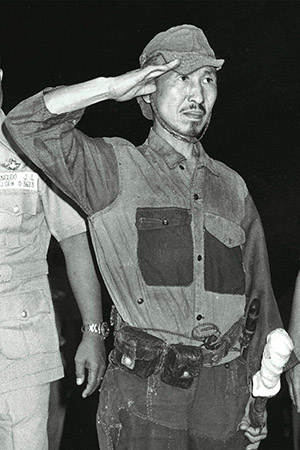
soldierLt. Hiroo Onoda, a soldier in the Japanese army, was sent to the remote Philippine island of Lubang in 1944 to conduct guerrilla warfare. Onoda was supposed to blow up the pier at the harbor and destroy the Lubang airfield. Unfortunately, his commanders, who were worried about other matters, decided not to help Onoda on his mission and soon the island was overrun by the Allies.  Time passed, the war ended, but nobody officially told Onoda; so for 29 years, Onoda remained a dedicated soldier, living in the jungle, eating coconuts and bananas and deftly evading searching parties. Hiding out in the dense jungles, Onoda ignored the leaflets, newspapers, photographs and letters from relatives dropped by planes during the years; he was convinced they were all part of an Allied plot.

In 1974, a college dropout named Norio Suzuki traveled to the Philippines, telling his friends he was out to find a panda, the Abominable Snowman and Lt. Onoda. Where others had failed, Suzuki succeeded. He found Lt. Onoda and tried to convince him that the war was over. However, Onoda refused to leave the island until his commander ordered him to do so. Suzuki traveled back to Japan and found Onoda’s former commander, who had become a bookseller. On March 9, 1974, Suzuki and the commander/bookseller met Onoda and delivered orders that all combat activity was to be ceased, and Onoda laid down his arms.

Tiny Tomato Killer Strikes Again

It is better to light a candle than curse the darkness, or so says some annoying pundit.  Likewise, I suppose, it is better to do something positive than curse the mounds of snow encircling us.  I’ve always been of the curse the darkness ilk, but occasionally I do try and rise above the winter of my discontent and light a candle in the snow.  One of the better remedies for my malaise is the old seed catalog – tiptoeing through the tulips, tomatoes and zinnias almost brings warmth to my icy heart.

If you ever order anything from a seed catalog, you will never have to worry about being without one again.  They will arrive every January just as reliably as the foot of snow they said would be an inch.  There’s Seed City, Happy Seeds, Seeds R Us and many more.  Funny thing is they all come from the same little town in the Midwest where a single little old lady – Granny Burpee – takes seeds out of great big jars and puts them in little envelopes with all those different names.

Nevertheless full seed ahead.  Seven tomato varieties, a couple of cucumbers, greens, beans, okra.  Snapdragons, sweet peas, exotic species I’ve never heard of.  “And there’s no such thing as too many sunflowers,” I’m reminded.

There is such a thing as too many seeds, however.  Granny Burpee doesn’t hold back – a hundred seeds here, two hundred there, a thousand.  I’d like to order six tomato seeds, please.  I really only need two cucumber seeds.  The theory seems to be that you must overplant, just in case some of them don’t sprout.

But they all sprout.

I wanted a couple of tomatoes.  I planted a plastic seed-starting tray, two or three seeds in each of its six cubicles.  Twenty tomato plants emerge.  Just thin out the extra plants, the catalogs advise, leaving one healthy tomato plant in each cubicle.  That’s theory again.  From over my shoulder, as I carefully pull out the runts of the seedlings:  “You’re not going to murder those little plants, are you?”

Come June, I have twenty tomato plants, a dozen cucumbers, a dozen nasturtium, I don’t know how many dozen sunflowers, a sea of seedlings that I forgot to label, and six zucchini.   With six zucchini plants, I’ll be able to place a giant zucchini on the back seat of every unlocked car in Vermont.

Maybe I’ll curse the darkness for a while.

March 8, 1969: Right After The Vows, Go To Your Room

Guiseppe Greco and Marcella Risciglione married in Paterno,holding-hands-dating Sicily, in 1969. The 21-year-old groom was an auto mechanic, the bride a sixth-grade student. She was 12. Somehow convinced that their parents would never agree to their marriage, the couple slipped away from home and spent two nights together, knowing that an unwritten Sicilian Code of Honor would leave their parents with no choice but to let them marry. Which they did.

Marcella’s father had the last word however. He grounded the newlyweds, not allowing them to go on a honeymoon. “She will go back to school and he to work on Monday,” said the father. And they will lose all Facebook privileges when it is invented.

Thumbs Up, George

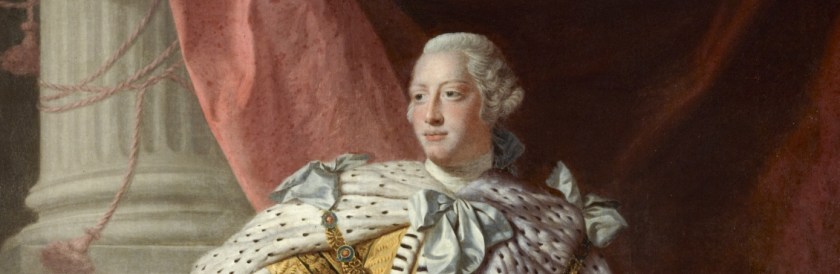
A couple of centuries earlier, a poor young lad about Guiseppe’s age was walking down a London street, gazing into shops and lamenting his own poverty.  His fancy was taken by a portrait in one of the shop windows and he wondered to himself if he too might paint such portraits and perhaps earn a farthing or two.  (This was long before the days of ‘draw me three inches tall’ on matchbook covers.)  He hurried home, scraped together brushes, paints and a bit of a broken looking glass and set about painting a small portrait of himself..  He was quite pleased with the result, and others evidently were as well, since he began to get gigs painting miniatures.  Success followed and he eventually was called on to paint various VIPs including King George III.

One day when the poor King was too far gone in his mental malady to sit for portrait painters, our now thriving artist drew a quick portrait of the King on his own thumb nail.  He later meticulously transferred the portrait to ivory.  The portrait delighted the King who paid the artist a hundred guineas for it.

The artist was Robert Bowyer, a name that rings precious few bells in the art world today.  When he is thought of at all, it is in relation to the profession of his later years as a printer and in particular as the printer of an edition of the Bible that came to bear his name — an elaborate and costly work of 45 volumes with over 600 engravings.

March 7. 1766: Gentlemen Rhymesters Out on a Spree

A certain Miss Molly Mogg of the Rose Tavern in Wokingham, England, turned up her dainty toes on March 7, 1766, at the age of 66. Some 40 years earlier she had been the subject of an amusing ballad written by “two or three men of wit.” The ballad, perhaps to the surprise of its authors, became quite popular. Literary historians have determined that the “men of wit” were Alexander Pope, Jonathan Swift, and John Gay and that the three were probably quite drunk when they penned the tribute to the pretty Molly.

It begins:

The schoolboy delights in a play-day,

The schoolmaster’s delight is to flog;

The milkmaid’s delight is in May-day,

But mine is in sweet Molly Mogg.

and continues on for eleven verses each ending with “sweet Molly Mogg. This, of course required the three rhymesters to come up with 11 words to rhyme with Mogg. Which they did.  In addition to the aforementioned flog, there’s bog, cog, frog, clog, jog, fog, dog, log, eclogue and agog — bypassing hog and Prague.

Cogito Airgonaut

Jean-Pierre Blanchard, the noted 18th century “Airgonaut,” made his first successful balloon flight in Paris back  in 1784, in a hydrogen gas balloonballoon4 launched from the Champ de Mars. Blanchard’s flight nearly ended in disaster, when one spectator slashed at the balloon’s mooring ropes and oars with his sword after being refused a place on board. Observer Horace Walpole wrote of the flight that the Airgonauts were just like birds; they flew through the air, perched in the top of a tree, and some passengers climbed out of their nest to look around.

Nevertheless, these early balloon flights set off a public “balloonomania”, with clothing, hairstyles and various objects decorated with images of balloons or styled to resemble a balloon. In 1793, Blanchard scored another first — the first balloon flight in North America, ascending in Philadelphia and landing in New Jersey. Witnesses to the flight included President George Washington, and future presidents John Adams, Thomas Jefferson, James Madison, and James Monroe. Some say Washington threw a silver dollar at the balloon.

Now famous, our  Airgonaut  married Marie Madeleine-Sophie Armant in 1804. But his run of fame, fortune and good luck came to a sudden end four years later, when Blanchard had a heart attack while ballooning above the Hague. He fell from his balloon and died of his injuries on March 7, 1809. His widow Sophie inherited everything including the ballooning bug which would be her undoing as well: she continued to support herself with ballooning demonstrations until it also killed her.  In 1819, she became the first woman to be killed in an aviation accident when, during an exhibition in the Tivoli Gardens in Paris, she launched fireworks that ignited the gas in her balloon. Her balloon crashed on the roof of a house, and she fell to her death.  Don’t try ballooning at home.

March 6, 1941: The Bigger They Are

If asked to name an important sculptor, the name John Gutzon de la Mothe Borglum, would not come tripping off most people’s lips, although his most important work certainly would. Borglum died on March 6, 1941, leaving the monument he had worked on since 1927 uncompleted.

Borglum sculpted big: a portrait of Abraham Lincoln carved from a six-ton block of marble, a 76 by 158 foot bas-relief of Confederate heroes, and what would have been his biggest ever, the 60-foot heads of George Washington, Thomas Jefferson, Abraham Lincoln and Theodore Roosevelt carved into the granite face of Mount Rushmore in South Dakota.

Although his work remains admired, his legacy was tarnished by his strong nativist leanings, including membership in the Ku Klux Klan.

Mount Rushmore is home to 2 million visitors and has been extensively depicted throughout popular culture, probably most famously in the climactic chase scene in Alfred Hitchcock’s 1959 thriller North by Northwest with Cary Grant swatting at secret agents from Lincoln ‘s forehead. Hitchcock later admitted: “I wanted Cary Grant to hide in Lincoln’s nostril and then have a fit of sneezing . . . the Department of Interior was rather upset at this thought. I argued until one of their number asked me how I would like it if they had Lincoln play the scene in Cary Grant’s nose. I saw their point at once.”

Speaking of Noses

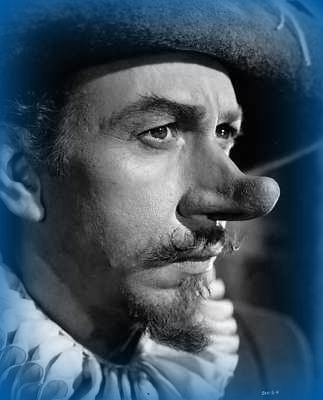
Cyrano de Bergerac, born in 1619, is of course best known in modern times for his nose. According to legend, it was quite large. Depending on which account you accept, Cyrano was either a French aristocrat, author and military hero with a big nose or the descendant of a Sardinian fishmonger who suffered from syphilis with a big nose. He was an early writer of science fiction, and in his most famous work, The Other World, Cyrano travels to the moon using rockets powered by firecrackers where he meets the inhabitants who have four legs, musical voices, and firearms that shoot game and cook it — the TV rights are still available, if you’re interested.  A  lesser known work, Noses from Mars, is self-explanatory.

Then we come to the story of Cyrano himself and how he courted the fair Roxanne on behalf of his friend Christian.  Although these people are real, the story is alas! pure fiction, which is probably just as well, for Roxanne was Cyrano’s cousin and had they ever consummated their relationship, their children would have been half-wits with big noses.