MARCH 25, 2018: WAITER, THERE’S A LOBSTER ON MY WAFFLE

Today is International Waffle Day, a tradition that is celebrated worldwide but mostly in Sweden. It’s a day to enjoy – guess what? – eating waffles. The day may have arisen out of confusion. Waffle Day in Swedish, Våffeldagen, sounds a lot like Our Lady’s Day,Vårfrudagen, (you really have to be on a street in Stockholm to get the full effect), a Christian holiday also known as Annunciation (the third Thursday after Pronunciation), when the Archangel Gabriel told the Virgin Mary she was pregnant. Mary was understandably upset and did what any virgin would do upon being told she was pregnant – stuffed herself with waffles. Waffle Day also coincides with the beginning of Spring, another traditional day for eating waffles in Sweden. Therefore, if you see a Swede eating waffles today, you don’t know if it’s religious or secular or just hunger.

More interesting facts:

Waffles were made with cheese and herbs in ancient Greece.

The familiar grid pattern of today’s waffles originated in the Middle Ages. Some waffles had fancier designs such as coats of arms,  landscapes and portraits of Middle Age people.

Waffles were so popular that they were even sold from street carts (by strange looking men who eventually switched to selling chestnuts and large pretzels).

In the late 1800’s, Thomas Jefferson returned from France with a waffle iron.  It’s unclear how he got it through security.

Many folks in Britain celebrate International Waffle Day by eating rutabagas which are known there as Swedes.  There is no International Rutabaga Day.

There is, however, a Lobster Newburg Day – and it’s today!

Lobster Newburg, lobster with a sherry and cognac infused, egg-thickened cream sauce, was first served at New York’s Delmonico’s in the 1870s. Delmonico’s was not only the first formal dining restaurant in the United States, it was the first to serve hamburger, the creator of Baked Alaska, the creator of Eggs Benedict, and of course the creator of Lobster Newburg.  A waffle topped with Lobster Newburg, anyone?

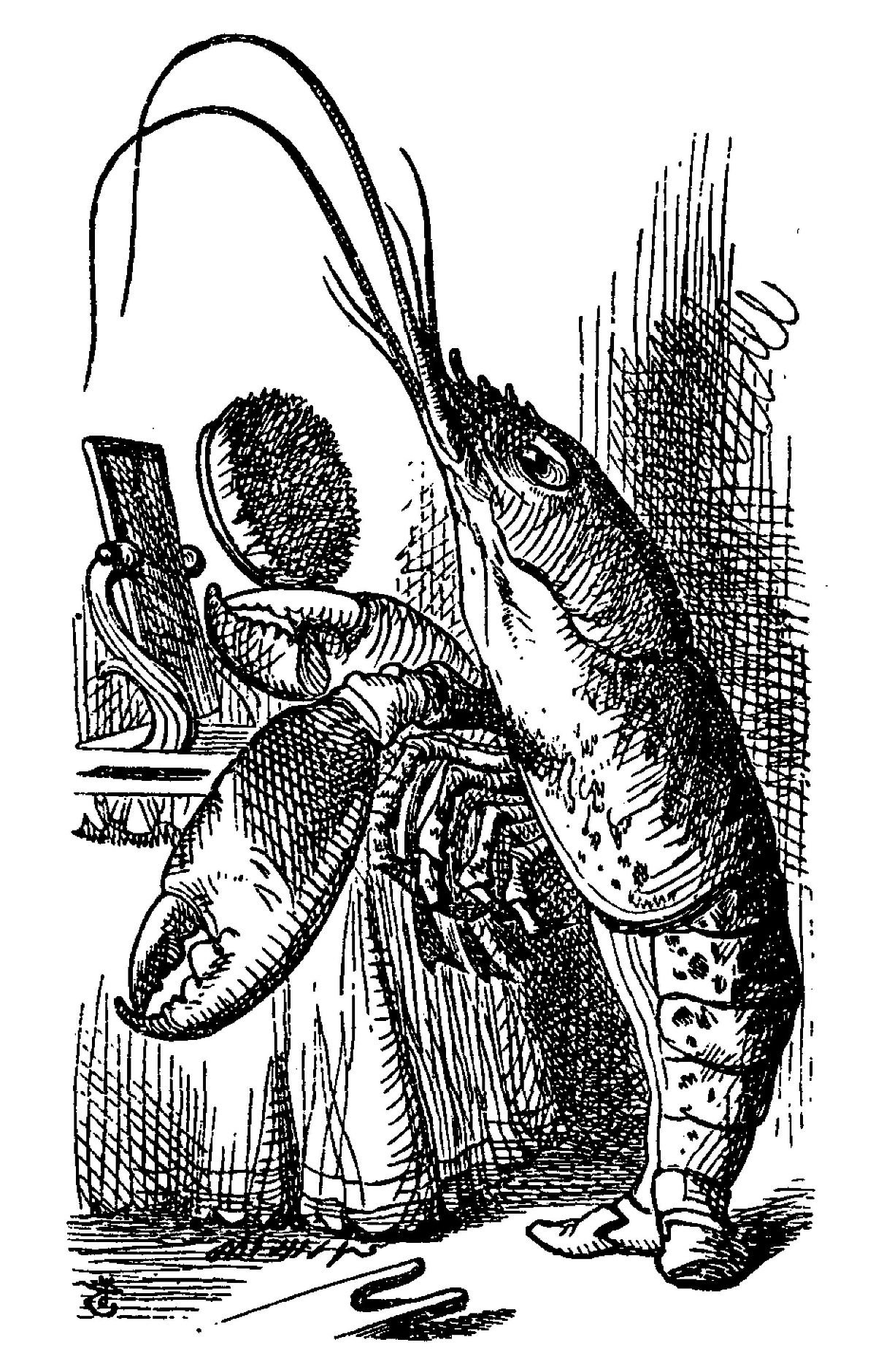
The Lobster Quadrille (from Alice in Wonderland)

“Will you walk a little faster?”
Said a whiting to a snail,
“There’s a porpoise close behind us,
Treading on my tail. ”
See how eagerly the lobsters
And the turtles all advance!
They are waiting on the shingle –
Will you come and join the dance?
So, will you, won’t you, won’t you,
Will you, won’t you join the dance?
Will you, won’t you, will you,
Won’t you, won’t you join the dance?

“You can really have no notion
How delightful it will be
When they take us up and throw us,
With the lobsters, out to sea! ”
But the snail replied, “Too far, too far!”
And gave a look askance –
Said he thanked the whiting kindly,
But he would not join the dance.
So, would not, could not, would not,
Could not, would not join the dance.
Would not, could not, would not,
Could not, could not join the dance.

“What matters it how far we go?”
His scaly friend replied,
“There is another shore, you know,
Upon the other side.
The further off from England
The nearer is to France –
Then turn not pale, beloved snail,
But come and join the dance.

Will you, won’t you, will you,
Won’t you, will you join the dance?
Will you, won’t you, won’t you,
Will you, won’t you join the dance?

Will you, won’t you, will you,
Won’t you, won’t you join the dance?
Will you, won’t you, will you,
Won’t you, won’t you join the dance?

MARCH 24, 1990: Bob & Ray & Bud & Lou

After a lifelong career on radio with partner Bob Elliott, beginning in 1946 at WHDH in Boston and ending in 1987 on National Pubic Radio, Ray Goulding died on March 24, 1990.

Bob and Ray created and gave voice to such offbeat characters as domestic advisor Mary Margaret McGoon; adenoidal reporter Wally Ballou, Matt Neffer, boy spot-welder; and cowboy singer Tex Blaisdell who did radio rope tricks. The duo also parodied radio and television with spoofs that often outlasted the programs they were based on —  Mr. Trace, Keener Than Most Persons; Jack Headstrong, The All-American American; and the soap operas One Fella’s Family and Mary Backstage, Noble Wife.  They  successfully adapted their comedy to other media, including stage and television.

One enduring routine features Goulding as a rather dense reporter interviewing Elliott as an expert on the Komodo dragon.

The comedy duo of Bud Abbott and Lou Costello made their first radio outing on the the Kate Smith Hour in February 1938 and became regular performers for two years. They first performed their classic “Who’s on First?” the following month on March 24.

abbott-costelloThe former vaudevillians quickly became major stars in radio, followed by movies and television. They left the Kate Smith show to star in their own radio program, as well as a Broadway revue, The Streets of Paris, and their first film, One Night in the Tropics, in which, although cast in supporting roles, they stole the show with several classic comedy routines and cemented their film careers.

buck-privatesUniversal Pictures signed them to a long-term contract. Their second film, Buck Privates, made them box-office stars and in the process saved Universal from bankruptcy. In most of their films, the plot was not much more than a framework that allowed them to reintroduce comedy routines they had first performed on stage. Universal also added glitzy production numbers to capitalize on the popularity of musical films, featuring such performers as the Andrews Sisters, Ella Fitzgerald, Martha Raye, Dick Powell and Ted Lewis and his Orchestra. The Andrews Sisters hits “Boogie Woogie Bugle Boy” and “I’ll Be With You In Apple Blossom Time” were both introduced in Buck Privates.

During the following years, Abbott and Costello “met” many other movie legends – Frankenstein, Dracula, the Wolf Man, the Invisible Man, Captain Kidd, Dr. Jekyll and Mr. Hyde, the Mummy, the Killer (Boris Karloff).  And they traveled throughout the world (and beyond): in a Harem, in the Foreign Legion, Lost in Alaska, Mexican Hayride, Mars, and Africa Screams, which featured both Clyde Beatty and Frank Buck as themselves. They made a total of 36 films.

On television, they frequently hosted the Colgate Comedy Hour and had their own syndicated television program.

In the 1950s Abbott and Costello’s popularity waned, their place atop the comedy heap taken by Dean Martin and Jerry Lewis. Another reason for the decline was overexposure. They were reluctant to introduce new material, and their familiar routines were glutting the movie and television markets, with two films a year, re-releases of most of their older films; their filmed television series and live TV appearances.

They dissolved their partnership in 1957, with Lou making sporadic appearances until his death in 1959.  Bud died in 1974.

MARCH 23, 1925: MAKING A MONKEY OUT OF A MOLEHILL

On this day in 1925 in the forward-looking State of Tennessee, it became a crime for a teacher in any public school or college to teach any theory that contradicted the Bible’s account of man’s creation. Wouldn’t you know it, within two months, a Dayton, Tennessee, high school science teacher and trouble-maker, John T. Scopes went right on ahead and taught his students that man descended from a lower order of animals, monkeys no less. This was, of course, the infamous theory of evolution.

Scopes was indicted, and later convicted, in what became known as the Monkey Trial. The trial, broadcast on radio, gained national attention, and brought together two of the biggest names in the nation, William Jennings Bryan for the prosecution and Clarence Darrow for the defense. Bryan chastised evolutionists for teaching children that humans were but one of precisely 35,000 species of mammals and that human beings were descended “not even from American monkeys, but from old world monkeys.” Darrow volunteered his services to the defense because he “realized there was no limit to the mischief that might be accomplished unless the country was aroused to the evil at hand.”

Scopes was fined $100, but the verdict was later overturned. Darrow called the case “the first of its kind since we stopped trying people for witchcraft.” This was almost a hundred years ago. Thank goodness we’ve gained a lot of insight since then.

My Kingdom for a Bic

Pedro I a 14th century king of Castile was one of the first monarchs who could write, and he had very nice penmanship. That didn’t prevent him from being stuck with the moniker Pedro the Cruel for various transgressions, real and imagined. His greatest sin seems to have been his hatred for the monks, a hatred which was returned in kind. When Pedro died by the dagger of his illegitimate brother on March 23, 1369, his place in history was left to those monks who could also write. And they proved that their pens were mightier than his scepter. Good penmanship can only take one so far.

The Game Show That Wouldn’t Die

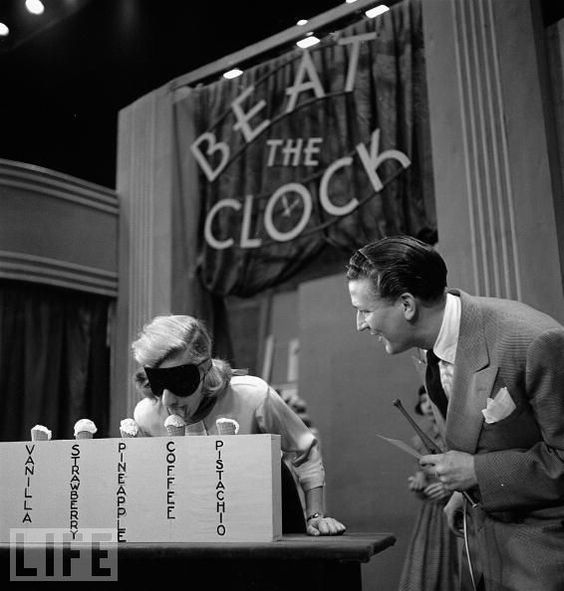
Beat the Clock made its CBS debut on March 23, 1950, hosted by Bud Collyer. It ran until 1961. It rose from the dead in 1969 as The New Beat the Clock, running until 1974. It reappeared in 1979 as The All-New Beat the Clock, and later as All-New All-Star Beat the Clock.

To win, contestants had to “solve problems” within a certain time limit which was counted down on a madly-ticking giant clock. If they succeeded, they “beat the clock”; if they didn’t, “the clock beat them.” And they died.


MARCH 22, 238: GORDIAN ANGELS

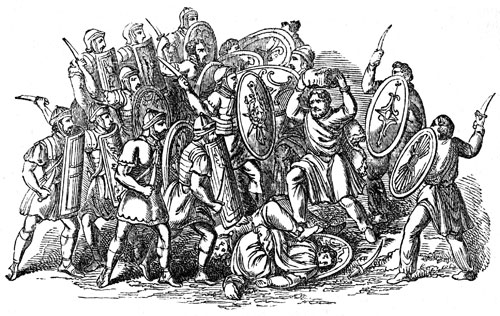
Romans got two emperors for the price of one, when in 238, Gordian I and II became father-and-son tag-team Caesars after an insurrection against Maximinus Thrax, a rather unpopular emperor who had come to the position by the popular tradition of assassinating his predecessor.  Gordian I was a bit long in the tooth so the younger Gordian was attached to the imperial throne and acclaimed Augustus too – sort of like if Poppa Bush and W had been presidents together, mano e mano so to speak.

Some supporters of Maximinus Thrax who were not happy with this turn of events staged a rebellion in Africa. Gordian II fought against them in the Battle of Carthage but lost and was killed for good measure. Hearing the bad news, Gordian I took his own life.  All of this happened within a month. Fortunately, there was no dearth of Gordians in Rome, and Gordian II’s 13-year-old nephew Gordian III soon became emperor. During his six-year reign, the teenage ruler endured pimples, the fickleness of teenage girls, and Persians until he was done in by the latter in yet another battle. He was succeeded by Philip the Arab (son of Ahab) sometimes referred to as the Gordian Not.

Slow and steady wins the race

Back in 1767, Lord Robert Clive of the East India Company was given a gift of four Aldabra tortoises from the Seychelle Islands. Three soon died, but the fourth, a gent named Addwaita “the one and only,” prospered.  He was transferred to a Calcutta zoo in 1875.

Addwaita was a bit of a loner, content to pass the decades in his zoo cubicle, munching on carrots, lettuce, chick peas, bran, bread and grass, growing to a stately 550 pounds and living  to the ripe old age of 250, give or take a year or two.

Alas, Addwaita bought the reptilian ranch on March 22, 2006. Foul play was not suspected.

Charlie Chan’s Words of Wisdom

MARCH 21, 1867: ON A SHOW BOAT TO BROADWAY

“Curtain! Fast music! Light! Ready for the last finale! Great! The show looks good, the show looks good!”

American Broadway impresario, Florenz “Flo” Ziegfeld, Jr. was born March 21, 1867 (died July 22, ZigfeldFollies19121932). The theater bug came to Ziegfeld early; while still in his teens, he was already running variety shows. In 1893, his father, who was the founder of the Chicago Music College, sent him to Europe to find classical musicians and orchestras. Flo returned with the Von Bulow Military Band — and Eugene Sandow, “the world’s strongest man.”

Ziegfeld was particularly noted for his series of theatrical revues, the Ziegfeld Follies, inspired by the Folies Bergère of Paris – spectacular extravaganzas, full of beautiful women, talented performers, and the best popular songs of the time – and was known as the “glorifier of the American girl”.

“Let us grant that a girl qualifies for one of my productions. It is interesting to note what follows. First, it is clearly outlined to her what she is expected to do. She may be impressed at the outset that the impossible is required, but honest application and heroic perseverance on her part plus skillful and encouraging direction by experts very seldom fail to achieve the desired results. But it is only through constant, faithful endeavor by the girl herself that the goal eventually is reached.”

He also produced musicals in his own newly built Ziegfeld Theatre – Rio Rita, which ran for nearly 500 performances, Rosalie, The Three Musketeers, Whoopee! and Show Boat. Several of his musicals hit the movie screens, including three different versions of Show Boat. William Powell played Flo in the 1932 biopic, The Great Ziegfeld, and a 1946 film recreated the flamboyant Ziegfeld Follies.

Wretched Richard’s Little Literary Lessons, No. 4

pro·tag·o·nist
prōˈtaɡənəst,prəˈtaɡənəst
noun
A protagonist is the main character in any story, such as a literary work or drama:
Say let us put man and woman together,
Find out which one is smarter (and which is the protagonist)

Paul wasn’t sure, but the five-foot duck waddling through the throngs of laughing, crying, shouting, whining children appeared to be waddling toward him – a duck with a destination and, perhaps, a mission. Chances are it had spotted him scowling in a land where grinning is the norm, and it, by God, meant to do something about it.

“Enjoying the Magic Kingdom?” asked the duck upon reaching him. Despite its carefully sculpted plastic smile, this duck wasn’t going to cheer anyone up; its voice dripped sarcasm.

“Of course, I am,” Paul answered, adopting his very own duck attitude. “Isn’t that why you’re here? By the way, didn’t I somewhere get the idea that you’re all supposed to be pleasant and cheerful?”

“I’m not even supposed to talk. Just wave.” The duck waved and, in silence, could have passed for pleasant and cheerful, albeit of a fabricated sort.

“Then why did you talk to me?” Paul asked.

“Because you look bored – like you positively hate the place.”

“Ah, you’re not just an ordinary duck, you’re a member of the happiness squad, here to lift my spirits.”

“No,” answered the duck. “I thought you might have a cigarette.”

Who’s our protagonist?  Paul?  Huey (the duck)? Or two protagonists for the price of one?  Find out here.


MARCH 20, 689: SOME FOLKS JUST WON’T STAY BURIED

Back in the 7th century on an island in northern Britain, the very holy St. Cuthbert gave up the ghost. The exact date of his departure was March 20, 689. Not only was Cuthbert very holy, he was, you might say, holier than thou, or at least holier than all his peers. He devoted his entire life to converting the half-savage heathens (and there were quite a few half-savage heathens at the time) and praying — lots of praying. Such was his devotion that those about him often wondered if he were not a man but an angel.

Cuthbert was duly shrouded and buried, remaining at rest for some 11 years until some curious monks dug him up to have a peek. They found Cuthbert in perfect condition, which they accepted as miraculous proof of his saintly character. They placed him in a new coffin, leaving him above ground so he might perform miraculous cures.

Another 174 years passed and, with Britain facing an invasion by the Danes, the monks (different monks) carried Cuthbert’s still perfect body away and wandered with it from place to place for many years.

Finally in the 11th century, Cuthbert’s body found a permanent home where it was enshrined and enriched with offerings of gold and jewelry from the faithful (there were a lot more of them now). In 1104, the body was inspected again and found still fresh. Another 400 years and another inspection.

Three hundred years. It’s 1827 and Cuthbert is past due for inspection. This time, however, the inspectors were much more rigorous, and it was discovered that Cuthbert was an ordinary skeleton swaddled up to look whole, including plaster balls to plump out the eye holes. It would appear that some monks along the way had been quite naughty. St. Cuthbert himself serves as a fine example of a person who was far more interesting dead than alive.

Deciders Unite

The Whigs didn’t last long as as political party. Formed in the 1830s out of annoyance with Andrew Jackson, they gave us four presidents — William Henry Harrison, John Tyler, Zachary republicanTaylor and Millard Fillmore, commonly known by their shared nickname, Who? (not to be confused with the rock group of the same name). As is the case with many political parties, they had disagreements over tents, finding themselves unable to deal with the concept of big ones, and eventually tore themselves asunder with internal disagreements.

The semi-official date of the party’s actual death was March 20, 1854. On that date, a number of don’t wanna-be Whigs met in Ripon, Wisconsin, and the result of that meeting was the birth of the Republican party, which lasted until 2016.


MARCH 19, 2009: pigeon

Brussels — A star racing pigeon named Armando has fetched a record 1.25 million euros (about $1.4 million) in an online auction, Belgian media reported Sunday. The prized bird — Belgian’s best long-distance racer of all time according to those in the know — was snapped up by a Chinese buyer for the princely sum that caused a flutter of excitement among fanciers.

Armando had been expected to break the previous record of 376,000 euros ($425,000) paid for a pigeon called Nadine — but not by such a wide margin.

“Earlier this week it became clear that Armando would be the most expensive pigeon ever sold in an online auction,” wrote the specialist website Pigeon Paradise (Pipa.be).

“However, no one expected that the magical cap of a million euros would be pulverised,” it added. The final amount was 1,252,000 euros.

Pigeon Paradise did not say who had bought the pigeon, but according to the Belgian news agency Belga it was a Chinese buyer who will no doubt use his new acquisition to breed other champions.


BYE, BYE, BIRDIE

When the swallows come back to Capistrano/ That’s the day I pray that you’ll come back  to me.

And the day is today, St. Josephs Day, although St. Joseph has nothing to do with swallows. Like feathered clockwork, cliff swallows year after year migrated from Goya, Argentina, to the Mission San Juan Capistrano in southern California. Every year the good townsfolk of San Juan Capistrano welcomed them back with an annual Swallows’ Day Parade with balloons and food trucks, politicians kissing babiesand other festive events. And flocks of tourists would come and everybody was happy.

Was happy. For in 2009, the fabled swallows were no shows. A swallowless decade followed, during which folks at the mission tried unsucessfully to lure their fickle feathered friends  back.

In 2016, swallow experts created faux nests attached to a large temporary wall in hopes that the birds would move in and eventually spill over and start using the actual mission structures. A couple of years ago, two real nests were discovered at the mission and several swallows were spotted in flight.  Swallow lovers hopes were riding high.

Hold your breath no longer.  They’re back!  And the villagers were happy once again, dancing round and round and singing “When the swallows come back to Capistrano

And we can sing once more.  “When the Swallows Come Back to Capistrano” was written by Leon René and first recorded by The Ink Spots in 1940, reaching #4 on the charts.  It has been recorded by Glenn Miller, Xavier Cugat, Gene Krupa, Fred Waring, Guy Lombardo, Billy May, the Five Satins, Elvis Presley, and Pat Boone.

Joseph was mostly known for being the father of Jesus  Not the actual father of course but kind of a placeholder for someone else.  And the real father that Joseph was standing in for was we are told the big guy himself.  Or as some would say the one and only god.So Joseph a carpenterandallaround nice guy schmuck who married the pregnantary tosaveherrep when the big guy asked him to.  Of couse refusing an ask by the big guy might just be inviting a smiting.

oseph, a carpenter by profession, was a descendant of the house of King David. He married Mary and found that she was already pregnant. Being a righteous man and unwilling to expose her to public disgrace, he decided to divorce her quietly. However, an angel convinced him that she was conceived by the holy spirit and that the child in her womb was the Son of God. This is where the story of St. Joseph starts. Joseph’s exit from the story of the Gospels is an unexplainable mystery in the scripture. But various traditions say that Joseph died around Jesus’ 20th birthday.

MARCH 18, 1902: ITALIAN TENORS ARE A LIRE A DOZEN

Tenor Enrico Caruso recorded ten arias for the Gramophone & Typewriter Company in Milan, Italy. He was paid 100 pounds sterling, and was not required to do any typing. These acoustic recordings, recorded in a hotel room on March 18, 1902, created a win-win situation for both Caruso and the Gramophone Company. The gramophone, and its flat circular discs, quickly became victorious in the recording competition, besting both Thomas Edison’s phonograph cylinders and eight-track tapes. The gramophone recordings became best-sellers, helping to spread the 29-year-old Caruso’s fame.

Caruso was signed by London’s Royal Opera House for a season of appearances in eight different operas ranging from Verdi’s Aida to Don Giovanni by Mozart. His successful debut at Covent Garden occurred just two months after his recording session. The following year, Caruso traveled to New York City to take up a contract with the Metropolitan Opera.

By 1920, Caruso had made nearly 300 recordings. His 1904 recording of “Vesti la giubba” from Leoncavallo’s opera Pagliacci was the first sound recording to sell a million copies. All of these recordings are available today on CD, as digital downloads, and in garages throughout the world on eight-track tapes.


Ivan Was Probably a Baritone

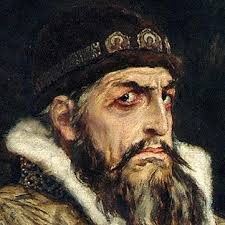
Ivan IV Vasileyevich, known to his friends as Ivan the Terrible, died in 1584 while engaged in a particularly wicked game of chess. He rose to prominence, and some might say infamy, as the Grand Prince of Moscow a position he held from 1533 to 1547, when he declared himself the first ever Tsar of All the Russias, a title he held until his death. He was succeeded by his son, Feodor the Not So Terrible.

Historians disagree on the exact nature of his enigmatic personality. He was described as intelligent and devout, yet paranoid and given to rages, episodic outbreaks of mental instability, and late-night tweet storms.

He was also know as Ivan the Fearsome but is not to be confused with Ivan the Gorilla.

Wretched Richard’s Little Literary Lessons – No. 3

plot

plät/  noun

~ the sequence of events of a play, novel, movie, or similar work that develops a story.

Use it in a sentence perhaps?

“What do you do when you’re not floating around the West Indies?” asked Albert.

“I write mostly.”

“A writer, says he,” Basil had returned from the bar and sat across the table from Terry. “I was a writer meself once upon. Never made any money at it, though. I was always a poor writer what never had a plot to piss on.”

Here’s where the plot thickens.


MARCH 17, 461: IS THAT A SHILLELAGH IN YOUR POCKET?

Today is St. Patrick’s Day, a major holiday for the Irish and for non-Irish hangers on who just want to drink green beer. There is precious little celebration of jolly old St. Patrick himself who died on March 17, 461, which is a pity for he was an interesting guy, turning Druids into Christians with a wave of his shillelagh, hurling blarney stones and sham rocks at unrepentant heathens, and playing his pipe to drive all the snakes out of Ireland.

He was, however, a bit of an enigma. Some believe there were actually two Patricks. That might explain some of the contradictions – a good Patrick and a bad Patrick. The good Patrick worked among the poor, feeding them corned beef and cabbage, encouraging them to be chaste and follow a righteous path. The bad Patrick worked among young women, pinching them if they weren’t wearing green, encouraging them to be unchaste and look at his shillelagh. It was the good Patrick who drove the snakes out of Ireland; the bad Patrick, who when he didn’t get enough recompense, stole all the Irish children to feed to the English.

How high’s the water, mama?

Some medieval calendars suggest that St. Patrick shares his day with a Biblical superstar name of Noah.  They have him boarding his ark on March 17 and disembarking on April 29.  And in religious plays of the time, they give Noah and his wife rather more down-to-earth personalities than depicted in the original source book — particularly the wife who is painted as somewhat of a shrew (which would make three shrews aboard the ark).

In one such play, when Noah brings her the news that God has recruited him as a sailor, she sneers at him, calls him a gullible fool, and complains that he never takes her anywhere, let alone on a cruise with a bunch of animals.  Noah tells her to hold her tongue, she refuses, and they come to blows.  He sulks away to build his ark.  She changes her tune when the waters start to rise, jumping aboard at the last minute, only to start complaining about the ambiance.  They continue their fighting ways — frequently beating each other around their heads with their shillelaghs — for forty days and forty nights.


Shaking His Shillelagh at Prairie Dogs

Legendary mountain man Jim Bridger was born on this day in 1804. He was not Irish. Bridger explored and trapped throughout the West during the mid-1800s which is what mountain men do. Were they on beaches instead of in mountains they would be beachcombers or, worse still, ho-dads. Bridger was one of the first white men to see the geysers of the Yellowstone region and the first European American to see the Great Salt Lake which he misnamed the Pacific Ocean. Most everything else he discovered he named after himself. He was a bit irascible, shaking his shillelagh at prairie dogs and playing his pipe to drive the Mormons out of Utah.


MARCH 16, 1963: PUFF YOUR OWN MAGIC DRAGON

Peter, Paul and Mary released the single, “Puff The Magic Dragon” in 1963. It became a big hit for the folk trio, peaking at number two on the pop charts in spite of its being banned by several radio stations whose management  figured that the song was about the illicit joys of smoking marijuana. The group denied this, saying: “It’s about a magic dragon named Puff.” “Puff” was followed by “Blowin’ in the Wind,” a song about trying to smoke pot on a stormy day, and “Leaving on a Jet Plane,” which is obviously a poorly disguised reference to getting high on the substance of your choice.

Davy, Davy Crockett

On this day eight years earlier, in 1955, “The Ballad of Davy Crockett,” by Bill Hayes, reached the number one spot on the pop music charts and stayed there for five weeks. The smash hit sold more than seven million records by several different artists. Coonskin caps were everywhere, and the words “born on a mountain top in Tennessee” on everyone’s lips – even though the next line “puffed a magic dragon when he was only three” was always bleeped.

Speaking of Substance Abuse:

Giving Up Smoking with Madame Zorene

I stood watching them — laughing young lovers, sitting on the bench, knees touching, talking conspiratorially.  Around them, lilacs and apple blossoms had burst into color, thanks to the fledgling warmth of spring.  As they puffed at long, sleek cigarettes, the exhaled smoke billowed lazily toward the blue sky.  There, sitting in the park, they created a richly satisfying tableau vivant, and I stood mesmerized as I contemplated descending upon them, ripping the cigarettes from their quivering lips and wildly puffing until my heart and lungs cried out in a tobacco-induced orgasm.  Instead, I popped a tiny square of nicotine gum into my mouth — it makes you burp and hallucinate yellow-toothed Doublemint twins — and stormed off.

People were meant to smoke, of course.  Why else tobacco?  A cigarette is tangible; a smoke-free environment hypothetical at best.  And cold turkey is just a dead bird defrosting for Thanksgiving.  Thus I reasoned, when I reached the store and demanded a pack of cigarettes, any brand, with or without filters, from the cowering clerk.  Back to the park, where I hastily lit a cigarette and let its mellowness caress my lungs.  I then smoked the entire pack, one cigarette after another.  It took me less than an hour.

Remorse naturally followed.  I cried out in anguish, bemoaned my weakness, condemned my cowardice — and I began to realize the hopelessness of my situation.  If I were ever to succeed in this quest –and doubts enveloped me — I needed a hired gun.

That evening, I let my fingers do the hobbling through the hypnosis section of the yellow pages.  The trusty phone book paraded before my anxious eyes a plethora of Ph.D.’s, licensed psychologists and certified hypnotherapists, any one of which, I found when phoning the following morning, would be happy to see me two weeks from now, three weeks from now, a month from now.  I had been decisive coming this far, and decisiveness is a fragile, short-lived thing.  I didn’t have that kind of time.

Then I found her.  She was neither psychologist nor hypnotherapist, but Madame Zorene would see me that evening.  I had my moments of doubt when she asked if I wanted her to put a curse on someone, but when I explained that I wanted to quit smoking through hypnosis, she seemed pleased.  “That’s good, too,” she said.

I chain-smoked on the way to my appointment with Madame Zorene, wondering if each cigarette might perhaps be my last.  Her office was tucked away in the back corner of a modern office complex.  I had feared that I would find her in an old shack in the middle of a bayou, although I was pretty certain there wasn’t a bayou within a thousand miles of here.  Upon opening the door, I faced her receptionist, and my fears returned.  A gaunt, colorless woman with stringy hair and sunken eyes, she had a vocabulary of three words:  “You pay first.”

But Madame Zorene herself was a pleasant surprise; a cheerful, chubby woman in her sixties, she smiled reassuringly and greeted me with a hearty handshake.  “Madame Zorene welcomes you,” she said as she opened a door and led me into her office.  “You are a brave man to attempt the smoking cessation.  Smoking is not good for your teeth or your lungs.  You will be happy when you quit.”  It sounded vaguely like a threat.

“Have a seat and relax yourself,” Madame Zorene continued.  “You must be relaxed.”

I settled into a comfortable chair facing her and tried my best to relax, but it wasn’t easy.  Staring at me over Madame Zorene’s left shoulder from the shelves at the other side of the small room was a human skull.  Several smaller skulls stood in a row next to it, each one staring.  On another shelf there were various jars in which dead toads and lizards were suspended in murky water.  There were no medical books, stethoscopes or sphygmomanometers, although there were masks, feathers and various powders.

“Are you a doctor or anything like that?” I asked.

“No, no.  Of course not.”

“What is your background?”

She saw that I was staring past her at her shelves.  “Ah, my little things, they upset you.  No need for you to worry.  I am a much experienced bokor.”

“A bokor?”

“Yes.  A bokor is a sorcerer in the voudun religion.”

“Voudun?”  I asked, growing steadily more anxious.  “Is that voodoo?”

Her eyes lit up and she grinned.  “Yes, yes.”

“And you do curses and things as well as smoking cessation?”

“Of course,” said Madame Zorene.  “But curses are not why we are here, are they?  Why don’t we start?  First I am going to give to you the great sleep.  Then I will lift from your body your ti bon ange.  That is one of your spirits.  I will talk to your ti bon ange, tell it that you no longer want to smoke.  Then when it returns to your body, it will guide you, so that you will no longer smoke.  Now you must relax.”

Madame Zorene stared at me, looked commandingly into my eyes, and began to speak softly in a language I didn’t recognize.  I wanted to turn away from her gaze, which was intimidating, not relaxing, to close my eyes, to stand, to run.  But I couldn’t move and I found myself growing drowsy,  the nagging worry that I would wake up a zombie growing steadily more distant.  I felt as though I were floating through a void.  I could hear Madame Zorene as she continued to talk, and someone answered her.  Was it me, my ti bon ange?

Then I was awake, and Madame Zorene was smiling at me, that same reassuring smile she had first greeted me with.  “Would you like a cigarette?” she asked, and in her smile I now saw the self-satisfaction.

“No, I don’t think so,” I answered truthfully.  I didn’t want one, and I don’t want one now.   I feel good, have no problems.  Well, I do have one problem — it’s odd, really.  The cat stares at me all the time, an evil, possessed stare.  I think it wants a cigarette.