APRIL 24, 1819: WHERE’S THE SODA, JERK?

Samuel Fahnestock was given a patent for the first soda fountain in 1819. Carbonated mineral water was all the rage at the time.  Joseph Priestley had created the first man-made carbonated water back in 1767, and Jacob Schweppes had developed a method of mass producing it, quickly leading to the production of different brands of soda and different flavors. Fahnestock’s soda fountain allowed these drinks to be sold by the glass. Oddly enough, it took more than fifty years for someone to create the first ice cream soda, even though ice cream had been around since at least the 10th century.

At the peak of their popularity in the 1940s and 1950s, soda fountains were everywhere – in pharmacies, ice cream parlors, candy stores, department stores, and five-and-dimes. They were public meeting places (or hangouts, when occupied by teenagers).

Soda fountains required the services of a soda jerk. The name referred not to the personality of the person serving sodas but to the jerking action used to swing the soda fountain handle back and forth when dispensing soda. The position of jerk was actually quite sought after and usually came only after an extended period of service in less desirable positions. The soda jerk was the star of the soda fountain show.

The decline of the soda fountain began in the early 1950s when the Walgreens chain introduced full self-service drug stores. Hello Dairy Queen and McDonalds and supersizing; goodbye chocolate soda with two straws and two cents plain.
APRIL 23, 1983: SATURDAY MORNING SUPERSTAR

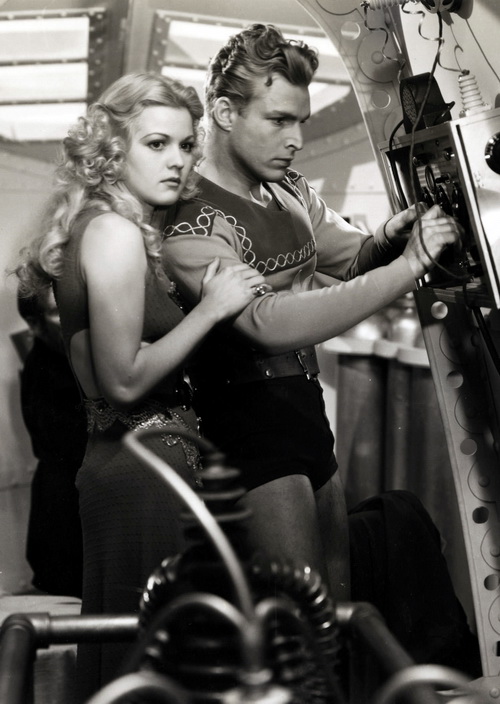
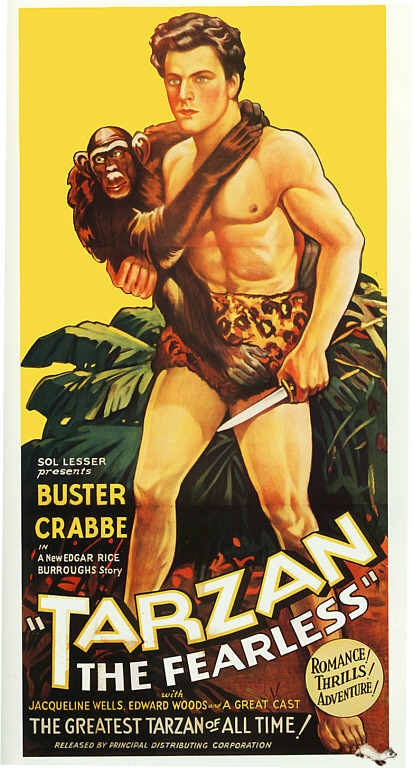
Athlete turned actor, Buster Crabbe (Clarence Linden Crabbe II), looking back over his career, could easily have said “been there, done that.” After winning Olympic gold in 1932 for freestyle swimming, Crabbe dived into the movies, eventually starring in over a hundred movies, first taking a turn as the jungle hero in Tarzan the Fearless in the 1933 serial and a variety of jungle men in movies such as King of the Jungle that same year,  Jungle Man in 1941, and the 1952 serial King of the Congo.
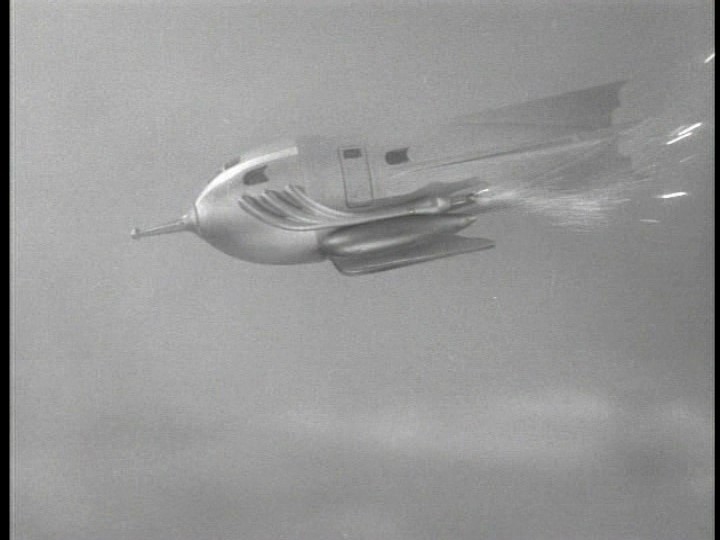
Leaving the jungle for the far reaches of space, he played both Buck Rogers and Flash Gordon. His three Flash Gordon serials were Saturday morning staples in the 30s and 40s. The serials were also compiled into full-length movies. They appeared extensively on American television in the 1950s and 60s, and eventually were edited for release on home video. Later on television, Crabbe also found his way into the French Foreign Legion. As his acting career wound down, he became a spokesman for his own line of swimming pools. He died on April 23, 1983.

Don’t Try This at Home

According to the National Rifle Association, guns don’t kill people, people kill people.  On the other hand, if you were to make a fist with your index finger pointing at your intended victim, and shout Bang, bang, you’re dead, chances are the only injury inflicted would be to your pride as you endured the derisive laughter all around you.

On yet another hand, take the case of William Lawlis Pace. Nine-year-old Billy was accidently shot in the head by his older brother. Pace died on April 23, 2012.  In his sleep.  At a California nursing home – 94 and a half years after the incident. The bullet was still in his head.

Doctors in Texas where the shooting took place left the .22 caliber bullet in his head because – well, because that’s what they do in Texas.

In 2006, Pace was crowned the Guinness world record holder in the category of “unwanted cranial ammunition acquisition.” A proud moment indeed, and Wayne LaPierre did not attend the ceremony.

Thank God, the Second Amendment still protects a citizen’s right to walk around for 94 years with a bullet in his head.

APRIL 22, 1886: BUT WILL YOU RESPECT ME IN THE MORNING?

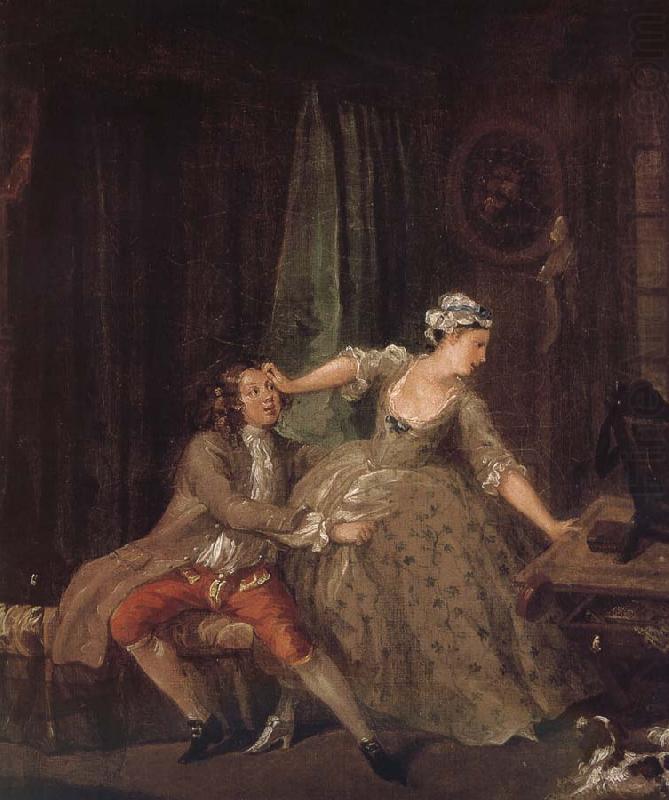
In a blow to lounge lechers everywhere, the state of Ohio passed a law making seduction unlawful. Covering any man seduction1over 18, it prohibited sex, consensual or not, with a woman of any age if the woman were being taught or instructed by the man. It covered all subject matter, leaving a lot of room for interpretation.  Other states jumped on the anti-seduction bandwagon. In Virginia, he’d better not try to engineer an “illicit connexion with any unmarried female of previous chaste character” using the promise of marriage. In Georgia, he couldn’t “seduce a virtuous unmarried female and induce her to yield to his lustful embraces.” In some jurisdictions, however, a woman could not press charges on her own behalf; only the father could do so based on his property interests in his daughters’ chastity.

Naturally, such laws were enforced with varying degrees of fervor. An unfortunate man trapped by the law in New York was headed for certain conviction until he proposed to his victim during the trial. Just to make certain, he didn’t back out, the judge brought in a minister and had the ceremony performed then and there.

A court in Michigan, on the other hand, went out of its way to favor the accused male. On three charges of seduction, two were thrown out because the woman was no longer virtuous after the first seduction. The other was tossed when the court ruled that her claim that they had sex in a buggy was physically impossible.

APRIL 21, 1986: SEEMS LIKE WE STRUCK OUT

Notorious gangster Al Capone moved to Chicago in 1919 where he built a career in gambling, alcohol, and prostitution rackets, eventually becoming Chicago’s go-to guy in the world of crime. He oversaw his various enterprises from a suite at the Lexington Hotel until his arrest in 1931.  He died in 1947.

The Lexington Hotel outlasted Capone by a good many years. In the 1980s, a construction Al-Capone-psd53402company undertook a renovation of the historic hotel. While surveying the building, the company made some unusual discoveries, including a shooting range and an elaborate series of hidden tunnels connecting to taverns and brothels and providing escape routes should the Chicago police get frisky and raid Capone’s headquarters. Most intriguing of all was a secret vault beneath the hotel, where rumor had it, Capone hid vast sums of his ill-gotten gains.

These discoveries were just too tempting for “investigative reporter” Geraldo Rivera to let pass by.  So on April 21, 1986, Geraldo planned to open the vault on live TV in a much ballyhooed special, The Mystery of Al Capone’s Vaults. What would the two-hour media event reveal? Piles of plunder? Bodies of Capone competitors? Jimmy Hoffa? Judge Crater? Among those who stood by Geraldo as the whole world watched were a medical examiner and agents of the Internal Revenue Service, lending the entire undertaking an aura of grim importance.

The vault was opened, and there . . . ? A lot of dirt and a couple of empty bottles. Geraldo did his best to snatch something out of the rubble, suggesting to 30 million disappointed viewers that the bottles were exciting because they had been used for bathtub gin during Prohibition. A nice try, but he summed up the evening by saying: “Seems like we struck out.”

April 20, 1935: Splish Splash, Snooky Was Taking a Bath

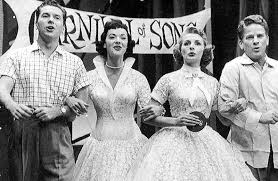
A music staple of the 40s and 50s, Your Hit Parade, made its radio debut on April 20, 1935. It lasted for nearly 25 years before being done in by rock and roll music – and perhaps Snooky Lanson. It began as a 60-minute program with 15 songs played in a random format, and eventually moved to television where the seven top-rated songs of the week were presented each week in elaborate production numbers requiring constant set and costume changes.  The list of top songs was compiled through a closely guarded top secret algorithm that involved record sales, quarters plunked into jukeboxes, shoplifted sheet music and the divination of an unidentified mystic in Memphis, Tennessee.

Dorothy Collins , Russell Arms, Snooky Lanson and Gisèle MacKenzie were top-billed during the show’s peak years. And Lucky Strike cigarettes starred throughout its run.

As the rock and roll era took over, the program’s chief fascination became seeing a singer like Snooky Lanson struggle with songs like Splish Splash and Hound Dog.

APRIL 19, 1949: SEND IN THE CLOWNS

russian

With the threat of nuclear annihilation hanging over the world, cold war adversaries were nonetheless able to find glimmers of humor. At the opening night of the Moscow Circus, noted Russian clown, Konsantin Berman, demonstrated who had the upper hand in the clown cold war, launching barb after barb in the direction of the United States.

Tossing a boomerang, he likened it to the U.S. Marshall Plan that was pumping economic recovery aid into Western Europe. “American aid to Europe,” he said, “Here is the dollar.” as the boomerang returned to his hand, delighting the audience. Producing a radio that bellowed out the sound of barking dogs, he announced: “That’s the Voice of America.”

Meanwhile American clowns were dumping buckets of water on each other and slipping on banana peels.

Speaking of Banana Peels

The Vagabond King a 1925 operetta by Rudolf Frimi was already an American success when it opened in London on April 19, 1927.  It’s success in England was probably assured given its theme of foibles of the French.  Its hero is a braggart, thief and rabble-rouser who attempts to steal an aristocratic lady from the king himself.  Not only that, he openly mocks the king, boasting about what he would do if he were king.  The angry king gives him royal powers for 24 hours — king for a day — during which he must solve all France’s problems or go to the gallows (the guillotine had not yet been invented).  He succeeds, wins the lady’s hand and lives happily ever after in exile — probably in England.  The operetta was the inspiration for a couple of movies and, of course, the popular radio and television program “Queen for a Day.”


APRIL 18, 1968: IF YOU BELIEVE THIS, I’VE GOT A BRIDGE . . .

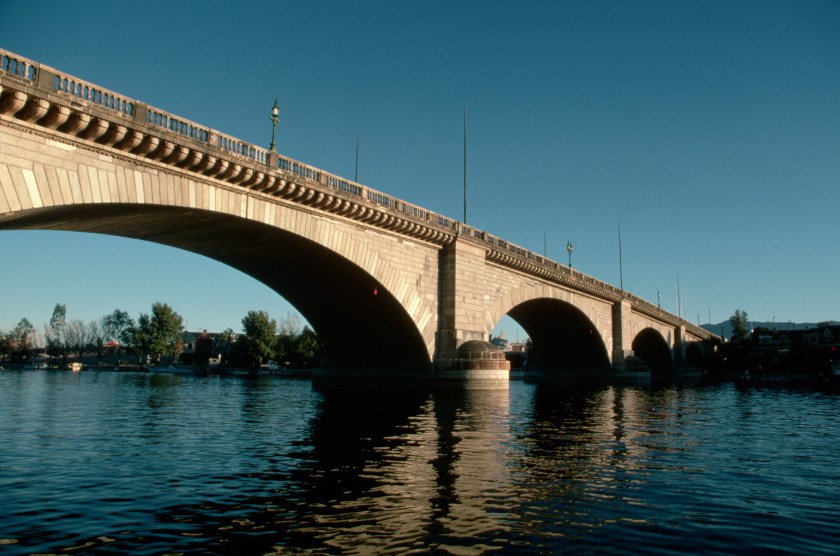
Famous real estate deals abound — the sale of Manhattan for beads, the Louisiana Purchase, Seward’s Folly. One of the more unusual is the April 18, 1968, sale of London Bridge for a mere $1 million (of course, as any schoolchild knows, the thing was falling down). American oil sphinx_magnate Robert McCullough was the buyer and he bought it as a large conversation piece for his Arizona real estate development in an out-of-the-way spot that had previously only been an inspiration for Roadrunner cartoons.  The bridge was disassembled in London, each piece numbered, then hauled to Lake Havasu City, Arizona, where it was reassembled.

McCullough had wanted to buy the Brooklyn Bridge for his project, but it had already been sold. Many times, actually. One George Parker had made his living selling the bridge to oil magnates and other naive visitors to New York, some of whom actually tried to erect toll booths.

The relocation of London Bridge inspired, in addition to a great deal of laughter, a forgettable 1985 made-for-television movie Bridge Across Time (aka Arizona Ripper or Terror at London Bridge) in which several murders are committed in Lake Havasu by the spirit of Jack the Ripper, whose soul is transported to the United States in one of the stones of the bridge (sorry you missed it, aren’t you).

Although the Sphinx may have been more architecturally appropriate to the location, McCullough wasn’t interested. “Something about the nose,” he said.

Legumes in Love

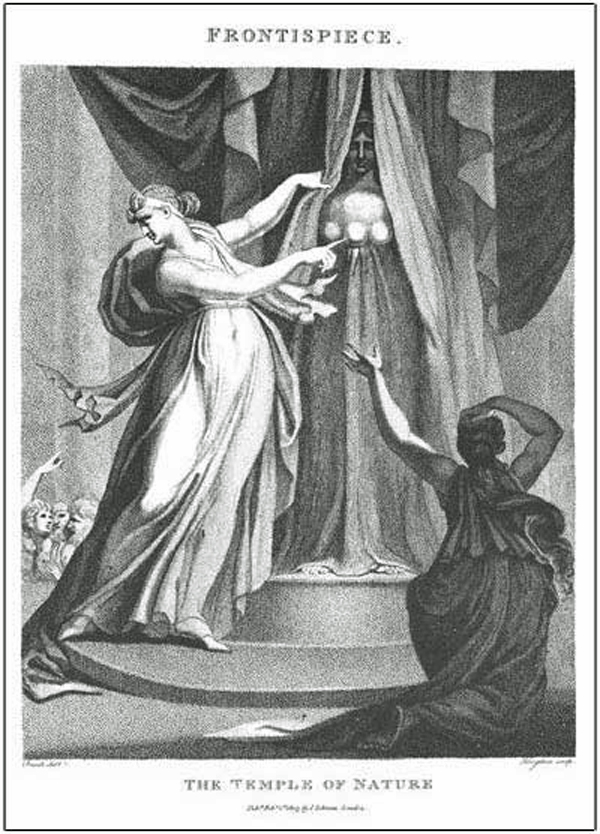
British poet and physician Erasmus Darwin died on April 18, 1802.  As a physician graduated from Cambridge, he didn’t really distinguish himself. When he is remembered at all, it is for his poetry, and one particular poem, The Loves of the Plants, part of a larger work called The Botanic Garden (the other part being The Economy of Vegetation), in which the physiology and classification of the vegetable world is presented in a rather lofty and lyrical manner. Although the subject was mundane and the technical accuracy questionable, the poetic frenzy reached amazing heights. Had Erasmus Darwin’s grandson Charles presented his discoveries in a more poetic fashion, perhaps they would have been more warmly received.


APRIL 17, 1610: SOMEWHERE A RIVER BEARS YOUR NAME

Back at the dawn of the 17th century, the holy grail among explorers was the Northwest halfPassage, that elusive sea route that Europeans had been seeking ever since they discovered that North America stood right in the middle of their way to China. (For some reason, they longed to go west to China even though it was a lot closer going east.)

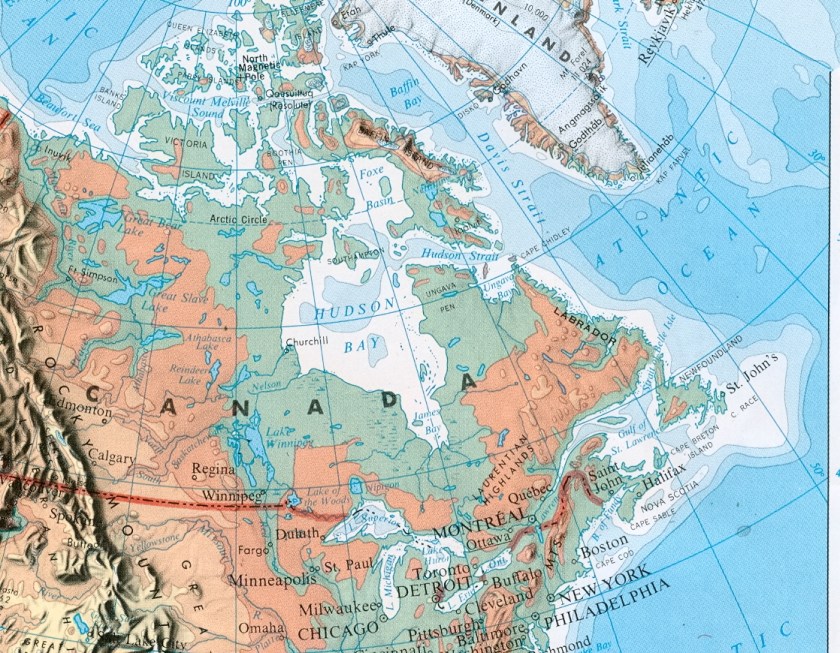
On April 17, 1610, intrepid British explorer Henry Hudson. already famous for having discovered and explored a river that just happened to share his last name, set sail on his latest attempt to find the passage that would at last allow Europeans to take (as the popular song tells us) a slow boat to China.

It was his fourth expedition, financed by adventurers from England. Sailing across the Atlantic, slipping between Greenland and Labrador, he entered the Hudson Strait (another remarkable coincidence) and soon reached (you’re not going to believe this) Hudson Bay. Unfortunately after all this seeming good luck, the expedition took a nasty turn.  After three months dawdling around the bay, Hudson was surprised by the onset of winter. Why winter north of Labrador in November would be a surprise is anyone’s guess. Nevertheless, Hudson and his crew were forced to set up a winter camp. The next few months were not pleasant, and many of the crew members were not amused. They grumbled and held their tongues throughout the winter until June. But once they were sailing again, they up and mutinied, setting Hudson, his son and seven friends adrift.  Although Hudson was never seen again, England laid claim to everything that shared his name — river, strait, bay and even a funny looking vehicle that seemed to have no useful purpose.


APRIL 16, 1850: CALL ME MADAME

Madame (Marie) Tussaud is arguably the world’s most famous wax sculptor. Born in France in 1761, she began her artistic career during the French Revolution, searching through corpses to find the heads of noted guillotine victims from which she made death masks. She herself was imprisoned for three months awaiting execution, but an influential friend intervened and she was released. She and her waxwork friends toured throughout Europe for 33 years before settling into a permanent exhibition in 1835 on Baker Street in London. There she gained prosperity and fame, managing her wax museum until her death on April 16, 1850.
Throughout Madame Tussaud’s long existence, its most popular feature has been the Chamber of Horrors (as pictured here).

And It Would Help with Social Distancing

Inventor Walter Pichler is the genius behind the amazing TV helmet of 1967. This device allows a user to leave the outside world and slip into his or her own little world of information and entertainment. The user simply inserts his or her head into a capsule that resembles a small submarine and hopes that he or she doesn’t bump into something while enjoying the “virtual world” of Gilligan’s Island.

Pearl Among . . .

minnie

“How-w-w-Dee-e-e-e! I’m jes’ so proud to be here!” “Here” might have been the National Comedy Hall of Fame into which, on April 16, 1994, Minnie Pearl became the first woman inducted. But more often it was on the stage of the Grand Ole Opry in Nashville, Tennessee, where Minnie held sway as the resident Southern hillbilly for over 50 years.

Her comedy was a good-natured satire of rural Southern culture. She appeared in her trademark hat, purchased at the Surasky Bros. Department Store in Aiken, South Carolina, for $1.98 before her first stage performance in 1939, along with styleless “down home” dresses.  Her self-deprecating humor was usually about her unsuccessful attempts to get “a feller” and her ne’er-do-well relatives. She also sang novelty songs and danced with Grandpa Jones. From the opening How-w-w Dee-e-e-e to her closing “I love you so much it hurts!”, she had the Opry audience in the palm of her hand.

The Little Tramp

Sir Charles Spencer Chaplin, known to millions of film buffs as “Charlie,” was born April 16, 1889.  His working life in entertainment began as a child performer in British music halls and spanned 75 years until his death in 1977 at the age of 88.   In the United States, he became one of the most important creative personalities of the silent-film era — acting in, directing, scripting, producing and composing the music for his own films.


April 15, 1992: Me, Pay Taxes?

April 15 is usually the deadline for filing income taxes, so it is quite fitting that prisoner number 15113-054 entered the federal prison in Lexington, Kentucky, on April 15, 1992, having been convicted of one count of conspiracy to defraud the United States, three helmsleycounts of tax evasion, three counts of filing false personal tax returns, sixteen counts of assisting in the filing of false corporate and partnership tax returns, and ten counts of mail fraud. Her famous excuse for this bit of naughtiness was “We don’t pay taxes. Only the little people pay taxes.”

Known affectionately as the “Queen of Mean,” Leona Helmsley started her amazing career of acquiring everything she laid her eyes on back in the mid60’s, soon aided and abetted by Harry Helmsley, after they disposed of his wife in 1972. Their real estate empire included the Park Lane Hotel, the Empire State Building, Helmsley Palace and a collection of condos throughout Manhattan.

In 1983 the Helmsleys bought a 21-room mansion weekend retreat in Greenwich, Connecticut, for $11 million. Finding it a tad shabby for their tastes, they had it remodeled for another $8 million, adding among other homey touches a million-dollar dance floor and a mahogany card table. When they tried to stiff the contractors, they were sued for non-payment. The Helmsleys eventually paid up, but it was revealed that most of the work was illegally billed to their hotels as business expenses.

A federal criminal investigation followed, and they were indicted on several tax-related charges, as well as extortion. Harry called in sick, and Leona took the fall alone.

Sounds a lot like another notorious New York real estate nabob.  Sometimes they get caught.