January 14, 1500: For the Ass Was a Donkey, You See

The Feast of the Ass held on January 14 from around 1100 until 1500 was meant as much as a teach-in as a party-in, a way to present religious doctrine to the illiterati who had no books or Internet access. This festival, held primarily in France as a cousin to the Feast of Fools, celebrated the flight of Joseph, Mary and Jesus into Egypt.

Traditionally, the most beautiful young woman in the village splendidly attired in gold-embroidered cloth, carrying a small child and riding a donkey would be led in a solemn procession through the town to the church. The donkey would stand beside the altar while a mock Mass was performed. Instead of the usual responses to the priest, the congregation would “hee-haw.” At the end of the service, instead of the usual benediction, the priest would bray three times and the congregation would respond with another round of hee-hawing. The choir would then offer up a hymn and everyone would bray along — except for the ass who thought the whole thing rather ridiculous and that these people were all making you know whats of themselves.

Talk to the Donkey

Yes, Doctor Doolittle could talk to the animals, including donkeys. And much more. He ran a post office, a circus and a zoo, took voyages to exotic places around the world, went to the moon. According to the neighborhood mussel-man, he was a nacheralist – “a man who knows all about animals and butterflies and plants and rocks an’ all.” Not only could he talk to and understand animals, he had written history books in monkey-talk, poetry in canary language and songs for magpies to sing. He didn’t just talk to your normal animals like pigs, rats, owls, seals and badgers but to  pushmi-pullyus and wiff-waffs as well.

January 1lofting4 is a red letter day for children who love to read and love animals. Two major authors who spent their lifetimes entertaining the younger set were born on this day 12 years and an ocean apart.

Hugh Lofting, creator of the amazing Doctor Doolittle from Puddleby-on-the-Marsh, was born in 1886 in Maidenhead, England. He wrote a dozen books featuring the doctor , a character he first created in letters to his children during his World War I service in the Irish Guards. The Story of Doctor Doolittle: Being the History of His Peculiar Life at Home and Astonishing Adventures in Foreign Parts Never Before Printed began the series in 1920 and was followed two years later by The Voyages of Doctor Dolittle.

Born on Cape Cod in 1874, Thornton Burgess was a conservationist and prolific writer of burgess1children’s books, producing 170 books between 1910 and 1965.  His books celebrated nature, featuring the many animals that lived in the Green Meadow and Green Forest.

Mother West Wind “How” Stories, an early collection of 16 stories, told how Lightfoot the Deer learned to jump, how the eyes of Old Mr. Owl became fixed, how Drummer the Woodpecker came by his red cap and so on. Other collections told when, where and why various animal things happened – Wild Kingdom without Marlin Perkins or TV commercials The anthropomorphic forest and meadow creatures that had their own adventure books included Peter Rabbit, Jimmy Skunk, Grandfather Frog, Little Joe Otter, Granny Fox, Jerry Muskrat and Digger the Badger to name just a few.


January 13, 1930: Day of the Mouse

He’s short with big ears, a big nose and a skinny tail.  He’s nattily attired in red shorts with two big buttons, big yellow shoes and white gloves.  He hails from Florida these days where he has his own kingdom and is a woke Robin Hood to the state’s evil governor.  Back in 1930 when he made his debut he wasn’t quite so colorful, his venue being a black and white comic strip.  Mickey Mouse was already well known when his comic strip first appeared, having been a film star since his first appearance in 1928 in the cartoon Plane Crazy.  Created by Walt Disney and Ub Iwerks, he has grown in stature through the years to become the face of the Walt Disney organization.

The first comic strip sequence was a reprise of the Plane Crazy cartoon in which Mickey dreams of following in the footsteps of his idol Charles Lindbergh, flying into adventure in his own homemade plane, along with his girlfriend Minnie.

The governor of Florida would probably fare better against a less formidable Disney character.  A DeSantis/Donald Duck debate would be priceless.

If Only It Had Wings

On January 13, 1854,  musical inventor Anthony Foss received a patent for his accordion, a strange device shaped like a box with a bellows that is compressed or expanded while pressing buttons or keys which cause pallets to open and air to flow across strips of brass or steel, creating something that vaguely resembles music. It is sometimes called a squeezebox. The person playing it is called an accordionist (or squeezeboxer?)

The harmonium and concertina are cousins. And, yes, there is a World Accordion Day.

If Only She’d Had a Squeezebox

Born in Russia on January 13, 1887, “the Last of the Red Hot Mamas,” Sophie Tucker immigrated to the United States as an infant and began her long career shortly afterward, singing for tips in her parents’ restaurant. Between taking orders and serving customers, Sophie would stand in a narrow space by the door and belt out songs with all the drama she could muster. “At the end of the last chorus,” she remembered, “between me and the onions, there wasn’t a dry eye in the place.”

She gained stardom using a combination of comic risque and “fat girl” songs such as “Nobody Loves a Fat Girl, But Oh How a Fat Girl Can Love.” Her signature song, however, was “Some of These Days.” She became one of the most popular entertainers in America, following her vaudeville and burlesque career with movies through the 30’s and 40’s and television in the 50’s and 60’s.  She influenced many female performers, including such larger than life performers as Mae West and Bette Midler.

Sophie Tucker continued performing until her death in 1966.

JANUARY 12, 1896: I CAN SEE CLEARLY NOW

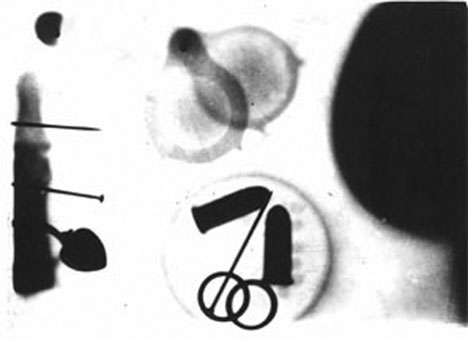
x-rayDr. Henry Louis Smith was a professor of physics at Davidson College in North Carolina where he was pioneering the use of X-rays in America. He planned to duplicate the work of the German physicist who discovered x-rays.  Smith made the mistake of telling his students about his plans.  On the night of January 12, 1896, three of Smith’s students bribed a janitor to let them into the medical laboratory on campus, where they played around until the wee hours, finally producing an X-ray photograph of two .22 caliber rifle cartridges, two rings and a pin inside a pillbox,some pills, a magnifying glass and a human finger they had sliced from a cadaver with a pocketknife — a historical first in the United States (the x-ray photograph not the finger).  Smith went on to create his own images and to spread the use of x-rays throughout the medical community.  The students kept their little adventure a secret until years later when they decided they would probably be forgiven for their naughtiness if they revealed their part in making history.

Surely There’s Some Noble Use for X-rays

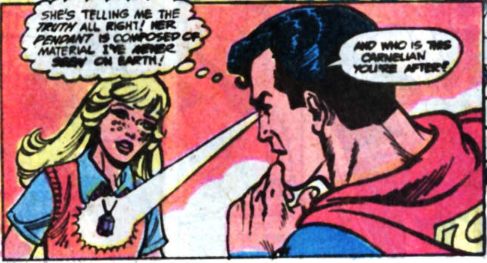
X-rays have since then become an important tool in medicine, saving many lives and other such noble stuff, but what has been more important to generations of boys is the concept of x-ray vision — the xrayvision1ability to see what’s on the other side of a wall, in a box, or under various articles of clothing.  Most boys learned about x-ray vision from Superman, easily the most famous employer of the art.  Superman only used his powers of x-ray vision for completely innocent pursuits such as the apprehension of bad guys.  However, those bad boys who sent for the x-ray spectacles advertised in comic books are quite another story.xspecs

A Man’s Home Is His Stonehenge

Stonemason, sculptor and oddball Edward Leedskalnin was born on January 12, 1887, in Latvia. He left Latvia for the United States at the age of 26 after 16-year-old Agnes Skuvst broke their engagement on the day before they were to be married.

Edward eventually purchased a parcel of land in Florida City and began what would become his life’s work — the construction of a massive structure he called “Rock Gate” and which he dedicated to his lost love Agnes. Working alone, he quarried and sculpted 1,100 tons of limestone into the titanic structure that came to be known as The Coral Castle and which was often called America’s stonehenge.

When asked how he moved all that heavy stone by himself, he answered: “I understand the laws of weight and leverage and I know the secrets of the people who built the pyramids.” He eventually opened his castle to the public, charging ten cents admission.

Ever the eccentric, he lived as a recluse and existed on a diet of crackers and sardines. He also published several pamphlets, the first being a dissertation on morality with text only on the left-hand pages so that his readers might offer their own opinions on the right. He got particularly worked up on the subject of teenage lust: “. . . everybody knows there is nothing good that can come to a girl from a fresh boy. When a girl is sixteen or seventeen years old, she is as good as she ever will be, but when a boy is sixteen years old, he is then fresher than in all his stages of development.”

And he probably owns x-ray glasses.

JANUARY 11, 1917: YOU GOTTA HAVE HEART

Have a Heart, a musical by a trio new to the Broadway scene opened for the first of 76 performances during the 1916-1917 season.  Although it was a pretty short run for Broadway, the team of Jerome Kern, Guy Bolton and Pelham Grenville Wodehouse would go on to create legendary musicals and forever change the landscape of American musical theater.  The exotic locales and characters of operetta and the over-the-top spectaculars of the Ziegfeld Follies gave way to the lives and loves of ordinary folk and the theatrical style of such giants as Richard Rodgers, Cole Porter and George Gershwin.  The trio only produced five musicals.  Kern would go on to produce such monumental musicals as Showboat.  Bolton would work as librettist with most of the top composers of the day.  And Wodehouse, now better known by the initials P.G. or the nickname Plum would make his mark in the literary world, giving us Bertie Wooster, Jeeves and dozens of characters whose comic entanglements filled 90 books, 40 plays and a couple hundred short stories.  A sampling of his amazing wit:

Freddie experienced the sort of abysmal soul-sadness which afflicts one of Tolstoy’s Russian peasants when, after putting in a heavy day’s work strangling his father, beating his wife, and dropping the baby into the city’s reservoir, he turns to the cupboards, only to find the vodka bottle empty.

He had the look of one who had drunk the cup of life and found a dead beetle at the bottom.

Mike nodded. A sombre nod. The nod Napoleon might have given if somebody had met him in 1812 and said, “So, you’re back from Moscow, eh?”

I could see that, if not actually disgruntled, he was far from being gruntled.

There is only one cure for gray hair. It was invented by a Frenchman. It is called the guillotine.

She looked as if she had been poured into her clothes and had forgotten to say ‘when.’

The fascination of shooting as a sport depends almost wholly on whether you are at the right or wrong end of the gun.

Every author really wants to have letters printed in the papers. Unable to make the grade, he drops down a rung of the ladder and writes novels.

It was my Uncle George who discovered that alcohol was a food well in advance of modern medical thought.

And she’s got brains enough for two, which is the exact quantity the girl who marries you will need.

At the age of eleven or thereabouts women acquire a poise and an ability to handle difficult situations which a man, if he is lucky, manages to achieve somewhere in the later seventies.

Wodehouse was knighted in 1975 at the age of ninety-three and died later that year.

Perhaps You Could Smoke It

We may never know why he did it — perhaps as a joke or prank — but on January 11, 1770, Benjamin Franklin shipped the first ever rhubarb to the United States. Americans were unimpressed until years later when Thomas Jefferson began to cultivate it and it finally caught on.

Rhubarb had been around in other parts of the world for a good 5,000 years. Fried rhubarb was used as a laxative in Imperial China. Greeks and Romans used it as well and gave it its name Rha (Greek for the Volga River) and barbarum (Latin for barbarian , anyone who was not a Roman). Marco Polo waxed poetic about Chinese rhubarb. It was a prized commodity on the Silk Road to Europe. And in Europe heavy demand made it more expensive than cinnamon and twice the price of opium (which explains why there weren’t very many rhubarb dens).

Rhubarb is a vegetable but is treated and cooked as a fruit. It tastes like a very sour apple which is why all rhubarb recipes use copious amounts of sugar. Why bother? Because it’s healthy as all get out, jam packed with such goodies as dietary fiber, vitamins C and K, B complex vitamins, calcium, potassium, magnesium, beta carotene just to mention a few.

Stalk of rhubarb, anyone?


JANUARY 10, 49 BC: WADE IN THE WATER

Back in 49 BC, Julius Caesar was a mere governor commissioned by the Roman Senate to oversee a portion of the empire that stretched from Gaul to Illyricum (pretty much most of today’s Europe except Italy). When his term of governorship ended, the Senate ordered Caesar to disband his army and return to Rome. Whatever you do, Julie baby, don’t bring that army across the Rubicon River for that is treason and insurrection and very bad manners. Oh, and the punishment is death.

Caesar may have misunderstood for didn’t he just up and cross the Rubicon into Italy on January 10. His biographer suggests that he was under the control of a supernatural apparition (the Devil made him do it). Willful or not, Caesar is said to have shouted “alia iacta est” as he and his merry men waded across the shallow river (or ‘the die has been cast,” certainly more dramatic in Latin).

Crossing the Rubicon was a declaration of war, but instead of arresting Caesar the Roman Senate fled Rome in fear. Caesar, far from being condemned to death, became dictator for life. Sometimes it’s good to cross the Rubicon. Crossing the Rubicon has endured as a phrase meaning passing a point of no return.

The Hole in My Record Is Bigger Than the Hole in Your Record

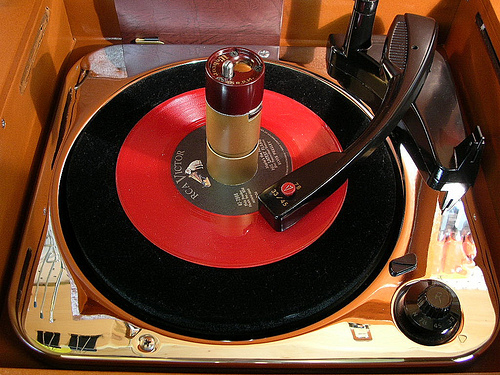
RCA Victor it might be said crossed the Rubicon when on January 10, 1949, it introduced a new kind of record — a vinyl disc, just seven inches in diameter with a great big hole in the middle, the 45 (referring to its revolutions per minute). The 45 replaced the big noisy shellac disc that rotated at a breakneck 78 rpm. The first 45 rpm single was “Peewee the Piccolo.” Remember it?

The Bun Knows

On January 10, 1984, 81-year-old Clara Peller first asked the question for which she would become famous:

JANUARY 9, 1493: I HAVE HEARD THE MERMAIDS SINGING

Do mermaids exist? These creatures – half woman, half fish – have found their way into the lore of seafaring cultures at least as far back as ancient Greece. You’ve seen them depicted; a woman’s head and torso and the tail of a fish instead of legs. They’re most often quite attractive, gazing upon their own countenance in a mirror and combing their long flowing tresses (like Darryl Hannah in the movie Splash, for example).

But believe in them? One might just as well believe in sirens, the half-woman, half-bird creatures who dwell on islands from where they sing seductive songs to lure sailors to their deaths. Yet there have been some notable sightings. No one less than Italian explorer Christopher Columbus has written of an encounter. On January 9, 1493, the intrepid New World traveler spotted not one but three mermaids frolicking somewhere near the Nina, Pinta or the Santa Maria (or maybe one entertaining each ship?)

He described the sighting in his ship’s journal: “They were not as beautiful as they are painted, although to some extent they have a human appearance in the face.” Columbus’ account would give ammunition to conspiracy theorists who claim that most mermaid sightings are actually manatees —  sea cows, although they’re said to share a common ancestor with elephants. Manatees are slow-moving aquatic beasts, weighing a good thousand pounds with bulbous faces but Bette Davis eyes. Most moviegoers would not mistake them for Darryl Hannah.

Would you mistake this . . .
. . . for this?

Henry Hudson, a British and therefore more reliable explorer, also sighted a mermaid “come close to the ship’s side, looking earnestly on the men. A little while after, a sea came and over-turned her. From the navel upward her back and breast were like a woman’s . . .her body as big as one of ours; her skin very white, and long hair hanging down behind . . . In her going down they saw her tail, which was like the tail of a porpoise, and speckled like a mackerel.” Much better, except for the mackerel part.

A few years later, Captain John Smith, of Pocahontas fame, spotted a mermaid off the coast of Massachusetts. He wrote that the upper part of her body perfectly resembled that of a woman and that she swam about with style and grace. She had “large eyes,

rather too round, a finely shaped nose (a little too short), well-formed ears, rather too long. . .” And she probably thought Smith was a little too much of a jerk.

Naturally, there is a male counterpart for the mermaid: the merman.  Collectively we might call them merfolk.

The most famous of the mermen was the Greek god Triton, the messenger of the sea who played a conch shell as though it were a trumpet and he were Louis Armstrong.  He wasn’t.  Another notable was Ethel the Merman.

A Merman

Lights! Camera! Gesundheit!

A major motion picture debuted in 1894 and became the first copyrighted film in the United States on January 9. Filmed by the Thomas Edison Studio a few days earlier, it starred a gentleman named Fred Ott. This five-second epic was officially titled “Edison Kinetoscopic Record of a Sneeze,” but became more familiar as “Fred Ott’s Sneeze.” Next day on Fred Ott’s dressing room, they did not hang a star.


January 8, 1310: How Cold Was It?

In England, this stretch of January  is considered the coldest of the year, probably because of the great frost that began on January 8 in 1310 with such cold that the Thames froze over so thickly bonfires could be lit on it.  Snow and piles of ice lasted through March.  In many subsequent years, folks would hold festivals with thousands of them stomping around on the frozen Thames.

How cold was it?   It was so cold that

. . . pickpockets were sticking their hands in strangers’ pockets just to keep them warm.

. . .  politicians had their hands in their own pockets.

. . . the squirrels in the park were throwing themselves at an electric fence.

. . . when I turned on the shower I got hail.

. . . mice were playing hockey in the toilet bowl.

Ode to Snow

Warning – the following is quite lyrical.

O glorious snow surrounding me with immense drifty mounds!

What do thy mounds conceal?  How many cocker spaniels, small children, miniCoopers have you swallowed, not to be seen again until May.  I am quite conscious of those mounds surrounding me, looming, as I go to fetch the mail, keeping close to the shoveled path lest I too be lost in the mounds ‘til May.

But the path is icy (for that’s what winter is about – snow and ice, ice and snow) and my feet, which have been more accustomed to soft earth, grassy carpeting, fly out from neath me.

I fall to the cruel ice.

And here I am in a place from which I never thought I’d be needing to shout:  “Help me.  I’ve fallen and I can’t get up.”  But I’m not going to shout, for it seems my mouth is frozen to the icy path.  O glorious ice!  Ice that holds me close to its vast but damn cold bosom.

I wait, hoping that someone will come along – a girl scout  peddling cookies, a hot dog vendor, or the UPS man delivering a package of lip warmers.  Or have they too been swallowed by the shifting, whispering mounds of snow?

I tell myself it could be worse; I could be in Chicago.  It doesn’t help.

Now my life flashes before me, especially the part where I’m on a beach in the Caribbean.   But what’s this?  My face is stuck in the sand.  Children frolic nearby, pointing and laughing.  “Hey, mon, why’s your face in the sand?”  Tanned beauties stroll by at a safe distance whispering about senility and too many pina coladas.    A sand crab sidles up and pinches my nose, and I’m suddenly back in frozen Vermont.

But help seems to be at hand.

Two Jehovah’s Witnesses approach.   They look down at me and ask,  “Are you ready to be saved?”  “Doesn’t it look like I’m ready to be saved?” I shout, but no words come out.   They chip me free from the ice with their Watchtowers.  I thank them, accept an armload of their publications, and they ask me if I’m ready for the end of the world.

You betcha.


JANUARY 7, 1784: sultan of squash

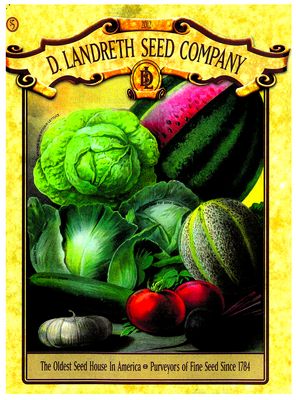
In 1780, David Landreth and his family sailed from England to Montreal, Canada, with the intention of starting a seed company. Finding Canada a little too cold for their liking, the Landreths moved south to Philadelphia in 1783, where on January 7, 1784, they opened the first seed company in the United States. D. Landreth & Sons numbered among their clients gardening enthusiasts such as George Washington and Thomas Jefferson.

During the following years, Landreth, in addition to selling seeds, applied adventurous horticultural tinkering to  such exotic new flowers and vegetables as tomatoes, zinnias and spinach.  He developed a potato that was white and an extra early pea.  The latter would surely have given Gregor Mendel goosebumps as he did his own pea tinkering  many years later (as celebrated in yesterday’s entry).

Landreth minded his peas and cukes and became one of the most influential forces in American horticulture — a sultan of squash, a watermelon wizard, a parsley poobah. His company, now headquartered in Shelburne, Vermont, continues to be a purveyor of seeds and remains the oldest seed company in the United States.

Dorothy Parker was once asked to use the word horticulture in a sentence.  “You can lead a horticulture,” she replied, “but you can’t make her think.”

Tiny Tomato Killer Strikes Again

It is better to light a candle than curse the darkness, or so says some annoying pundit.  Likewise, I suppose, it is better to do something positive than curse the mounds of snow still encircling us.  I’ve always been of the curse the darkness ilk, but occasionally I do try and rise above the winter of my discontent and light a candle in the snow.  One of the better remedies for my malaise is the old seed catalog – tiptoeing through the tulips, tomatoes and zinnias almost brings warmth to my icy heart.

If you ever order anything from a seed catalog, you will never have to worry about being without one again.  They will arrive every January just as reliably as freezing rain.  There’s Seed City, Happy Seeds, Seeds R Us and many more.  Funny thing is they all come from the same little town in the Midwest.  One could develop a dandy conspiracy theory about this: a single little old lady – Granny Burpee – taking seeds out of great big jars and putting them in little envelopes with all those different names so that every spring every one of us plants the same seeds in every garden everywhere.  Are we really planting radishes and marigolds?

Nevertheless I jump in full seed ahead.  Seven tomato varieties, a couple of cucumbers, greens, beans, okra.  Snapdragons, sweet peas, exotic species I’ve never heard of.  “And there’s no such thing as too many sunflowers,” I’m reminded.

There is such a thing as too many seeds, however.  Granny Burpee doesn’t hold back – a hundred seeds here, two hundred there, a thousand.  I’d like to order six tomato seeds, please.  I really only need two cucumber seeds.  The theory seems to be that you must over plant, just in case some of them don’t sprout.

But they all sprout.

I wanted a couple of tomatoes.  I planted a plastic seed-starting tray, two or three seeds in each of its six cubicles.  Twenty tomato plants emerge.  Just thin out the extra plants, the catalogs advise, leaving one healthy tomato plant in each cubicle.  That’s theory again.  From over my shoulder, as I carefully pull out the runts of the seedlings:  “You’re not going to murder those little plants, are you?”

Come June, I have twenty tomato plants, a dozen cucumbers, a dozen nasturtium, I don’t know how many dozen sunflowers, a sea of seedlings that I forgot to label, and six zucchini.   With six zucchini plants, I’ll be able to place a giant zucchini on the back seat of every unlocked car in Vermont.

Maybe I’ll curse the darkness for a while.


January 6, 1884: Pea Picking 101

Gregor Mendel was a friar/scientist/pea picker born in Austria in 1822. Had he been born later he would have been a Czech friar/scientist/pea picker since the part of Austria in which he was born is now the Czech Republic. He is remembered today for minding his peas and cukes, and even has a law named after him.

Gregor had this strange fascination with the propagation of peas. This and his inquiring mind led him to crossbreed short plump green peas with tall skinny yellow peas. Well wasn’t he surprised when all the little baby peas from this union were tall, skinny and yellow. He pondered this at great length and eventually had a forehead-slapping moment.

“Peas have genes!” he probably shouted. (Jeans, on the other hand, were just a twinkle in Levi Strauss’ eyes at the time.) Not only did peas have genes; some of them were dominant and some were recessive — just like kids on a playground or in the House of Representatives.

As any dominant kid of five knows, Mendel’s pea play became the science of genetics and Mendel became (posthumously) the father of same. He died on January 6, 1884, eleven years after the birth of blue jeans.

Elementary, my dear Mendel

Consulting detective Sherlock Holmes, a master of observation and deduction was born on January 6, 1854. The greatest detective in history, he has been depicted in more than 25,000 stories, plays and films. Guinness lists him as the “most portrayed movie character” of all time. His legion of fanatical fans — Sherlockians, Holmesians and Baker Street Babes — celebrate the day annually.  Holmes would have approved of Mendel’s scientific methods.

Many other fictional detectives have vied for our attention over the years.  And while not as versed in scientific methodology as Sherlock, they all could turn a catchy phrase now and then:

The truth must be quite plain, if one could just clear away the litter.”Jane Marple

I don’t mind your showing me your legs. They’re very swell legs and it’s a pleasure to make their acquaintance. —Phillip Marlowe

‘And when you’re slapped you’ll take it and like it.’ — Sam Spade

Because I am Hercule Poirot! I do not need to be told.”

It was a Friday night. I was tooling home from the Mexican border in a light blue convertible and a dark blue mood.” –Lew Archer

All right, talk, but do you mind putting the gun away? My wife doesn’t care, but I’m pregnant.” — Nick Charles

(Nero) Wolfe still paid no attention to me. As a matter of fact, I didn’t expect him to, since he was busy taking exercise. He had recently got the impression he weighed too much- which was about the same as if the Atlantic Ocean had decided it was too wet…” — Archie Goodwin

Have two ears, but can only hear one thing at time.” — Charlie Chan


JANUARY 5: Twelfth Day, Twelfth Night

Here we are — the last day of Christmas, number twelve, the big climax.  And what a thundering climax for True Love.  We already have milking maids, dancing ladies, leaping lords, piping pipers and all those birds.  And now twelve drummers drumming, furiously wielding those drumsticks on snare drums, bass drums, tomtoms, steel drums, bongos even.  For Scrooge, it’s an anticlimax; the twelfth ghost of Christmas made it clear that Scrooge was not off the hook, that he would be seeing more ghosts come Valentines.  Scrooge was nevertheless relieved.  He went to his window and called down to a passing boy “What day is it?” “It’s night, you old fool. Twelfth night.” “What a clever boy.  Does the poulterer still have that great big turkey?” “How should I know?” “Quick, run and see and fetch it for me.” “It’ll cost you.” “What a lad.”  The boy returned a few minutes later.  “The turkey’s gone, so I brought you something else instead.”  “What my boy?” “There’s seven swans a-swimming, six geese a-laying, five . . .”

Night Falls

Twelfth Night is a celebration.  Traditionally, once everyone is pleasantly plastered, they all head out into the fields where they toast oxen and trees and rocks until they get cold and decide to go back inside only to find that they’ve been locked out and will not be admitted until they sing a few songs. Those that don’t sing freeze to death. Everybody else goes back inside where they divide up a cake that someone has baked a bean into. Whoever gets the bean gets to be King or Queen of the Bean and boss everyone around.

Then they watch a little Shakspeare, a play coincidentally called Twelfth Night or Whatever.  In it, Viola and Sebastian, twins, have been shipwrecked, and each thinks the other has drowned. Viola disguises herself as a man, Cesario, and goes to work as a servant for the Duke, Orsino.

Orsino loves Olivia, but she’s mourning her dead brother and has no time for Orsino. He sends Cesario (Viola)  to woo Olivia on his behalf. But Olivia falls in love with Cesario who is really Viola.  Viola (Cesario) meanwhile has fallen in love with Orsino  So at halftime, Viola loves Orsino, Orsino loves Olivia and Olivia loves Cesario who is Viola.

Sebastian (remember him?) returns.  He meets Olivia. She thinks he’s Cesario and asks him to marry her, and he says okay.  So at the homestretch, we have Olivia and Sebastion and Cesario and — well, let’s just say they all live happily ever after.  Especially the revelers who have all passed out.

And the twelve drummers finally stop drumming.