January 22, 2003: No, a Raptor Isn’t a Rap Singer

Although it might just as well be.  This overused word could refer to a truck model, a Toronto basketball player, a video game, a space ship, a roller coaster or a (ho hum) flow chart program.  We’ll stick with the classic raptor, however — a bird-like dinosaur (or, if you prefer a dinosaur-like bird),  a (wherefore art thou) dromeosaur to be specific.  The most famous of these would be the velociraptor, thanks to the movie Jurassic World.  The newest kid on the block would be the Microraptor Gui who had its coming out party on January 22, 2003 when Chinese researchers announced its discovery.

Microraptor Gui is a cute little creature as dinosaurs go.  A four-winged, flying feathered people eater, if you will.  At a height of three feet, it looks vaguely like a baby dragon or a roadrunner.  It probably couldn’t have eaten people, just nipped annoyingly at their heinies, although those who know such things would say there were no human heinies around to nip at.  What this little fellow does is give us a chance to segue to the dinosaurs that are really interesting — the big ones, the ones who would swallow people whole.

Take brontosaurus . . . please.  Seventy feet from nose to tail — that’s a lot to swallow.  If you don’t believe that the world is getting hotter or that its round or that Joe Biden won the 2020 election, you’re gonna believe in this guy placidly chomping on tree tops rather than his fellow dinosaurs? Or tasty humans?  We could show countless film clips showing humans and dinosaurs together but instead we’ll show a clip of two dinosaurs fighting.  Over the last human, probably.

No, Your Other West

Back to flying creatures. (How’s that for a segue?) American aviator Douglas Corrigan was born on January 22, 1907.  In 1938, he bought a fixer-upper airplane and rebuilt it himself.  Then in July of that year he flew nonstop from California to New York.  This wasn’t a first by any means; he only got national attention because no one thought his clunker would make it.

In New York, he filed flight plans for a transatlantic trip but was denied permission by aviation authorities.  They did grudgingly give him permission for a return trip to California, and once again he took to the air.  Twenty-eight hours later he touched down in Dublin, Ireland, expressing surprise that it didn’t look much like California.  When advised of his actual location, he aw shucksed a story about getting confused in the clouds with a bum compass.

No one believed it, and he was grounded and shipped back to the states along with his plane.  But “Wrong Way” Corrigan had become a national celebrity.

Your Feet’s Too Big

Sir Walter Raleigh, born on January 22, 1552, was what you might call an English dabbler.  He colonized, soldiered, explored, spied, wrote poetry, played at politics, and pushed tobacco.  He was a favorite courtier of Queen Elizabeth I because, as legend has it, he spread his coat over a puddle so she wouldn’t get her feet wet.  He was executed in 1618 by James I, who did get his feet wet.
January 21, 1903: Give My Regards to Toto

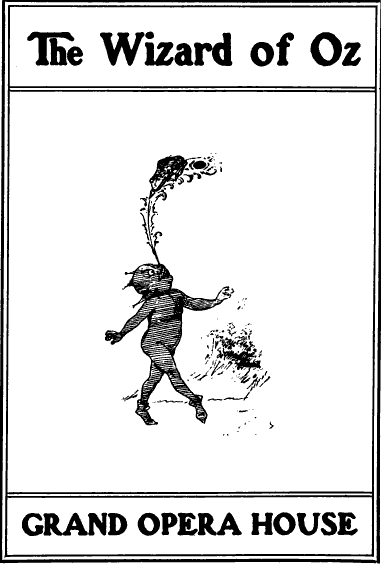
A little girl lives in the middle of the great Kansas prairies with her aunt, wizard_of_oz_1902uncle and a little dog. One day, while she is playing with her pet, she is interrupted by a fierce whirlwind. The little girl and the dog take shelter in the farmhouse, which is whisked away into the stratosphere, plopping down in a strange, alien land.

The plot of the Wizard of Oz, written by L. Frank Baum in 1900 is easily recognized. Many children read the Wizard or one of the many Oz books. And is there anyone on the planet who has not seen the 1939 movie version?

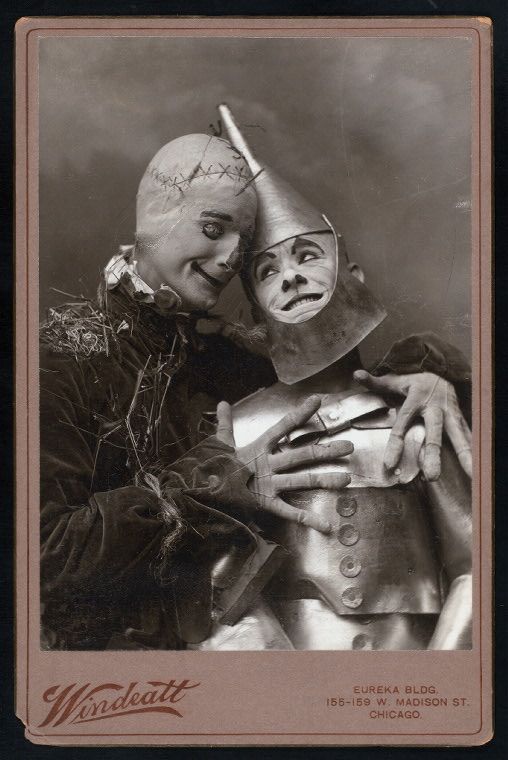
The first outing, other than in print, for the Wizard of Oz came just a few years after publication of the book. A musical extravaganza for the stage opened on Broadway on January 21, 1903, and ran for 293 performances, closing at the end of 1904. It starred pretty much forgotten performers: Anna Laughlin as Dorothy, Fred Stone as the Scarecrow and David Montgomery as the Tin Man. The Cowardly Lion was reduced to a bit part, and the Wicked Witch was completely eliminated. (Fans of the current hit musical Wicked might dispute the logic of that move.) Toto was replaced by Dorothy’s pet cow, Imogene (probably because it created work for two actors instead of one little dog). New characters included King Pastoria II and his girlfriend, Trixie Tryfle, a waitress; Cynthia Cynch, a lunatic; Sir Dashemoff Daily, the Oz poet laureate; Sir Wiley Gyle; and General Riskitt.

The main plot of the musical is King Pastoria’s attempts to wrest the throne from the Wizard of Oz. Dorothy and her fellow protagonists become fugitives searching for the Wizard. The music is pretty much forgotten as well. Such tunes as “Just a Simple Girl from the Prairie” and “Budweiser’s a Friend of Mine” haven’t found their way into medleys with “Somewhere Over the Rainbow.”

Ready When You Are, Cecil

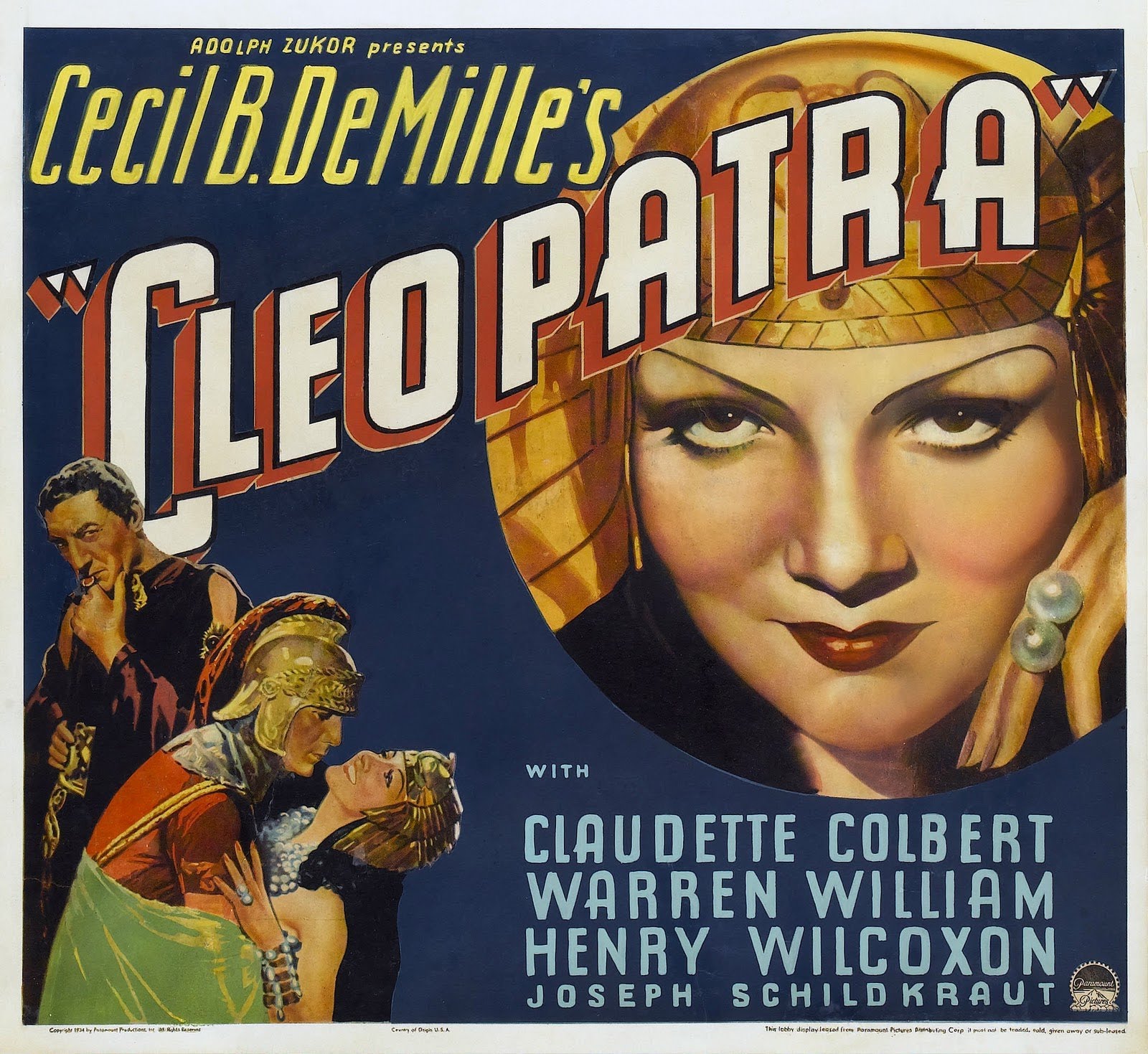
Cecil Blount DeMille (it’s easy to see why he was known as C.B.) died on January 21, 1959.  As a film director, he was most widely known for his Biblical epics “with a cast of thousands.”

What About Bob?

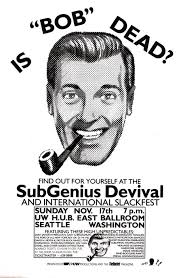
J. R. “Bob” Dobbs (not of who killed J.R.? fame) did not make as big a splash in the religious world.  Founder of the Church of the SubGenius, he died in 1984 at the hands of an assassin.  (Okay, somebody probably asked who killed J.R.?)  Dobbs early career was that of a salesman until on one fateful day in 1953, he saw a vision of God on a television set, inspiring him to found the religion whose motto was “Eternal Salvation — or triple your money back.”  Although he died in 1984, he has come back from the dead a number of times, according to his church.


January 20, 1820: Dream a Little Dream of Me

It’s a red letter day for fair young maidens everywhere, for in addition to being January 20, it is the Eve of St. Agnes, a night in which, if they play their cards right, they’ll gaze upon the countenance of their true love. Naturally there’s a ritual that must be performed to make this happen. First the maiden must go to bed without her supper, having got herself buck naked and having placed a sprig of rosemary and one of thyme (no parsley, no sage) in each of her shoes at the side of her bed. She then lies with her hands under her pillow and, staring upward, chants: “St. Agnes, that’s to lovers kind / Come ease the trouble of my mind” whereupon she falls asleep and conjures up the lucky fellow.

St. Agnes was a martyr who was born back in 291 and died in 304. She is celebrated for her virginity and is the patron saint of young women hoping to lose theirs.

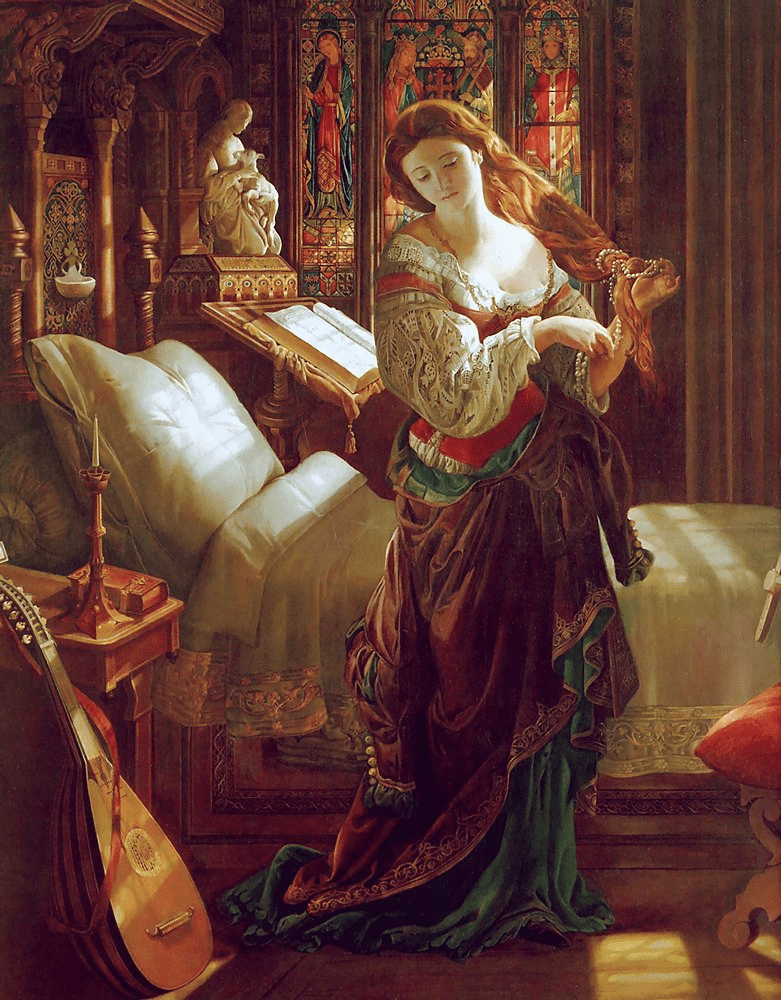
The Eve of St. Agnes ritual was celebrated in an 1820 poem by John Keats titled, oddly enough, “The Eve of St. Agnes.” For 42 rather lyrical stanzas (read that steamy, no Grecian urns or nightingales here) Keats recounts the St. Agnes Eve adventures of Madeline and her paramour Porphyro. Keat’s publishers were uncomfortable with his lyricism and forced him to bring it down a few notches (to PG-13 lyricism).

Madeline’s family is all liquored up (another custom) so she scurries off to bed to perform the ritual, hoping to see Porphyro in her sleep. Porphyro hopes to see Madeline as well, but not in his sleep. He sneaks into her room and waits in the closet. From there, he watches her as she readies herself for bed and falls asleep, after which the naughty fellow creeps closer to get a better look. She awakes having been dreaming of him and sees him in the flesh. Naturally she assumes this is still a dream, so she welcomes him into her bed. When she is fully awake, she realizes her mistake and is a bit chagrined until he declares his love for her. They dash off together across the moors and we are left to wonder about their fate. (As anyone who’s ever read Hound of the Baskervilles knows, you don’t go out on the moors at night.)

Step Step Hop Hop

Born January 20, 1922, Ray Anthony became a successful band leader during the 1950s, despite composing “The Bunny Hop.”

Yes We Can

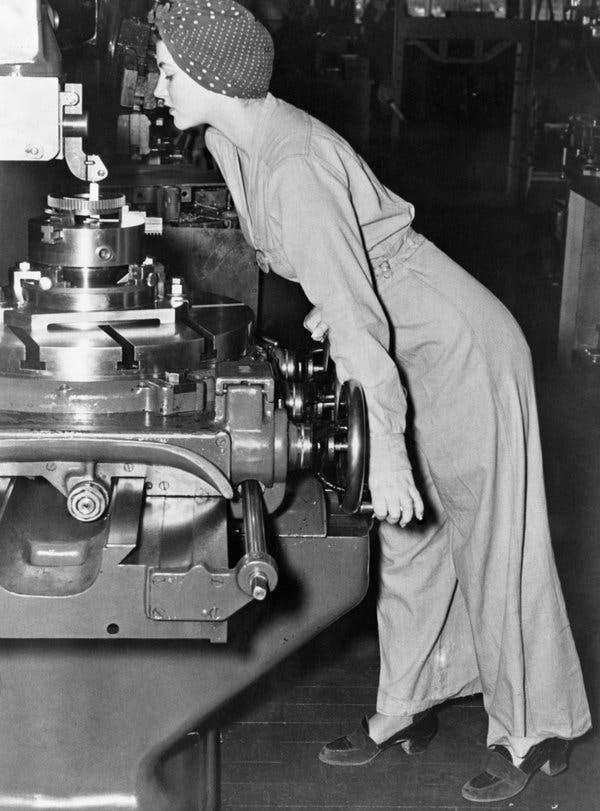
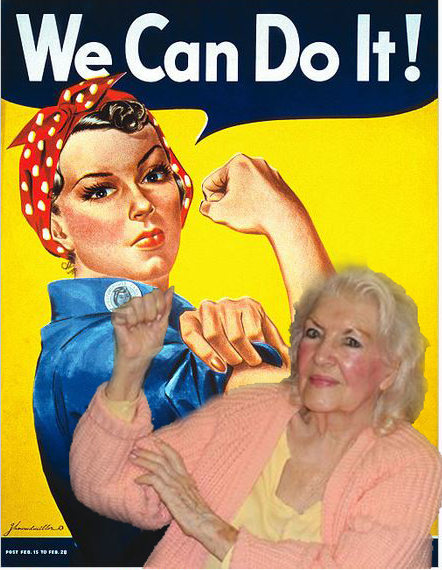
Naomi Parker Fraley died on January 29, 2018, at the age of 96.  She was a California waitress who, though unsung for most of her life, became far better known as Rosie the Riveter.  A photo of Fraley operating a lathe during World War II was the inspiration for J. Howard Miller’s poster, “We Can Do It!”

January 19, 1944: Patriotism and Promiscuity

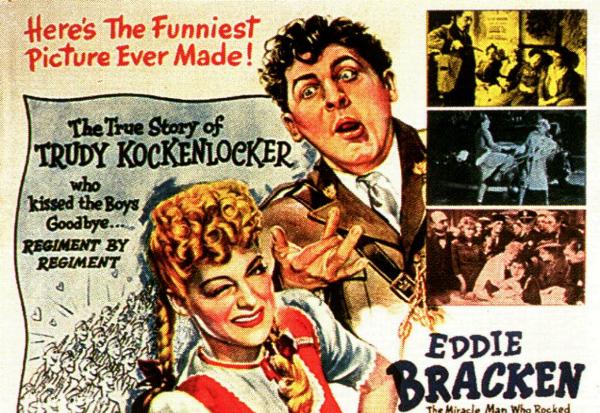
A movie released for national distribution back on January 19, 1944, depicted the predicament of a young woman named Trudy Kockenlocker. It’s seen today as a rather tame screwball comedy (except in Florida maybe) – something that would be at home in the Ozzie and Harriet and Ward and June era – but back when it was released, it was downright scandalous.”Miracle at Morgan’s Creek” starred Betty Hutton and Eddie Bracken and was directed by Preston Sturges. It tells how Trudy wakes up one morning after a farewell party for a group of soldiers to discover that, while drunk, she married one of them whose name she can’t remember. A short time later, she discovers she is pregnant.

Well, didn’t the alarms go off at the Hays Office, that noble outfit charged with protecting Americans from perversion through diligent censorship. The script was sent to the office in 1942, and Paramount quickly received a seven-page catalog of complaints, starting with the fact that Trudy was drunk and working its way up to the possible comparison of Trudy’s dilemma with the virgin birth of Jesus. When the Hays Office had finished its snipping, only ten pages of the script remained in tact. The War Department weighed in, objecting to the moral conduct depicted by the departing soldiers. A pastor in the film who delivers the moral warning against mixing patriotism with promiscuity got the hook as well.

The film was finally released, the Hays Office was bombarded with complaints, including one critic’s suggestion that the office had been “raped in its sleep” for allowing the film to be released, (evidently, Sturges had somehow forgotten to share the film’s ending with the Hays Office). and it became Paramount’s highest-grossing film of the year. It also won an Oscar for Best Screenplay.

The American Film Institute has listed the film as #54 on it’s list of all-time best comedies.


Except in Florida Maybe

A lot of folks would spin the channel to CBS in 1953 to catch  another birth, this one a tad less controversial as Lucy gave birth to Little Ricky (Ricky Ricardo Jr.) – 71.7% of all television sets in the United States were tuned into the I Love Lucy program. On the same day, Lucy gave birth to a nonfictional son, Desi Arnaz Jr.

January 18, 970: The Mice That Roared

On an island in the Rhine River near the German village of Bingen am Rhein, there’s a structure known as Mäuseturm, the Mouse Tower.  The tower was first erected by the Romans, and in 968 it was restored by Hatto II, the Archbishop of Mainz.  It has, if you choose to believe it, a curious history which features the untimely death of the Archbishop on January 18, 970.

Hatto was not one of Germany’s nicer guys. Aided by archers and crossbowmen, he used his tower to extract “tolls” from passing ships, all in all a lucrative sideline to his religious duties. He also filled his barns with grain in anticipation of a future rainy day which soon came in the form of a famine. The nearby peasants ran out of food and you know who was ready to sell it to them at prices they could not afford. Naturally, the peasants were not a happy lot, and Hatto got wind of a possible rebellion. Hatto assembled the peasants at his castle and promised to feed them.  He sent the hungry but now happy peasants to an empty barn to wait for the food he would bring.  But when Hatto and his servants arrived at the barn, they were not armed with food. Hatto ordered the barn doors locked, and immediately set the barn on fire. Hearing the screams from inside, Hatto was said to have remarked: “Hear the mice squeak!”

Hatto’s amusement was short-lived. When he returned to his castle, he was set upon by thousands of mice. With the mice in pursuit, Hatto fled the castle and crossed the river to his tower, in hopes that the mice would drown if they followed. They didn’t. They swarmed the island, gnawed their way through the tower door, and — well, as a poet described it:

They have whetted their teeth against the stones,
And now they pick the bishop’s bones;
They gnawed the flesh from every limb,
For they were sent to punish him!

The Kid’s Got Talent?

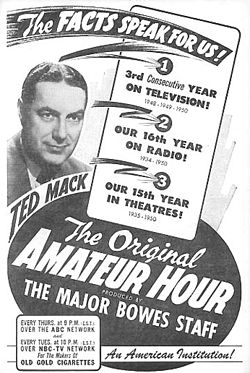
As the program began, the spinning of a wheel would determine the contestants’ order of appearance. As the wheel spun, Ted Mack would chant the magic words: “Round and round she goes, and where she stops nobody knows.” It was January 18, 1948, and The Original Amateur Hour, episode number one, was on the air. And each week, we would be informed how many episodes had aired. The final broadcast in 1970 was number 1,651.

Ted Mack brought the Amateur Hour to television from radio where it amateurhourhad been a fixture for over a decade under the command of Major Edward Bowes. Mack’s television version was one of only six shows to appear on all four major TV networks – ABC, CBS, NBC, and DuMont. (the others were The Arthur Murray Party; Down You Go; The Ernie Kovacs Show; Pantomime Quiz; and Tom Corbett, Space Cadet).

Contestants were often singers and other musicians, although acts included jugglers, tap dancers, baton twirlers, and such. The television audience voted for their favorites by postcard or by calling JUdson 6-7000. Winners returned for another appearance, and three-time winners became eligible for the annual championship and the chance to win a $2000 scholarship.

During 22 years on television, you might guess that the program would discover a throng of celebrities, but you’d be wrong. Gladys Knight, Ann-Margret, Irene Cara, and Tanya Tucker were a few of the handful of future stars. Pat Boone was a winner, but his appearances caused a bit of a tempest in a TV pot. After his winning appearances, it was discovered that he had appeared on the rival program Arthur Godfrey’s Talent Scouts, and was therefore not an “amateur” singer. Boone was booted from the program, but his fame was already a given, and within a few years he was hosting his own variety show The Pat Boone Chevy Showroom (Ted Mack was never a guest).

Elvis Presley, on the other hand, was turned down for the show.

January 17, 1893: Just Think Pineapple

Back in the eighth century, simple Polynesian voyagers in their handmade sailing vessels arrived on the islands of Hawaii, not known then as the Hawaiian Islands or even the Sandwich Islands. They led an idyllic existence – hula dancing, surfing, exchanging leis, trading banter: “Kulikuli, Ku’uipo” or “Hau‘oli Makahiki Hou” and occasionally chanting.

For nearly a thousand years, Hawaiians lived like this (not the same ones, but many generations), and then came the  European explorers and – the Americans. American traders came to Hawaii for the islands’ sandalwood, which they sold to China. Then came the sugar industry followed naturally by missionaries. They moved right in and immediately upended Hawaiian political, cultural, economic, and religious life. In 1840, the monarchy, which had given us such notables as Kamehameha and Kamehameha II and Kamehameha III, became constitutional and lost much of its grandeur.

Four years later, a man name of Sanford B. Dole was born in Honolulu to American parents.

During the next four decades, Hawaii’s ties to the United States grew closer thanks to a number of treaties, and in 1887, a U.S. naval base was established at Pearl Harbor as part of a new Hawaiian constitution. Sugar exports to the United States grew, and U.S. investors and American sugar planters broadened their dominion over Hawaiian affairs. Queen Lydia Kamehameha Liliuokalani, who ascended to the throne in 1891, wanted none of this and said hele along with a Hawaiian gesture involving a ukulele.

The Americans were above trading unpleasantries. Instead on January 17, 1893, a revolutionary “Committee of Safety,” organized by the aforementioned Sanford B. Dole, staged a coup against the aforementioned Queen Liliuokalani. The United States turned a blind eye to the Hawaiian troubles, but 300 Marines who just happened to be in the neighborhood watched from offshore.

Shortly afterward, the US annexed Hawaii and Sanford B. Dole, a name that lives on in infamy and pineapples, became president.


Liliuokalani-hero-H

Liliuo — we’ll just call her Lydia — petitioned President Grover Cleveland who said the coup was probably illegal and certainly not very nice. But Dole just thumbed his nose at the pronouncement. Eventually, after an attempted uprising for which she was blamed, Lydia was placed under house arrest. During her confinement, she penned Hawaii’s most famous song, “Aloha Oe” (other than Don Ho’s “Tiny Bubbles” perhaps).

Lydia Kamehameha Liliuokalani was pardoned in 1896 and died in 1917 at the age of 79.


Italian Explorer for Hire

Just as Christopher Columbus was an Italian explorer in the service of Spain, Giovanni da Verrazzano was an Italian explorer in the service of France.  It seemed nobody served Italy.  Verrazzano set sail on January 17, 1524, in search of that ever elusive passage to China.  Like Columbus before him, he discovered the New World instead.  And it’s fortunate that Columbus was before him.  Just think District of Verrazzano, Verrazzano OH, Verrazzano Day.  Verrazzano had his own accomplishments, being the first European to explore the Atlantic coast of North America, where, in New York, he bought himself a bridge.

Caucus Race

As she stepped through the door which was now the perfect size for a person of her size, Alice spotted a sign that read Donaldland, Center of the Universe, brilliantly ruled by our most revered Queen. Everything on this side of the door was the right size. “I think I’m going to like this place,” she predicted..

She set off to explore, passing through lovely meadows and gardens filled with colorful flowers, past dear little ponds. The only things marring the beauty of the place were the many signs saying Make Donaldland Great Again. At one of those ponds, she spotted a queer-looking group of animals marching around it. “Curiouser and curiouser,” she said, although everything was curious today. There was an Auk, an Emu, an Ostrich, a Tasmanian Devil and several other strange animals. And leading the parade was a Dodo. They moved about the pond, each at its own pace, some faster, some slower, some stopping now and then, some bumping into one another, until the Dodo suddenly cried out: “The Caucus-race is over.”

“Who has won?” the others all shouted.

The Dodo thought for a moment then said: “Everyone. We all have won.” The animals all cheered. Alice, who was now standing among them, asked: “What is a Caucus-race?”

The Dodo pressed a finger to its forehead and thought some more. “It’s like a real caucus only it’s not, because we’re not invited to real Caucuses anymore. We used to be GOPs, but we’re outcasts now. We’ve been tweetstormed by the Queen.”

Alice was filled with questions, and she blurted them right out: “What’s a GOP? What’s a tweetstorm? What kind of animal are you?”

“I’m a Dodo.”

“Aren’t Dodos extinct?”

“Might as well be. I guess I’m a Dodo In Name Only. And a GOP in Name Only.”

“You haven’t told me what a GOP is,” Alice complained.

“A Grouchy Old Poop. I was once proud to be one — to wear a campaign button on my lapel, a flag on my butt, and make patriotic noise. But that was then and this is now. I’ve — we’ve all been tossed from the poopdeck, bundled off, shown the exit ramp. Unfriended. Tweetstormed.” The Queen doesn’t know us and therefore we don’t exist.”

Stay tuned, same time same place — a royal revelation

Going Down

Alice was growing sleepy, sitting next to her sister who was reading a book. “What’s the use of a book if it can’t get you online?” she muttered to herself. Just as she was beginning to drift off, a large White Rabbit ran by. This was rather remarkable in and of itself but even more so as the Rabbit pulled a watch out of its waist-coat pocket and said “Oh dear! Oh dear! I shall be too late. The Queen will have my head for sure.”

Now wide awake with curiosity, Alice jumped up and chased after the Rabbit, just in time to see it pop down a large rabbit hole. Alice went right down the hole herself, never giving it a thought, and found herself falling. The hole was very deep and she was falling very slowly, for she had time to look around. The sides of the hole had become walls, covered with pictures. Mostly they were grumpy looking old men, but one of them looked like a Queen. She wore a royal gown, the kind you see on a playing card, and a royal crown nestled in a strange outcropping of very orange hair. The Queen had big hands and — Alice didn’t finish the thought for she landed with a thud on the floor of an ornate room.

The room had no windows and just one tiny door barely big enough for a mouse. It was certainly too tiny for Alice to go through it. The only furniture in the room was a single table. On the top of the table was a small bottle with a note attached that read: Drink me, if you want to become small enough to go through the door. She took a sip from the bottle and waited. Nothing happened. She finished it off. Still nothing. Then she saw more writing on the back of the note: I lied. The only way to get small is to think small. It’s like pulling yourself up by your own bootstraps, except there are no boots or straps and it’s down rather than up.

Alice sat down in front of the little door and recited “I am small. I am small.” As she continued to repeat these words, she saw that the little door was growing larger. Or was she getting smaller? When the door looked like a normal-sized door she said loudly: “I really am small.” She took a deep breath and opened the door.

Stay tuned, same time, same place — a caucus-race

January 16, 1749: If I Could Spend Time in a Bottle

If I were to crawl into a wine bottle (a standard 750 ml) before your very eyes and, while residing in said bottle, entertain you with a few songs (bawdy ones, probably), you’d pay to see that, wouldn’t you? Of course you would. A lot of people in London paid a lot of money to see just that back in 1749 by a performer scheduled to appear on the evening of the 16th at the Haymarket Theater. The performer’s name has been lost to history. Just call him the Bottle Conjurer.

The posters promised this feat and more: in addition to his tenure in the bottle, he would take an ordinary walking cane and play upon it every musical instrument in current use. Well, of course the huge crowd that assembled that evening was anticipatory. After all, this was the Age of Enlightenment.

The audience waited and they waited. It was beginning to look like the Conjurer was a no show. Finally the theater manager appeared before the crowd and promised a refund of all the ticket purchases. The crowd was not pleased. And when an Age of Enlightenment crowd is not pleased, what do they do. They riot of course. They ripped up the benches, tore down the boxes, shredded the scenery. In short, they demolished the theater. As an encored, they started a great bonfire and raised the theater curtain as a defiant flag.

No one knew for sure who perpetrated what was now assumed to be a hoax. The chief suspect was the Second Duke of Montagu, known for his enlightened practical jokes.

Texas Okay, But Not Arizona or New Mexico

In 1917, Arthur Zimmerman, the German foreign secretary, sent a coded telegram to the German minister in Mexico. The telegram proposed a German Mexican alliance if the United States declared was on Germany. As an inducement, Germany would allow Mexico to take Texas, Arizona and New Mexico. When the telegram was revealed, the United States got all hot and bothered and jumped right into the war against Germany.

January 15, 1797: Flamboyant Haberdashery

John Hetherington, a London haberdasher was hauled before the Lord Mayor on January 15, 1797, charged with inciting a riot. His breach of the peace had caused passers by to panic, women to faint, children to run screaming, dogs to yowl and one poor lad to suffer a broken arm from being trampled by the mob.

What had Hetherington done to cause such turmoil? According to authorities, he had appeared in public wearing upon his head “a tall structure having a shiny luster calculated to frighten timid people.” That is, he was the first person to wear a top hat on the streets of London. And for his act of flamboyant haberdashery, he was forced to post a ₤500 bond.

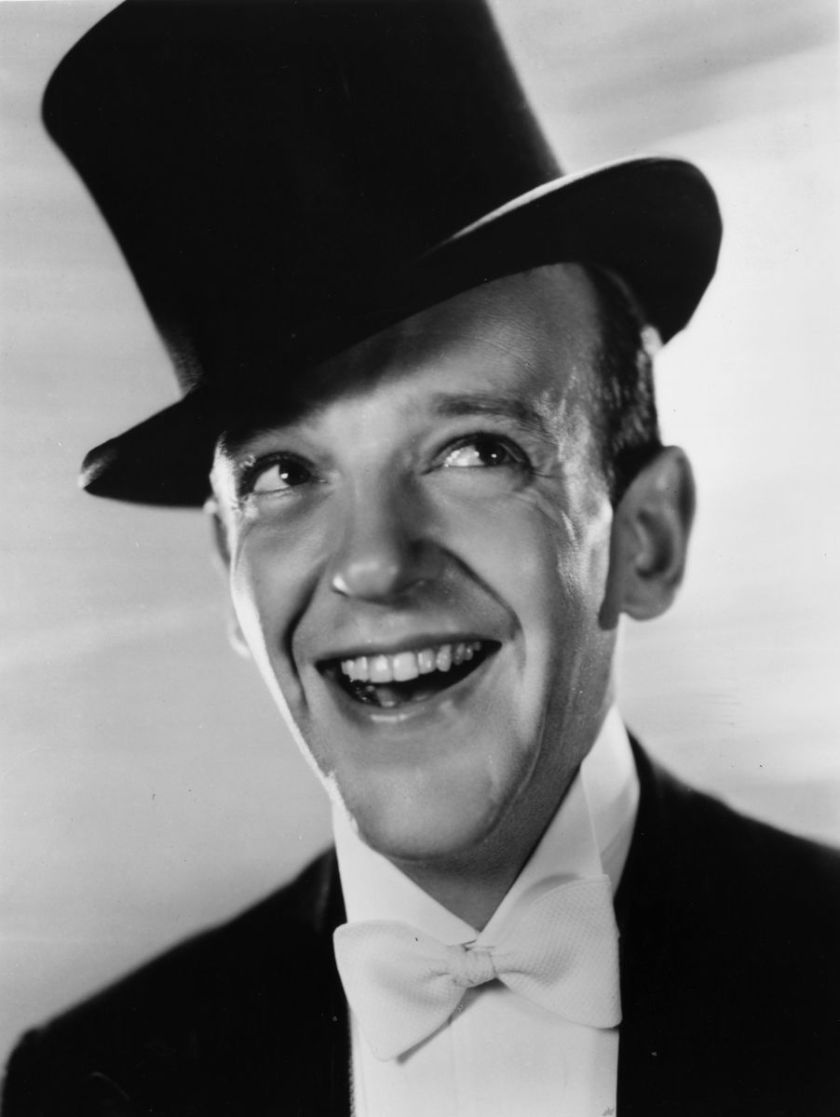
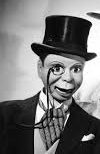
Hetherington’s chapeau was a silk topper also known as a high hat, silk hat, beaver hat, or stove pipe hat. It became popular soon after Hetherington’s breach and remained so through the middle of the 20th century. Folks associated with the top hat include Fred Astaire, Charlie McCarthy, Uncle Sam, and Rich Uncle Pennybags (the Monopoly man).

In 1814, Louis Comte became the first magician to pull a rabbit out of a top hat, and in 1961, John F. Kennedy became the last president to be inaugurated in one.


Don’t Be Nasty, Thomas

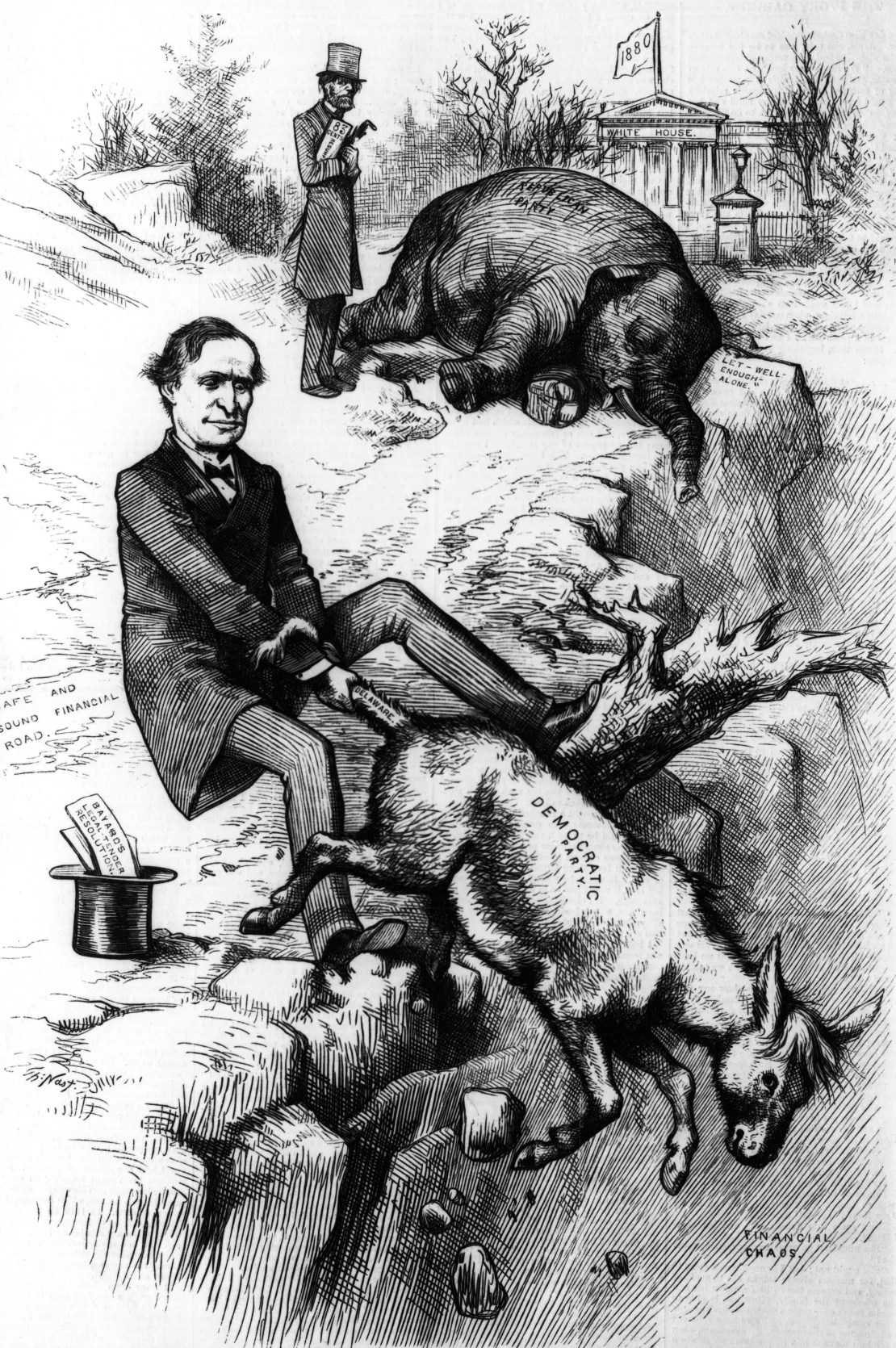
No, the adjective nasty did not refer to the noted political cartoonist Thomas Nast, but one could certainly be forgiven for thinking so.  Nast was the first  artist to picture the Democratic Party as a donkey– in Harper’s Weekly, January 15 1870. He also gave us the modern concepts of both Uncle Sam (with a top hat) and Santa Claus.

Democraticjackass

While the Democratic party was a hopelessly stubborn creature, Nast would go on to characterize the Republican party as an oversized oafish elephant, lumbering about in a clueless daze.  Neither animal wore as top hat.


The Democrats seem to be basically nicer people, but they have demonstrated time and again that they have the management skills of celery.  They’re the kind of people who’d stop to help you change a flat, but would somehow manage to set your car on fire.  I would be reluctant to trust them with a Cuisinart, let alone the economy.  The Republicans, on the other hand, would know how to fix your tire, but they wouldn’t bother to stop because they’d want to be on time for Ugly Pants Night as the country club. — Dave Barry