March 11, 1958: And Then We’ll Nuke North Carolina

In 1958, the U.S. Air Force bombed South Carolina. Surprisingly, the bombing of Mars Bluff, a rural area near Florence, was not intentional. The bomb was a nuclear weapon carried by a B-47 Stratojet en route from Savannah, Georgia, to the United Kingdom. (The Air Force was not planning to bomb the Brits; the plane was on its way to military exercises and was required to carry nuclear weapons in the event of a sudden Dr. Strangelovian incident with the Soviet Union.)  A fault light in the cockpit indicated that the bomb harness locking pin for the transatlantic flight did not engage, and the navigator was summoned to the bomb bay to investigate. As he reached around the bomb to pull himself up, he mistakenly grabbed Printthe emergency release pin. The bomb dropped to the floor of the B-47, its weight forcing the bomb bay doors open and sending the bomb 15,000 feet down to unsuspecting Mars Bluff. Oops.

Because the removable core of fissionable uranium and plutonium was stored separately on board the plane, the bomb was not actually atomic, but it did contain 7,600 pounds of explosives. And it created a pretty good mushroom cloud over Mars Bluff, leaving a 75-foot wide and 35-foot deep crater where Walter Gregg’s home and vegetable garden had been. The only real casualties were several chickens who bought the farm so to speak.

The crater is still preserved but grown over, pretty much just a big hole. Steven Smith, who chaired a 50th anniversary event a few years ago, couldn’t understand why it never became a real tourist attraction. “It sure could be,” he said. “This is a national treasure!”

Take This Verb and Parse It

Diagramming sentences – what fond memories that brings back.  Shuffling nouns and verbs and predicate adjectives around until they find their proper position on the diagram.  Those were the days, my friend.  However, it’s with some sorrow that I contemplate our dear parts of speech.  One of their number has fallen upon some hard times.

“Snow White bit into the apple,” said the brothers grimly.

Pity the poor adverb.  Modern writing mavens pretty much eschew the adverb today – plucking it from the garden of good writing (or the garden of bad metaphors, if you prefer) as though it were an insignificant weed.  Okay, maybe it’s sometimes overused, but in moderation, like alcohol, caffeine and fat, it serves a noble purpose.

It wasn’t always considered a sin to associate with an adverb.  Some important folks have — as I will demonstrate.  Going way back to cite an example from a good book (or as many prefer The Good Book)  “Verily, I say unto you . . .”  Okay, all together now, what part of speech is that word verily?  You got it.  And it’s used more than once by you know who.  Okay, who wants to go first? Just step right up and say “Lose that adverb.”  I’d say that’s inviting a smiting.

Thomas Mann:  Hold fast to time!  Use it!  Be conscious of each day, each hour!  They slip away unnoticed all too easily and swiftly.

E. B. White: Be obscure clearly.

Mark Twain:  The intellect is stunned by the shock but gropingly gathers the meaning of the words.

Or you may remember that catchy tune by Francis Scott Key with words that go something like this: Whose broad stripes and bright stars, thru the perilous fight, O’er the ramparts we watched, were so gallantly streaming?  Call the adverb police.

And finally, moving into the future, I quote just three words from one Captain Kirk: “to boldly go.”  Now there’s a strong, sassy adverb coming to the rescue of a puny little verb and splitting an infinitive just for good measure.


March 10, 1876: It’s a Telephone, My Dear Watson

Who would have thought back on March 10, 1876, that in a hundred or so years practically every other human on the face of the earth would have a phone pressed against the side of his or her head at any given moment. Certainly not Alexander Graham Bell, as he was in the process of making the very first phone call. It wasn’t much of a call, certainly not long distance. Bell called his assistant Thomas A. Watson who was in the next room. The phones they used weren’t much to behold; they looked more like tin cans connected by a long string than today’s sleek models. But nevertheless they made history.

The moment of truth in Bell’s own words: “I then shouted . . . the following sentence: Mr. Watson come here — I want to see you. To my delight he came and declared that he had heard and understood what I said.”

Enter the quibblers. Why didn’t Watson answer Bell using that brand new telephone, they ask. And if Bell shouted his words and Watson were in the very next room, he’d very likely hear them without the phone, they suggest.

Watson’s diary says Bell’s words were actually “Mr. Watson, come here, I want you. ” a minor difference but just chock full of innuendo, they say, eyebrows raised. And some even suggest that the incident is all fabrication, that Bell actually stole the idea for the telephone from another inventor, Elisha Gray.

History does not record Bell’s disappointment when he tried to duplicate the experiment and was put on hold.

The Milkman Cometh

New Mexico State University’s first ever graduation was to have taken place on this date in milkman1893 but was abruptly canceled when Sam Steel, the lone graduating senior, was shot and killed while delivering milk the day before graduation.

Said the local paper: “The hearts of the whole community were stricken with sadness when it was learned that Samuel Steel, the most brilliant student of our College, had been foully and wil(l)fully murdered on Thursday evening, March 9th. We do not consider it in place to refer to the details of this ghastly deed, which are known to most of our readers; we only feel assured that it was perpetrated in sheer cold-bloodedness, and, knowing the victim as well as we have done, without the slightest provocation.”

Knowing what we do today about the reputation of milkmen, one might speculate that there could have been a slight provocation.

March 9, 1831: Beau Everybody

Louis Phillippe, King of the French (as opposed to King of France) from 1830 to 1848, created an elite military force on March 9, 1831, to bolster the regular French army.  The French Foreign Legion or Légion étrangère was unique in that it was open to foreigners wising to join the French armed forces which normally allowed only French citizens to serve.  Legionnaires could apply for French citizenship after three years’ service or immediately after being wounded in battle — “Français par le sang versé” (“French by spilled blood”).  Known for its exceptional military skills and its strong esprit de corps, it became gained a reputation as a top mercenary corps.

The Legion also became legendary in pop culture.  It has played a part in hundreds of books and movies, probably the most famous of which is the 1924 novel Beau Geste, about three brothers joining the Legion.  It was made into a movie five times, and parodied even more.  Buster Crabbe joined the Legion as Captain Gallant.  Abbott and Costello, Laurel and Hardy, and the Three Stooges all did time.  As did Bugs Bunny, Porky Pig, Donald Duck, Mickey Mouse, Goofy, Pepé Le Pew, Heckle and Jeckle, and Snoopy.  Edith Piaf and Frank Sinatra have both sung about the Legion.

In 1977, Marty Feldman wrote and starred  in The Last Remake of Beau Geste.  It probably won’t be.

The Japanese Foreign Legion?

Lt. Hiroo Onoda, a soldier in the Japanese army, was sent to the remote Philippine island of Lubang in 1944 to conduct guerrilla warfare. Onoda was supposed to blow up the pier at the harbor and destroy the Lubang airfield. Unfortunately, his commanders, who were worried about other matters, decided not to help Onoda on his mission and soon the island was overrun by the Allies.  Time passed, the war ended, but nobody officially told Onoda; so for 29 years, Onoda remained a dedicated soldier, living in the jungle, eating coconuts and bananas and deftly evading searching parties. Hiding out in the dense jungles, Onoda ignored the leaflets, newspapers, photographs and letters from relatives dropped by planes during the years; he was convinced they were all part of an Allied plot.

In 1974, a college dropout named Norio Suzuki traveled to the Philippines, telling his friends he was out to find a panda, the Abominable Snowman and Lt. Onoda. Where others had failed, Suzuki succeeded. He found Lt. Onoda and tried to convince him that the war was over. However, Onoda refused to leave the island until his commander ordered him to do so. Suzuki traveled back to Japan and found Onoda’s former commander, who had become a bookseller. On March 9, 1974, Suzuki and the commander/bookseller met Onoda and delivered orders that all combat activity was to be ceased, and Onoda laid down his arms.

Millard Fillmore ominously assumed the presidency as number 13 when President Zachary Taylor, “Old Rough and Ready,”  pushed up presidential daisies in 1850. As the Last of the Red Hot Whigs to hold the office of president, Fillmore had a rather lackluster four years in office before receiving the boot from his own party. He is consistently a cellar dweller in historical POTUS rankings.

Fillmore’s most lasting legacy, trumpeted in a 1917 article, was the installation of a bathtub, a mahogany model, in the White House, giving the device an imprimatur that paved its way for wider distribution in the United States. This bit of sudsy statesmanship is frequently cited in reference to the Fillmore presidency. The whole story was of course a hoax, fabricated by one of the nation’s less reliable historians, H. L. Mencken. Even though the article was blatantly false and “a tissue of somewhat heavy absurdities,” it was widely quoted as fact for years. “My motive,” Mencken later explained, “was simply to have some harmless fun in war days. It never occurred to me that it would be taken seriously. Soon I began to encounter my preposterous “facts” in the writings of other men…. The chiropractors and other such quacks collared them for use as evidence of the stupidity of medical men. They were cited by medical men as proof of the progress of public hygiene. They got into learned journals and the transactions of learned societies. They were alluded to on the floor of Congress. The editorial writers of the land, borrowing them in toto and without mentioning my begetting of them, began to labor them in their dull, indignant way. They crossed the dreadful wastes of the North Atlantic, and were discussed horribly by English uplifters and German professors. Finally, they got into the standard works of reference, and began to be taught to the young.”

Old Rub-a-Dub-Dub joined Old Rough and Ready on March 8, 1874.

.

For every complex problem there is an answer that is clear, simple, and wrong. — H. L. Mencken

March 8, 1874: Old Rub-a-Dub-Dub

March 7. 1766: Gentlemen Rhymesters Out on a Spree

A certain Miss Molly Mogg of the Rose Tavern in Wokingham, England, turned up her dainty toes on March 7, 1766, at the age of 66. Some 40 years earlier she had been the subject of an amusing ballad written by “two or three men of wit.” The ballad, perhaps to the surprise of its authors, became quite popular. Literary historians have determined that the “men of wit” were Alexander Pope, Jonathan Swift, and John Gay and that the three were probably quite drunk when they penned the tribute to the pretty Molly.

It begins:

The schoolboy delights in a play-day,

The schoolmaster’s delight is to flog;

The milkmaid’s delight is in May-day,

But mine is in sweet Molly Mogg.

and continues on for eleven verses each ending with “sweet Molly Mogg. This, of course required the three rhymesters to come up with 11 words to rhyme with Mogg. Which they did.  In addition to the aforementioned flog, there’s bog, cog, frog, clog, jog, fog, dog, log, eclogue and agog — bypassing hog and Prague.

Cogito Airgonaut

Jean-Pierre Blanchard, the noted 18th century “Airgonaut,” made his first successful balloon flight in Paris back  in 1784, in a hydrogen gas balloonballoon4 launched from the Champ de Mars. Blanchard’s flight nearly ended in disaster, when one spectator slashed at the balloon’s mooring ropes and oars with his sword after being refused a place on board. Observer Horace Walpole wrote of the flight that the Airgonauts were just like birds; they flew through the air, perched in the top of a tree, and some passengers climbed out of their nest to look around.

Nevertheless, these early balloon flights set off a public “balloonomania”, with clothing, hairstyles and various objects decorated with images of balloons or styled to resemble a balloon. In 1793, Blanchard scored another first — the first balloon flight in North America, ascending in Philadelphia and landing in New Jersey. Witnesses to the flight included President George Washington, and future presidents John Adams, Thomas Jefferson, James Madison, and James Monroe. Some say Washington threw a silver dollar at the balloon.

Now famous, our  Airgonaut  married Marie Madeleine-Sophie Armant in 1804. But his run of fame, fortune and good luck came to a sudden end four years later, when Blanchard had a heart attack while ballooning above the Hague. He fell from his balloon and died of his injuries on March 7, 1809. His widow Sophie inherited everything including the ballooning bug which would be her undoing as well: she continued to support herself with ballooning demonstrations until it also killed her.  In 1819, she became the first woman to be killed in an aviation accident when, during an exhibition in the Tivoli Gardens in Paris, she launched fireworks that ignited the gas in her balloon. Her balloon crashed on the roof of a house, and she fell to her death.  Don’t try ballooning at home.

March 6, 1941: The Bigger They Are

If asked to name an important sculptor, the name John Gutzon de la Mothe Borglum, would not come tripping off most people’s lips, although his most important work certainly would. Borglum died on March 6, 1941, leaving the monument he had worked on since 1927 uncompleted.

Borglum sculpted big: a portrait of Abraham Lincoln carved from a six-ton block of marble, a 76 by 158 foot bas-relief of Confederate heroes, and what would have been his biggest ever, the 60-foot heads of George Washington, Thomas Jefferson, Abraham Lincoln and Theodore Roosevelt carved into the granite face of Mount Rushmore in South Dakota.

From the very moment the monument was completed, folks have wanted to edit it by sticking another head up there.  And they become quite passionate about whose head it should be.

 In 1937, while work was still in progress, a bill was introduced in Congress to add women’s right activist Susan B. Anthony. It failed to advance.  A 2010 poll suggested JFK.  Ronald Reagan, Bill Clinton and Barack Obama all had their hats tossed into the ring. Obama responded “I don’t think my ears would make it. There’s only so much rock up there.”

Donald Trump’s head would not satisfy the MAGA tribe.  They want it to be renamed Mount Trumpmore.

The support for a fifth head gets no government support: “The National Park Service takes the position that death stayed the hand of the artist and the work is complete in its present form. Thus, to maintain both the integrity of the structure and the artist’s concept, there is no procedure for adding another likeness, the sculpture is complete.”

The Nose Knows

Mount Rushmore is home to 2 million visitors and has been extensively depicted throughout popular culture, probably most famously in the climactic chase scene in Alfred Hitchcock’s 1959 thriller North by Northwest with Cary Grant swatting at secret agents from Lincoln ‘s forehead. Hitchcock later admitted: “I wanted Cary Grant to hide in Lincoln’s nostril and then have a fit of sneezing . . . the Department of Interior was rather upset at this thought. I argued until one of their number asked me how I would like it if they had Lincoln play the scene in Cary Grant’s nose. I saw their point at once.”

The Nose Knows II

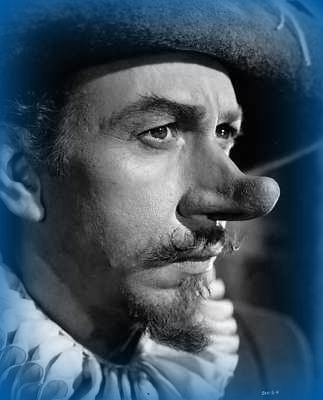
Cyrano de Bergerac, born in 1619, is of course best known in modern times for his nose. According to legend, it was quite large. Depending on which account you accept, Cyrano was either a French aristocrat, author and military hero with a big nose or the descendant of a Sardinian fishmonger who suffered from syphilis with a big nose. He was an early writer of science fiction, and in his most famous work, The Other World, Cyrano travels to the moon using rockets powered by firecrackers where he meets the inhabitants who have four legs, musical voices, and firearms that shoot game and cook it — the TV rights are still available, if you’re interested.  A  lesser known work, Noses from Mars, is self-explanatory.

Then we come to the story of Cyrano himself and how he courted the fair Roxanne on behalf of his friend Christian.  Although these people are real, the story is alas! pure fiction, which is probably just as well, for Roxanne was Cyrano’s cousin and had they ever consummated their relationship, their children would have been half-wits with big noses.

March 5, 1876: Speak Softly But Carry a Big Speech

John Schrank was born in Bavaria on March 5, 1876, and emigrated to the United States when he was 9. Things didn’t go all that well for John. His parents died soon after their arrival. He was taken in by an aunt and uncle, working for them in their New York tavern. They also died, and when his only girlfriends died as well, he sold off his inheritance properties and set to rambling around the east coast. Just as this was beginning to sound like the plot of an opera, he got religion and became a bit of a biblical authority (at least in his own eyes), lecturing other folks on their sins in various barrooms and public places. Although he annoyed a lot of people, he did no real harm.

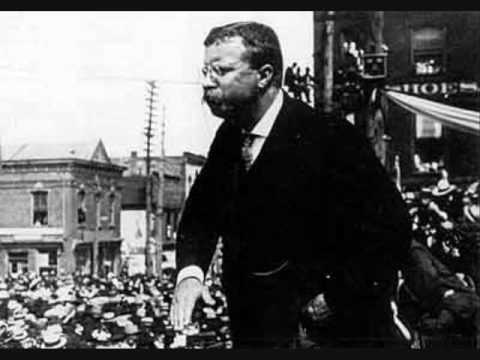
During the 1912 presidential contests, the Republican party suffered a schism, each side wanting the Republican tent to be a little smaller, excluding the other side. Conservatives were led by William Howard Taft, and moderates (known today as RINOs) were led by ex-President Theodore Roosevelt. When Taft won the nomination, Roosevelt bolted and formed the Bull Moose Party. Roosevelt was campaigning in Wisconsin when he was shot by our biblical scholar John Schrank. The bullet hit the text of Roosevelt’s speech, eliminating several dozen useless adjectives and other excess verbiage.

The speech was much improved and Roosevelt himself was unhurt. Schrank explained to authorities that he had nothing against Roosevelt as an individual; in fact he rather liked him. His quarrel was with ‘Roosevelt, the third-termer’ and was meant as a warning to any other politician who might seek a third term. And not only that, shooting Roosevelt was not his own idea. The ghost of William McKinley made him do it. The ghost rose up right out of a coffin, pointed at a picture of Roosevelt and said: “Do it.”

Even with this quite splendid explanation, the authorities nonetheless sent Schrank away to a Wisconsin mental hospital where he remained until his death in 1943.

Makes the Heart Grow Fonder

Although the United States threw in the towel on the prohibition of alcohol back in 1933, one alcoholic beverage remained in the crosshairs of the temperance types for another seven decades.

Absinthe, also known as the Green Fairy or the Green Lady, was created back in the early 19th century by French doctor, Pierre Ordinaire, an innocent enough sounding gentleman. It was made by infusing wormwood, fennel, anise and other herbs into alcohol, creating an elixir that tastes like licorice but packs a much more powerful punch. The good doctor used it to treat a variety of illnesses.

It later became trendy as an alcoholic beverage thanks to celebrity imbibers such as Ernest Hemingway, Pablo Picasso, Oscar Wilde, James Joyce and Vincent van Gogh, who thought it increased their creativity. But then came studies that unfairly claimed that absinthe not only had hallucinogenic effects but caused immorality, antisocial behavior and madness. Some critics even claimed that it was absinthe that led van Gogh to take a knife to his ear.

Absinthe was soon proscribed (as opposed to prescribed) pretty much everywhere, and remained so throughout the 20th century, until a host of modern studies cleared its name.  It received its U.S. reprieve on March 5, 2007.

March 4, 1925: Swain Song

On this date in 1925, the United States annexed Swain’s Island. If your history or geography course somehow skipped over this event, here’s practically everything you need to know (and then some).  Swain’s Island is a 461-acre atoll in the Pacific (and not to be confused with Newfoundland’s Swain’s Island). A Portuguese navigator was the first European explorer to southvisit Swain’s Island, arriving in 1606, although it was not called Swain’s Island then. It wasn’t called anything then, so he named it Isla de la Gente Hermosa, which in Spanish means “island of the beautiful people” (and some would say, a much nicer name than Swain’s Island).

Years later, Fakaofoan invaders (folks from a nearby island — no need to memorize their name) killed or enslaved all the gente hermosas. It was a Pyrrhic victory, however, since the island became infertile thanks to a curse placed on it by the chief of the gente hermosas (who evidently had a mean streak under all that beauty). Everyone died, and the island remained uninhabited until an American, Eli Hutchinson Jennings, founded a community with his Samoan wife, Malia, claiming to have received title to the atoll from a British Captain Turnbull for fifteen shillings per acre and a bottle of gin. The curse had expired, and the Jennings developed a thriving copra (coconuts, not snakes) business.

In 1907, Britain claimed ownership of Swain’s Island, demanding payment of a tax of $85. Jennings paid the tax, but he complained to the U.S. State Department, and his money was ultimately refunded. The British government also conceded that Swain’s Island was an American possession, and it officially became part of American Samoa on March 4, 1925.

Because it is in the middle of nowhere, Swain’s Island is considered an amateur radio “entity” and has become a mecca for ham operators, straining the hospitality of the island’s 17 permanent residents, none of whom would be called gente hermosas.

.


March 3, 1605: And a Decaf Peppermint Almond Latte

Ippolito Aldobrandini was born into a prominent Florentine family in 1536. As a child he was told that any little boy could grow up to be Pope. And didn’t he just do it, becoming a noted canon lawyer, a Cardinal Priest, and in 1592, Pope Clement VIII. He led the church until March 3, 1605. VIII’s enduring papal legacy for most of the world is not his bringing France back into the Catholic fold or leading the opposition to the Ottoman Empire, but rather his blessing of a certain beverage.

“The grain or berry called coffee groweth upon little trees only in the deserts of Arabia,” an early handbill proclaimed. “It is a simple, innocent thing, composed into a drink, by being dried in an oven, and ground to powder, and boiled up with spring water . . . and to be taken as hot as possibly can be endured.”

sheepCoffee had been around for centuries from the time when shepherds noticed that the beans when eaten by their sheep caused those sheep to become rather frisky. Naturally, the shepherds were anxious to try it themselves. Eventually, after a lot of broken teeth, they learned to roast it, grind it and brew it.

It didn’t take long for coffee to become wildly popular throughout the Muslim world. Not so in Europe however; no civilized Christian could share the drink of those infidels they had been battling practically forever.  The beverage came to be known as “Satan’s drink.” and Christians pleaded with Pope Clement to ban the evil liquid and declare that anyone who drank it would be destined to burn in Hell or some other nasty spot.

Clement considered this request, but being reasonable as well as infallible, would not condemn the drink without a fair trial. Thus a steaming cup of coffee was placed before him. He took a sip, and immediately became as frisky as those Muslim sheep.. “This devil’s drink is delicious.” he declared. “We should cheat the devil by baptizing it.”

And then came Starbucks.

Note: The popular folk song that came much later was not named for Clement VIII. It was “Oh My Darling Clement IX.”

March 2, 1978: Grave Intrigue in Heidiland

graveSwiss auto mechanics turned thieves,Roman Wardas and Gantscho Ganev, had a great idea for a heist. They executed their bold plan with daring and cunning in the wee hours of March 2, 1978. Their target: a 300-pound oak coffin in the village of Corsier, Switzerland. Inside the coffin, was the body of the Little Tramp, Charlie Chaplin, who had died on Christmas day of the previous year. The graverobbers phoned Chaplin’s widow Oona with their demand for £400,000 a few days later.

Oona was having none of it. “Charlie would have thought it rather ridiculous,” she said, refusing to pay. A cat and mouse game between police and the robbers ensued as the police set up phony payoff meetings. The robbers got cold feet, however, and contact was never made, although police and robbers continued to communicate in an effort to achieve their disparate goals.

So dogged were the Swiss police that they put 200 phone booths under surveillance. The robbers again called Oona, whose phone had been tapped. The call was traced, and the hapless thieves were arrested. The men led police to a cornfield where they had buried the body. Chaplin was buried once again in the same burial plot, surrounded by a thick layer of concrete where he has since rested in peace.

Other robbers have made attempts to steal notable remains, Elvis Presley for a supposed ransom of $10 million and Abraham Lincoln for a mere $200,000. Neither attempt got very far, but as a result the bodies of Presley and his mother were moved from a Memphis cemetery to Graceland and 24-hour security monitoring. The 16th President now rests in a steel cage ten feet below ground, covered by concrete.

Captain Courageous

Captain America was the beefier alter ego of Steve Rogers, a typical captain90-pound weakling who realized every 90-pound weakling’s dream of being enhanced to the peak of human perfection by an experimental magic potion, so that he could employ his super abilities in the American war effort. He wore a rather gaudy American flag costume, a lot like those seen at Republican national conventions today.

In the first issue of Captain America Comics (March 1941), Captain America faced the Red Skull, a bellhop recruited by the Fuhrer himself to become a super villain for the Third Reich (and someone you wouldn’t want to forget to tip).

The incredibly patriotic Captain America fought the Nazis throughout World War II, and was one of the most popular comic characters during the war. After the war ended, his popularity waned and he was whisked off to the superheros’ retirement home in the 1950s, but made a super comeback during the 60s.